
If you want one router table that works in a tight garage shop, the Bosch RA1181 is our pick for the best router tables for small shops. Its cast aluminum top stays flat through years of use, it clamps to a bench without stealing floor space, and it has the largest review base of anything we tested. Below, you will find nine options, every one judged on the same three questions: how much room does it eat, can it be put away when the door is open, and does it stay flat once the shop gets humid.
A router table is a flat work surface with a fence and a hole cut in it. Your handheld router clamps upside down underneath, the bit comes up through the opening, and the fence guides the workpiece past it at a set depth. That single change turns a tool you use freehand into a machine that makes the same cut fifty times in a row without your hands anywhere near the spinning steel.
For a small shop, that matters more than it does in a large one. A jointer, planer, or shaper each demands a dedicated footprint and a dust system. A benchtop router table borrows surface area you already own. We went through nine current models, looked closely at the tops, fences, plates, and stands, and talked through what actual owners report after living with them.
Table of Contents
Top 3 Picks: Router Tables for Small Shops in 2026

Bosch RA1181 Benchtop Router Table
- Cast aluminum top
- Pre-drilled aluminum plate
- 24 inch fence with dust port
SKIL RT1323-01 Table and Router Kit
- Table plus 2.0 HP router
- Above-table bit adjustment
- Dual-outlet switch

POWERTEC 71402V with Steel Stand
- 24 by 16 inch top
- Eight-point plate leveling
- Four reducing rings
Best Router Tables for Small Shops (October 2026)
| Product | Specifications | Action |
|---|---|---|
| Bosch RA1181 Benchtop Router Table |
|
Check Latest Price |
| SKIL RT1323-01 Table and Router Kit |
|
Check Latest Price |
| POWERTEC 71402V Benchtop Table with Stand |
|
Check Latest Price |
 SKIL SRT1039 Benchtop Router Table SKIL SRT1039 Benchtop Router Table |
|
Check Latest Price |
 Kreg PRS2100 Bench Top Router Table Kreg PRS2100 Bench Top Router Table |
|
Check Latest Price |
 RYOBI Universal Router Table A25RT03 RYOBI Universal Router Table A25RT03 |
|
Check Latest Price |
 Leegol RT150 Wide-Bench Router Table Leegol RT150 Wide-Bench Router Table |
|
Check Latest Price |
 VIYUKI Universal Electric Benchtop Table VIYUKI Universal Electric Benchtop Table |
|
Check Latest Price |
 Kreg PRS1200 Beaded Face-Frame System Kreg PRS1200 Beaded Face-Frame System |
|
Check Latest Price |
What a Router Table Actually Does in a Small Shop
Here is the honest list of what a router table earns its space for. It runs molding and profile stock edge-on against a fence, which is work a handheld router does badly and slowly. It cuts raised panel and frame stock flat on the table, where the fence holds a consistent reference. It runs dados, rabbets, and grooves in long rails without your hands supporting the workpiece.
It also does joinery that a table saw extension cannot easily reach. Box joints and sliding dovetails on a small scale, template routing with a jig, hinge mortises, and flush trimming along a cabinet edge are all jobs where bit height and reference surface matter more than blade diameter. A fence at a fixed height turns a plunge into a repeatable setting.
The safety case is the one shop owners mention most. A table keeps your hands on the workpiece and away from the bit, both in front of the cut and behind it. On short pieces, where a handheld router is at its least stable, that difference decides whether the job gets done at all.
Dust is the part people forget. A router table throws chips down the face of the workpiece and drops fine dust straight down through the plate opening. Any table with a port behind the fence lets you hook a hose; a shop with a good vac is the difference between routing one board and routing forty.
1. Bosch RA1181 Benchtop Router Table – The Best Overall Pick for Small Shops
Bosch RA1181 Benchtop Router Table
Cast aluminum top
Pre-drilled aluminum plate
30 lb benchtop build
2-1/2 inch dust port
Pros
- Top stays flat and resists warping
- Pre-drilled plate fits most full-size routers
- Tall rigid fence with dual faceplates
- Integrated switch with outlet for a vac
- Two jointing shims for edge jointing
Cons
- Plastic base and feet need clamping to a solid bench
- No pre-drilled holes for trim routers
- Surface scratches and needs sanding
This is the table we kept coming back to. It weighs 30 pounds, which sounds like a lot until you understand it is solid aluminum rather than MDF, and it is the reason the top does not go out of flat after a year of humid summers. In a small shop where you cannot easily replace a machine, that flatness is the whole argument.
What convinced us was the pre-drilled mounting plate. The pattern is fixed and generous, so the router you already own bolts up without a drilling jig, and above-table height adjustment through the plate becomes possible. Owners on r/BeginnerWoodWorking call the Bosch combination close to the best value in this category, and the two reasons they give are the power switch and the plate height adjustment.
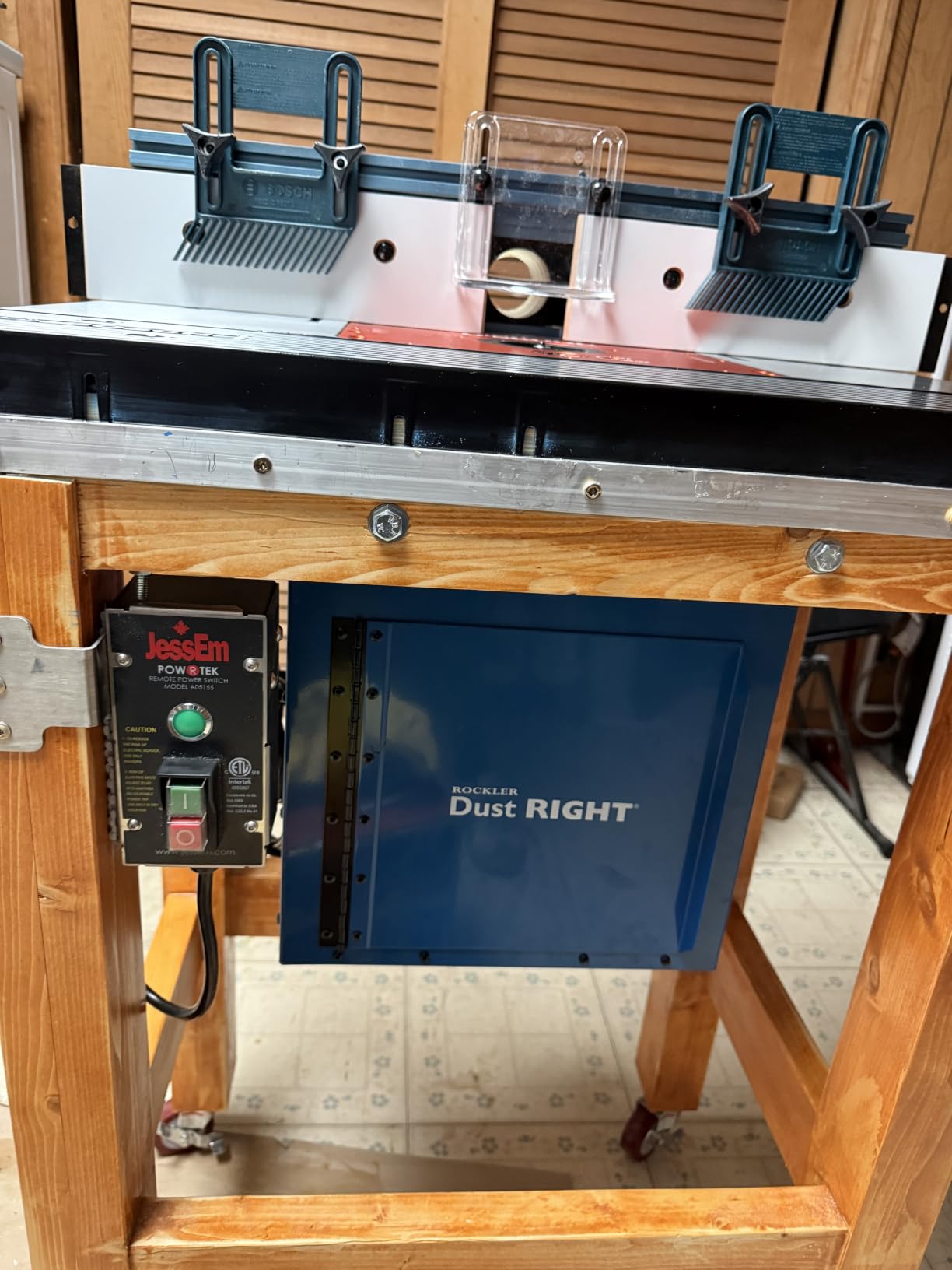
The fence is taller than most and made of aluminum with adjustable faceplates, so it stays rigid rather than bowing into the cut. The two 1/16 inch jointing shims let you do edge jointing without a two-part fence, which is unusual at this level. Integrated bit storage, a storage pocket, and a cord wrap for six feet of cord keep the bench face tidy.
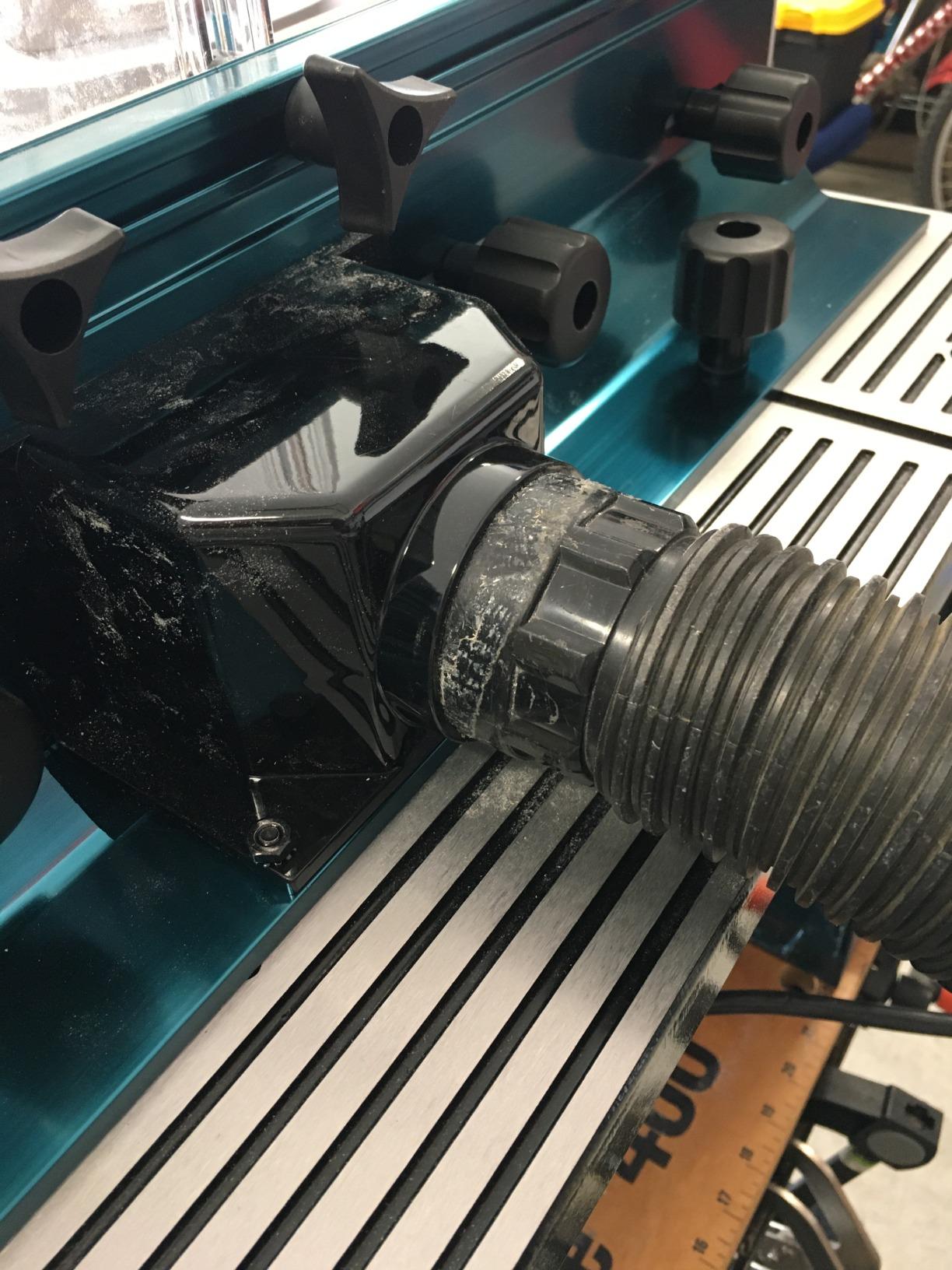
The dust port takes a standard 2-1/2 inch hose, and the integrated switch has a second outlet, so a shop vac starts and stops with the router. That single feature saves more time in a real week than any of the rest.
Why the Bosch earns its place in a small shop
It borrows bench space instead of claiming floor space, and clamping it down is a ten minute job with four bolts. For a shop that already owns a decent bench, this is the cheapest way to add a production machine without rearranging the room.
Because the top is aluminum, a stray glue squeeze or a dropped chisel does not permanently scar it the way it would in MDF. Reviewers note the surface picks up light scratches that need sanding out, but the plate and fence stay true, which is what actually determines cut quality.
Where it falls short
The plastic base, switch fascia, and feet are the weak points, and owners consistently recommend clamping the table to a solid bench rather than trusting the factory feet. The switch fascia also flexes when you press it, and the fence hold-down guard is easy to knock off.
One compatibility note matters: the plate has no pre-drilled 60mm hole pattern for compact and trim routers. If your shop runs a small plunge router, check the pattern before you commit. Check the base width too, since it is wider than the top at the mounting holes.
2. SKIL RT1323-01 Table and 10 Amp Router Kit – Best Value
SKIL RT1323-01 Router Table and 10Amp Fixed Base Router Kit
Table plus 10 Amp router
26 inch class top
41.5 lb kit
1 year warranty
Pros
- Only complete table and router package here
- 2.0 HP motor with soft start and speed control
- Above-table bit access
- Includes miter gauge slot and two featherboards
- Assembles in under an hour
Cons
- Laminate-over-MDF fence flexes
- Switch box partly blocks the dust port
- Router must be tilted out for bit changes
This is the only package in our group that includes a router. If you are setting up a first shop and do not already own a fixed base machine, that changes the arithmetic completely, because every other table here assumes you have one.
The router is the surprise. A 2.0 HP motor with soft start, speed control, and a live tool indicator is more than a small benchtop package usually carries, and the above-table adjustment means you can change a bit without pulling the router out from under the table. That feature alone saves minutes per bit change over a project.
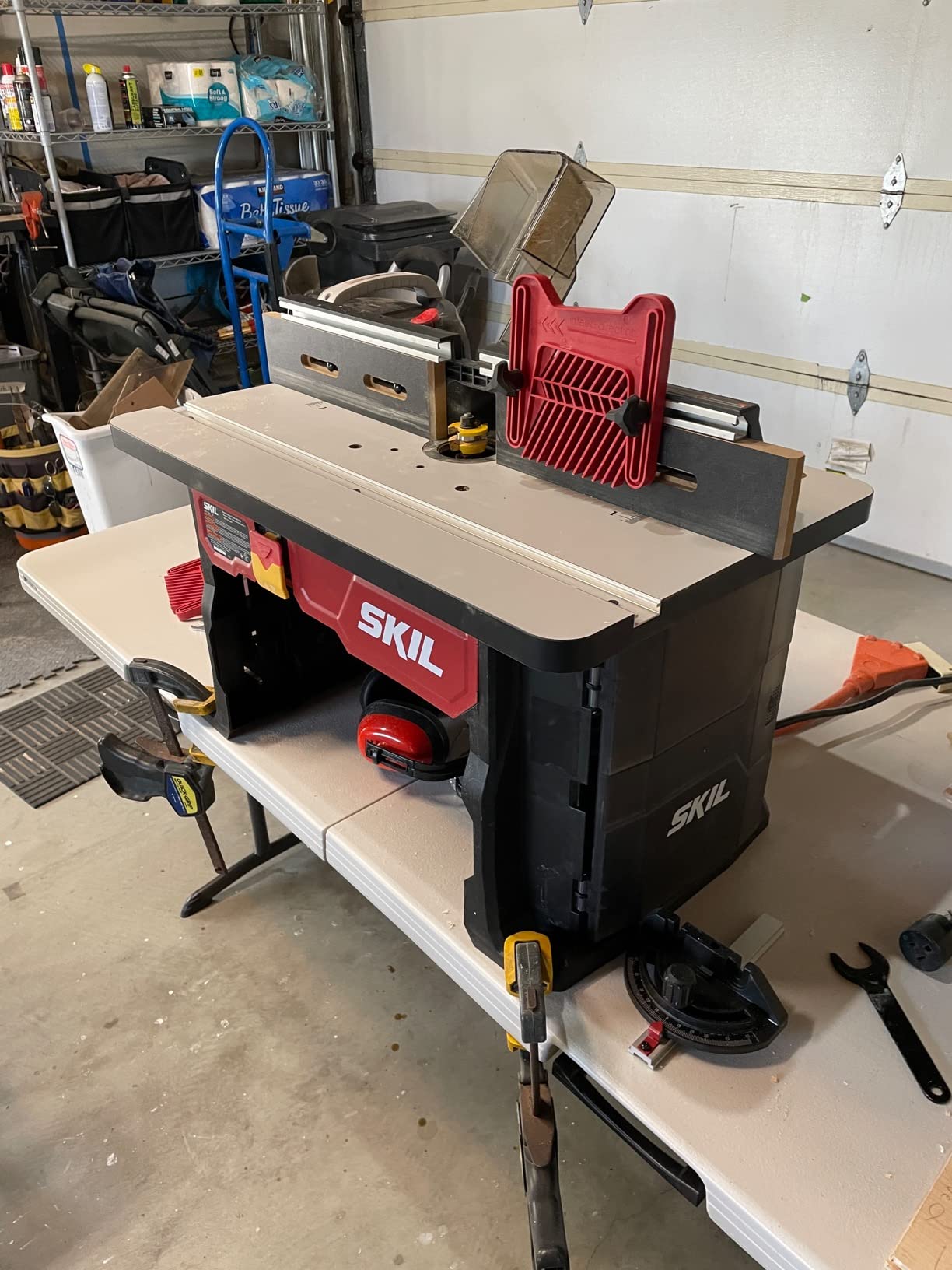
Side-mounted bit storage cubbies hold your bits at the table rather than in a drawer, which is genuinely useful in a small shop where a rolling tool chest is a luxury. The table clamps down solidly once mounted, and most owners finish assembly in under an hour.
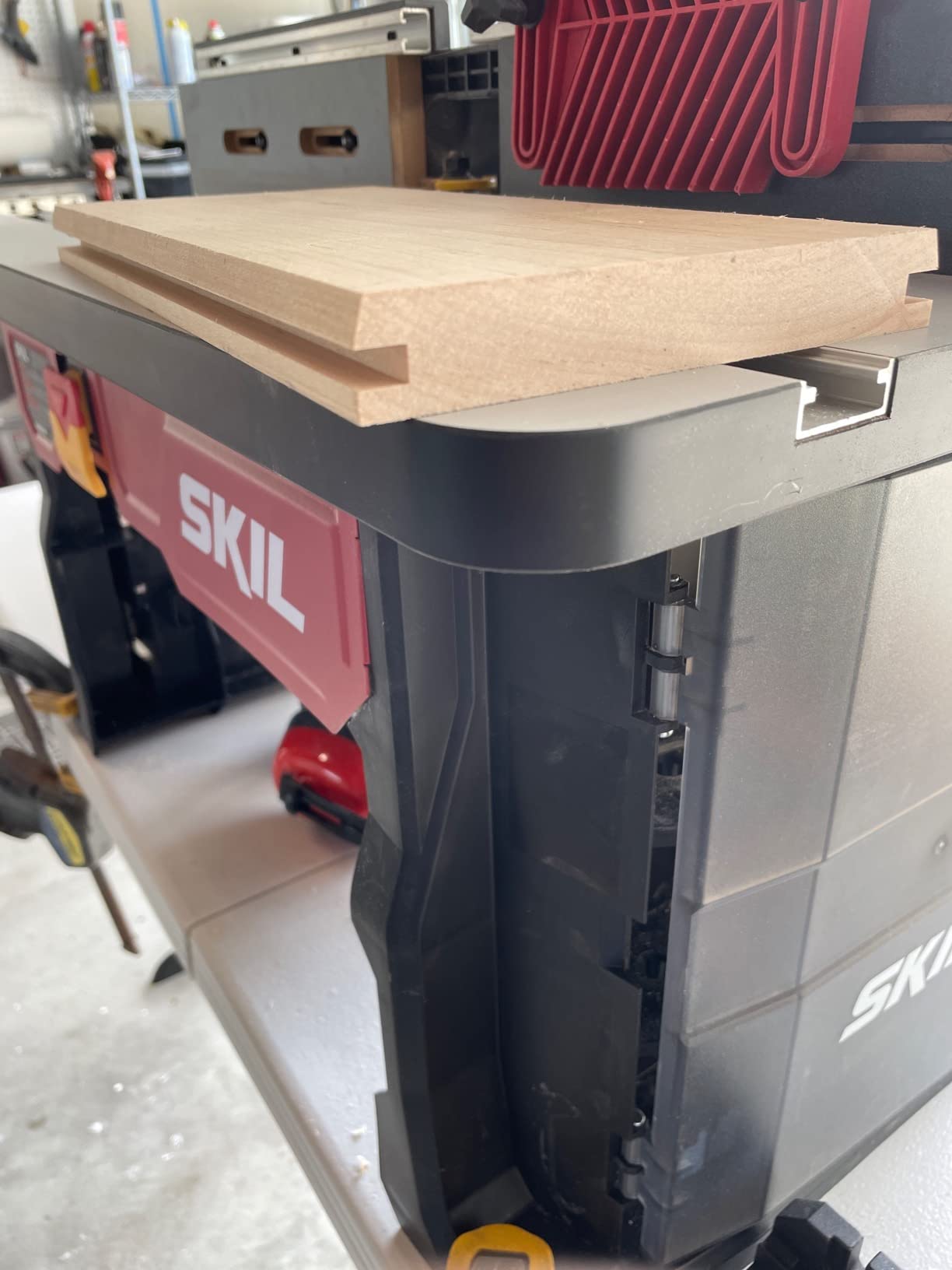
Two details show real thought. The fence measures 24 inches with adjustable MDF face plates, a starter pin, and a guard, and an aluminum miter gauge slot runs in the top so you can crosscut small parts without a separate jig. Two featherboards come in the box, which is more than most competitors include.
Who this kit suits best
A first-time router owner in a garage shop gets a working setup from one purchase instead of two, and the above-table access means more finished parts per session. It is the recommendation we give a hobbyist moving from occasional hand-tool work to repeat cabinetry.
If you already own a decent fixed base router, the standalone tables further down this list are a better use of the same money. Buying a second router you do not need is how small shops fill up with half-used equipment.
What to watch out for
The laminate-over-MDF top and fence flex under load, which is fine for molding and profile work but not ideal for precision edge jointing. The switch box sits close enough to the dust port to partly block it when the router is mounted as instructed, so plan your hose routing before you commit.
On some setups the router has to be lifted or tilted out for bit changes despite the above-table access, and the supplied flat-head screws do not fit the mounting plate cleanly, so bring pan heads. Owners also note it runs hot on a shared 15 amp circuit alongside a shop vac.
3. POWERTEC 71402V Benchtop Router Table with Steel Stand – Premium Build
POWERTEC Benchtop Router Table with Steel Stand and Adjustable Fence – 24″ x 16″ MDF Laminated Top, Insert Plate, 2-1/2″ Dust Port, Fence Stop, Featherboard & Additional Accessories (71402V)
24 by 16 inch MDF top
Steel stand with rubber feet
27.5 lb
Four reducing rings
Pros
- Comes as a full system with stand and fence
- Eight-point plate leveling for a truly flat surface
- Heavy rigid 24 inch fence with flip stop and featherboard
- Reducing rings fit several bit diameters
- Well machined components throughout
Cons
- Fence hold-down sticks are thin and awkward
- Plate slots span only 18 inches
- No drilling template for the top opening
The POWERTEC is the most complete single purchase here short of a lift system. You get the stand, the fence, the insert plate with four reducing rings, a plate leveler set, jointing rods, a flip stop, a featherboard, a bit guard, and the hardware. Nothing important is missing, which is the failure mode that turns cheap tables into expensive ones.
Eight leveling points with 3/8 inch or 5/8 inch screws is the feature that separates it. Owners who level this plate properly report the flattest surface in the group, and the reducing ring set lets the opening change to fit different bit diameters with a tool-free swap using the included ring wrench.
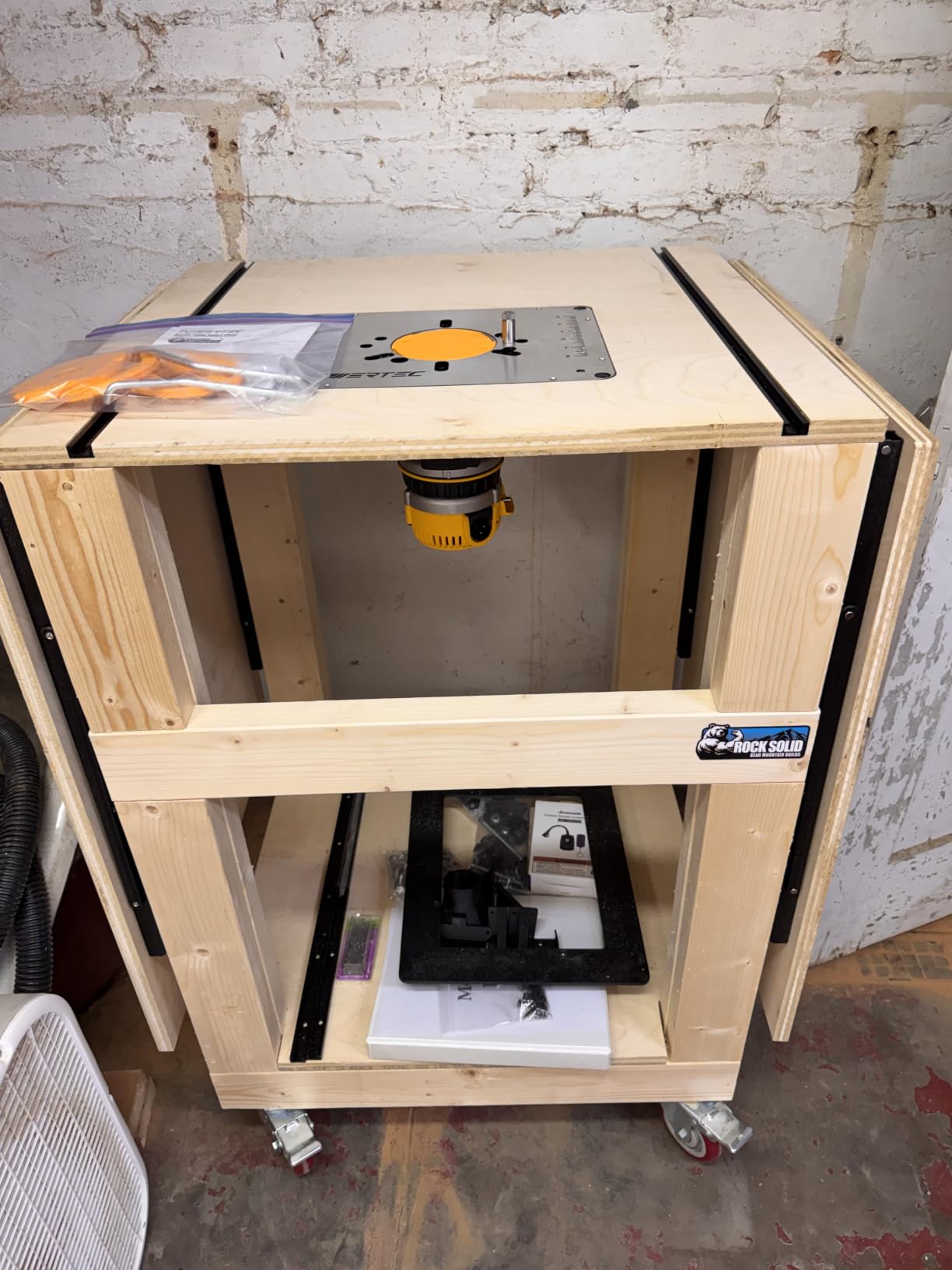
The steel stand with vibration-absorbing rubber feet is heavier and more stable than folding steel legs on budget tables, and it does not shift when you push a long board across. For a shop where the table will be a fixed station rather than a carry-around tool, that stability is worth the extra weight.
The 24 inch aluminum fence has an integrated dust port, a measuring scale, an adjustable bit guard, and a reversible flip stop. That is a genuinely pro feature set on a mid-range table, and it is why we call this our premium build rather than our best overall pick.
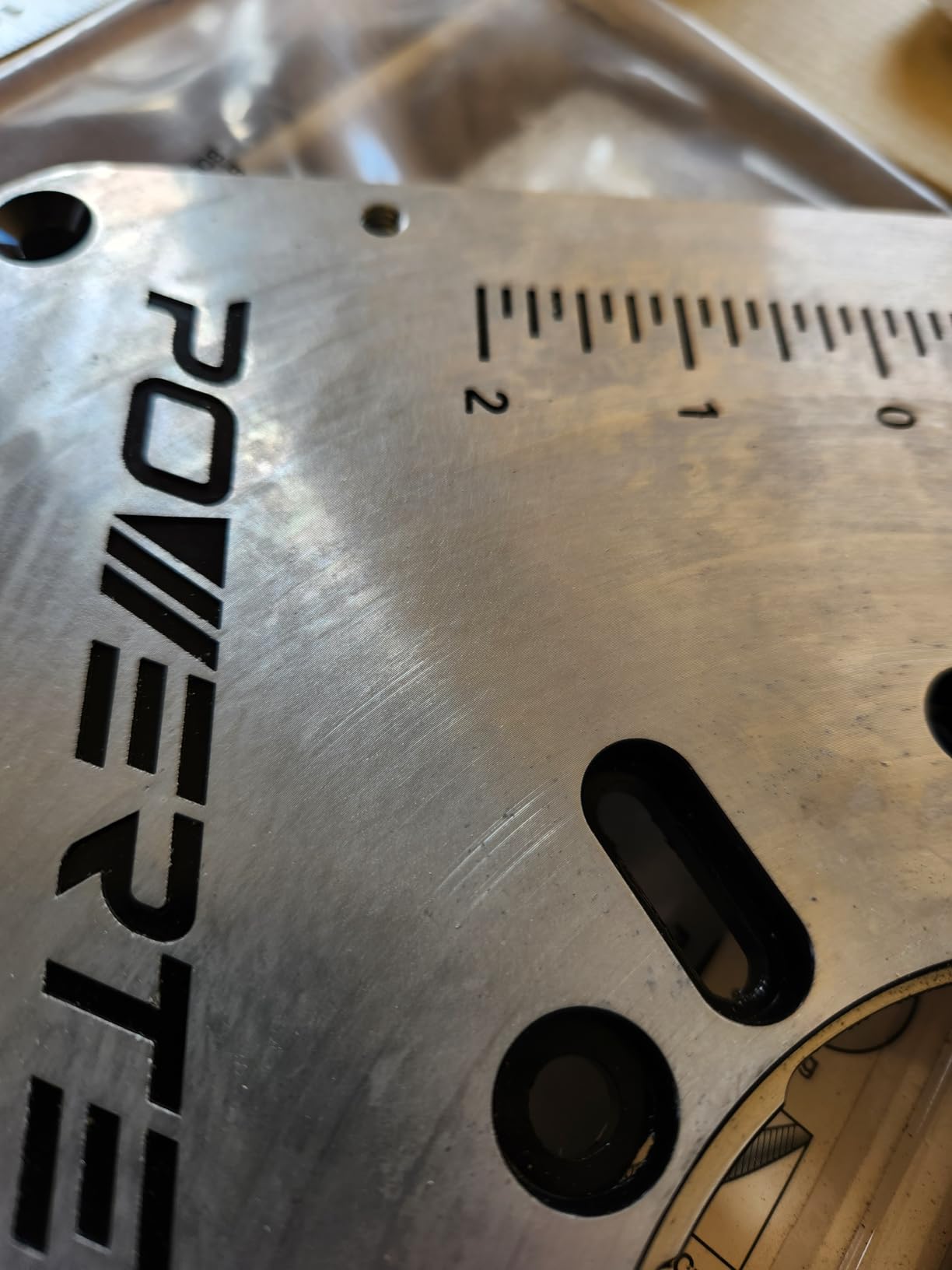
Where it earns its rank
A shop that runs the same profile across batch after batch of molding, or repeats edge work on a lot of similar boards, gets the most from the eight-point leveling. Once the plate is dialed in, the setup stays put, and repeat batches come out identical without rechecking height.
It is also the best value here if you want jointing capability without a jointer. The included jointing rods and the stiff fence make single-board edge jointing realistic within the 24 inch fence width.
What to check before buying
Router fit is the main question. The insert plate hole pattern is not universal, and a few owners drilled custom mounting holes. The T-bolt slots on the plate span up to 18 inches, which limits how small a table you can pair it with, and no drilling template is supplied for cutting the top opening.
The fence hold-down sticks are thin and awkward to tighten by hand, so expect to use a wrench the first few times. A few reviews attached to this listing cover the standalone fence kit sold as a variant, so read carefully when comparing owner comments.
4. SKIL SRT1039 Benchtop Router Table – Best for the Tightest Shops
SKIL SRT1039 Benchtop Portable Router Table for SKIL Routers RT1323-00 & RT1322-00 (Router Not Included)
26 by 16 inch MDF top
24 inch MDF-faced fence
24.2 lb
Above-table access
Pros
- Largest top in the budget group for its footprint
- Above-table adjustment and bit storage
- Quick clamp fits most major router brands
- Starter pin miter gauge and featherboards included
- Light enough to move between jobs
Cons
- Router sold separately
- MDF fence is less rigid than aluminum
- Finishing and parts are budget grade
The SRT1039 is the table we would put in the smallest shop in this roundup. At 26 by 16 inches it gives you more supported surface than most benchtop designs without growing the footprint, and at 24.2 pounds you can carry it to the other side of the shop when you need the bench back.
It is the standalone version of the SKIL kit above, and it keeps the two features reviewers single out as unusual at this level: above-table height adjustment and a quick clamp that fits most major router brands without drilling. The clamp matters more than it sounds, because a plate that requires a jig is where many first-time builds go wrong.
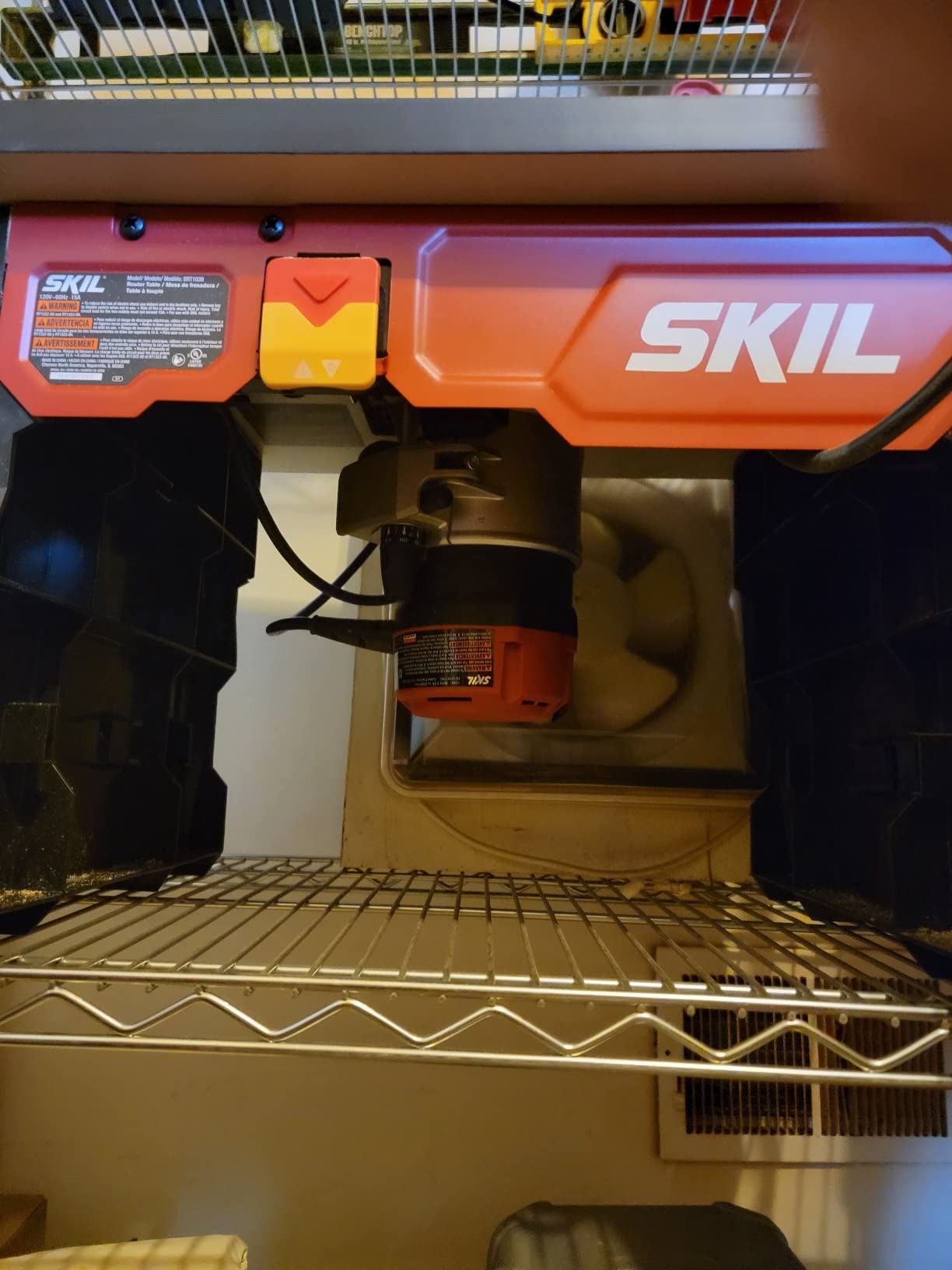
The box includes a starter pin, a miter gauge, two featherboards, and three inserts, and there is a durable aluminum miter gauge slot in the top. Dual-sided integrated bit storage means the bits travel with the machine, which is a small thing that matters a lot when storage space is the constraint.
Pair it with a SKIL RT1323-00 or RT1322-00 router if you want the intended fit, but owners report good results with other major brands through the clamp. That flexibility is what makes it a safer buy before you have committed to a router.
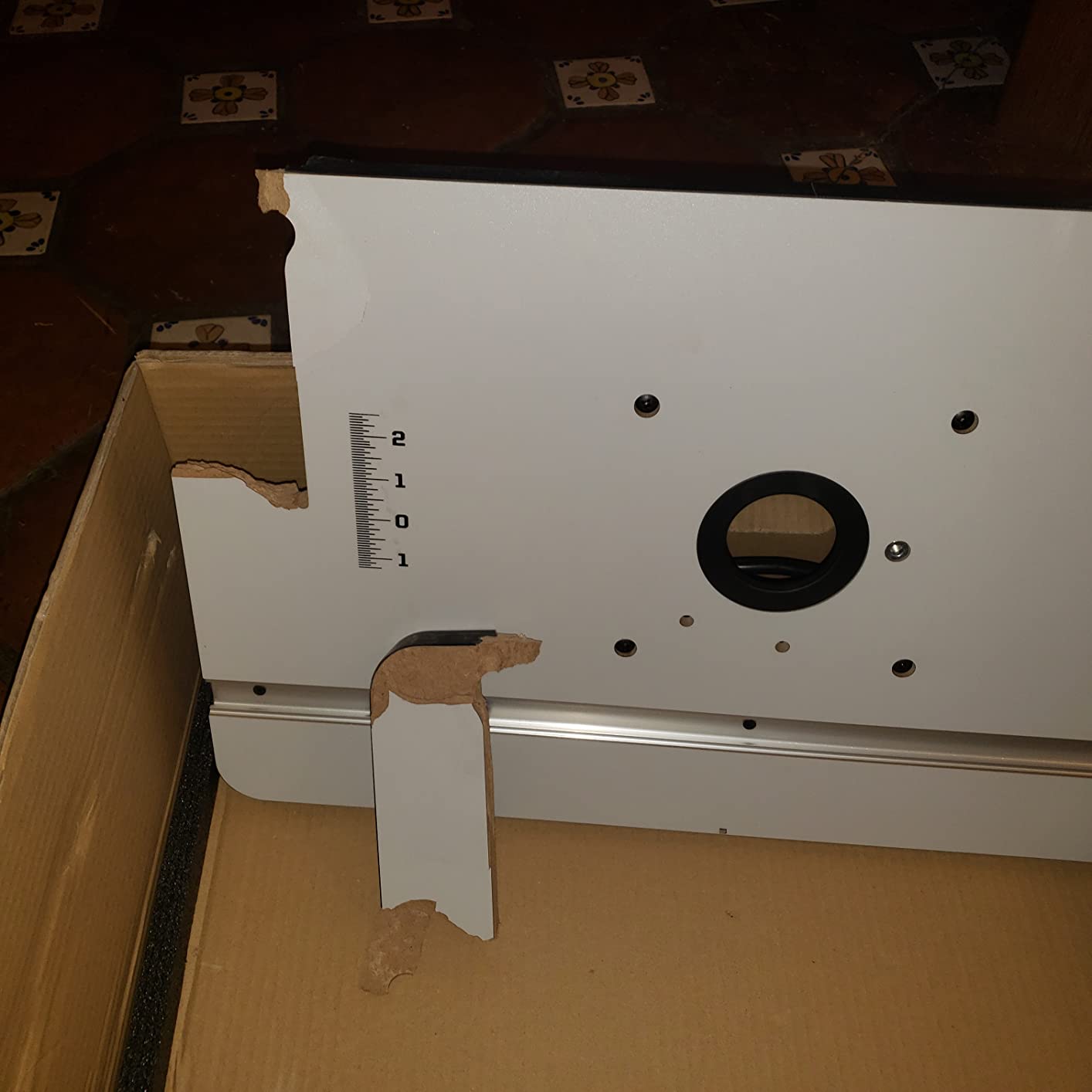
Why a small shop should like it
A 26 inch top supports long narrow workpieces that a 20 inch benchtop top lets sag, and MDF of this thickness is heavy enough not to chatter. The above-table access means a bit change takes seconds, so a session spent routing a batch of rails is not constantly interrupted.
It is also the natural first upgrade from a folding table. Set it on a proper bench, bolt or clamp it down, and you have most of the function of a larger machine in a corner of the shop.
What you give up
You buy a router separately, so the total outlay is higher than the standalone price suggests. The MDF fence and its face plates are adequate rather than rigid, which shows up if you try to joint an edge with it.
Finishing and hardware are budget grade, and it sits high on a typical benchtop workbench, so plan your bench height around it. If you need the table to be flat and rigid under heavy side pressure, look at the POWERTEC instead.
5. Kreg PRS2100 Bench Top Router Table – Best for Edge Jointing
Kreg Bench Top Router Table, Woodworking Router Table, PRS2100, Bench Top
30 inch wide top
26.5 lb steel and aluminum frame
16 inch tall form
MDF top with micro-dot skin
Pros
- Heavy frame that does not rack or flex
- Excellent plate leveling with Level-Loc rings
- Jointing rods add real edge jointing capability
- Noticeably less vibration than cheaper tables
- 30 inch width suits compact rooms
Cons
- Assembly is genuinely difficult with thin instructions
- Switch and featherboards are sold separately
- Fence lacks a micro adjuster
The Kreg PRS2100 is the one we would choose if your work in a small shop is panel work and edge jointing rather than molding. The 30 inch width is the largest top in this group, and the jointing rods mounted behind the fence add capability that almost no competitor includes at any level.
Build quality is the story here. The steel and aluminum frame does not rack, and owners consistently report quieter running and noticeably less vibration than cheaper MDF tables. The edge-banded MDF top carries a micro-dot skin specifically to dampen that vibration, which is a small design decision that shows up in finished edges.
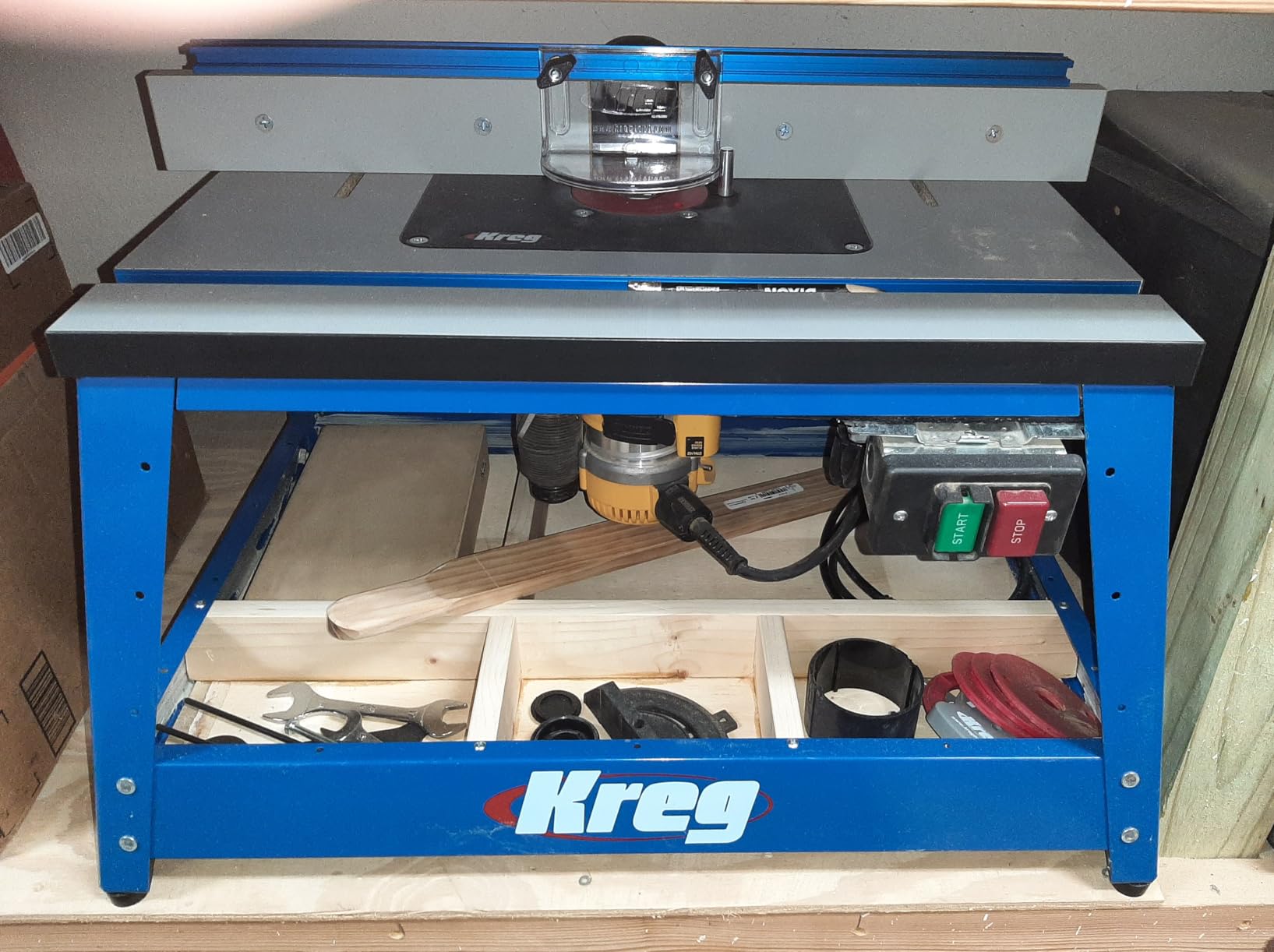
The plate leveling system with Level-Loc rings is the best in this roundup, and it is what justifies the price on a table that otherwise looks like a straightforward benchtop unit. The fence uses sliding faces with locking levers, and its track accepts featherboards, flip stops, and other add-ons later.
It is designed as a benchtop unit on a 16 inch tall form factor, which suits compact rooms, and the aluminum fence carries a dust collection port and a bit guard as standard.
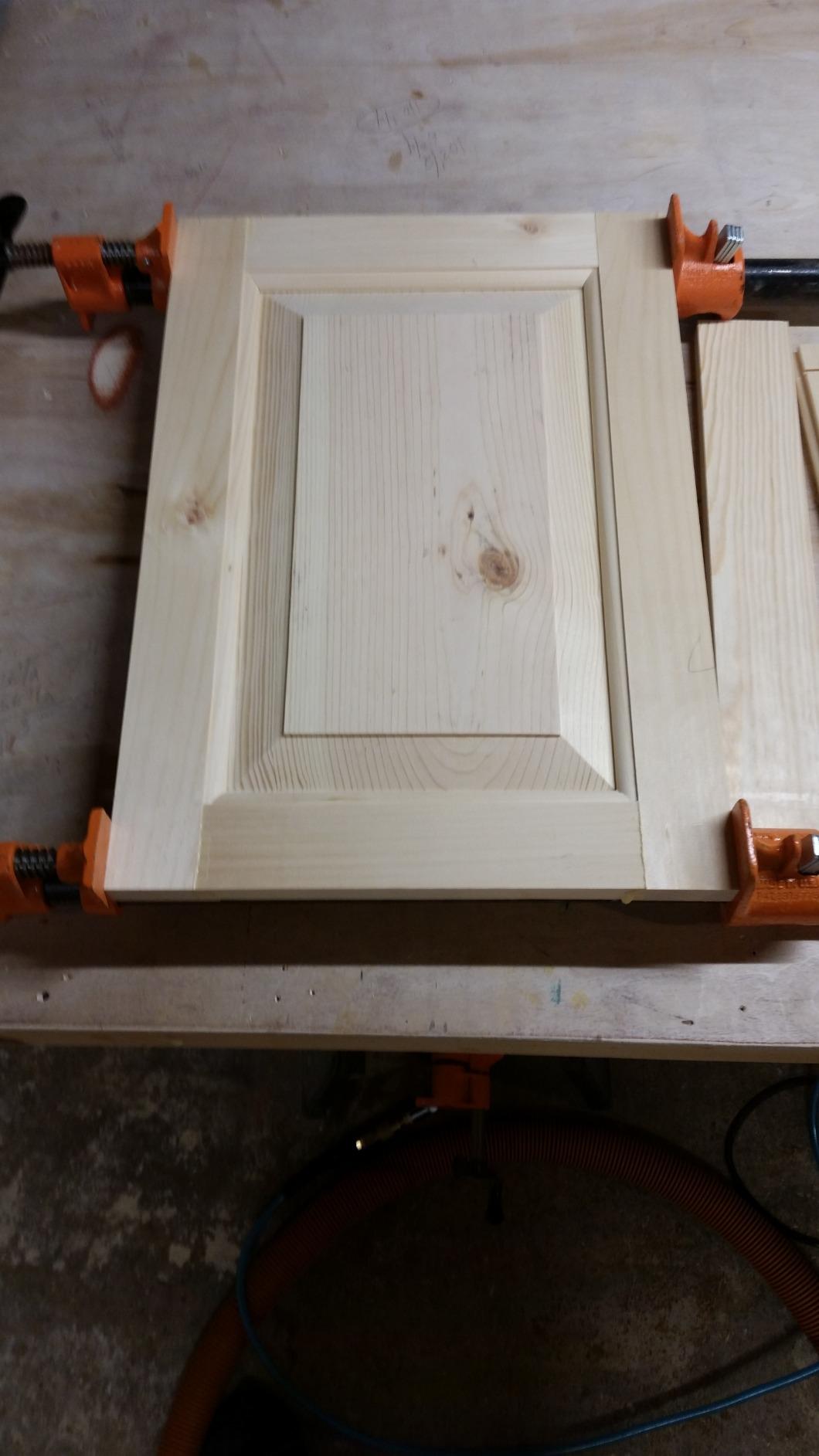
What you get that cheaper tables skip
Jointing rods plus a rigid fence mean you can true up a single edge without a jointer, within the limits of a 30 inch top. For a shop building flat panels, doors, or cabinet carcasses, that removes a machine from the shopping list and a footprint from the floor plan.
The 30 inch width also handles sheet goods far better than a 20 inch benchtop, which matters if you are routing a large frame rather than a strip of molding. A routerforums thread recommending a cabinet-style table for extra storage points at the same logic: in a small shop, a machine that does two jobs is worth more than two machines.
Why it frustrates some buyers
Assembly is the dominant complaint. Owners report spending hours on it with thin instructions and unlabeled parts bags, and the cam-lock fence hold-down is fiddly to work with. Nearly all of them still say it was worth the effort once assembled, but budget the evening.
Two practical notes. The on/off switch and featherboards are not included, so the real cost lands closer to the upper end of the mid range. And the fence has no micro adjuster, so if you rely on that feature for fine setup, plan to add one.
6. RYOBI Universal Router Table A25RT03 – Best for Longer Workpieces
RYOBI Universal Router Table A25RT03
Metal construction
32 inch overall span
28 lb
Adjustable fence with featherboard
Pros
- Sturdy metal build for its tier
- Fence featherboard miter gauge and guard all included
- Large format handles longer workpieces
- Easy assembly for RYOBI corded routers
Cons
- Not universal
- throat opening will not take every router
- Fence halves do not align perfectly
- Miter slot is wider than a standard 3/4 inch
The RYOBI is a metal table rather than an MDF bench, and at 28 pounds it feels planted rather than temporary. That is the trade: you give up some of the portability of a folding benchtop design and get a surface that stays put under side pressure from a long board.
The accessory set is unusually complete for the money. You get an adjustable fence, a featherboard, a miter gauge, and a functional guard, plus a dual outlet switch so the router and your dust collector run from one box. Owners with RYOBI corded routers report easy assembly and a table that performs well out of the box.
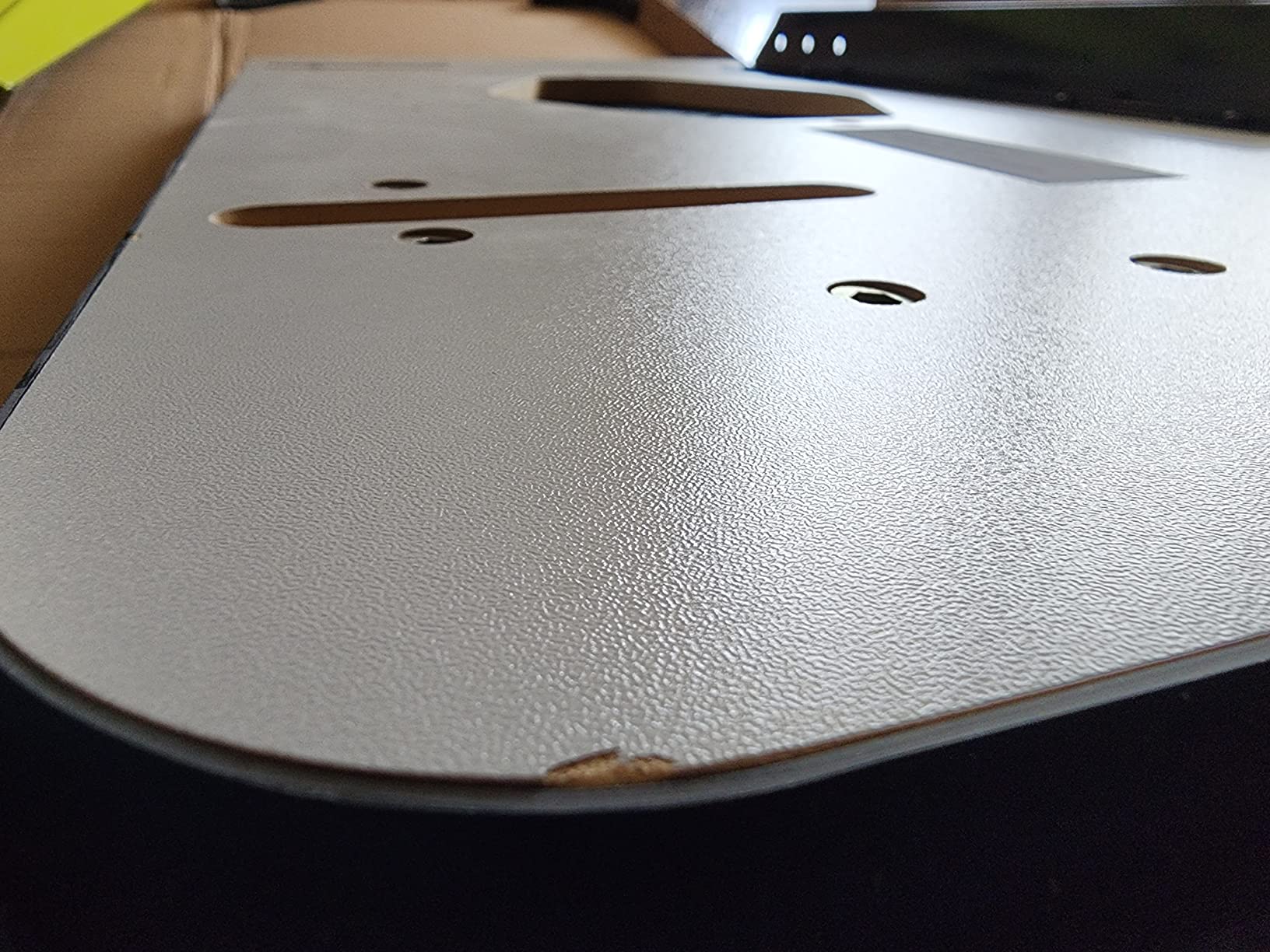
The large format table handles longer workpieces than most benchtop units in this group, which is the reason it earns a place for anyone routing long rails or trim. The 18.25 by 32 inch listed dimensions give you more supported length than a 20 inch square top.
It fits a specific shop well: one that already runs RYOBI corded routers and wants a stable, permanent station instead of a carry-around table. The universal mount accepts most fixed base routers with compatible plate dimensions, which covers a lot of brands but not all.
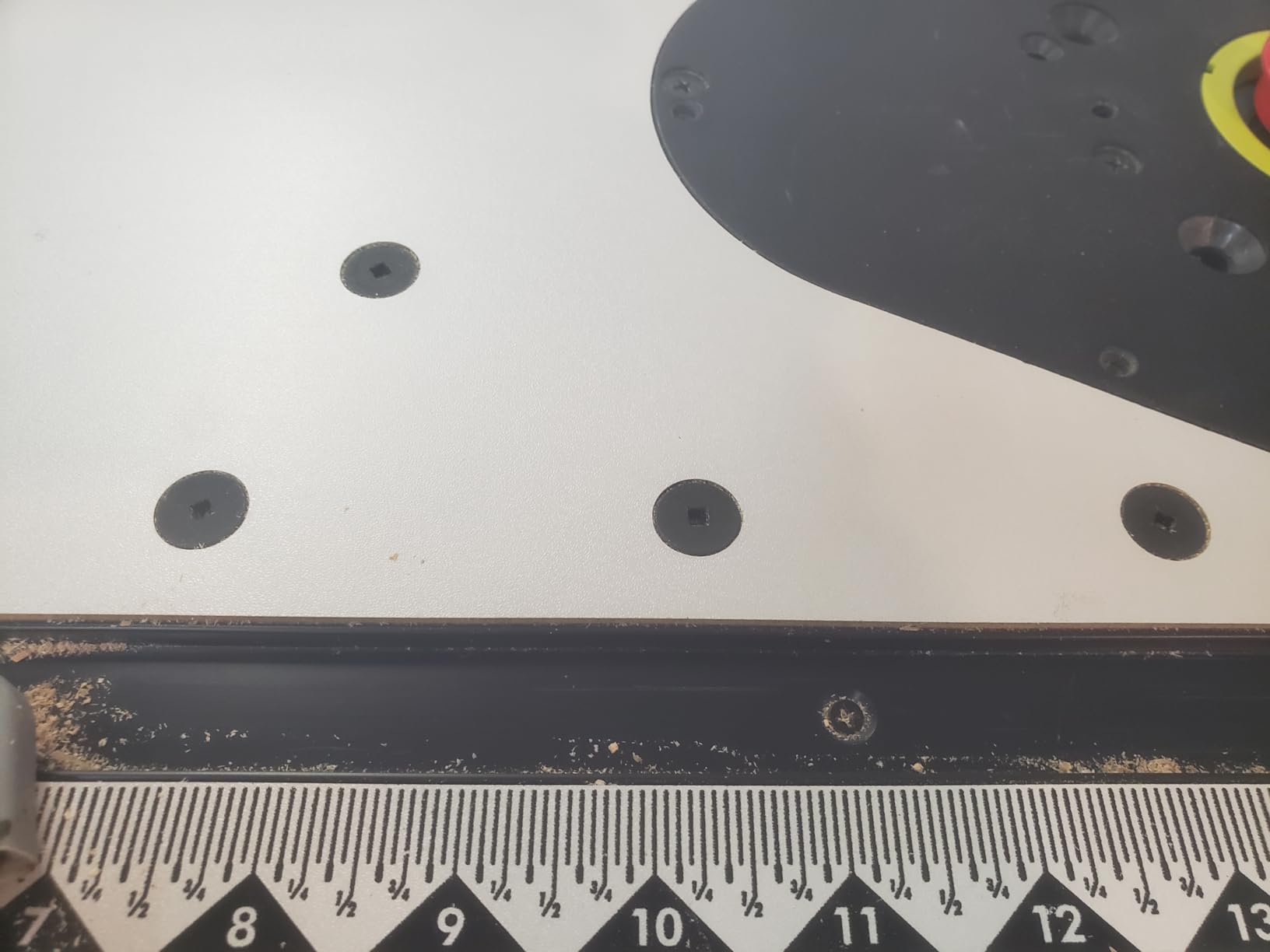
When it makes sense
If your work involves routing long pieces and you want a table that stays where you put it, the metal construction and larger format hold up better than a folding MDF bench. The included featherboard and miter gauge remove two purchases from your list on day one.
The dual outlet switch is the quiet winner for dust control, because one switch starts both the router and the collector, so you stop routing into a cloud of settled dust.
Where the compatibility bites
Buy it for your router, not in hope. Several owners assumed universal fit and found the throat plate opening would not accept compact or third-party routers without cutting the table, and one common RYOBI variant is named in reviews as a problem case. Measure your router base before ordering.
The two fence halves do not align perfectly, and the left section is held by a single center lock that can pivot during jointing. The miter slot is also slightly wider than a standard 3/4 inch, so table saw featherboards will not drop in. Check all three before you commit.
7. Leegol RT150 Wide-Bench Router Table – Best for Width on a Budget
Leegol Electric Benchtop Router Table Wood Working Craftsman Tool (Router Table A)
34 inch span with two extension wings
17.6 lb
Aluminum top with steel wings
Fits 6 inch base plates
Pros
- Widest span in the group with two 8 by 18 inch wings
- Aluminum main top is rustproof and light
- Fence doubles as a vertical jointer
- Retractable transparent chip guard
- Steel wide-stance stands add stability
Cons
- Lowest rating in the group at 3.9 stars
- Steel wings are lighter duty than the aluminum center
- Minimal instructions
- Miter gauge and fence accuracy are adequate
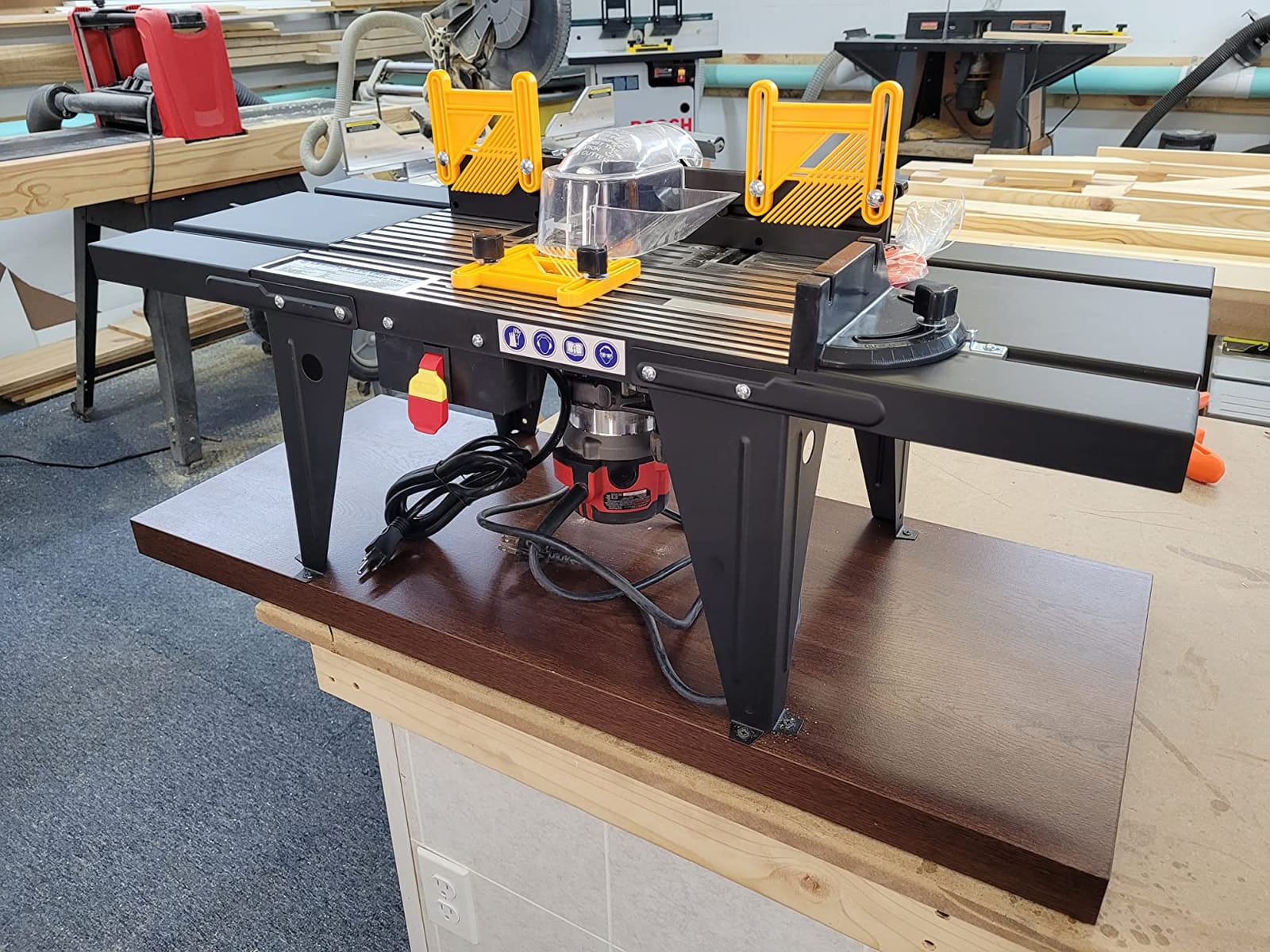
The Leegol solves one specific small-shop problem well: length. With extension tables at both ends, each 8 by 18 inches, it gives you a 34 inch working span from a package that weighs 17.6 pounds and costs the least of anything we looked at. If your work is long thin stock, that combination is hard to argue with.
The fence is multifunctional. It supports the workpiece around the bit for normal fence work, and it combines with a jointing fence to function as a vertical jointer, which gives you an edge-flattening option without buying a second machine. There is also a retractable transparent guard that inserts into the fence to contain chips.
The main table is aluminum alloy and the extension wings and structure are steel, with wide-stance heavy duty stands underneath. It fits routers with up to a 6 inch base plate, which is the broadest compatibility range in this roundup, and an exact miter gauge is included for straight cuts and angle measurement.
Reviewers like the width and the price, and the aluminum top is a real advantage over MDF in a damp garage. It is the lightest metal-topped option here, so moving it between a bench and the floor is not a two-person job.
Who should buy it
Anyone routing long trim, long rails, or repeated straight runs who cannot spare bench depth for a bigger top. The two wings slide out only when you need the length, so in normal use it occupies a much smaller space than the 34 inch figure suggests.
It is also a reasonable first router table for a hobby shop, where the combination of low weight, metal top, and broad router compatibility lowers the number of ways the purchase can go wrong.
Where quality shows
Be clear-eyed about the rating. It sits lowest in this group with a 3.9 average and a 51 percent five-star share, and the complaints cluster in predictable places: lighter duty steel construction compared with the aluminum center, thin instructions, and finishing that some owners chose to improve themselves.
The miter gauge and fence accuracy are adequate rather than precise, so treat it as a production helper for repetitive work, not as a machine for fine cabinetry. Buy it for width and price, and not for finish quality.
8. VIYUKI Universal Electric Benchtop Router Table – Best for Stowing Away
VIYUKI Universal Electric Benchtop Router Tables Wood Working Craftsman Tool
Die-cast aluminum top with iron wings
14.5 lb total
11.22 inch height
Fits 6 inch base plates
Pros
- Lightest table here at 14.5 lb
- Flat rustproof aluminum top
- Compact enough to store between sessions
- Retractable fence guard contains chips
- Can be adapted for jig saw or circular saw use
Cons
- Fence is short
- Aluminum extrusion spacing lets shaped pieces dive in
- Four wing-nut clamps do not hold a router firmly
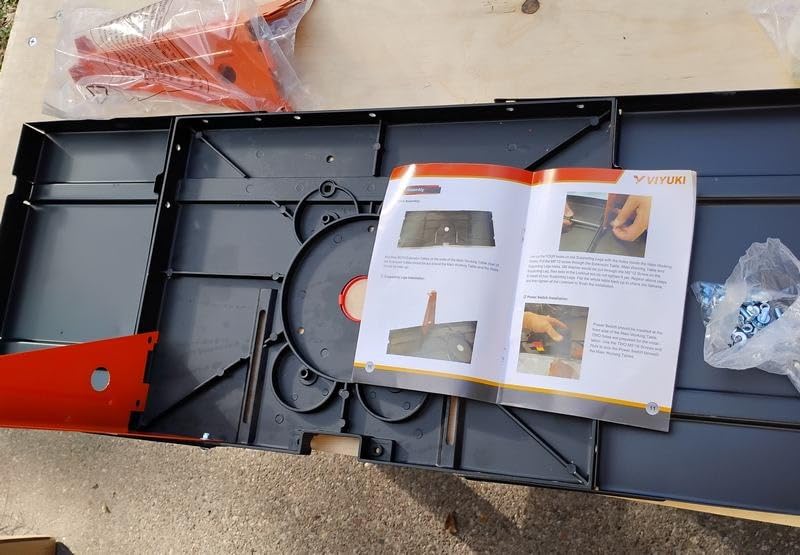
- Manual does not explain router mounting
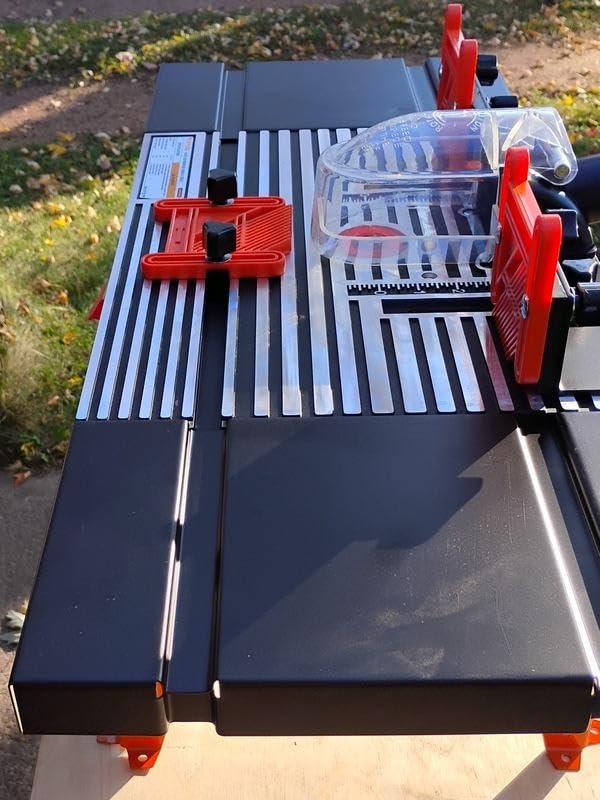
At 14.5 pounds, this is the table that disappears when you are not using it. In a one-car garage where the router table competes with the workbench, a machine you can lift with one arm and set on a shelf is worth more than a heavier table that permanently owns floor space.
The die-cast aluminum top is flat, rustproof, and lighter than any MDF competitor here, with iron extension tables on either side and a listed height of just over 11 inches. It also accepts routers with up to a 6 inch base plate, so compatibility is not the weak point.
Two details stand out. A retractable guard inserts into the fence to contain chips, which matters more than it sounds on profile work, and the table can be adapted for jig saw or circular saw use, turning one surface into a shared station when the router is not running.
Owners report build quality exceeding expectations for the price and quick assembly, and once set up it is stable. That is a good trade in a shop where the machine needs to be mobile rather than permanent.
Why stowability changes the buying decision
Most of the tables here are bolted to a bench and stay there. If your shop is multi-use, that is wasted surface. A 14.5 pound table can live on a shelf, under a bench, or in a corner between projects, and it comes back out for the two hours a week you actually need it.
It is also a sensible companion to a machine you already own that you do not want to bolt down. Bring it out for template work, stow it again, and your floor plan is unchanged.
The problems you should know about
The fence is the weak point. Owners say it should be taller and longer, and some fabricated a replacement. The extrusion spacing on the table face is too wide, so a shaped piece routed along the bed can dive into the grooves and tear out. That limits flush trimming and delicate profile work.
The four wing-nut clamps that hold the router do not grip firmly, and routers can shift or work loose mid-cut, which is a safety issue rather than a convenience one. The manual also omits how to mount the router. Note the review base here is the thinnest in the roundup, so treat the long-term picture as less certain than the others.
9. Kreg PRS1200 Precision Beaded Face-Frame System – Best for Face-Frame Cabinetry
Kreg PRS1200 Router Table System, Precision Beaded Face-Frame, Steel Base
Clamps to an existing router table
12 lb
Steel base
Includes router table stop
Pros
- Purpose-built for repeatable beaded face frames
- Included table stop makes repeat cuts consistent
- Clamp adjusts fast to different thicknesses
- Control arm gives smooth operation
- Steel base stays stable for repetitive work
Cons
- Router and router table not included
- Narrow focus
- not a general purpose table
- Only 57 ratings to judge long term reliability
This one is not a router table, and we would rather tell you that plainly than pretend otherwise. The Kreg PRS1200 is a Precision Beaded Face-Frame system that clamps onto a table you already own. If you build face-frame cabinetry, it turns a general router table into a dedicated jig for one specific high-volume job.
That job is the beaded face frame, and the included router table stop is what makes it repeatable. Rather than measuring and marking every rail by hand, you clamp the stock against the stop and the bead comes out the same width every time. That is the kind of specificity a small shop feels most, because face frames are the part you build first and the part you build many of.
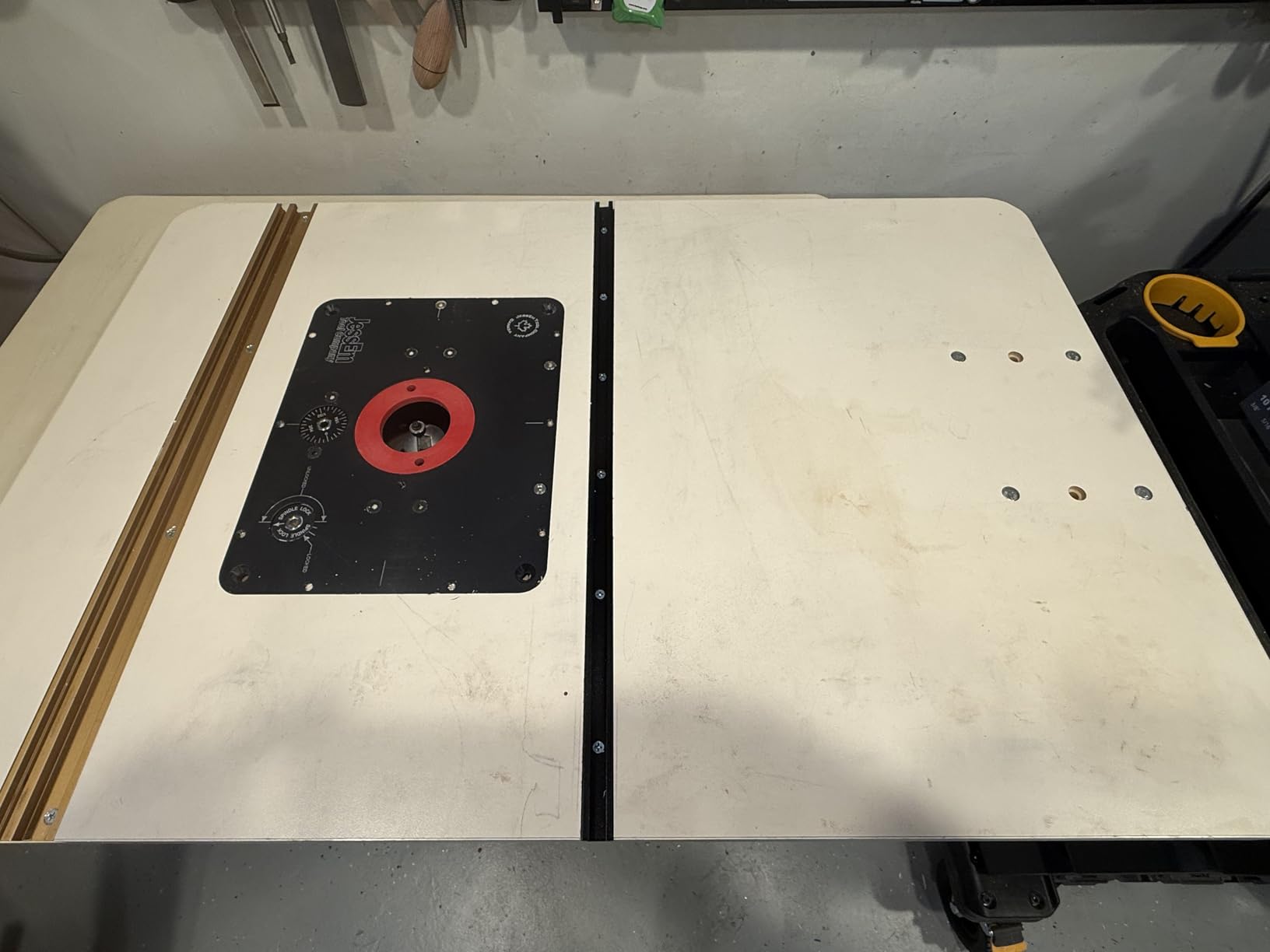
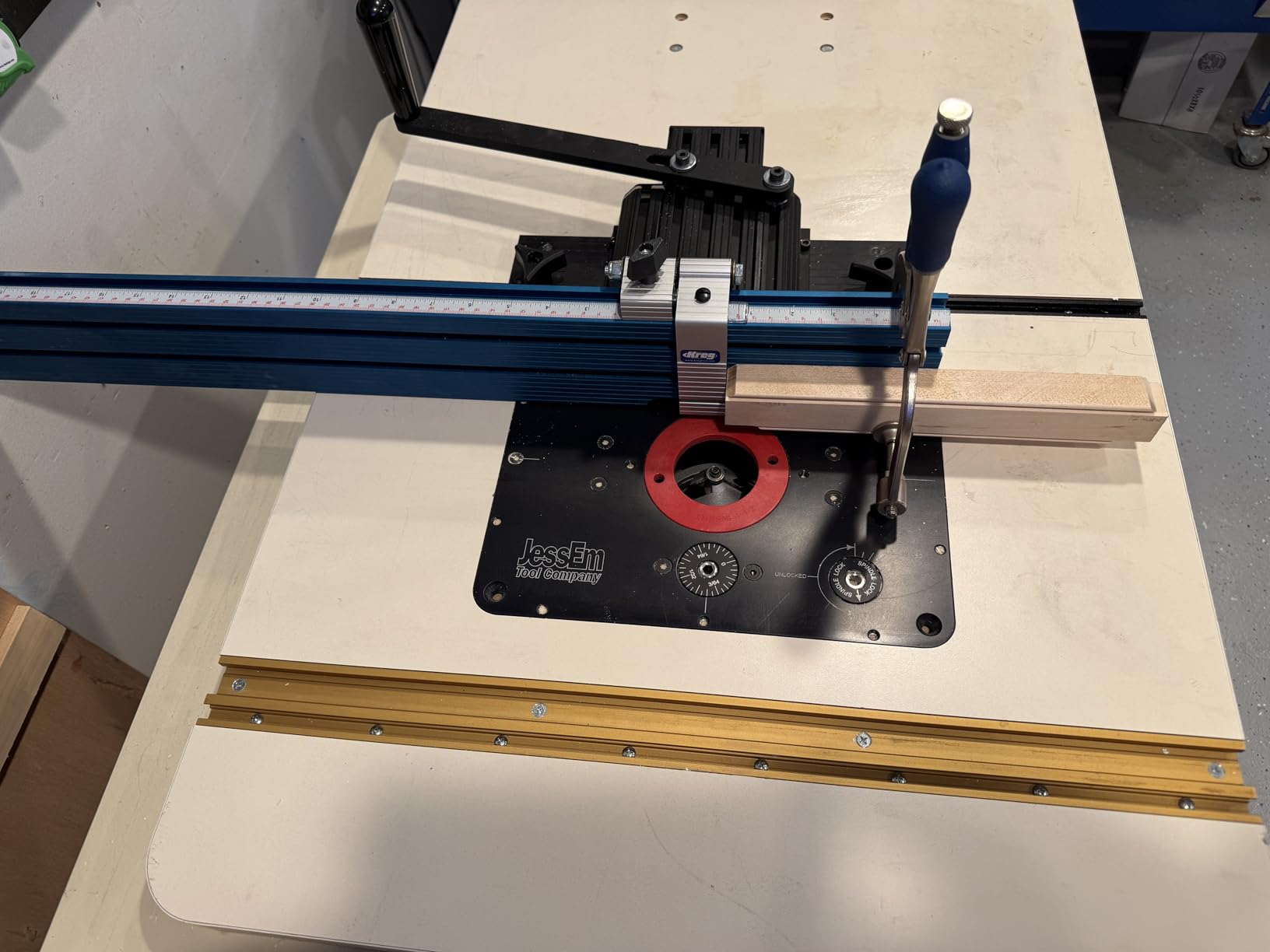
The clamp adjusts quickly to different thicknesses and the control arm gives smooth, controlled operation, and the steel base stays planted through repetitive work. It is light at 12 pounds, so it does not turn into another thing you cannot move once it is set up.
It carries the highest five-star share of any product in this roundup, which tells you the people who use it for its intended purpose are happy. The small review base of 57 ratings simply reflects how narrowly it is used.
Who this is actually for
A cabinet shop in a small space that already has a benchtop router table and keeps re-cutting the same face frames. For that buyer, this is a cheap way to remove the most error-prone repetitive step in the build, and it needs no additional floor space at all.
If you build face frames occasionally, buy a straight fence and a stop block instead. If you build them every week, this earns its place quickly.
Why it is last in the list
Neither a router nor a router table is included, so this is a system add-on rather than a machine you can start with. It does one job well and is not a general shop table, so ranking it beside full tables is only fair if you already own a table you are happy with.
The narrow focus and the 57-rating review base also mean less long-term evidence than any other pick here. Buy it for a specific recurring job, not as a general investment in the shop.
How to Choose a Router Table for a Small Shop
Start with the room, not the machine. Measure the bench or the floor area you can genuinely give up, then check the listed dimensions of the table against it. The difference between a 26 inch top and a 34 inch top with wings is a foot of standing room, which is the difference between a usable shop and a cramped one.
Second, decide how the table will live. A benchtop design that bolts to a bench you already own costs you no floor space at all. A portable design you can lift with one arm can be stowed. A free-standing cabinet gives you storage but claims a permanent footprint. In a small shop, that is a bigger decision than the fence. Commercial kitchens solve the same puzzle with their own layout guides, and the advice we cover in our picks of prep tables for restaurants translates directly to a bench that has to earn its square inches.
Third, check the mounting plate against the router you already own, and do it before you buy anything. Pre-drilled patterns are convenient, adjustable clamps accept more brands, and some throat openings will not take a compact or trim router without cutting the top. A Lumberjocks thread on fitting out a new shop is full of exactly this question, and it is the single most common regret we saw.
Fourth, look at what is actually in the box. Featherboards, a miter gauge, a starter pin, a router switch, a bit guard, and a set of plate levelers are the accessories that turn a table into a working station. Tables that omit them become false economies, and r/BeginnerWoodWorking builders keep the same list: featherboards, a router switch, a push button, and a miter gauge.
Fifth, look for a dust port behind the fence, and a switch with a second outlet so the collector runs with the router. Owners on Reddit consistently add a shop vac port behind the fence for the same reason, because you are going to make a lot of sawdust and it settles everywhere.
Sixth, think about top material. A cast iron or cast aluminum top stays flat and damps vibration. Phenolic is stable and moisture resistant. MDF and laminate are lighter and cheaper but can move with humidity, and that is the durability fear that comes up most often in small shops. If you cannot live with a top that might not be flat in two years, spend on metal.
Seventh, decide about a router lift now. None of the tables here include one, so if you want height changes from above the table rather than from underneath, plan for an aftermarket lift and confirm the plate pattern will take it. A benchtop table that accepts a lift later is an upgrade path; a plate that does not is a dead end.
One last practical point about layout. The thinking that goes into fitting a machine into a small room is the same as dining tables for small apartments or coffee tables for small living rooms: measure twice, plan the walkway first, and treat every piece of footprint as permanent unless it can be carried away.
Top Material, Fence and Lift Decisions
Cast iron and cast aluminum
Metal tops are heavy, which is a feature in a small shop. Weight stops a table from walking across the floor when you push a long board, and both cast iron and cast aluminum stay flat through humidity swings. Aluminum is lighter and easier to move, so it suits shops where the table is not bolted down.
Phenolic and laminate over MDF
Phenolic resin tops are dimensionally stable and moisture resistant, which makes them a good middle ground. Laminate over MDF is the most common budget choice and the most commonly regretted one. It is light and cheap, and the finish is what fails first, so buy it for molding and template work rather than for edges you will see.
What a T-square fence does and why it matters
A T-square fence is a single rigid face that the workpiece runs along, usually with adjustable sub-fences for micro adjustment. A split fence has two halves that move independently, which lets you cut a groove or a bead centered on a board without measuring twice. Forum users trust T-square fences with MDF faces for edge work, and split fences for centered profiles. Ask which one you need before you judge the fence included.
Router table versus router lift
A router table is the surface, the fence, and the mounting plate. A router lift is a mechanism that raises and lowers the router through that plate, typically by a crank above the table, so you set bit height from the operator position instead of reaching underneath. They are not alternatives. Almost every table sold without a lift can accept one later, provided the plate pattern matches, and buying the table first is the normal order because the lift depends on the plate.
Jointing limits on a small table
You can joint a single edge on a router table with jointing rods or shims behind the fence, but the limit is the fence width. Across a 24 inch fence you are comfortably working with 20 to 22 inch material, and wider boards need an extension or a second pass. If you regularly joint full-width boards, check the Leegol wings or the Kreg 30 inch top, and accept that this is a small-shop compromise rather than a jointer replacement.
Frequently Asked Questions
What is the best size router table for woodworkers?
For a small shop, 26 by 16 inches is the sweet spot. It supports long narrow workpieces like rails and trim without a large footprint, and it bolts to a bench you already own. Wider 30 to 34 inch tables give you sheet goods and full-length molding but take more bench depth. Below 20 inches, longer pieces begin to sag and you lose support on both sides of the cut.
Which router table is better, Bosch or Kreg?
For a general small shop, the Bosch RA1181 is easier to live with: a cast aluminum top, a pre-drilled plate that fits most full-size routers, and a fence that stays rigid. The Kreg PRS2100 offers a wider 30 inch top and jointing rods for edge work, but assembly is harder and the switch and featherboards cost extra. Choose Bosch for simplicity, Kreg for panel work.
Is it worth buying a router table?
Yes, if you cut molding, raised panels, dados, rabbets, or repeat joinery. A router table turns a handheld tool into a repeatable machine with a fixed fence reference, keeps your hands away from the bit, and costs no additional floor space if you mount it on an existing bench. If you only make one or two decorative cuts a year, a handheld router is enough.
What to look for when buying a router table?
Check these seven things. First, the footprint against your available bench or floor space. Second, whether the top is cast iron, cast aluminum, phenolic, or laminate over MDF. Third, whether the mounting plate fits the router you already own, pre-drilled or adjustable. Fourth, fence type, T-square or split, and whether a micro adjuster is included. Fifth, whether a router lift can be added later. Sixth, a dust port behind the fence and a switch with a second outlet. Seventh, which accessories are in the box.
Is the Harbor Freight router table any good?
We did not include a Harbor Freight table in this roundup, so we cannot give you a measured verdict on that specific model. What we can say is what to check on any budget table: whether the mounting plate is pre-drilled or requires a drilling jig, whether featherboards and a miter gauge are included, and whether the top is MDF that may warp. Our lowest-cost picks in this list are the Leegol and VIYUKI tables, and we rated them on measured specs and owner reports.
What is the difference between a router table and a router lift?
A router table is the work surface, fence, and mounting plate that hold your router upside down. A router lift is a mechanism that raises and lowers the router through that plate, usually by a crank above the table, so you change bit height from the operator position instead of reaching underneath. They are complementary, not alternatives, and a lift must match the plate pattern of the table it goes into.
What is the best router to use on a router table?
Look for a fixed base router with a standard diameter base plate and enough power for the material. A 2.0 HP fixed base router covers most small shop molding and joinery work, and a plunge base adds the ability to make stopped cuts and grooves. Check the table plate pattern first, because pre-drilled plates only accept certain diameters and some compact routers need different holes.
The Verdict for Small Shops in 2026
The Bosch RA1181 is our best router table for small shops overall, because a flat cast aluminum top and a pre-drilled plate solve the two problems that decide whether a small-shop table survives contact with a real garage. If you have no router at all, the SKIL RT1323-01 kit saves you a second purchase. If your shop needs edge jointing more than molding, the Kreg PRS2100 earns its extra assembly time.
Whatever you choose, measure the footprint before you order, check the plate pattern against your router, and add a dust port and a featherboard to the list. Those three details do more for daily use than any other feature on the box.