
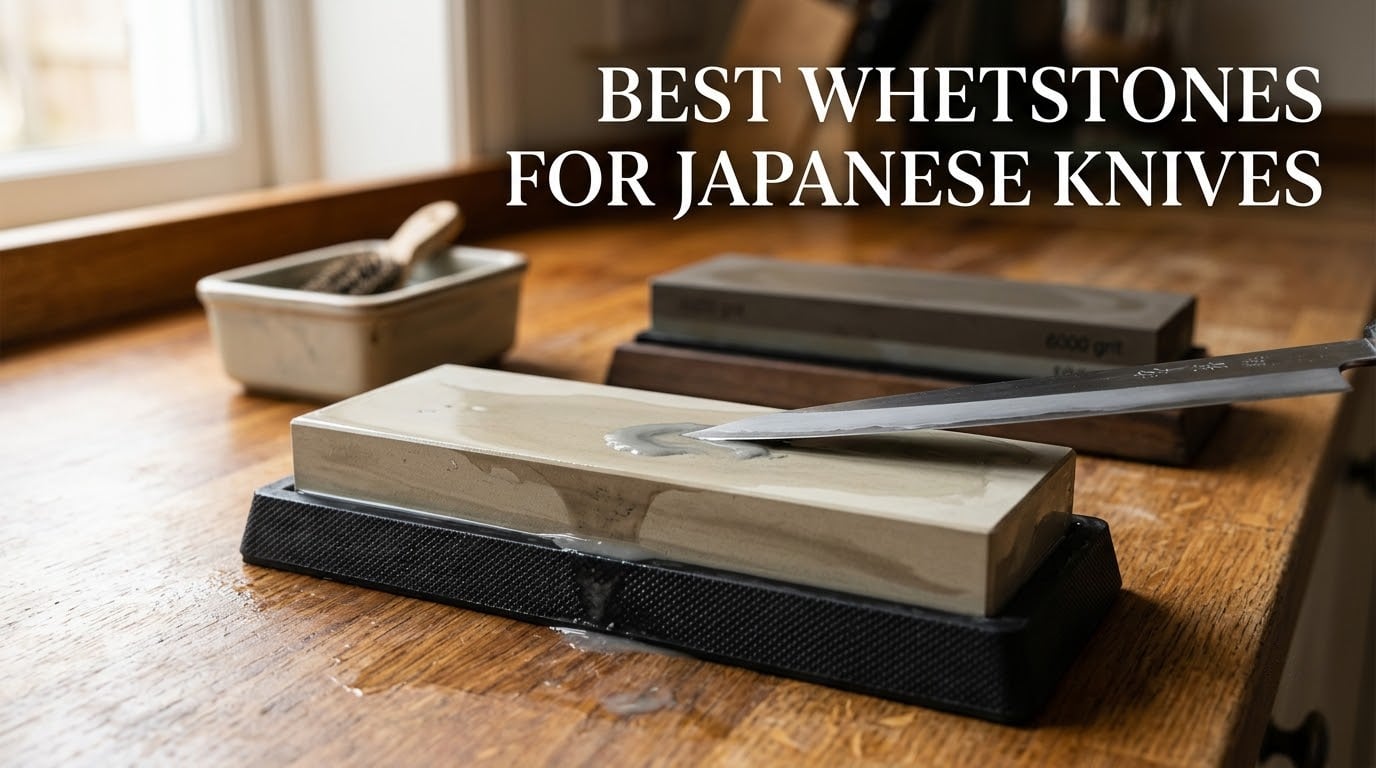
Most people who ask for the best whetstones for Japanese knives want a short list and a straight answer: a single medium-grit waterstone around 1000 grit handles the large majority of kitchen sharpening, and everything else is a refinement. We worked through the stones below, comparing how they cut, how much setup they demand, and how they behave on the thin asymmetric edges Japanese blades are built with.
A whetstone, also called a sharpening stone or water stone, is a block of abrasive used to re-form the apex of a blade. The word whet has nothing to do with water, even though Japanese-style stones are lubricated with water while you work. A stone does not slice metal like a saw; it grinds it away slowly, which is why a water stone can produce an edge that pull-through sharpeners and electric grinders destroy.
Japanese steel is hard, often in the 60s HRC, and usually ground thin so the knife slices rather than chops. A pull-through sharpener or a fast grinding wheel removes too much metal at once, overheats the edge, and leaves it chipped or rolled. A water stone lets you control the angle, the pressure, and how much material comes off, so the original geometry survives.
We put all 12 stones through the same routine: flatten if needed, wet, establish a consistent angle on a normally dull kitchen blade, and refine. If you also handle fish regularly, our picks for the best fillet knives for anglers run into a similar thin-edge problem worth knowing about.
Table of Contents
Top 3 Best Whetstones for Japanese Knives in October


All 12 Best Whetstones for Japanese Knives in 2026
| Product | Specifications | Action |
|---|---|---|
| KING KW65 1000/6000 Combination |
|
Check Latest Price |
| Shapton K0702 Kuromaku #1000 |
|
Check Latest Price |
 Shapton K0710 Kuromaku #8000 Shapton K0710 Kuromaku #8000 |
|
Check Latest Price |
 Sharp Pebble 3000/8000 Kit Sharp Pebble 3000/8000 Kit |
|
Check Latest Price |
 KING Grain #1000 KING Grain #1000 |
|
Check Latest Price |
 Kota Japan 1000/6000 Combo Kota Japan 1000/6000 Combo |
|
Check Latest Price |
 Suehiro Cerax 1010 #1000 Suehiro Cerax 1010 #1000 |
|
Check Latest Price |
 Norton 4000/8000 Combination Norton 4000/8000 Combination |
|
Check Latest Price |
 Shapton Ha No Kuromaku 1000/5000 Set Shapton Ha No Kuromaku 1000/5000 Set |
|
Check Latest Price |
 Mitsumoto Sakari 1000/3000 Mitsumoto Sakari 1000/3000 |
|
Check Latest Price |
 Suehiro Rika 5000-DN Finisher Suehiro Rika 5000-DN Finisher |
|
Check Latest Price |
 Suehiro Cerax #320 Suehiro Cerax #320 |
|
Check Latest Price |
What Each Grit Number Actually Does
Grit is simply particle size. A low number means large, fast-cutting particles; a high number means small, slow particles that polish. Every range below has one job, and doing that job well matters more than owning many ranges.
Between 200 and 400 grit, you are removing chips, resetting a neglected bevel, or reprofiling a knife never sharpened on stones. A 220 grit stone works fast and leaves obvious scratches. A 400 grit stone is gentler and is where most people stop for repair work, because going finer wastes steel.
Between 800 and 1200 grit, you are maintaining the working edge your knife actually cuts with. This is the default range, and 1000 grit is where most people should start. An 800 grit stone, as sold in the Naniwa Chosera line that forum regulars argue about constantly, cuts faster than a 1000 while still leaving a usable finish.
Between 2000 and 3000 grit, the edge becomes more refined and slices cleaner on dense fish or soft produce. A 3000 grit stone is the first step toward a finished bevel rather than a working one.
Between 4000 and 6000 grit, you are polishing. A 4000 face smooths a bevel after a 1000, and a 6000 face produces a noticeably shinier result. Past this range, grit stops improving cutting performance and only changes how light the surface looks.
From 8000 to 10000 grit and beyond, you are chasing a mirror finish for show and for very delicate fish work. On a VG-10 gyuto in daily use, that is close to effort with no practical return.
Two rules keep a Japanese edge safe. Do not grind a thin edge with 200 grit unless there is real damage to remove, and do not buy a set that contains only fine stones, because those will not touch a dull blade. One single-bevel note: a yanagiba or deba has an asymmetrical grind, so the flat back must be polished flat on a stone and never ground into a curve. Double-bevel gyuto and santoku knives are far more forgiving of learning mistakes.
1. KING KW65 1000/6000 Combination Whetstone with Plastic Base – The One Stone To Buy First
KING KW65 1000/6000 Grit Combination Whetstone with Plastic Base
1000 and 6000 grit in one stone
Soak the 1000 side, splash the 6000
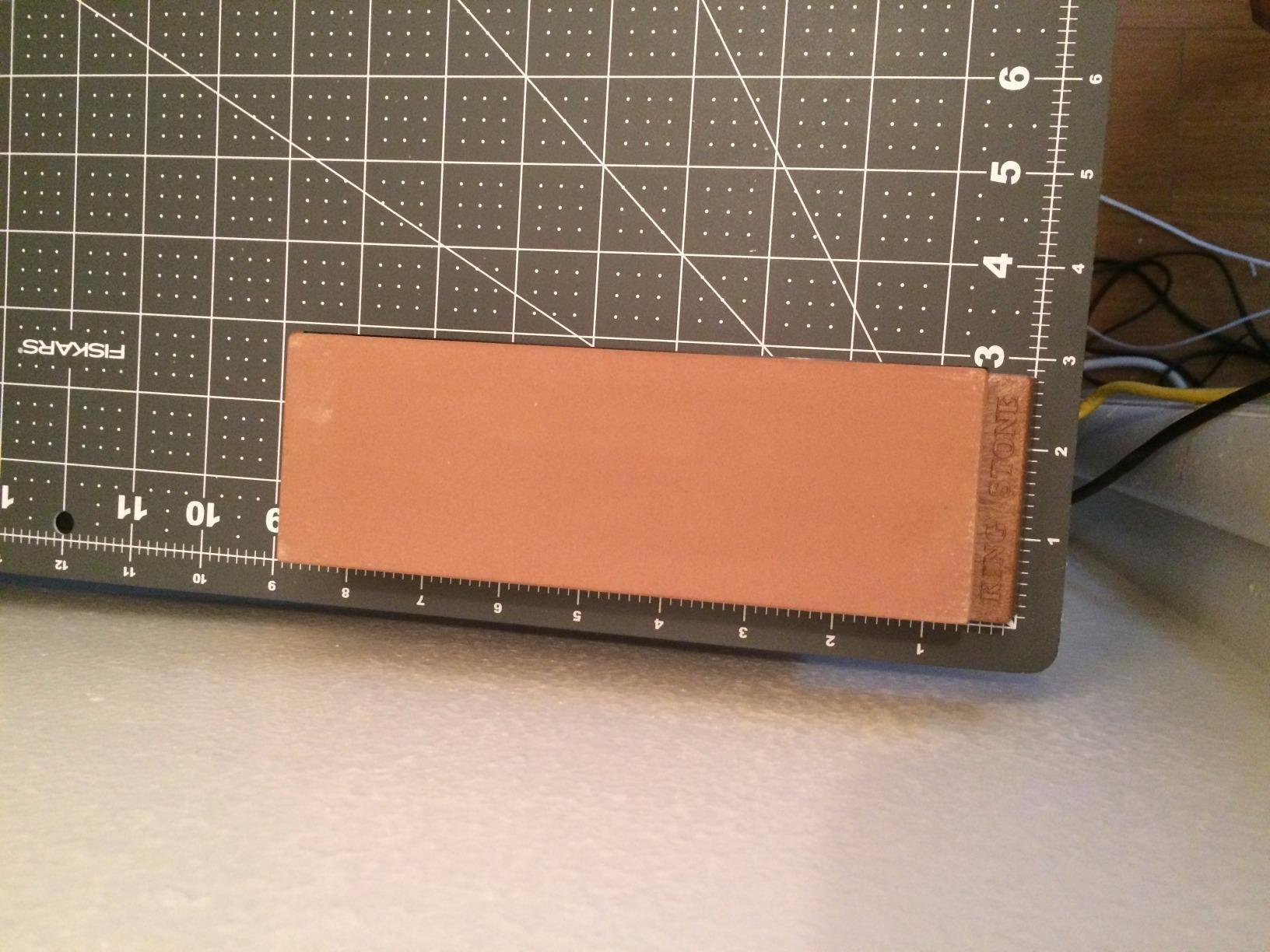
8 x 2 inch face
Plastic base included
Pros
- Two grits cover sharpening and polishing in one stone
- 1000 side restores a dull edge quickly
- 6000 side gives a noticeably smoother edge
- Plastic base works well on a damp towel
- Thousands of reviews from long-term owners
Cons
- Sides carry no grit labelling
- Watery clay slurry can stain surfaces
- Soft stone that dishes with heavy use
This is the stone we hand to friends who own good Japanese knives and cannot get them sharp. The dark 1000 side rebuilds a dull working edge in minutes, and the white 6000 side removes the burr for a smoother finish.
It runs at 4.6 stars across more than 7500 reviews, the deepest owner base in this group, and owners report hair-shaving edges on both cheap stainless chef’s knives and higher-end Japanese blades.
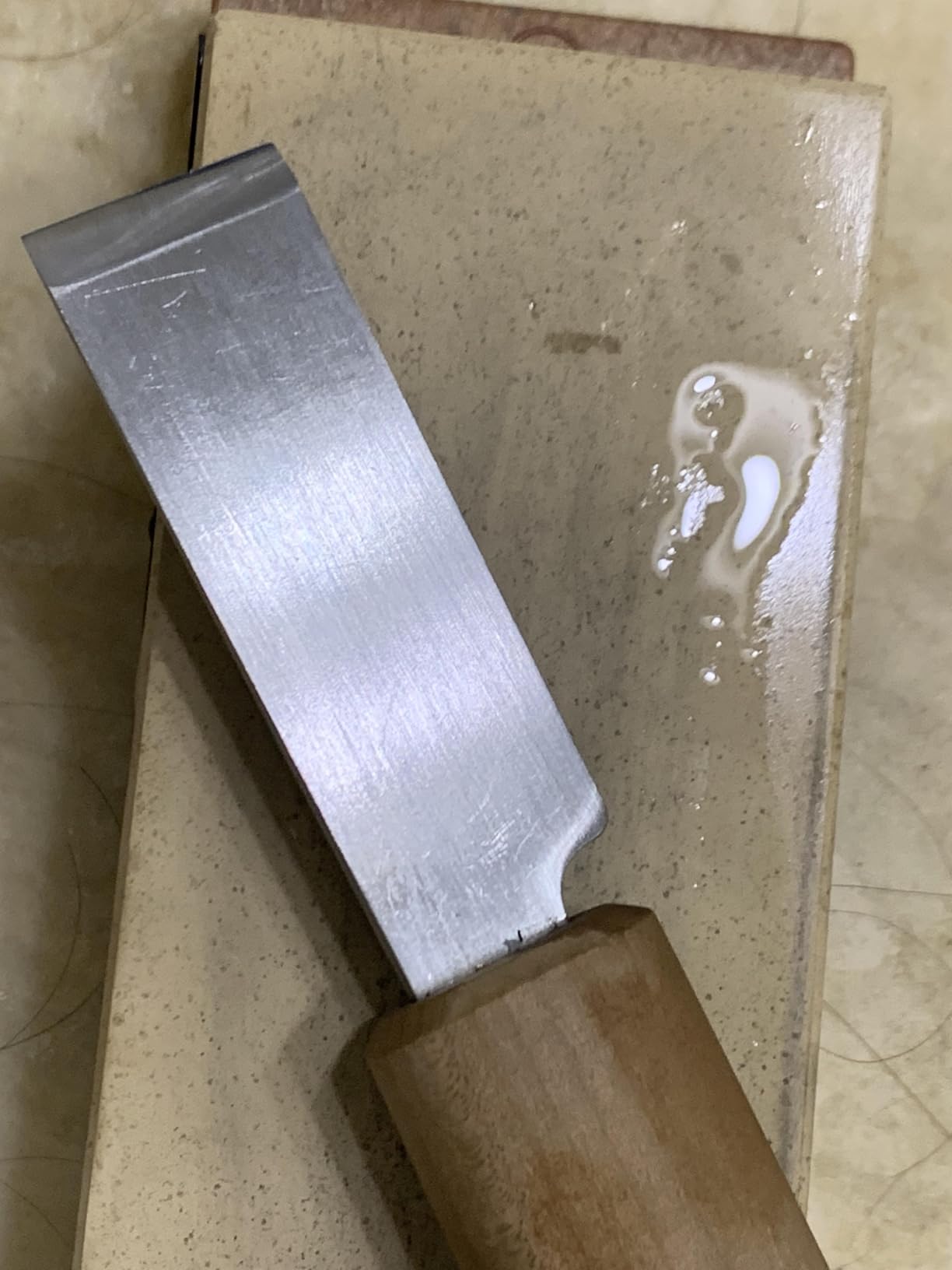
Soak the 1000 side for about ten minutes and put a damp towel under the plastic base; the 6000 side is splash-and-go. Skip the soak and you will get a slow, uneven result and blame the stone.
The drawbacks are honest. Nobody labels the two sides, the 1000 side throws a watery clay slurry that stains a wooden bench, and the stone is soft enough to dish with heavy use.
Who this suits
Buy it if you own one or two Japanese kitchen knives and want a working solution this week. It handles monthly maintenance on a gyuto or santoku, and members of r/TrueChefKnives describe a simple two-grit combination as all a new owner needs.
Where it falls short
It is not a repair stone, so a chip or a rolled edge will not come out here. Users on r/sharpening note that a soft stone gives beginners friendlier feedback than a very hard one, which helps learning but limits finishing. If polishing is your only goal, work in the 3000 to 6000 range instead.
2. Shapton K0702 Kuromaku #1000 – The Best All-Rounder
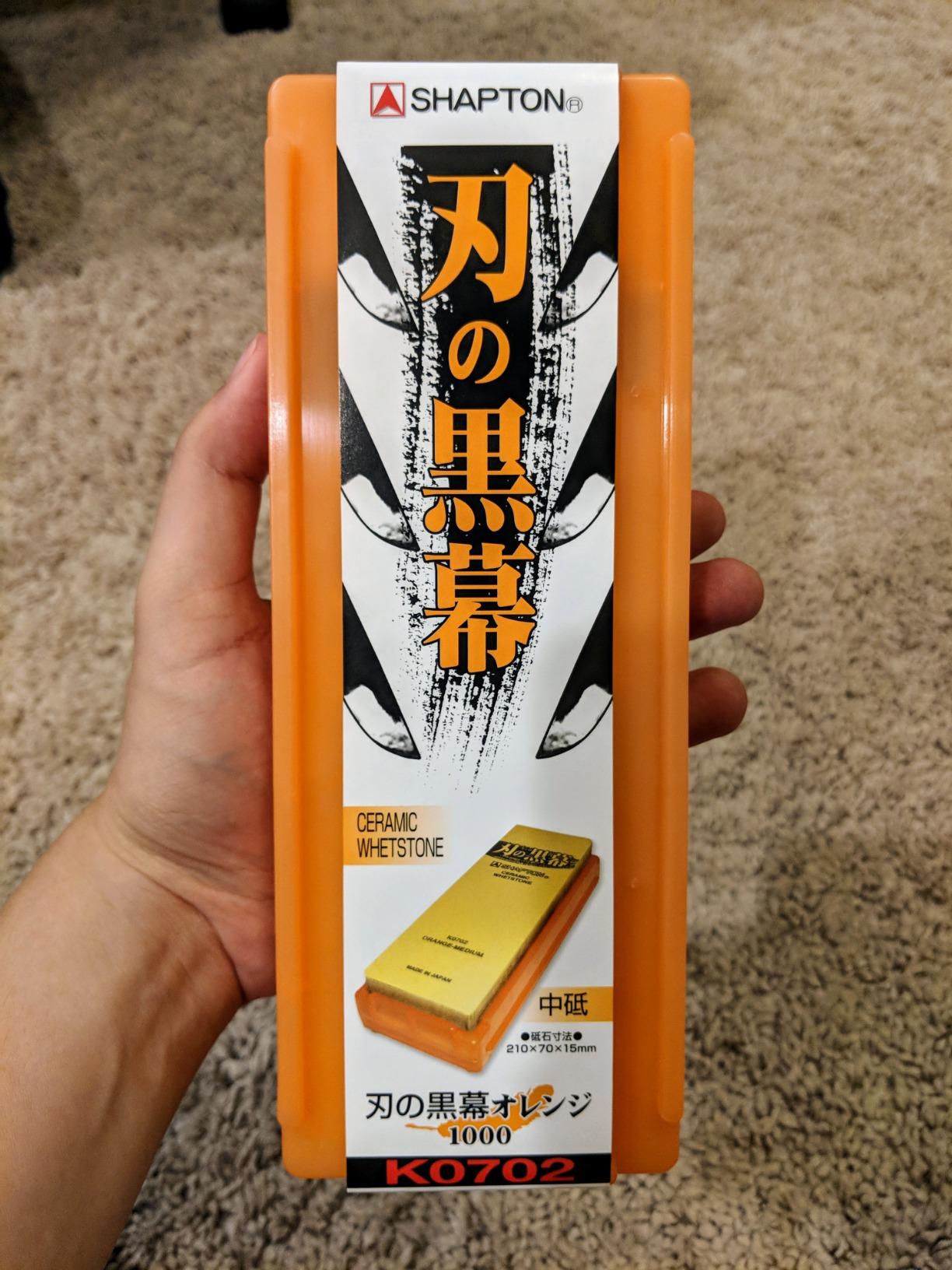
Shapton K0702 Blade, #1000, Medium, Orange
1000 medium grit splash-and-go
Hard ceramic that resists loading
210 x 70 x 15mm
Colour coded orange
Pros
- No soaking needed
- just add water
- Hard surface stays flat with routine use
- Resists loading with steel
- Colour coded grit identification
- Keen toothy working edge
Cons
- Needs a coarser stone for chip repair
- Limited feedback versus softer stones
- Arrives with a light surface film
The Kuromaku 1000 is the stone we reach for when a knife needs a full session rather than a quick touch-up. It cuts fast for a hard stone, builds a clean slurry quickly, and rinses clean because it is splash-and-go ceramic. No soaking, no container, no oily film.
At 4.8 stars from more than 4500 owners, it pairs the highest rating group with the second largest review base, which is why it takes a podium slot. Owners across the Kuromaku range consistently call the 1000 the best all-round stone in the line.
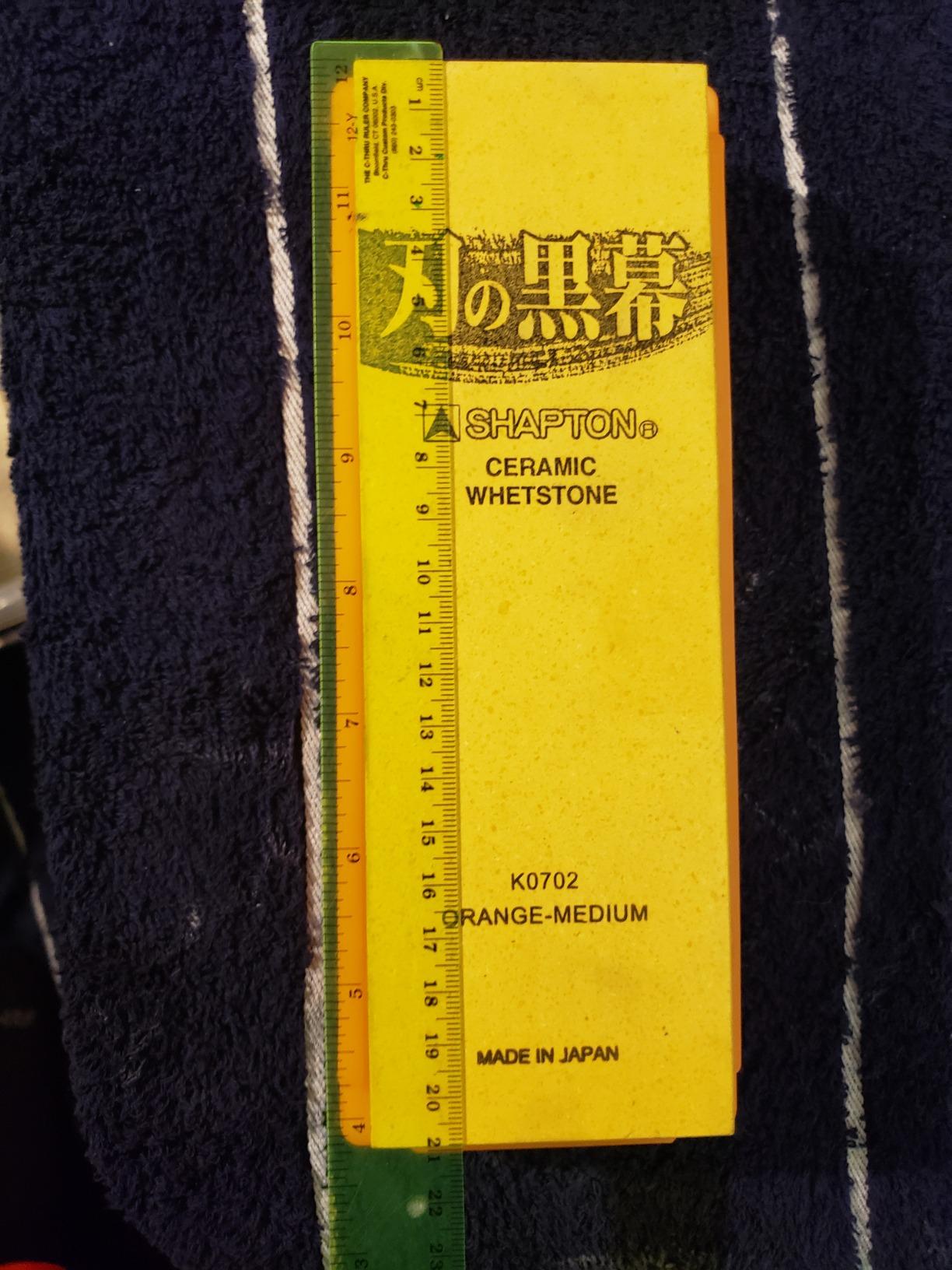
Two notes before you use it. Kuromaku stones commonly arrive slightly out of flat with a light surface film, so run them over a diamond flattening plate once first. The 210 x 70 mm face is also narrower than the King, which matters on a long slicer where you want room for the heel.
On feedback, this stone is harder and smoother than a traditional soaking stone, so first-timers sometimes call it slippery. That fades with practice, and it is the trade for a surface that stays flat for years without turning to mud.
Who this suits
Choose it if you sharpen regularly and hate the ritual of soaking. It is the pick for a monthly session on a VG-10 gyuto, or for anyone maintaining several Japanese knives without wanting a tray of water on the bench. It also suits hard steels, because a hard slow-wearing surface holds its flatness while a thin edge is refined.
Where it falls short
It removes steel slowly, so it is the wrong tool for chip repair or a full reprofile. Pair it with a coarse stone or a 400 grit diamond plate for that. The limited feedback also makes it a less forgiving teacher than a softer stone for a beginner still learning to read the edge.
3. Shapton K0710 Melon #8000 – The Finisher for Hard Steel
Shapton K0710 Melon 8000 Blade Finishing
8000 grit finishing stone
Splash-and-go ceramic
210 x 70 x 15mm face
Colour coded melon
Pros
- Very hard surface that stays flat
- Produces a fine polished edge
- Splash-and-go with minimal mess
- Colour coded grit identification
Cons
- Removes steel slowly
- Limited tactile feedback
- Arrives with an oily film to lap off
This turns a merely sharp bevel into a polished one. After a 1000 or 3000 grit session, a pass on the melon-coloured 8000 produces a bright, fine finish that feels cleaner through food. On hard steels in the low 60s HRC, the visual payoff starts here.
It is a hard ceramic stone, so it stays flat, does not load with steel, and never needs soaking. Owners rate the Kuromaku line as splash-and-go and slow wearing, and the 8000 itself at 4.7 stars across more than 3200 reviews.
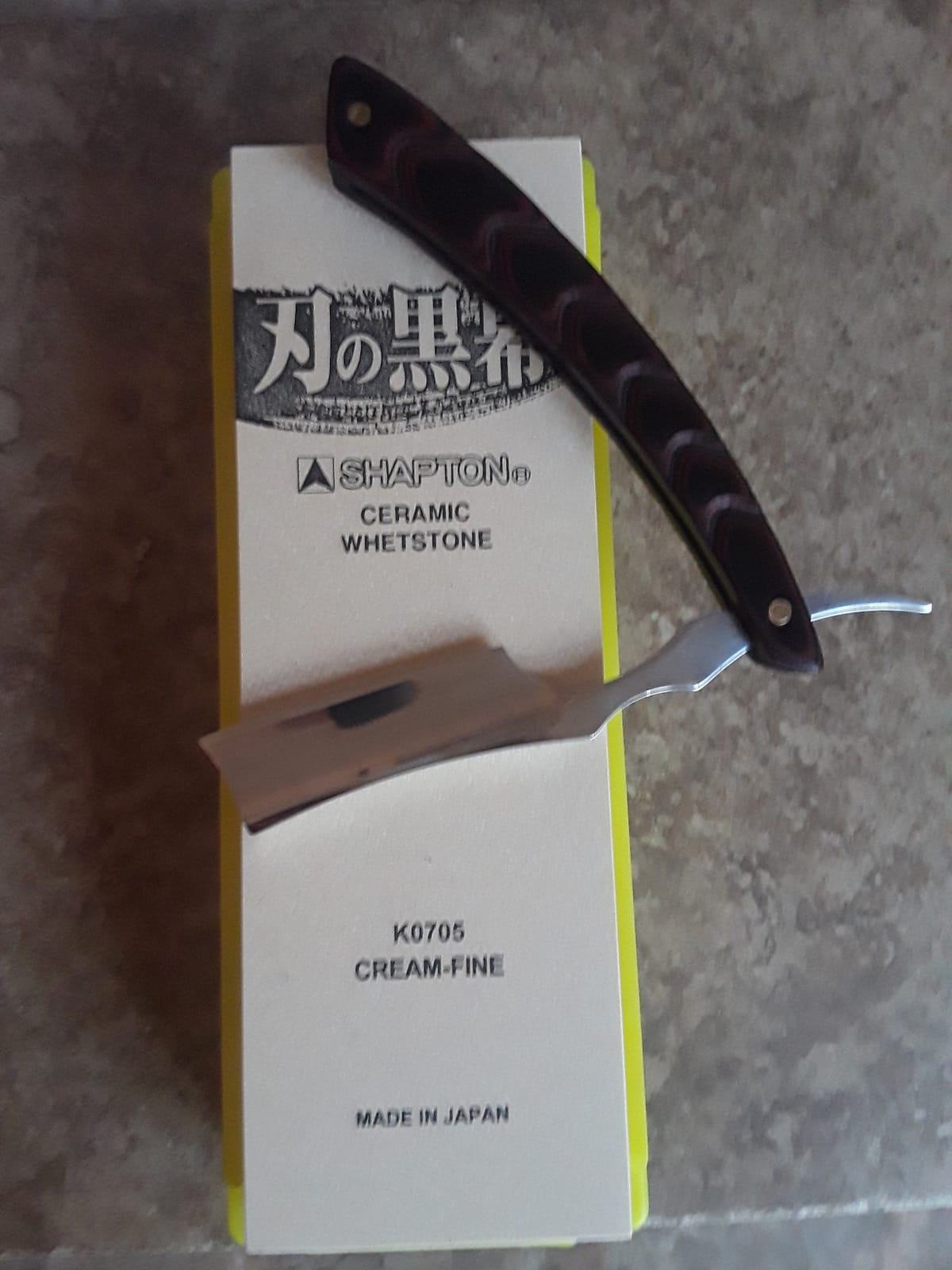
Finishing stone is doing real work here. The 8000 removes steel so slowly that using it on a dull blade will frustrate you. Owners describe it as the last step after a 5000, not the step after a 1000. In a two-stone setup it belongs at the end, not the start.
Like the rest of the range it arrives with a light oily film and high and low spots, so a single lapping session makes a real difference. The melon colour also lets you identify it at a glance on a crowded shelf.
Who this suits
It is built for people who already have a working edge and want it refined. Sashimi knives, a yanagiba after a careful 1000 pass, and hard stainless like VG-10 or D2 all benefit. It also suits anyone who wants a surface that barely wears, because a hard ceramic block holds its flatness far longer than a soft bonding stone.
Where it falls short
It is close to useless for a dull or damaged edge, and the limited feedback gives a beginner very little to read. If your only stone so far is a combination block, buying this first is a mistake. Start with a 1000 grit stone and add this later.
4. Sharp Pebble 3000/8000 Kit – Most Complete Box
Sharp Pebble Whetstone Sharpening Stone 3000/8000 – with Flattening Stone
3000 and 8000 grit honing pair
Aluminum oxide
Bamboo base holder and flattening stone
7.25 x 2.25 inch
Pros
- Base holder and flattening stone in one box
- Water only with no sharpening oil
- Stable platform for a steady angle
- Works on knives scissors and razors
Cons
- No coarse grit for dull or damaged edges
- Leaves visible scratches after both sides
- Included flattening stone is small
- Digital guide mixes up colours and grits
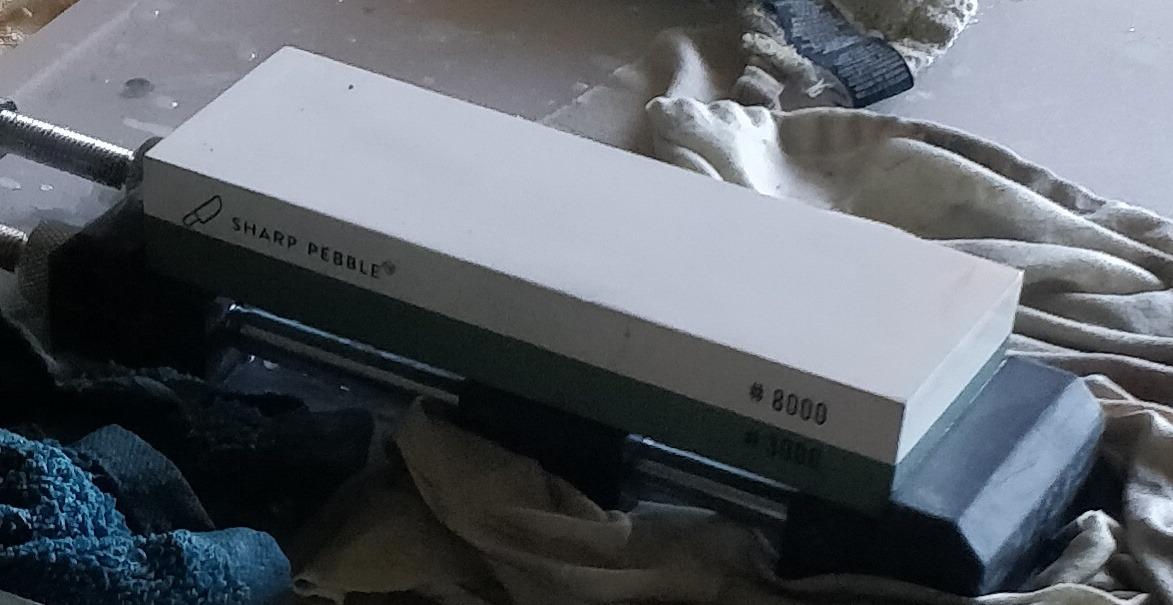
What makes this kit interesting is everything except the grit. The stone arrives with a non-slip bamboo base, a silicone holder, and a flattening stone, which is exactly the accessory set beginners otherwise assemble over several separate purchases.
The stone is an aluminum oxide water stone with a 3000 face for refining and an 8000 face for polishing. Owners at 4.6 stars across more than 4400 reviews report keen edges and, for straight razor users, a shave-ready finish.
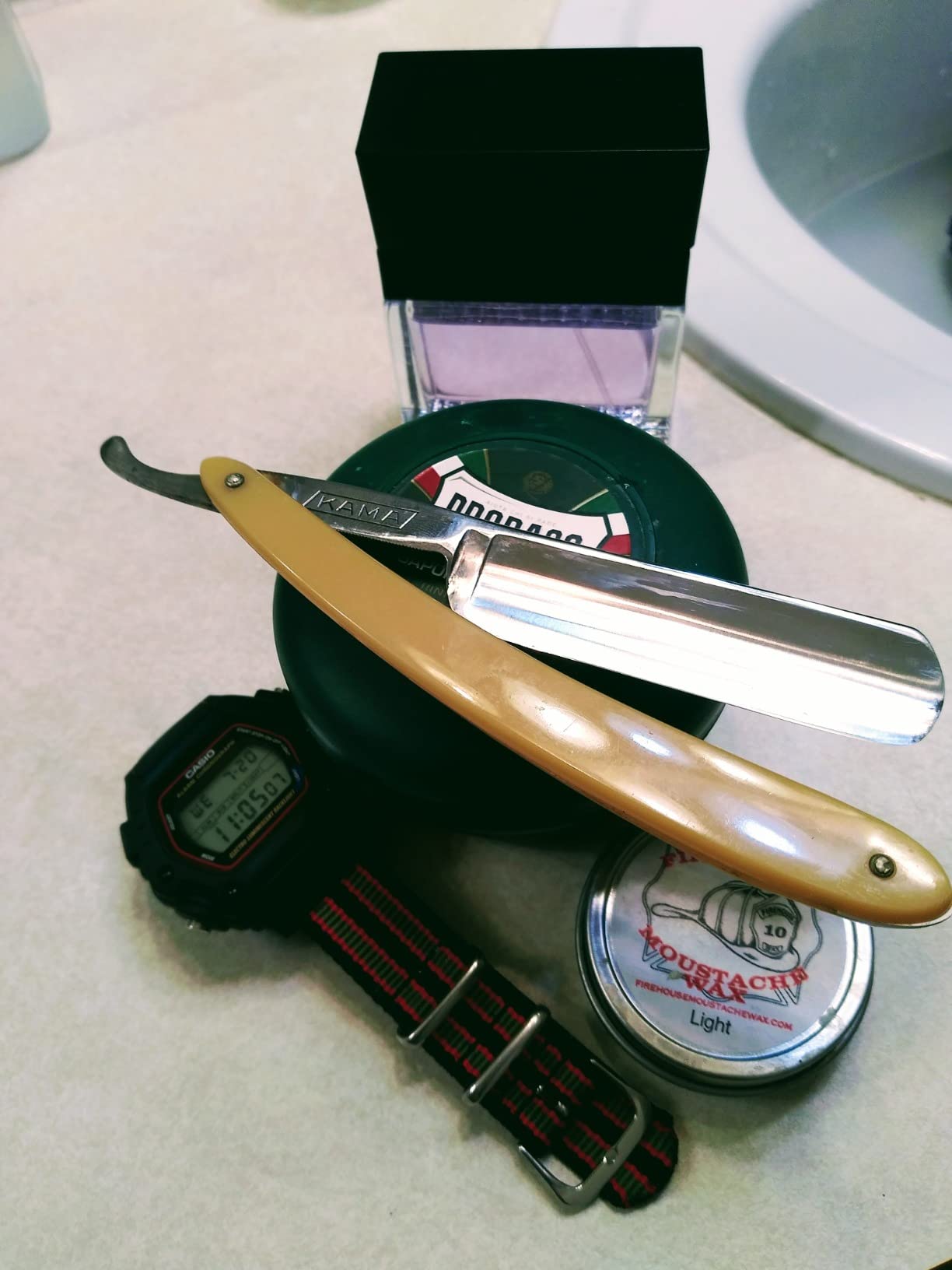
The catch is the grit range. Both faces are honing and polishing grits, so this is not a sharpening system on its own, and reviewers almost universally pair it with something coarser. If your knives are only dull, you will be disappointed.
Smaller complaints come up repeatedly. Some buyers notice scratch lines remaining after both faces, and the printed digital guide confuses the colours against the markings on the stone. The included flattening stone is also small enough that a proper diamond plate still makes sense.
Who this suits
Pick it if your interest is maintaining an already sharp edge, or if you sharpen straight razors and want a compact all-in-one station. It is also a good gift, because nothing is missing from the box. Owners of stones below 1000 grit note on BladeForums that coarser stones matter more to acquire first, so treat this as the second purchase.
Where it falls short
It cannot reset a dull edge, remove a chip, or set a new bevel. Do not let the accessory bundle persuade you it is a complete kit, because 3000 grit does not remove steel fast enough to build an edge back. Never leave it submerged, since a film and rust spots can develop.
5. KING Grain #1000 – The Best Teacher
KING Grain Sharpening Stone, #1000, Medium
True 1000 grit medium stone
Soak before use
Builds a slurry
9.06 x 2.8 inch face
Pros
- Excellent tactile feedback for learners
- Hard for its class and slow wearing
- Very thick stone with long service life
- Uniform scratch pattern
- Handles steels to about 64 HRC
Cons
- Slower cutting than newer stones
- Soft enough to dish or gouge
- No coarse grit for damage repair
- Instructions in Japanese only
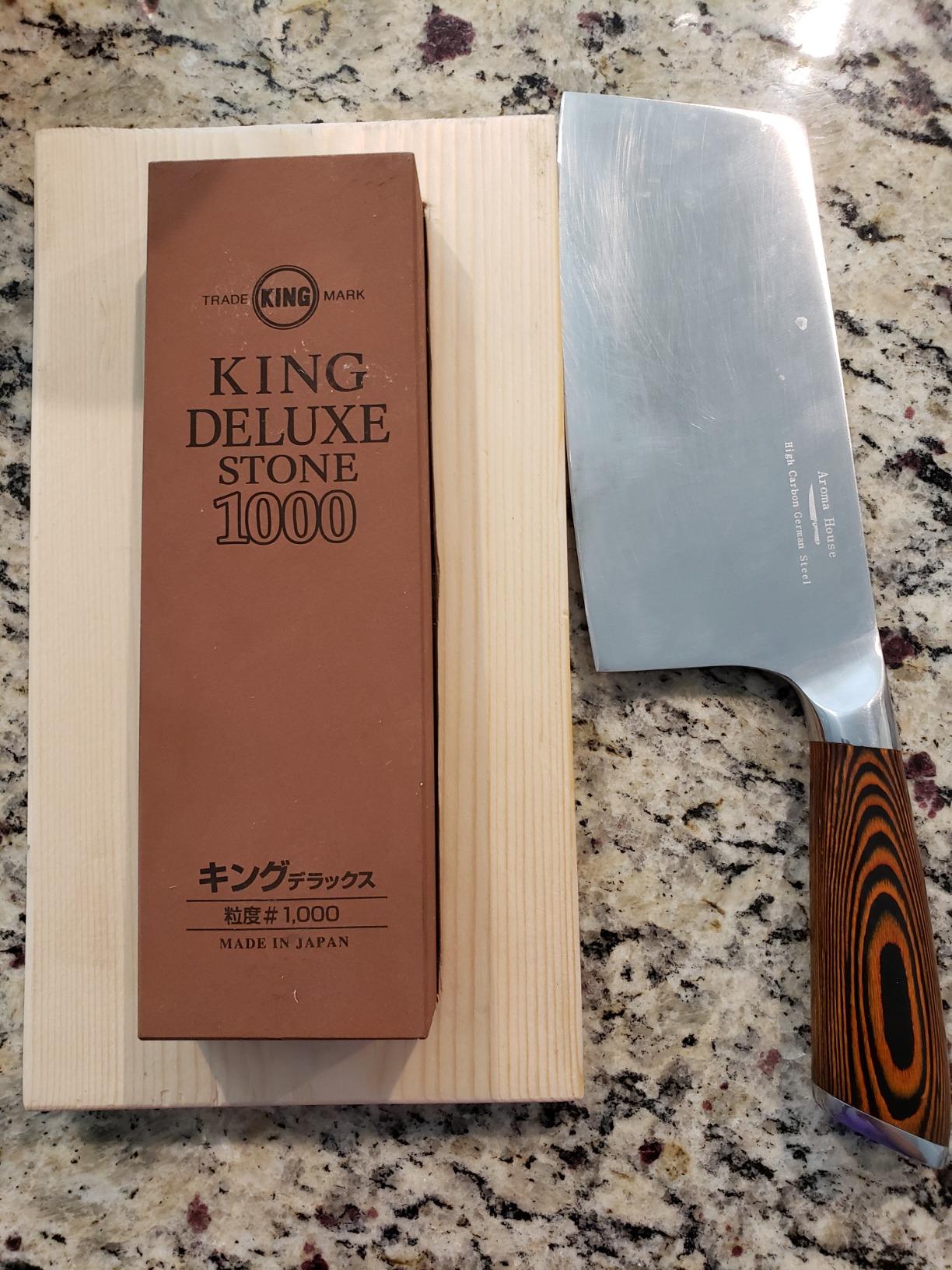
This single-grit King is the classic waterstone without the combination format, and for learning it is the better tool. The grit is a true 1000 rather than a coarser effective number, the stone is thick, and the feedback tells you clearly when the apex is being refined.
It runs at 4.7 stars from more than 2000 owners, and reviews describe a uniform scratch pattern and a hair-shaving edge on Japanese knives. It also handles carbon steel and harder steels up to roughly 64 HRC, which is where the feedback pays off.
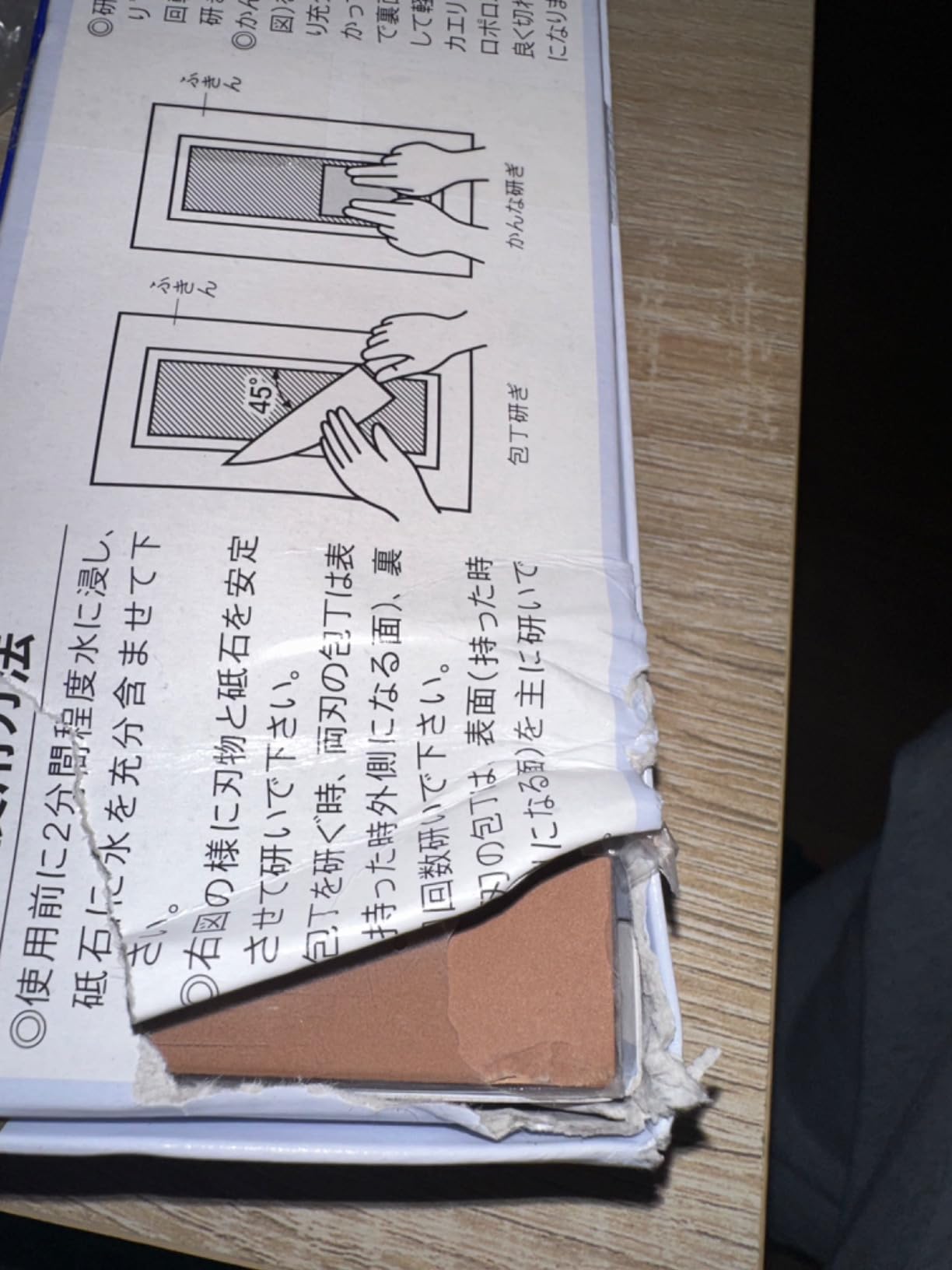
There is a trade. It is a soaking stone, so it needs a flood of water and a container, and it is soft enough to dish or even gouge if you push the edge forward under pressure. Owners also point out that it cuts more slowly than newer stones in the same class.
The face is close to 9 inches long, which makes it a good match for a 210 mm slicer where a smaller stone would force two overlapping passes and invite an angle change mid-blade.
Who this suits
It is built for the person who is new to stones and wants to read the edge. A softer soaking stone teaches you where the apex is faster than a hard ceramic will. Members of r/sharpening split their preferences along hardness lines, favouring softer stones for soft stainless and thinning clad knives, which is where this one sits.
Where it falls short
It does nothing for a chipped edge and it is not a finishing stone. The instructions are in Japanese only, so read the package carefully. Budget for a flattening plate early, since a soft stone that dishes will quietly stop cutting flat.
6. Kota Japan 1000/6000 Combination with Bamboo Base
Kota Japan 1000-grit Coarse Side and 6000-grit Polishing Side Knife Sharpening Whetstone with Bamboo Base and Blade Guide
1000 and 6000 grit dual side
Soak 10 to 15 minutes
Aluminum oxide
Bamboo base and silicone holder
Pros
- Sharpens and polishes on one stone
- Bamboo base and holder keep it steady
- Aluminum oxide resists cracking and chipping
- No oil needed for cleanup
Cons
- Ten to fifteen minute soak each session
- Bulky on the bench
- Japanese-language instructions only
- No angle guide despite the listing
This is a straightforward dual-grit water stone with a stable base included, and its value is convenience rather than refinement. The bamboo base and silicone holder do a good job of stopping the stone sliding, which is the single biggest reason beginners get an inconsistent angle on a first attempt.
At 4.6 stars from just under 1000 owners, the feedback is consistent: it sharpens and polishes in one tool, handles kitchen knives, pocket knives, scissors and razors, and needs no oil for cleanup.
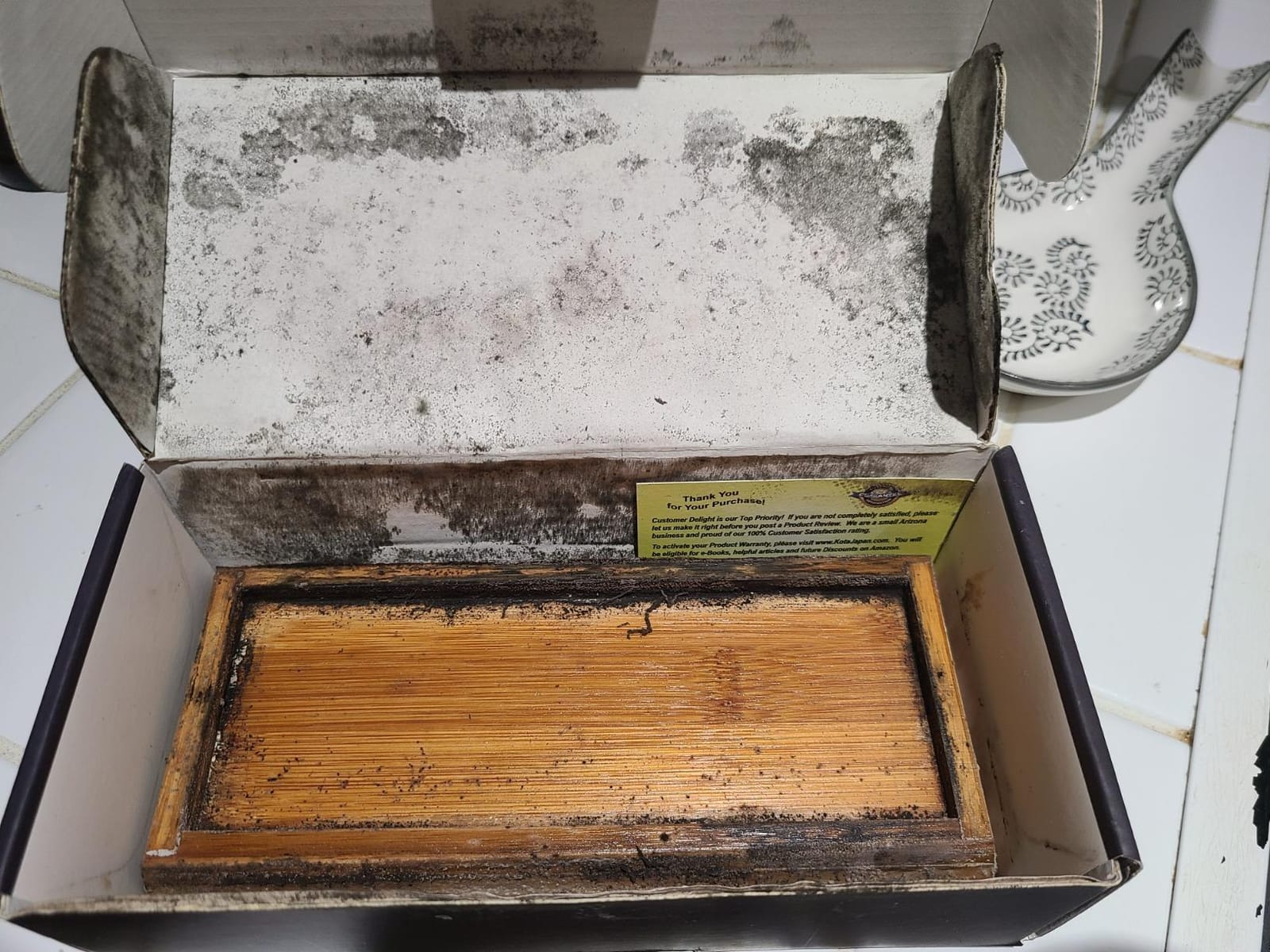
The setup requirement decides it. This is a soaking stone, so you wait ten to fifteen minutes before every session and need a container to match. The construction is aluminum oxide, which resists chipping better than a soft clay-bonded stone, but the face is only about 7.25 inches long.
It is also bulky and Japanese-language only, despite the listing mentioning a blade guide. Do not rely on that guide. Learn the angle on a cheap knife first, then take the stone to good steel.
Who this suits
It suits a first-time owner who wants a stable platform more than a premium surface and does not mind waiting while the stone soaks. It is also a reasonable second stone for someone who sharpens straight razors alongside kitchen knives and wants a 6000 face on hand.
Where it falls short
It will not reset a damaged edge, and the required soak makes it a poor fit for quick touch-ups during cooking. The listing wording implies an angle guide that owners do not receive, so treat the included accessories as base and holder only.
7. Suehiro Cerax 1010 #1000 – Best for Carbon Steel
Suehiro Cerax 1010 Grit #1000 Sharpening Stone
1000 medium grit soaking stone
Cerax series ceramic
210 x 73 x 30mm class
Sold without a base
Pros
- Consistent grit and clean scratch pattern
- Well made Japanese construction
- Packs well with Cerax 320 and Rika 5000
- A standard first stage for kitchen knives
Cons
- Needs soaking and a container
- Softer than splash-and-go ceramic
- Sold without a base
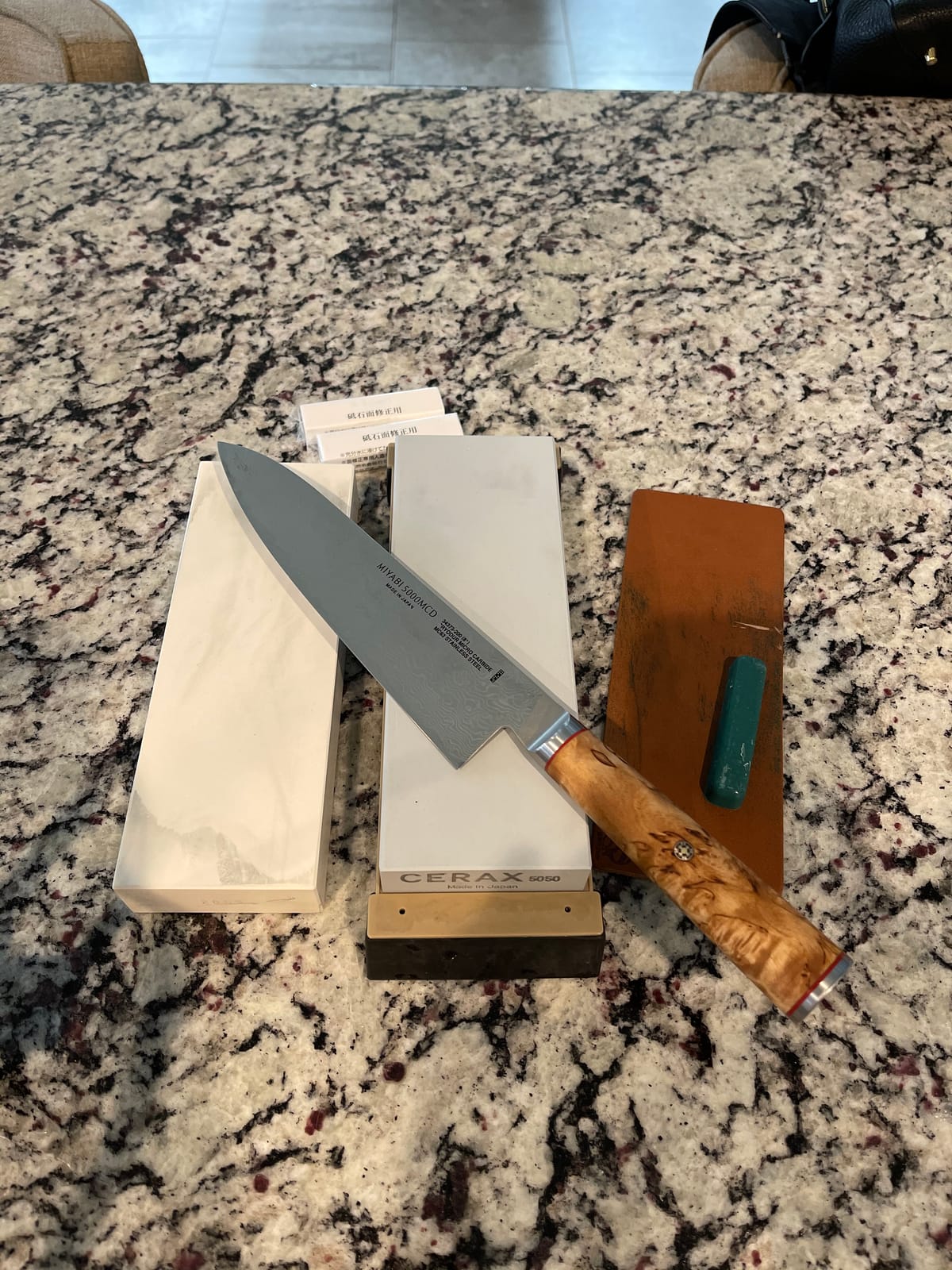
The Cerax 1010 is a soaking 1000 grit stone from a Japanese maker with a very consistent reputation, and it earns 4.8 stars across more than 600 owners. Grit consistency is the headline, producing a clean uniform scratch pattern that makes progress easy to judge on a carbon steel blade.
It is a soft stone, so it forms a proper slurry and it dishes, which means flattening is part of owning it. That is the behaviour that makes a traditional Japanese waterstone feel like a waterstone.
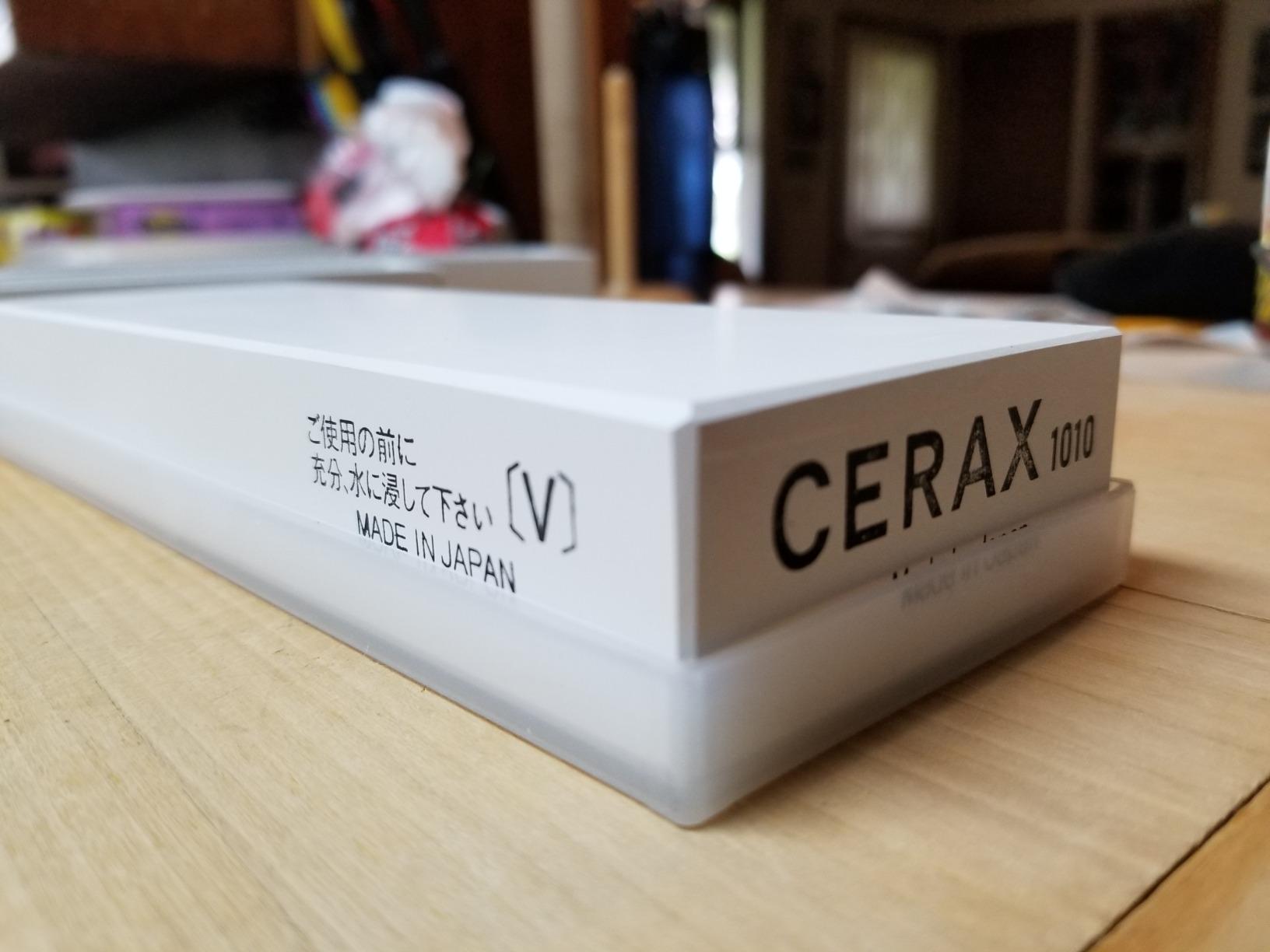
Think of it as the middle of a system. Owners pair it with the Cerax 320 for damage repair and the Rika 5000 as a finisher, and that three-stone Cerax progression is one of the most discussed setups in knife forums. You do not need all three to start, but it shows where this stone sits.
Plan the logistics. It is sold as a bare stone with no base and needs a ten to fifteen minute soak, so buy a container and a stone holder before the first session rather than after.
Who this suits
It is a strong choice for carbon steel and clad Japanese kitchen knives where the edge is maintained rather than rebuilt. The uniform finish makes it a good teacher for anyone comfortable with a traditional waterstone routine, and it pairs cleanly with the Rika 5000 in this same guide.
Where it falls short
It is neither a finisher nor a repair stone. The soaking requirement makes it awkward for quick jobs, and without a base you will improvise a stable platform on your first attempt. Buy the holder at the same time.
8. Norton 4000/8000 Combination Bench Stone
Norton Knife Sharpener Whetstone Japanese Sharpening Stone with 4000/8000 Combination Grit, Wet Stone Sharpening Stone
4000 and 8000 grit faces
Soak 15 to 20 minutes
Corundum bench stone
1 x 8 x 3 inch
Pros
- Smooth polished edges on a sharp blade
- Case doubles as a stand with grippy feet
- Needs less pressure than an oil stone
- Works on knives and straight razors
Cons
- Some units arrive out of flat
- Soft and dishes faster than harder ceramic
- 8000 face can glaze without a dressing stone
- Too fine to reset a dull edge
This is a Western bench stone rather than a Japanese import, and it behaves differently on purpose. The 4000 face maintains and refines, the 8000 face polishes, and water lubrication means you need noticeably less pressure than with an oil stone.
It is a long-standing favourite with straight razor owners, and that use case transfers to a fine-edged Japanese knife once the edge is already refined. The plastic case doubles as a holder with rubber feet.
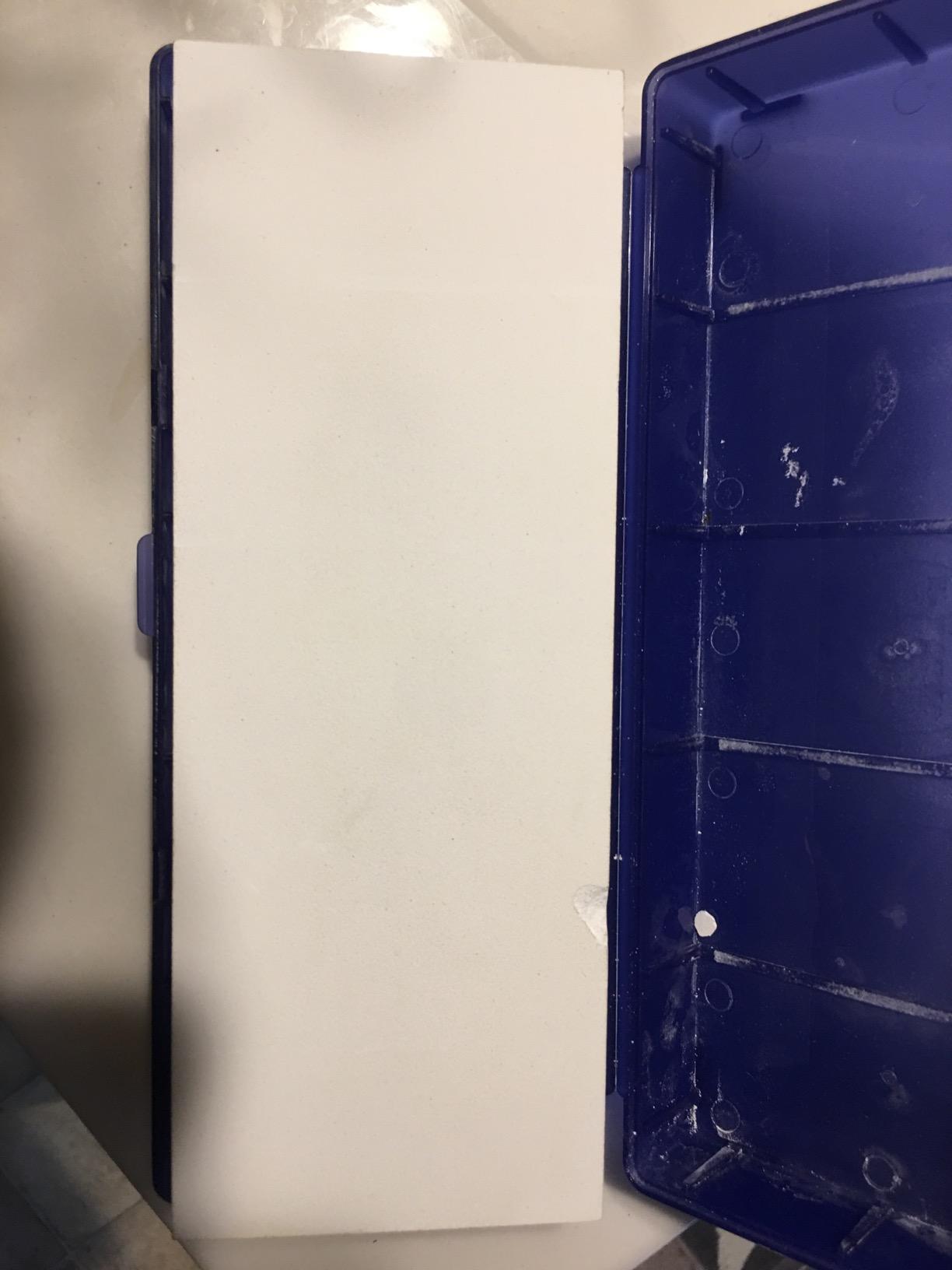
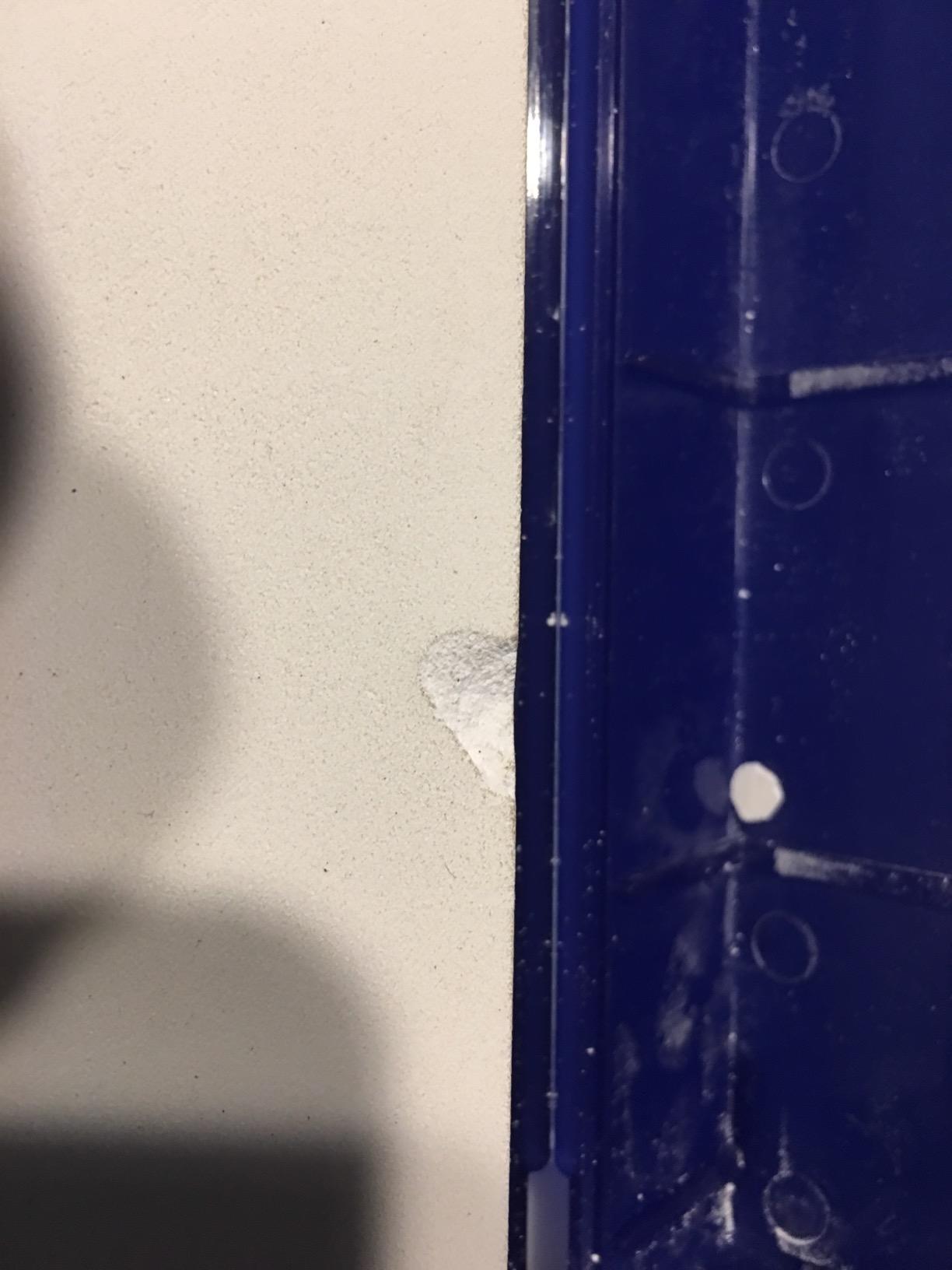
Two warnings. Some units arrive out of flat and need a flattening plate first, and because it is a soft stone it wears and dishes faster than hard ceramic. The 8000 face can also glaze over and stop cutting unless dressed periodically with a nagura stone.
Both faces are fine enough that this stone cannot repair a dull edge or establish a new bevel. If your knife is dull, work in the 400 to 1000 range first.
Who this suits
It is a good second stone for a kitchen setup that already has a coarse and medium option, and a strong pick if you split your hobby between kitchen knives and straight razors. The bench size and included holder make it a low-friction addition, and it suits anyone who prefers one familiar Western stone for a mixed knife block.
Where it falls short
Softness, inconsistent out-of-box flatness and a glazing 8000 face together mean it asks for more maintenance than a hard ceramic stone. It is also a heavy bench-sized option, and the fifteen to twenty minute soak is the longest we recommend.
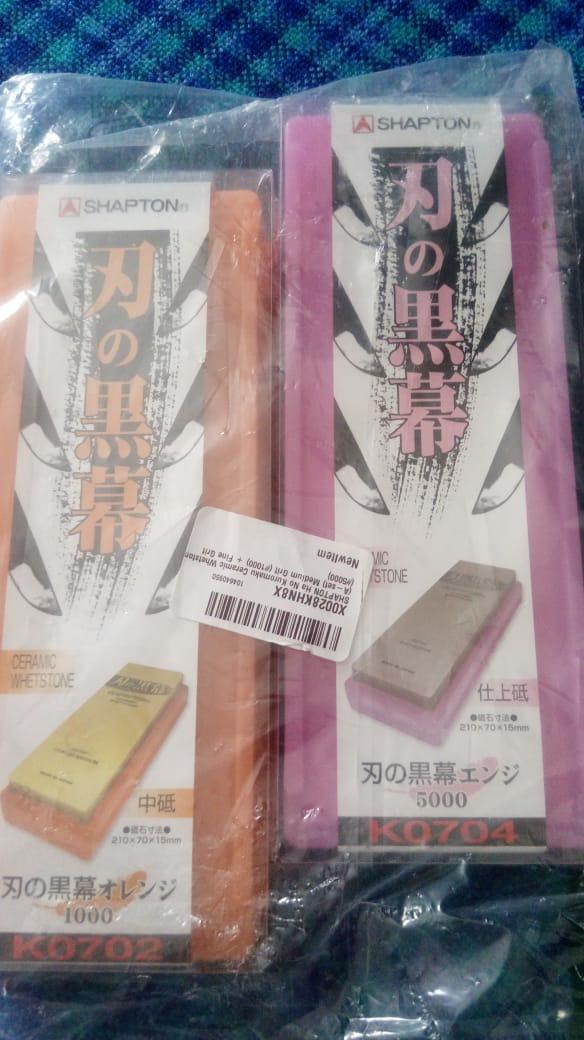
9. Shapton Ha No Kuromaku 1000/5000 Set – Best Two-Stone Box
SHAPTON Ha No Kuromaku Ceramic Whetstone (A-set) Medium Grit (#1000) + Fine Grit (#5000)
1000 and 5000 grit pair
Splash-and-go ceramic
Vented boxes double as holders
210 x 70 x 15mm each
Pros
- Covers a full sharpen and polish progression
- No soaking and quick cleanup
- Hard slow wearing ceramic construction
- Vented cases hold the stones steady
Cons
- Stones need lapping before first use
- The 1000 cuts coarser than most 1000 grit stones
- 5000 still shows fine scratches
- No angle guide included
This set is the cleanest two-stone answer in the guide. A 1000 grit stone builds and maintains the working edge, a 5000 grit stone refines it, and both are splash-and-go ceramic that clean up with water in seconds. Long-time sharpeners put it among the best-performing synthetic waterstones available.
It runs at 4.8 stars from more than 400 owners, and the recurring comment is fast cutting, slow wear and a polished result. Reported edges hold well on kitchen, pocket and outdoor knives.
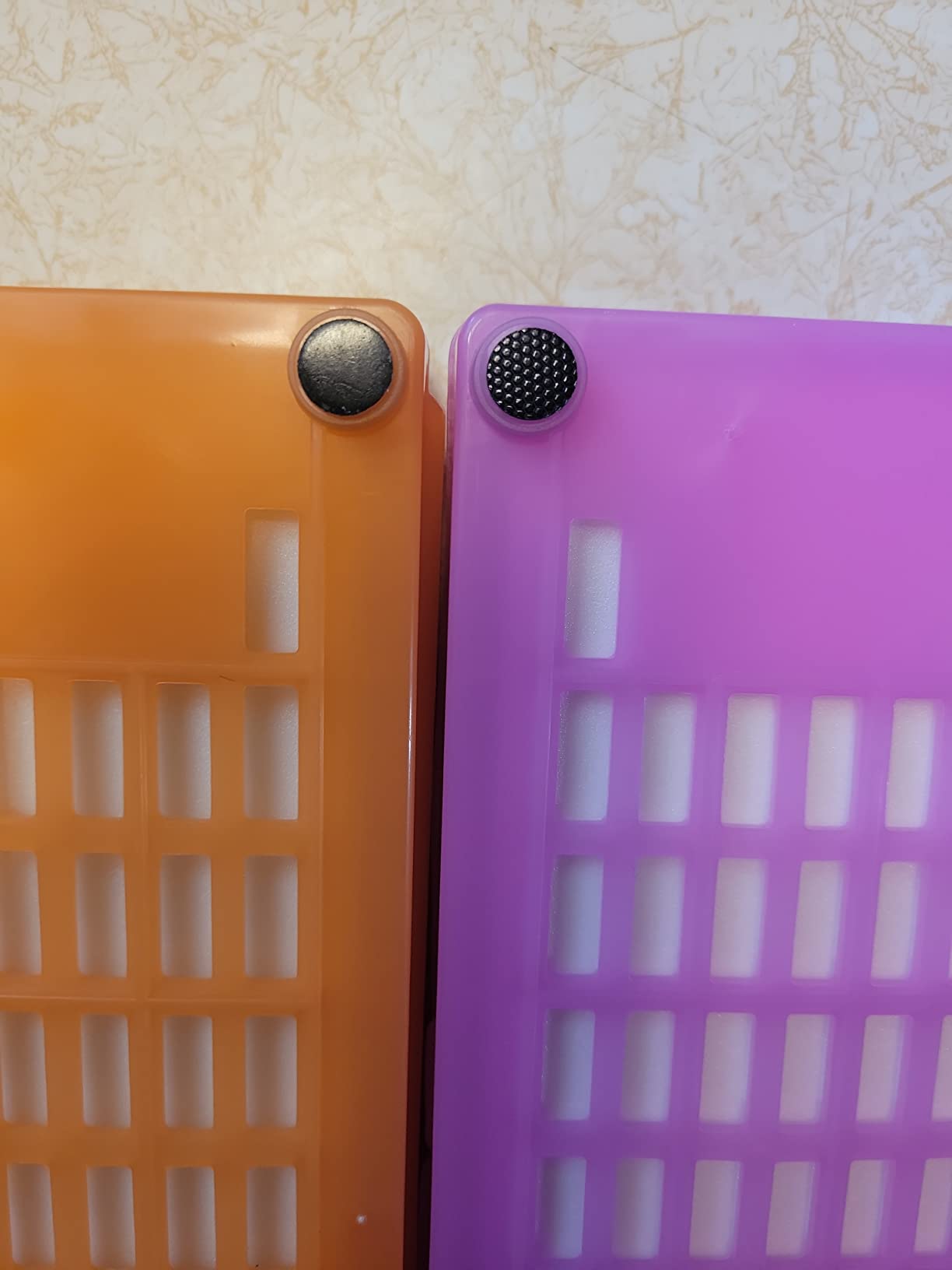
The most useful thing owners tell you is that these stones arrive with high and low spots, so lap both before the first use. The second is that the 1000 grit in this set cuts coarser than other stones sold as 1000. Neither is a defect, but both surprise people who compare it against a softer traditional stone.
The 5000 face is a finisher, not a mirror stone. For a truly reflective bevel you need 8000 or above, and many owners suggest a 2000 grit stone or a strop to fill the gap between the two included faces.
Who this suits
It suits anyone who has decided to maintain Japanese knives seriously and wants a complete, matching system in one purchase. The vented boxes double as holders, and because both stones share the same dimensions you can stack them and work across a consistent face between stages.
Where it falls short
There is no coarse stone in the box, so a chipped edge is still unhandled, and no angle guide is included. The coarse effective grit of the 1000 face also means this cannot serve as a finishing-only setup for an already polished knife.
10. Mitsumoto Sakari 1000/3000 Whetstone
MITSUMOTO SAKARI 1000/3000 Grit Japanese Whetstone Knife Sharpening Stone
1000 and 3000 grit faces
Soaking waterstone
Sintered white corundum
7.09 x 2.36 inch
Pros
- Two-sided sharpen and polish
- Bamboo base helps hold a steady angle
- Brings dull knives back to sharp
- Compact size suits travel
Cons
- Soaking and slurry mess
- No instructions included
- One report of a chipped corner on arrival
- Lowest average rating in this group at 4.5
The 1000 face repairs a dull edge and the 3000 face hones and polishes, all on one compact stone. The construction is high-temperature sintered white corundum for uniform abrasion, and the optimised pore structure produces a steady slurry after soaking rather than a dry scratchy pass.
Owners rate it at 4.5 stars across more than 400 reviews, the lowest average in this group, and the reviews reflect a stone that works once the technique is learned. Several mention taking dull carbon steel and kitchen knives back to sharp convincingly.
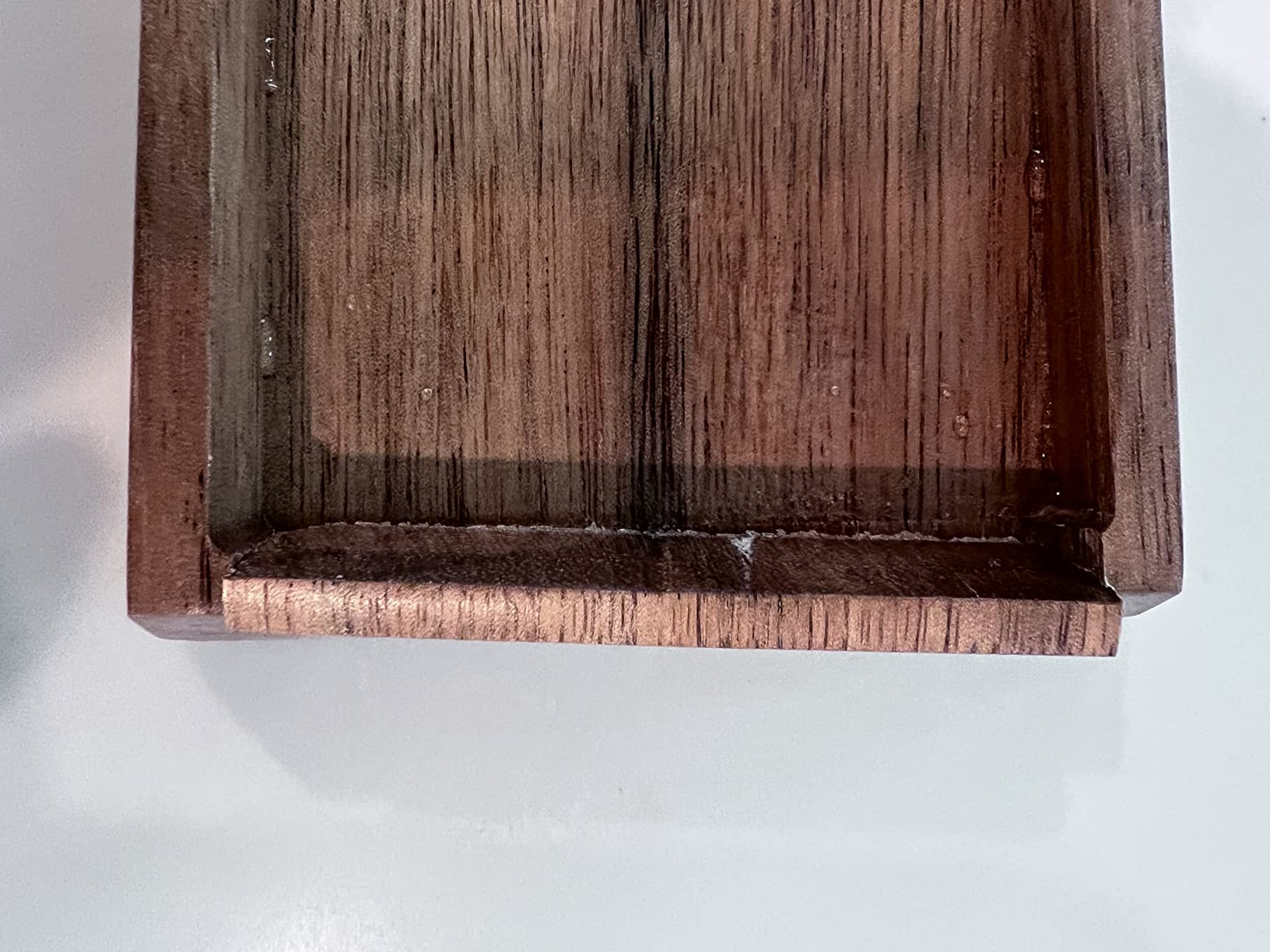
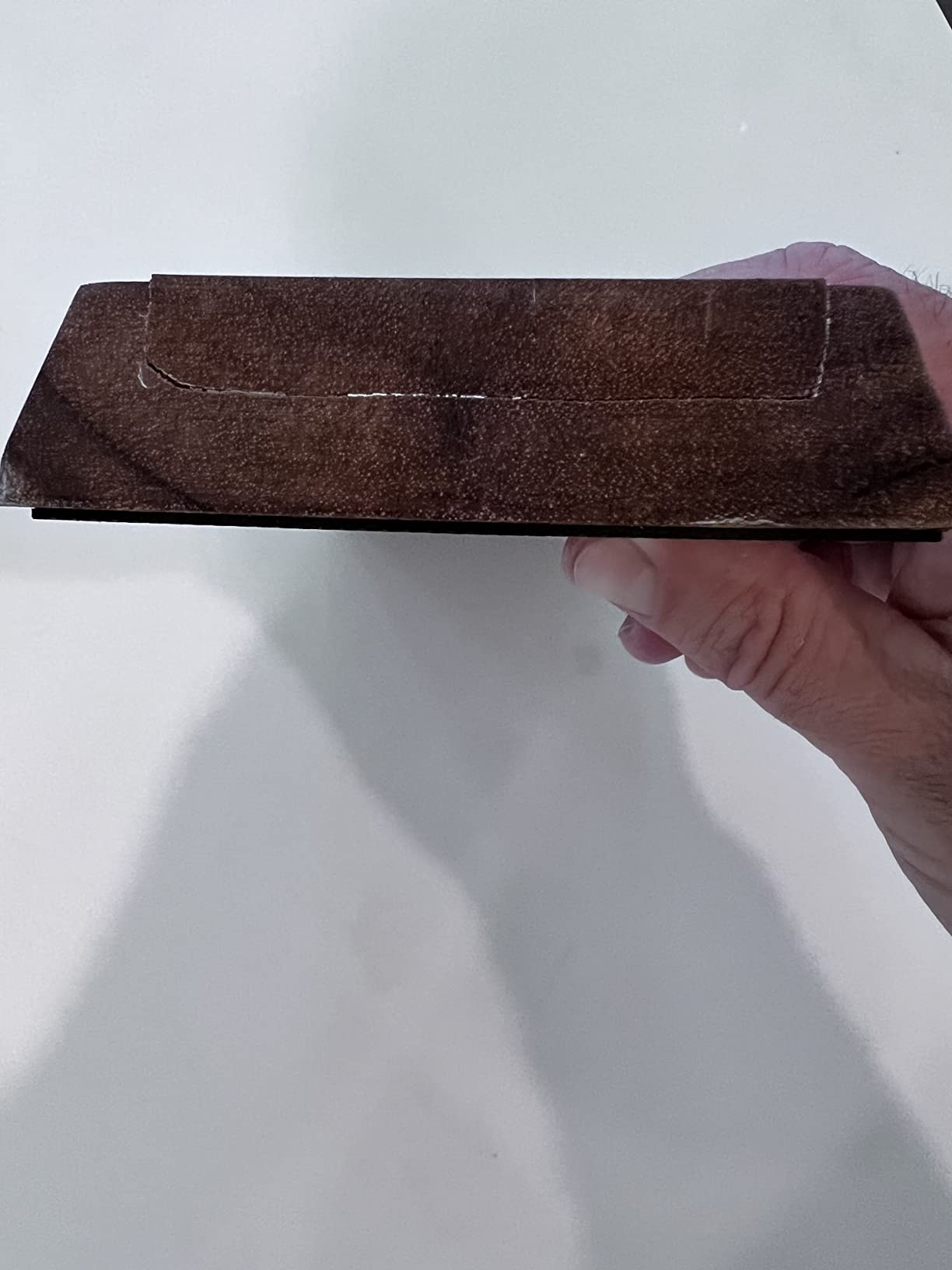
The bamboo base is a genuine feature, because it reduces sliding and helps hold a steady angle in the 15 to 20 degree range a Japanese double-bevel edge wants. The compact 7 inch face is easy to pack but means a 210 mm blade needs overlapping passes.
Expect the usual soaking friction. It needs water before use, it forms a slurry that takes some cleaning up, and no instructions are included. One buyer also reported a chipped corner and a stone that needed flattening on arrival.
Who this suits
It suits a home cook who wants sharpening and polishing on one compact stone and travels with it, or who sharpens at a second property. The non-slip base makes it a friendly first waterstone for anyone worried about a sliding surface ruining the angle, and the 1000 face handles ordinary dull Western steel too.
Where it falls short
Both faces are too fine for a chipped edge, the soaking and slurry make it poor for quick sessions, and the small face limits long blades. With the lowest average rating here, expect more variability in finish quality between units.
11. Suehiro Rika 5000-DN Finishing Stone
Suehiro Grit #5000 ‘Rika 5000-DN Without Base’ Finishing Whetstone
5000 grit finishing stone
Soaking ceramic
Sold without a base
206 x 73 x 23mm
Pros
- Very smooth creamy feedback
- Bright satin to near-mirror bevel
- Hard wearing surface
- Often beats a 1000/6000 plus a strop
Cons
- Sold without a base
- Must be soaked despite ceramic construction
- Softer than Shapton Kuromaku
- Takes days to dry out
The Rika 5000 is the stone in this group that people describe as enjoyable. The feedback is smooth and creamy in a way fine synthetic stones rarely manage, and the finish is a bright satin that approaches a mirror without chasing one.
It holds 4.8 stars from more than 350 owners, and a common report is that it beats a 1000/6000 combination followed by a strop. For a double-bevel kitchen knife already sharpened at 1000 or 3000, that is a meaningful upgrade.
Two things catch people out. It is ceramic, so you expect splash-and-go, but it is a soaking stone needing roughly five minutes of water. And it is sold without a base, so a holder or stone tub is a mandatory companion purchase rather than an optional extra.
Being softer than the Shapton Kuromaku, it wears faster and produces more slurry, and the fine grain can take days to dry out completely. Store it ventilated, never sealed while damp. The current version also has no grit markings on the stone, so keep the box.
Who this suits
It suits anyone who has finished at 1000 or 3000 and wants a more refined bevel without buying a fourth stone. It works across kitchen knives, pocket folders and fixed blades, and it pairs well with the Cerax 1010 in this same guide. If a bright, sharp-looking edge is part of the satisfaction, this delivers it.
Where it falls short
It removes very little steel, so it is a poor choice as a first or only stone. It needs a base and a soaking container, and the slow drying cycle is a nuisance in a small kitchen. If you already own a 5000 or finer, this is an upgrade rather than a necessity.
12. Suehiro Cerax #320 Coarse Stone
Suehiro Cerax #320
320 grit coarse waterstone
Soak 10 to 15 minutes
210 x 75 x 30mm
Cerax series
Pros
- Cuts fast and removes metal efficiently
- Resets bevels and clears edge dings
- Consistent Japanese grit with no soft spots
- Good felt feedback through the pass
Cons
- Ten to fifteen minute soak
- Too aggressive for touch-ups
- Sits near 400 grit diamond plates that need no setup
- Can soften and clog with heavy use
Most roundups of Japanese stones skip the coarse end, and that is a mistake for anyone whose knives have been neglected. The Cerax 320 resets a bevel, clears edge dings, and removes metal fast enough that owners report taking dull German and cheap knives to paper-sharp in about ten minutes when followed by a Cerax 1000.
It rates 4.8 stars across more than 240 reviews, and the praise is consistent: fast cutting, no soft spots in the grit, and it removes chips without creating new damage. The 210 x 75 x 30 mm block is thick, which is what you want from a stone taking heavy passes.
Who this suits
It suits anyone with nicked edges, a knife that has never been sharpened on stones, or a budget knife needing a fresh bevel. It is also the natural companion to the Cerax 1010, and together they cover repair and maintenance in one system. BladeForums regulars advise acquiring stones below 1000 grit before the high-grit stones, and this is the way to act on that with a genuine Japanese waterstone rather than a generic plate.
Where it falls short
The 320 grit is too aggressive for touch-ups, and repeated use on a thin Japanese edge removes steel you cannot replace. It also overlaps closely with a 400 grit diamond plate, which does the same job faster with no soaking, container or flattening. Soak time is a further friction, and very heavy use can clog and soften the surface.
How to Choose a Whetstone Without Overbuying
Most beginners in this forum topic describe the same problem: too many options, and a fear of buying the wrong stone. The fix is to route by the job rather than by the grit ladder. Start from the condition of your edge, then the level you are at, then the format you will actually live with.
Step one, choose by edge condition. A dull but undamaged blade wants a 1000 grit stone. A chipped or badly rolled edge wants 400 grit or a coarse plate first, then 1000. An already sharp edge that you want to look and feel better wants 3000 to 6000. That single question removes most of the confusion.
Step two, choose by level. If this is your first whetstone, a soft soaking stone with clear feedback teaches you fastest. If you already know how to hold an angle, a hard splash-and-go ceramic saves you setup time and wears slower. A learner who buys the hardest stone usually concludes the stone is faulty, when the real issue is that they cannot read the edge yet.
Step three, match the geometry. A yanagiba or deba is single bevel, so the back side must be polished flat on a stone and only touched on the front. A gyuto or santoku is double bevel and forgives a lot. Single-bevel work wants a stable base and a flat, trustworthy surface, which is an argument for a stone that does not move.
Match the steel as well. VG-10, Aogami and Shirogami steels in the low 60s HRC respond well to hard ceramic finishers. Very wear-resistant stainless such as D2 or S35VN grinds slowly on waterstones alone, so a 400 grit diamond plate saves a lot of time. Carbon steel and honyaki respond to traditional soaking stones, where the faster slurry cuts cheaply and predictably.
Now the kit. A stone alone is not a complete setup. Add a diamond flattening plate, which is the accessory almost every sharpener treats as mandatory, a stone holder or tub if you soak, and a strop or leather for deburring. That is the whole starter kit. Add a coarse stone only when you hit a real chip, and a fine finisher only when 1000 stops satisfying you.
What not to buy yet is worth stating plainly. Skip the five-stone progression, skip natural stones, which are collectible rather than practical for almost everyone, and skip any set made only of fine grits. Skip a pure diamond plate as your only tool too, because it refines an edge rather than rebuilding one. If you want more context on knife selection alongside edge care, our fillet knife roundup covers thinner edges that need the same gentle approach.
Soaking vs Splash-and-Go: Which One Suits You
Soaking stones are traditional clay-bonded stones that need ten to twenty minutes in room temperature water until the bubbles stop and the water sits on the surface. They build a rich slurry, give clear tactile feedback, and cut fast. The cost is setup time and a wet kitchen bench.
Splash-and-go stones are hard ceramic bonds that only need water added to the surface. They are ready immediately, produce very little mess, and stay flat for years. The cost is less feedback and a slower, more toothy finish at the same grit number.
For a beginner who sharpens once a month, splash-and-go removes the main reason people give up. For someone sharpening several knives a week, soaking pays off because the slurry and feedback speed up every session. Whichever you pick, buy the matching accessories on the same day, because a soaking stone without a tub is a frustrating first purchase.
Flattening, Cleaning and Storage
A waterstone that is not flat will not produce a flat edge, and a stone that has dished in the middle will rock on the knife. Check flatness by drawing a straightedge across the surface or by marking a grid with a pencil and lapping until the marks disappear evenly.
Lap on a diamond flattening plate rather than sandpaper, and work the whole face in a figure of eight. Then clean the stone properly: rinse off the slurry, wipe the face, and let it air dry completely on its side. A fine stone such as the Rika 5000 can take days to dry, so do not seal it while it is damp.
Fine stones glaze over when the pores fill with steel particles, and a nagura dressing stone restores cutting speed in seconds. Run it across a wet 4000 to 8000 grit face every few sessions and the finish stays consistent. Store stones dry and ventilated, and keep the colour-coded boxes if you own the Shapton range, because they double as holders and the colour is the fastest way to identify a grit.
One last safety note. Never run a finger along a sharpened edge to test it, and keep your other hand out of the blade path. Learn the angle on an inexpensive knife before you take a stone to anything you care about.
Frequently Asked Questions
What type of whetstone is best for sharpening Japanese knives?
A synthetic waterstone in the 800 to 1200 grit range is the best starting point for most Japanese kitchen knives, and 1000 grit is the standard. It removes metal fast enough to rebuild a dull working edge, is gentle enough not to chew through a thin edge, and leaves a finish good enough to cut with. Add a finer stone from 3000 to 6000 grit later if you want a more polished bevel.
Is 1000 grit okay for a Japanese knife?
Yes, 1000 grit is the default answer for Japanese knives and the grit most sharpeners build an edge on. It sits in the middle of the range: coarse enough to reset a dull edge quickly, fine enough to leave a usable, keen finish. If your edge is chipped rather than dull, start coarser at around 400 grit and move up to 1000 before finishing.
Do Japanese knives need special sharpening?
They need gentler sharpening than most Western knives. Japanese blades are often harder, in the low 60s HRC, and ground thin so they can slice, which means a pull-through sharpener or a fast grinding wheel can overheat the edge, chip it, or remove too much metal in a single pass. A water stone lets you control the angle and pressure so the original geometry is preserved.
Why are Japanese whetstones so expensive?
A quality Japanese stone costs what it does because the abrasive is graded tightly, the ceramic or clay bond is fired under controlled conditions, and the block is cut and finished to a precise flatness. Imported stones also carry freight, and a single-grit professional stone is a specialised manufacturing run rather than a mass-market item. Synthetic splash-and-go stones avoid the most expensive part of that process, which is why they cost less.
What grit whetstone should a beginner buy first?
Buy a 1000 grit stone, either as a single stone or as part of a 1000 and 6000 combination. It covers daily maintenance, it can handle a moderately dull edge, and it is forgiving enough to learn on. Do not start with 200 grit, which removes steel fast and can ruin a thin edge, and avoid sets that only contain 3000 grit and finer, because they cannot rebuild anything.
Do I really need multiple stones?
For most home kitchens, no. One 1000 grit stone handles roughly ninety percent of real sharpening work, and a combination stone with a 6000 face covers polishing. Add a coarse stone only after you chip a knife, and a fine finisher only when 1000 grit stops satisfying you. Buying a full grit progression at once leaves you with several stones you will not use for years.
Soaking vs splash-and-go – which is better?
Neither is better in the abstract. A soaking stone needs ten to twenty minutes in water, builds a rich slurry, gives clearer tactile feedback, and cuts faster. A splash-and-go ceramic stone needs only water on the surface, is ready instantly, produces very little mess, and stays flat for years. Beginners sharpening occasionally usually prefer splash-and-go, while frequent sharpeners get more out of a soaking stone.
How often should I flatten my whetstone?
Check flatness every few sessions and flatten whenever a pencil grid drawn on the surface stops clearing evenly, or when you can feel the stone rocking on the knife. Soft stones such as the Cerax 1010, the King 1000, and the Norton 4000/8000 need this far more often than hard ceramic stones. A diamond flattening plate makes the job a few minutes of work.
Is a whetstone better than a pull-through sharpener?
Yes, for Japanese knives. A pull-through sharpener scrapes metal away in an uncontrolled pass, which over-grinds a thin edge, leaves it rough, and cannot follow an existing angle or a single bevel. A whetstone removes metal slowly and predictably, so you keep control of the apex and the edge geometry. A pull-through tool is fine for a cheap cleaver you barely care about, but not for a gyuto you paid real money for.
Can I use these stones on my German or other Western knives?
Yes, and one stone can cover an entire mixed knife block. A 1000 grit synthetic waterstone works well on German and Western stainless steels, which are usually a little softer than Japanese steel. The main difference is that a Western chef’s knife often has a thicker, more obtuse edge, so it accepts a coarser stone more readily. Use a 400 grit stage for chips and a 1000 for regular maintenance.
What angle should a Japanese knife be sharpened at?
A double-bevel gyuto or santoku is usually sharpened to roughly 15 to 20 degrees per side, which gives a strong, versatile edge for general kitchen work. A single-bevel yanagiba or deba is typically around 15 degrees on the front with a flat, unmodified back, and that asymmetry is why single-bevel knives need more careful stone control. Most home cooks do not need to measure this at all, just keep the angle consistent stroke to stroke.
Is a higher grit whetstone always better?
No. Grit above about 6000 mostly changes the appearance of the bevel rather than how well it cuts in a kitchen, and it removes steel very slowly. A 1000 grit edge that has been deburred on a strop will outperform a poorly executed 10000 grit edge every time. Very fine stones also glaze over faster and are easier to damage. Use grit to match the job, not as a status symbol.
The Best Whetstone for Japanese Knives in 2026
Start with the KING KW65 1000/6000 combination and a diamond flattening plate. That pairing covers sharpening and polishing, works on hard Japanese steel without over-grinding, and has the deepest owner base of anything in this guide, which makes it the safest first purchase in 2026.
Add a hard ceramic 1000 stone like the Shapton Kuromaku if you want zero setup time, and pick up the Suehiro Cerax 320 only when a chip actually needs removing. The mistake to avoid is buying the whole grit ladder at once, because a single well-chosen stone plus a flattening plate will carry you further than five stones you never reach for.