
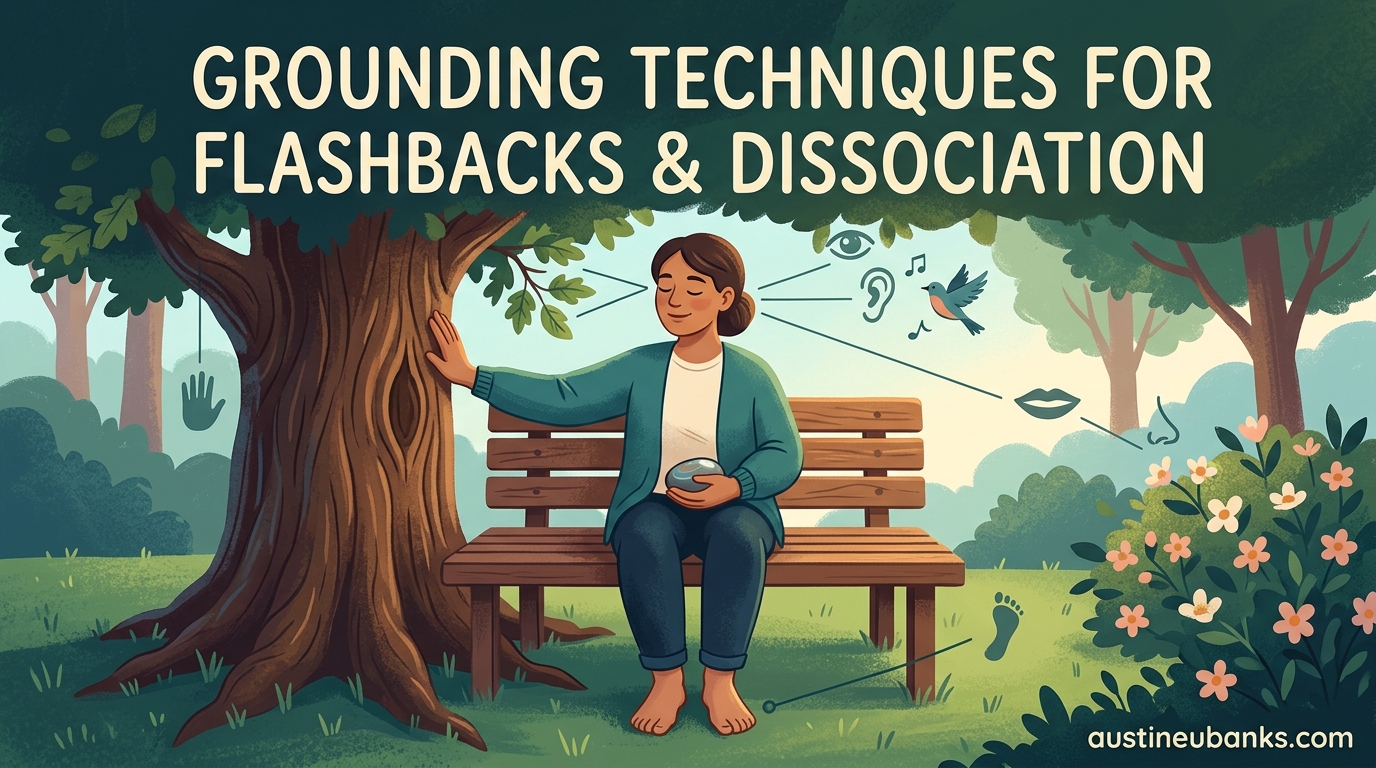
Grounding techniques are coping exercises that help you refocus on the present moment to manage distressing thoughts, flashbacks, and dissociation by engaging your senses and redirecting your attention away from overwhelming emotions or memories. When trauma pulls your mind into the past or causes it to detach entirely, grounding brings you back to the here and now.
If you live with PTSD, C-PTSD, or complex trauma, you already know how disorienting flashbacks and dissociation can be. One moment you are fine, and the next you are reliving a traumatic memory or feeling like you are floating outside your own body. Grounding techniques for flashbacks and dissociation give you practical tools to interrupt those experiences and return to safety.
I have spent years researching trauma-informed coping strategies, studying what mental health professionals recommend, and paying close attention to what real people in support communities say actually works for them. What I found is that no single technique works for everyone. The most effective approach is building a personalized toolkit of methods you have tested and practiced ahead of time.
This guide covers everything from the widely known 5-4-3-2-1 sensory method to somatic grounding, breathing exercises, cognitive techniques, and strategies for when standard grounding falls short. I also address a pain point that comes up repeatedly in trauma support communities: what to do when grounding techniques simply do not work for severe dissociation.
You will find a comparison table to help you choose the right technique for your specific situation, a step-by-step system for building your own grounding toolkit, and practical advice for using these skills at work, in public, and at night when flashbacks tend to intensify.
Table of Contents
What Are Grounding Techniques?
Grounding techniques are exercises that anchor your awareness in the present moment. They use your five senses, your body, or your mental focus to pull attention away from intrusive memories, emotional flooding, or the disconnected feeling of dissociation. Think of them as a bridge between a trauma response and your current reality.
Mental health professionals generally group grounding into three categories. Physical grounding uses your body and senses, things like holding an ice cube, feeling your feet on the floor, or splashing cold water on your face. Mental grounding uses cognitive tasks like counting backward, listing categories, or reciting something from memory. Soothing grounding uses comfort and self-kindness, such as repeating a calming affirmation or visualizing a safe place.
Each category serves a different purpose. Physical techniques tend to work fastest for acute flashbacks because they create strong sensory input that is hard for your brain to ignore. Mental techniques work well for milder dissociation or anxiety because they engage your prefrontal cortex and pull you out of emotional overload. Soothing techniques help regulate your nervous system after the immediate crisis passes.
What Are Flashbacks?
Flashbacks are involuntary replays of traumatic memories that feel as though the event is happening again in the present moment. They can be visual, where you see images or scenes from the trauma. They can also be emotional, where you suddenly feel the same fear, shame, or helplessness you felt during the original event without any visual component.
This distinction matters because emotional flashbacks, which are especially common in C-PTSD, require different grounding approaches than visual ones. A visual flashback might respond well to looking around your environment and naming objects. An emotional flashback might need body-based techniques that address the physiological arousal before cognitive exercises can work.
During a flashback, your brain processes the memory as a current threat. Your sympathetic nervous system activates the fight-or-flight response, flooding your body with stress hormones. Grounding interrupts this by providing competing sensory information that tells your brain you are safe in the present.
What Is Dissociation?
Dissociation is a defense mechanism where your mind disconnects from your thoughts, feelings, surroundings, or sense of identity. It exists on a spectrum from mild daydreaming to severe detachment. Two common forms are depersonalization, where you feel detached from your body as if watching yourself from outside, and derealization, where the world around you feels unreal, foggy, or distorted.
Dissociation often develops as a survival response to trauma. When a situation feels overwhelmingly unsafe, the brain copes by checking out. In the moment of trauma, this protective mechanism makes sense. The problem arises when dissociation continues long after the danger has passed, triggered by everyday stress, reminders of the trauma, or seemingly nothing at all.
People describe dissociation in different ways. Some say it feels like being behind glass. Others describe a buzzing or static feeling, a sense that their body is not theirs, or a feeling that time is passing strangely. Recognizing your personal early warning signs is the first step to using grounding techniques effectively before dissociation deepens.
Grounding vs Containment: What Is the Difference?
This is a question that comes up constantly in trauma support communities, and most professional articles never address it. Grounding and containment are related but distinct approaches, and knowing the difference helps you choose the right tool at the right time.
Grounding techniques pull you into the present moment. They expand your awareness and engage your senses to connect you with your current environment. The goal is full presence: feeling your body, seeing your surroundings, and knowing you are safe right now.
Containment techniques do the opposite. They help you set distressing material aside temporarily so you can function. If a traumatic memory surfaces during a work meeting, containment helps you box it up and deal with it later in a safe setting. Containment is about managing what you process and when, not about staying fully present.
Both are valid and necessary skills. Grounding is generally the first choice for flashbacks and dissociation because it directly addresses disconnection. But containment has an important role when full grounding is not practical or when processing trauma material in the moment would overwhelm you further.
How Grounding Techniques Work: The Science
Understanding the mechanism behind grounding techniques helps you use them more effectively. When you experience a flashback or dissociative episode, your nervous system enters a state of dysregulation. Your brain perceives a threat and activates survival responses that bypass logical thinking.
Your autonomic nervous system has two main branches. The sympathetic nervous system drives the fight-or-flight response, increasing heart rate, redirecting blood flow, and flooding your body with adrenaline. The parasympathetic nervous system is the rest-and-digest branch that calms the body down and signals safety.
During a flashback, your sympathetic nervous system is in overdrive. During dissociation, your nervous system often shifts into a freeze response, which is an extreme parasympathetic state mediated by the dorsal vagal complex. This is why dissociation can feel like shutdown rather than activation, you feel numb, disconnected, and slowed down rather than panicky.
Grounding works by engaging your senses to send new information to your brain. When you feel something cold, hear a specific sound, or count objects in the room, you activate sensory processing pathways that compete with the trauma circuits. This sensory input tells your brain that you are in the present, not in the past, and that your current environment is safe.
For fight-or-flight states, grounding techniques that activate the parasympathetic nervous system are especially helpful. Slow breathing, soothing touch, and calming visualization all stimulate the vagus nerve, which acts as the body’s natural braking system. For freeze states, more activating grounding techniques like cold water, movement, or strong sensory input work better because they help your nervous system shift out of shutdown.
The Window of Tolerance
Psychologist Dan Siegel coined the term window of tolerance to describe the zone of nervous system arousal where you can function effectively. Inside your window, you feel calm, present, and capable. Above your window, you are hyperaroused, anxious, or panicking. Below your window, you are hypoaroused, dissociated, or shut down.
Grounding techniques help you return to your window of tolerance when trauma pushes you outside of it. If you are above your window, calming techniques bring you down. If you are below your window, activating techniques bring you up. This is why the same technique can help one person and make another worse, it depends on which direction your nervous system has been pushed.
Why Some Grounding Techniques Fail
People in trauma support communities frequently express frustration that grounding techniques do not work for them. This is not a personal failure. There are several reasons why standard grounding can fall short, and understanding them helps you adapt your approach.
Some techniques require a level of cognitive function that is not available during deep dissociation. If your prefrontal cortex is essentially offline, asking it to count backward from 100 by sevens is not realistic. In these cases, body-based and sensory techniques that bypass higher thinking work better.
Other techniques can inadvertently trigger more distress. If your trauma involved specific sounds, smells, or physical sensations, a grounding exercise that uses those sensory channels might intensify your symptoms rather than relieve them. This is why personalization matters so much, and why testing techniques when you are calm is essential.
For severe dissociative disorders including DID and OSDD, standard grounding may be insufficient. People with these conditions may need specialized therapeutic approaches like phase-oriented trauma treatment, where stabilization and grounding skills are built gradually within a structured therapy relationship.
Which Technique Should You Use? Quick Comparison
Different experiences call for different grounding approaches. Use this reference to match techniques to what you are going through.
During a visual flashback: Physical sensory techniques work best because they create strong competing input. Hold an ice cube, splash cold water on your face, press your feet hard into the floor, or look around and name five objects out loud. Movement helps too: stand up, walk, or do jumping jacks to disrupt the visual loop.
During emotional flashbacks: Body-based techniques are your priority because emotional flashbacks are physractical experiences stored in the body. Try progressive muscle relaxation, body scanning, or holding something textured and focusing on how it feels. Breathing exercises help once the initial intensity decreases.
During dissociation or depersonalization: Activating techniques counter the shutdown response. Cold water, strong flavors like sour candy or peppermint, and physical movement help bring your nervous system back online. Avoid purely cognitive techniques until you feel more present.
During derealization: Focus on concrete, tangible details of your environment to combat the sense of unreality. Touch surfaces and name what they are made of. Hold something heavy. Look at text and read it aloud. The goal is to reinforce that your surroundings are real.
During anxiety or panic: Calming techniques that activate the parasympathetic nervous system are ideal. Box breathing, 4-7-8 breathing, soothing affirmations, and grounding objects all help regulate your nervous system and reduce the intensity of anxious arousal.
The 5-4-3-2-1 Sensory Method: Step by Step
The 5-4-3-2-1 technique is the most widely recommended grounding method for PTSD and dissociation. It works by systematically engaging all five senses to anchor you in the present moment. Here is how to do it.
5: Name five things you can see. Look around and identify objects in detail. Notice colors, shapes, and textures.
4: Name four things you can feel. Pay attention to physical sensations like your feet on the floor, the fabric of your clothes, or the chair supporting you.
3: Name three things you can hear. Listen for sounds both near and far. A clock ticking, traffic outside, or your own breathing.
2: Name two things you can smell. If you cannot smell anything immediately, think of two scents you enjoy or move to where scents are available.
1: Name one thing you can taste. Notice the current taste in your mouth, take a sip of something, or eat a small piece of food mindfully.
The beauty of 5-4-3-2-1 is its flexibility. You can do it silently or out loud. You can go through the senses in any order. You can spend ten seconds or ten minutes on it. The structure provides a clear task for your brain when it is overwhelmed, and the sensory engagement directly counters dissociation by forcing your attention outward.
When 5-4-3-2-1 Does Not Work
Despite its popularity, 5-4-3-2-1 does not work for everyone. In trauma support communities, people with severe dissociation frequently report that it feels too simple or even superficial. If you are deeply dissociated, the cognitive task of counting and naming might not be accessible. You might go through the motions without actually connecting to the present.
Several modifications can help. Instead of just naming what you see, describe it in vivid detail: the color, the shape, what it is made of, who made it. Instead of passively hearing sounds, try to locate where each sound is coming from. Adding physical action like touching objects with your hands or walking while you do the exercise increases sensory engagement.
If modifications do not help, switch to a different technique. Body-based grounding like cold water or strong physical sensation often works when cognitive methods fail. You can also try sequential grounding, starting with an activating physical technique to bring your awareness up, then transitioning to 5-4-3-2-1 once you are more present.
Physical and Sensory Grounding Techniques
Physical grounding uses your body and senses to reconnect with the present. These techniques tend to work quickly because they create sensory input that is difficult for your brain to override with trauma responses. They are especially effective for acute flashbacks and moderate to severe dissociation.
Cold Water and Ice Techniques
Cold water is one of the most effective immediate grounding tools. The intense temperature sensation triggers the mammalian dive reflex, which slows your heart rate and activates your parasympathetic nervous system. This is the same reflex that calms infants when water hits their face.
Splash cold water on your face, hold an ice cube in your hand and focus on the sensation as it melts, or press something cold against the back of your neck. If you have time, a cold shower provides full-body sensory input that can interrupt even intense dissociative episodes. Many people in trauma communities report that cold water works when nothing else does.
Keep ice packs in your freezer or carry a small water bottle you can make cold. If you are somewhere without access to cold water, press something cool against your skin like a metal surface, a window in winter, or even your own wrist where blood vessels are close to the surface.
Movement and Exercise
Physical movement is powerful because it engages your muscles, changes your blood flow, and releases tension that trauma stores in your body. During a flashback, your body is preparing for survival action that never gets completed. Movement helps discharge that energy.
Walk with attention to each step. Do jumping jacks or jog in place. Stretch your arms, legs, and back. Try progressive muscle relaxation: tense each muscle group for five seconds, then release. Shake your hands, arms, and legs to release stored tension. Even standing up and sitting down several times creates enough sensory change to help.
If you are in a situation where vigorous movement is not possible, try subtle alternatives. Press your toes against the inside of your shoes. Squeeze a stress ball or a fistful of your clothing. Rock gently in your chair. These smaller movements still send grounding signals to your brain.
Touch and Tactile Grounding
Your sense of touch is a direct line to present-moment awareness. Tactile grounding works because physical sensation is immediate and undeniable. You cannot argue with the feeling of something in your hand.
Press your feet firmly into the floor and feel the solid surface supporting you. Run your hands over a textured object like a stone, a piece of fabric, or a fidget toy. Feel the weight of your body in the chair. Press your thumb and forefinger together and focus on the pressure. Hold something warm like a cup of tea and concentrate on the heat.
Many people benefit from carrying a specific grounding object. A smooth stone, a textured coin, a piece of jewelry, or a small fidget tool can serve as a tactile anchor. The key is choosing something with a distinct texture or temperature that you associate with safety and presence.
Somatic Grounding for Dissociation
Somatic grounding focuses specifically on body awareness, which makes it particularly effective for dissociation. While standard grounding techniques might ask you to notice your environment, somatic techniques ask you to notice your internal experience.
Start with a body scan. Close your eyes and mentally move through your body from head to toe, noticing sensations without judgment. Where is there tension? Where is there ease? Where do you feel nothing at all? The areas where you feel numb are especially important to gently bring awareness to.
Try orienting: look around your environment slowly, letting your eyes and head move together as you take in your surroundings. This mimics what animals do when they enter a new space and signals to your nervous system that the area is safe. Humming or singing stimulates the vagus nerve through vocal cord vibration. Even gentle self-massage of your hands, arms, or neck can help you reconnect with your physical form.
For people who feel disconnected from their bodies, somatic grounding should be approached gently. Forcing body awareness can sometimes increase distress, especially for survivors of physical or sexual abuse. Start with external sensations like feeling the floor, then gradually move to internal awareness as comfort allows.
Mental and Cognitive Grounding Techniques
Mental grounding uses cognitive tasks to engage your prefrontal cortex, the part of your brain responsible for logical thinking and problem-solving. When trauma activates your limbic system, engaging your prefrontal cortex helps restore balance. These techniques work well for anxiety, mild to moderate dissociation, and as a follow-up after physical grounding has brought you back to a baseline of presence.
Counting and Math
Counting backward gives your brain a structured task that requires focus. Start with counting backward from 100. If that is too easy, count backward by sevens, by threes, or by some other increment. The task needs to be challenging enough to require concentration but not so difficult that it causes frustration.
Mental math serves the same purpose. Try to solve math problems in your head, calculate a tip, or figure out how many days until a future date. The goal is not to get the right answer but to engage the cognitive process that pulls you out of emotional overload.
Keep in mind that counting requires a baseline of cognitive function. During severe dissociation, your prefrontal cortex may not be available for this kind of task. If counting feels impossible, switch to a physical technique first and return to mental exercises once you feel more present.
Category Listing
Category listing is a mental technique that combines cognitive engagement with structured thinking. Pick a category and list as many items as you can. Categories can include: animals that start with each letter of the alphabet, cities you have visited, movies from a specific decade, colors of items in your kitchen, or types of trees.
This technique works well because it provides structure without requiring physical items or movement. You can do it anywhere, including during a meeting, in a waiting room, or lying in bed at night. The cognitive demand is moderate, enough to distract from trauma responses without overwhelming a stressed brain.
Variation makes this technique sustainable. If you always use the same category, it becomes automatic and loses its grounding power. Rotate through different categories to keep the exercise engaging and demanding enough to hold your attention.
Anchoring Statements
Anchoring statements are short, factual reminders of who you are and where you are in the present moment. They work by giving your brain concrete evidence that the trauma is over and you are safe now.
A typical anchoring statement goes like this: My name is [your name]. I am [your age] years old. Today is [day of week], [date]. I am in [your location]. I am safe here. This is the present, not the past.
Customize your statement with details that reinforce safety and orientation. Include sensory information like what you see around you and what you are doing right now. Say it silently or out loud. Some people write their anchoring statement on a card they carry with them, so they can read it when their mind is too foggy to generate it from memory.
Recitation Techniques
Reciting something from memory engages your brain in a way that requires focus and sequence. The lyrics to a favorite song, a poem you memorized, the alphabet backward, or the steps of a recipe you know well all work for this technique.
The material should be something you know well enough to recite but not so well that you can do it on autopilot. If you can recite it without thinking, it will not ground you. Choose material that requires just enough effort to keep your mind engaged.
If your mind is too scattered to recall memorized material, try reading instead. Read text on a page, a sign, or your phone screen. Reading aloud is even better because it engages multiple senses and motor pathways simultaneously.
Breathing Exercises for Grounding
Breathing exercises are unique among grounding techniques because you always have your breath with you. No tools, no preparation, no environment requirements. Your breath is also a direct lever for nervous system regulation, specific breathing patterns can activate your parasympathetic nervous system and signal safety to your body.
4-7-8 Breathing
The 4-7-8 method, developed by Dr. Andrew Weil, is a structured breathing technique that calms the nervous system. Inhale through your nose for four counts. Hold your breath for seven counts. Exhale slowly through your mouth for eight counts. Repeat the cycle four times to start.
The extended exhale is what makes this technique effective. Longer exhales than inhales stimulate the vagus nerve and activate the parasympathetic nervous system. The counting gives your mind a task, and the breath pattern gives your body a signal to calm down.
4-7-8 breathing works best for anxiety, hyperarousal, and as a follow-up after a flashback has been interrupted. It is less effective for deep dissociation because the stillness of the exercise might deepen the shutdown response.
Box Breathing
Box breathing, also called square breathing, uses an equal count for each phase. Inhale for four counts. Hold for four counts. Exhale for four counts. Hold for four counts. The pattern forms a box, with each side representing four counts.
This technique is used by Navy SEALs and first responders to manage stress in high-pressure situations. It is effective because the equal counts create a steady rhythm that stabilizes your nervous system. The holding phases teach your body that pausing is safe, which counters the urgency of fight-or-flight responses.
Box breathing is versatile. You can use it preventively before a stressful situation, during a flashback to regulate your body after the initial sensory grounding, or as a daily practice to build nervous system resilience over time.
Diaphragmatic Breathing
Diaphragmatic breathing, also called belly breathing, focuses on breathing deeply into your abdomen rather than shallowly into your chest. Place one hand on your chest and one on your belly. Breathe in slowly through your nose, making the hand on your belly rise while the hand on your chest stays relatively still. Exhale slowly through pursed lips.
Chest breathing is associated with anxiety and stress. It keeps your nervous system in a mild state of activation. Belly breathing reverses this pattern, sending signals of safety and relaxation throughout your body. Many people with trauma and anxiety breathe shallowly from their chest by default, so diaphragmatic breathing requires conscious practice.
Practice diaphragmatic breathing when you are calm so it becomes familiar. Then you can access it more easily during moments of distress. Aim for five to ten minutes of practice daily to retrain your default breathing pattern.
Soothing and Comforting Grounding Techniques
Soothing grounding techniques use self-compassion and comfort to regulate your nervous system. While physical and mental techniques are about interrupting trauma responses, soothing techniques are about actively calming and nurturing yourself. They work well as a third step: first ground with sensory input, then engage your mind, then soothe your emotions.
Affirmations and Self-Talk
Repeating a soothing phrase gives your mind a calming message to focus on. The phrase should be personal and meaningful to you. Examples include: I am safe right now. This feeling will pass. I have survived this before and I will survive it again. I am in my body, in the present moment. I am okay.
The key is choosing a phrase that feels true and comforting rather than hollow or dismissive. Generic affirmations can feel inauthentic. Tailor your phrase to what you most need to hear during a flashback or dissociative episode.
Say your affirmation silently or out loud. Write it on a card you carry with you. Some people record themselves saying their affirmations and listen to the recording when they need it. Having the phrase pre-prepared means you do not have to come up with words when your cognitive function is impaired.
Favorite Place Visualization
Imagine a place where you feel completely safe and at peace. This could be a real location you have visited, a fictional place, or somewhere entirely imagined. Picture it in vivid detail: what you see, hear, smell, feel, and taste there. Spend several minutes immersed in the visualization.
This technique works best when you have practiced it ahead of time. Build your safe place visualization when you are calm, adding more sensory detail each time. The richer and more detailed the image, the more effectively it can ground you during distress.
For some people with severe dissociation, visualization can intensify disconnection because it involves turning inward and away from the external environment. If this happens, combine visualization with a physical anchor like holding a grounding object or keeping your eyes open.
Music and Sound Grounding
Music can be a powerful grounding tool. The key is choosing music that matches what you need: calming music to reduce anxiety, or music with a strong beat to counter dissociation. Some people in trauma communities report that upbeat music with a prominent rhythm works better than calming music when they are deeply dissociated.
Create playlists for different situations. A calming playlist for anxiety. An energizing playlist for dissociation. A comfort playlist with songs that remind you of safe people and good times. Having pre-made playlists means you do not have to make decisions when you are already overwhelmed.
Nature sounds, white noise, or podcasts can also serve as auditory grounding. The key is choosing audio that engages your attention without overwhelming your senses. For some people, listening to a familiar podcast feels like company, which reduces the isolation of dissociation.
Grounding Objects and Tools
A grounding object is a physical item you carry with you that helps anchor you to the present. The ideal object has a distinct texture, weight, or temperature that demands your attention when you hold or touch it.
Common grounding objects include smooth stones, textured worry coins, fidget toys, pieces of favorite fabric, essential oil rollers, and small pieces of hard candy. Choose objects that feel pleasant to interact with and that you associate with safety.
Keep grounding objects in places where you are likely to need them: your pocket, your desk, your bedside table, your car. Having multiple objects in multiple locations means you are never far from a tool. Some people build small grounding kits with several items for different sensory channels.
What to Do When Grounding Techniques Do Not Work
This section addresses one of the most common frustrations expressed in trauma support communities. You try the techniques, and nothing happens. Or worse, the techniques seem to intensify your symptoms. You are not alone in this experience, and it does not mean you are doing something wrong.
Why Standard Grounding Fails for Severe Dissociation
Severe dissociation involves a profound shutdown of the nervous system. Your dorsal vagal complex, the most primitive branch of your parasympathetic nervous system, has taken over. In this state, your brain is conserving energy and blocking out stimuli. Techniques that require cognitive engagement or gentle sensory input simply do not register.
Some people describe standard grounding as feeling like swapping one trance state for another. They go through the motions of counting or naming objects but remain disconnected from the actual experience. This is a real phenomenon, not a failure of effort. The dissociation is too deep for the technique to penetrate.
Sensory sensitivity can also cause grounding to backfire. If your nervous system is already overwhelmed, adding more sensory input like bright lights, loud sounds, or intense physical sensations can push you further into shutdown or trigger a flashback. Knowing your sensitivities helps you avoid techniques that will make things worse.
Alternative Approaches When Basic Techniques Fail
When standard grounding fails, try shifting your approach. Instead of cognitive techniques, go fully physical. The more intense and immediate the sensory input, the more likely it is to penetrate deep dissociation. Cold water is frequently cited as the most reliable technique for severe episodes.
Strong tastes can help. Sour candy, peppermint, hot sauce, or salt on your tongue creates a sensory signal that is hard to ignore. Strong smells like peppermint oil, eucalyptus, or coffee can have a similar effect. The goal is to find sensory input that is powerful enough to break through the dissociative barrier.
If your nervous system is in freeze mode, gentle techniques may deepen the shutdown. You need activation instead. Movement, strong sensory input, and even mild, controlled stress like a cold shower can help your nervous system shift out of freeze. The paradox is that what feels uncomfortable can be exactly what your body needs to wake up.
Sequential Grounding: Combining Techniques
Sequential grounding means using multiple techniques in a specific order to build presence gradually. Start with the most activating technique available, use it to bring your awareness up to a baseline level, then transition to a technique that helps you stay present, and finally use a soothing technique to stabilize.
A typical sequence might be: hold an ice cube or splash cold water to activate your system. Then walk around and press your feet into the floor to maintain physical presence. Then do the 5-4-3-2-1 method to engage your senses and cognitive function. Then use box breathing and an anchoring statement to stabilize.
The idea is to meet your nervous system where it is and guide it step by step back to the window of tolerance. Rushing straight to a gentle technique when you are in deep freeze will not work. But layering techniques progressively gives each one a better chance of succeeding because the previous technique has already shifted your state.
When to Switch from Grounding to Containment
Sometimes full grounding is not the right goal in the moment. If you are at work, in a social situation, or somewhere that full processing would be disruptive or unsafe, containment may be more appropriate. Containment lets you acknowledge the distressing material and set it aside temporarily.
A containment technique might involve imagining putting the memory or feeling in a box and closing the lid. Or mentally placing it on a shelf to take down later in therapy. Or telling yourself: I notice this is coming up. I will address it when I am in a safe space. For now, I am setting it aside.
Containment is not avoidance. It is a deliberate, conscious decision to manage when and where you process difficult material. The key is following through: if you contain something during the day, make sure you create time later to address it through grounding, journaling, therapy, or conversation with a trusted person.
Build Your Personal Grounding Toolkit
No two nervous systems are identical, which means no single set of techniques will work for everyone. The most effective approach is to build a personalized grounding toolkit: a collection of techniques you have tested, a plan for when to use each one, and physical tools to support you. Here is a step-by-step process for creating your toolkit.
Step 1: Identify Your Triggers and Warning Signs
Before you can use grounding effectively, you need to know when you need it. Spend a week or two tracking your dissociation and flashback episodes. Note what was happening before each one: what you were doing, what triggered it, what time of day it was, and what the earliest signs were that something was shifting.
Early warning signs vary widely. You might notice a change in your vision, a feeling of floating, sudden numbness in your hands, a shift in how sounds feel, brain fog, or an urge to withdraw. Some people notice irritability or restlessness before dissociation sets in. Others feel nothing at all until they suddenly realize they have been checked out for an hour.
Write your triggers and warning signs down. This awareness gives you a critical advantage: you can start grounding at the first sign of trouble rather than waiting until you are fully dissociated. Early intervention is always more effective than trying to ground from a deep state of disconnection.
Step 2: Test and Rate Techniques When Calm
Do not wait for a crisis to try grounding techniques for the first time. Test them when you are calm and regulated. Go through each technique in this guide and rate how it feels on a scale of one to ten for effectiveness and comfort. Note which ones made you feel more present, which ones felt neutral, and which ones felt uncomfortable or triggering.
Pay attention to your sensory sensitivities. If certain sounds, smells, or physical sensations are connected to your trauma, mark those techniques as off-limits or proceed with extreme caution. If body awareness exercises feel unsafe, prioritize external sensory techniques instead. Your toolkit should feel manageable and safe, not overwhelming.
Aim to identify three to five techniques that consistently help you feel more present. These become your core toolkit. Having multiple options means you always have a backup if your first choice does not work in a particular moment.
Step 3: Create Your Emergency Script
When you are dissociated or in a flashback, your ability to think clearly and make decisions is impaired. You might know you have a toolkit, but you may not be able to remember what is in it or decide which technique to use. An emergency script solves this problem.
Write down, step by step, exactly what to do when you notice warning signs. Keep it simple and specific. Example: First, hold an ice cube for 30 seconds. Then, press both feet into the floor and say out loud: I am safe, it is [year], I am at [location]. Then, look around and name five blue objects. Then, do box breathing for two minutes.
Keep your script in multiple accessible formats. A card in your wallet. A note on your phone lock screen. A printed copy on your refrigerator. Tell a trusted person about your script so they can guide you through it if you cannot access it yourself. The goal is to remove all decision-making from the crisis moment.
Step 4: Build a Physical Grounding Kit
A physical grounding kit is a small collection of items that support your techniques. Keep one at home, one at work, and one in your bag. Tailor the contents to your tested techniques.
A sample kit might include: a smooth stone or textured object for tactile grounding, a small container of essential oil for scent grounding, sour candy or mints for taste grounding, a stress ball or fidget toy for touch and motor engagement, and a card with your emergency script written on it. Some people add a photograph of a loved one or a safe place for visual grounding.
The kit does not need to be elaborate or expensive. It needs to be accessible and effective. Review and refresh it regularly. If an item loses its grounding power through habituation, replace it with something new.
Step 5: Practice and Refine
Grounding is a skill, and like any skill, it gets stronger with practice. Dedicate five to ten minutes daily to practicing your core techniques when you are calm. This builds neural pathways that make the techniques more accessible during actual episodes.
Review your toolkit monthly. What is working? What is not? Have your triggers changed? Do you need to add new techniques or retire ones that have lost effectiveness? Your grounding toolkit should evolve as you heal and as your needs change.
Most importantly, be patient with yourself. Building an effective grounding practice takes time. Progress is not linear, and setbacks are part of the process. Every attempt at grounding, even when it does not fully work, is a step toward greater self-regulation and safety.
Grounding Techniques for Different Settings
The setting you are in when a flashback or dissociative episode hits affects which techniques are available to you. Planning ahead for common environments ensures you always have an option.
At Work or in Public
Discreetness is the priority at work and in public. You need techniques that do not draw attention. Press your feet into the floor and feel the ground beneath you. Squeeze a stress ball in your pocket. Discreetly smell something: a wrist with perfume or cologne, a coffee cup, a pen. Touch the texture of your desk, your clothing, or a piece of jewelry. Do box breathing without anyone noticing. silently count backward from 100 by sevens. Text yourself your anchoring statement.
Keep discreet grounding tools accessible: a stone in your pocket, a piece of candy, an essential oil roller. Plan which techniques you will use in a meeting versus at your desk versus in a restroom where you have more privacy.
At Night Before Sleep
Nighttime is when many people experience their worst flashbacks and dissociation. The day’s distractions fall away, and the mind turns inward. Create a wind-down routine that incorporates grounding: progressive muscle relaxation in bed, diaphragmatic breathing, or holding a grounding object while you settle in.
If you wake from a nightmare and are flooding or dissociating, start with physical grounding. Turn on a light to change your visual environment. Hold something cold. Press your feet into the floor and stand up. Once you feel somewhat present, use a soothing technique like your favorite place visualization or a calming affirmation to settle back toward sleep.
Keep your bedside grounding kit within arm’s reach. Fumbling in the dark for tools adds frustration to an already difficult moment. A small container with a stone, a piece of candy, and a card with your emergency script should be on your nightstand.
In Social Situations
Social settings add complexity because you may feel pressure to appear fine. Having a plan in advance reduces anxiety about potential episodes. Know where the restroom is so you have a private space to ground if needed. Identify a safe person you can text or signal if you are struggling. Choose techniques you can do without anyone noticing: tactile grounding in your pocket, breathing exercises, or mental counting.
If you need to step away, have a simple script ready: I need some air, I will be right back. You do not owe anyone an explanation in the moment. Your priority is your own regulation and safety.
When to Seek Professional Help
Grounding techniques are self-help tools, not a substitute for professional treatment. If flashbacks and dissociation are frequent, severe, or interfering with your daily life, working with a trauma-informed therapist is one of the most important steps you can take. Therapy provides the structured support needed to process trauma at the root, not just manage its symptoms.
Warning Signs That Dissociation Is Becoming Serious
Certain signs indicate that dissociation has reached a level where professional intervention is important. If you are losing significant chunks of time and cannot account for hours or days, seek help. If you find yourself in places without remembering how you got there, this is a serious sign. If dissociation is causing you to engage in self-harm, risky behavior, or puts you in physical danger, professional support is urgent.
Other signs include dissociation that does not respond to any grounding technique, dissociation that is increasing in frequency or intensity, dissociation that interferes with work or relationships, and any experience of identity confusion or feeling like different parts of yourself are taking control. These symptoms suggest a level of trauma response that requires specialized treatment.
Treatment Options for PTSD and C-PTSD
Several evidence-based therapies effectively treat PTSD, C-PTSD, and dissociative disorders. EMDR (Eye Movement Desensitization and Reprocessing) uses bilateral stimulation to help the brain reprocess traumatic memories. Cognitive Processing Therapy (CPT) helps you identify and change trauma-based beliefs. Trauma-Focused CBT combines cognitive techniques with trauma processing.
For dissociative disorders specifically, phase-oriented treatment is the standard approach. Phase one focuses on safety and stabilization, including building grounding skills. Phase two involves processing traumatic memories. Phase three focuses on integration and moving forward. This structured approach ensures you have adequate coping skills before tackling the deeper trauma work.
Somatic therapies like Somatic Experiencing and Sensorimotor Psychotherapy work directly with the body to release stored trauma. These can be particularly helpful for people whose dissociation does not respond to traditional talk therapy. DBT (Dialectical Behavior Therapy) also offers distress tolerance and grounding skills as part of its curriculum.
Resources and Organizations
Several organizations provide information, support, and referrals for trauma and dissociation. The International Society for the Study of Trauma and Dissociation (ISSTD) offers a therapist directory specializing in dissociative disorders. The Anxiety and Depression Association of America (ADAA) provides resources for anxiety and PTSD. PTSD UK offers information and support specific to PTSD and C-PTSD.
If you are in crisis, contact your local emergency services or a crisis line immediately. In the United States, the 988 Suicide and Crisis Lifeline is available 24 hours a day. You do not have to be suicidal to call; they support anyone in emotional distress. In the UK, Samaritans is available at 116 123. Reaching out for help is a sign of strength, not weakness.
FAQs
Does grounding help with dissociation?
Yes, grounding can help with dissociation by using your senses to anchor you in the present moment. Physical techniques like cold water, strong tastes, and movement are especially effective because they create sensory input that penetrates dissociative states. Mental techniques work better once you have re-established a baseline of presence. However, grounding may be less effective for severe dissociative disorders without professional support.
What is 5-4-3-2-1 grounding for PTSD?
The 5-4-3-2-1 method is a sensory grounding technique for PTSD that involves identifying 5 things you can see, 4 things you can feel, 3 things you can hear, 2 things you can smell, and 1 thing you can taste. It works by engaging all five senses to pull your attention into the present moment, interrupting flashbacks and dissociation by giving your brain concrete sensory information that contradicts the trauma response.
Do flashbacks cause dissociation?
Flashbacks and dissociation are related but distinct trauma responses that often co-occur. Flashbacks pull you into the past while dissociation pulls you away from the present. A flashback can trigger dissociation as a protective response to overwhelming memories. Both stem from the same root: a nervous system that learned to respond to trauma by either reliving it (flashback) or escaping it (dissociation).
Does grounding help with derealization?
Yes, grounding can help with derealization. Derealization makes your surroundings feel unreal or distorted, so grounding techniques that reinforce the concrete reality of your environment are most effective. Touch surfaces and name what they are made of, hold something heavy, read text aloud, or focus on detailed visual descriptions of objects around you. The goal is to provide your brain with undeniable evidence that your environment is real.
How long should you practice grounding techniques?
Practice grounding techniques for 5 to 10 minutes daily when you are calm to build familiarity and make them accessible during distress. During an actual flashback or dissociative episode, use grounding for as long as needed to feel present and safe, which may be anywhere from 30 seconds to 20 minutes. Consistent daily practice is more important than long sessions because it builds the neural pathways that make grounding automatic.
What should I do when grounding techniques don’t work for me?
If standard grounding does not work, try more intense physical techniques like cold water, strong tastes, or vigorous movement that create sensory input powerful enough to break through dissociation. Try sequential grounding, layering multiple techniques in order. Consider whether you need containment rather than grounding in the moment. If grounding consistently fails, work with a trauma-informed therapist who can help identify why and develop a personalized approach.
Conclusion
Grounding techniques for flashbacks and dissociation give you practical tools to manage some of the most disorienting symptoms of trauma. From the 5-4-3-2-1 sensory method to cold water, breathing exercises, somatic techniques, and sequential grounding, you now have a comprehensive catalog of approaches to draw from.
The most important takeaway is that grounding works best when it is personalized. Build your toolkit. Test techniques when you are calm. Create an emergency script. Assemble a physical kit. Practice regularly so your skills are ready when you need them. And if standard techniques do not work for you, know that you are not alone and that alternatives exist, from more intense sensory input to containment strategies to professional trauma therapy.
If flashbacks and dissociation are significantly impacting your life, please reach out to a trauma-informed mental health professional. Grounding is a coping skill, and healing happens when you have the right support to process the trauma underneath. You deserve to feel safe in your body and in the present moment. With the right tools and support, that is possible.