
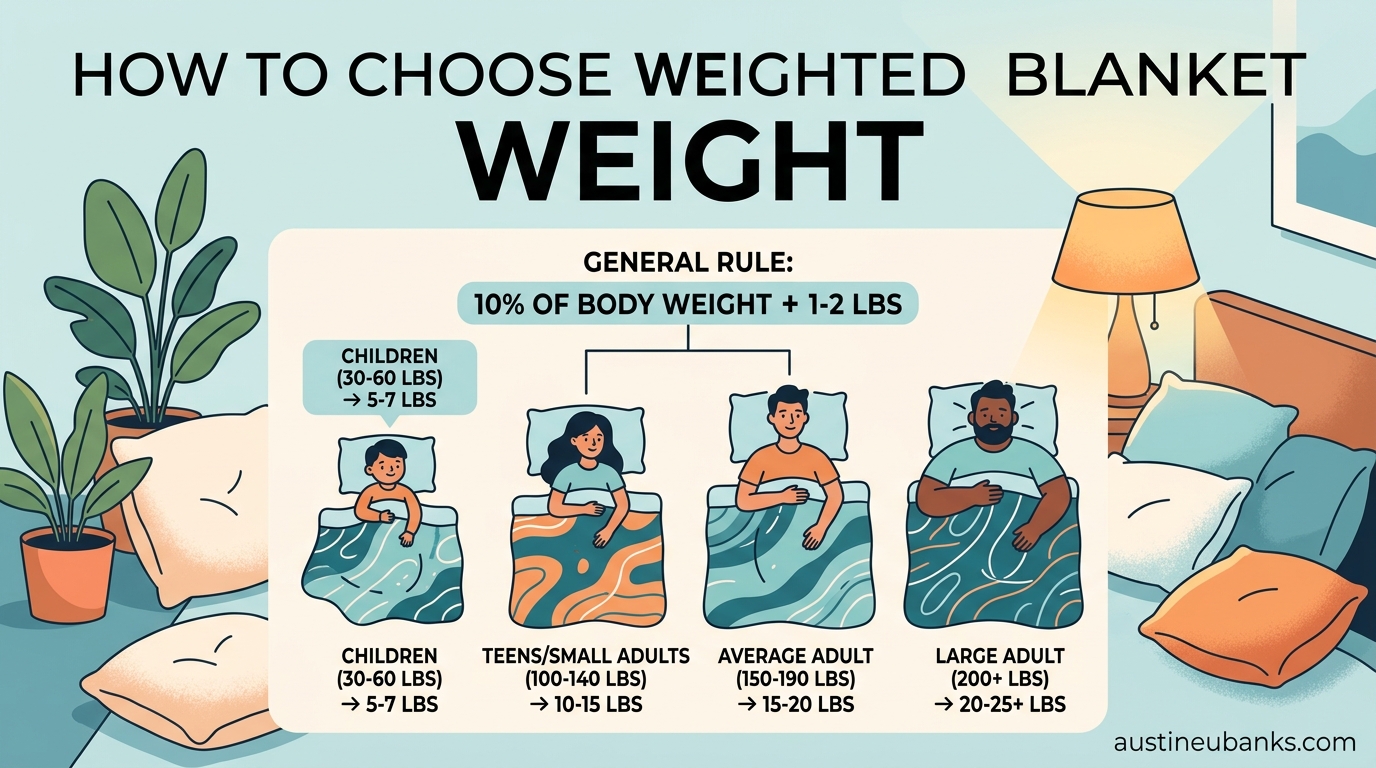
Choosing a weighted blanket that is approximately 10% of your body weight is the golden rule for most adults. If you weigh 180 pounds, that means looking for a blanket in the 18-pound range. But that number is a starting point, not a hard limit. The right weighted blanket weight for your body also depends on your sleep position, sensitivity to pressure, age, and even the climate where you live.
Our team has spent months researching how weighted blankets actually perform across different body types, sleep habits, and health conditions. We dug into forum discussions, scientific studies, and real user experiences to figure out what actually matters when you are standing in a store (or scrolling online) trying to pick between a 15-pound and a 20-pound option.
If you have ever asked yourself “how heavy should my weighted blanket be?” and gotten confused by conflicting advice, this guide breaks it all down. We cover the 10% body weight rule, provide a detailed weight chart, discuss safety considerations for medical conditions, and share factors that most guides completely skip. Here is how to choose the right weighted blanket weight for your body without the guesswork.
Table of Contents
What Is a Weighted Blanket and How Does It Work?
A weighted blanket is a heavy therapeutic blanket typically weighing between 5 and 30 pounds. It is filled with materials like glass microbeads, plastic poly pellets, or steel shot beads that distribute weight evenly across your body. Unlike a regular comforter, a weighted blanket applies gentle, consistent pressure that mimics a technique called deep pressure stimulation.
Deep pressure stimulation is the science behind why these blankets feel so comforting. When the blanket presses against your body, it triggers your autonomic nervous system to shift from a “fight or flight” state into a “rest and digest” mode. This pressure encourages the release of serotonin and dopamine, which are neurotransmitters associated with calm and happiness. At the same time, it helps reduce cortisol, the stress hormone that keeps you wired at night.
Research suggests that this combination of increased calming hormones and reduced stress hormones can help you fall asleep faster and stay asleep longer. People dealing with anxiety, insomnia, restless leg syndrome, and sensory processing differences often report meaningful improvements. But none of those benefits materialize if the blanket is the wrong weight for your body.
How to Choose the Right Weighted Blanket Weight for Your Body: The 10% Rule
The standard recommendation is to choose a weighted blanket that equals roughly 10% of your body weight. This guideline has been adopted across the sleep industry because it provides enough pressure to activate deep pressure stimulation without feeling smothering or restrictive. Most manufacturers, sleep specialists, and occupational therapists reference this rule as the baseline.
That said, the actual comfortable range falls between 5% and 12% of your body weight. The 10% mark sits right in the middle of that range, which is why it works as a universal starting point. If you prefer a lighter touch or you are trying a weighted blanket for the first time, leaning toward the lower end (around 7-8%) can help your body adjust. If you are an experienced user who craves firm pressure, you might prefer the higher end (11-12%).
Here is a simple step-by-step method to calculate your ideal starting weight:
Step 1: Weigh yourself and note the number in pounds.
Step 2: Calculate 10% of that number by moving the decimal one place to the left. For example, 160 pounds becomes 16 pounds.
Step 3: Round to the nearest available blanket weight. Most brands sell blankets in 5-pound increments (5, 10, 15, 20, 25, 30 lbs), so you will round up or down to the closest option.
Step 4: Adjust based on personal preference. If 16 pounds is your target but you can only find 15 or 20, think about whether you tend to prefer gentle or firm pressure before deciding.
Why does the 10% range work so well? At this ratio, the blanket applies enough force to stimulate the proprioceptive system without interfering with your ability to breathe naturally or shift positions during the night. Going significantly heavier than 12% risks making the blanket feel oppressive, especially for first-time users. Going much lighter than 5% means you may not feel enough pressure to trigger the calming response at all.
Weighted Blanket Weight Chart by Body Weight
Use this chart as a quick reference to find your recommended blanket weight based on your body weight. We have included both pounds and kilograms since many of our readers shop internationally.
Body Weight: 50-70 lbs (23-32 kg) — Recommended blanket weight: 5-7 lbs. Best for older children and smaller teens. Always consult a pediatrician before purchasing for anyone under 50 lbs.
Body Weight: 70-100 lbs (32-45 kg) — Recommended blanket weight: 7-10 lbs. Suitable for teenagers and small-framed adults. Start at the lower end if this is a first weighted blanket.
Body Weight: 100-130 lbs (45-59 kg) — Recommended blanket weight: 10-13 lbs. A common range for lighter adults. Many users in this bracket find 12 lbs to be the sweet spot.
Body Weight: 130-170 lbs (59-77 kg) — Recommended blanket weight: 13-17 lbs. One of the most popular weight ranges. A 15-pound blanket is the best-selling option across most major brands for this body weight group.
Body Weight: 170-200 lbs (77-91 kg) — Recommended blanket weight: 17-20 lbs. If you weigh around 180 pounds, an 18-pound or 20-pound blanket will give you that deep pressure feeling without being overwhelming.
Body Weight: 200-230 lbs (91-104 kg) — Recommended blanket weight: 20-23 lbs. Users in this range typically prefer a 20-pound blanket. If you are a hot sleeper, consider a cooling weighted blanket at this weight since heavier blankets trap more heat.
Body Weight: 230+ lbs (104+ kg) — Recommended blanket weight: 25-30 lbs. The heaviest commercially available blankets are in this range. Make sure the blanket size is large enough to distribute this weight evenly across your body.
Keep in mind that these are guidelines, not absolute rules. Your ideal weight might fall slightly outside these ranges based on the factors we cover in the next section.
Factors That Affect Your Ideal Blanket Weight
The 10% rule gives you a baseline, but several personal factors can shift your ideal weight up or down. Understanding these variables helps you fine-tune your choice instead of relying on a single number.
Sleep Position Matters More Than You Think
Your sleep position changes how weight distributes across your body. Side sleepers generally feel pressure more intensely on their shoulders and hips, so they may want to stay at or slightly below the 10% mark. A lighter blanket prevents uncomfortable pressure points from building up overnight.
Back sleepers tend to tolerate the full 10% weight comfortably because the blanket spreads evenly across the entire front of the body. The pressure distributes across the chest, stomach, and legs rather than concentrating on a few joints. Many back sleepers find they can even go slightly above 10% without discomfort.
Stomach sleepers face the biggest challenge with weighted blankets. The weight presses directly against the chest and can restrict breathing, especially at heavier weights. If you sleep on your stomach, consider dropping 2-3 pounds below your calculated weight. Some stomach sleepers find they cannot use a weighted blanket comfortably at any weight.
Age and Body Frame
Adults between 18 and 60 can generally follow the 10% rule directly. Seniors over 65 may want to reduce the weight by a few pounds, especially if they have arthritis, reduced mobility, or circulatory issues. A heavy blanket can be difficult to reposition for someone with limited upper body strength.
Your frame size also plays a role. A muscular 180-pound person and a slim 180-pound person may experience the same blanket weight differently. Broader frames distribute weight across more surface area, making a heavier blanket feel lighter. Narrower frames concentrate the same weight on less surface area, making it feel more intense.
Personal Pressure Sensitivity
Some people love the feeling of heavy weight on their body. Others feel claustrophobic under anything heavier than a light sheet. If you know you are sensitive to pressure, start at the lower end of the recommended range. You can always move up to a heavier blanket later, but starting too heavy can turn you off weighted blankets entirely.
This is especially relevant for first-time buyers. Forum users on Reddit frequently mention that they initially bought a blanket that was too heavy and had to exchange it. The most common exchange reason across multiple forums is wanting a different weight, usually a lighter one.
Climate and Seasonal Considerations
Heavier blankets trap more body heat. If you live in a warm climate or tend to sleep hot, you may want to go slightly lighter and pair it with a cooling duvet cover. A 20-pound blanket in July in Texas feels very different from a 20-pound blanket in January in Maine.
For hot sleepers, consider choosing a weighted blanket with breathable cotton or moisture-wicking bamboo fabric. Some users buy two blankets: a lighter one for summer and a heavier one for winter. If you can only buy one, pick a weight based on your year-round average comfort.
Weighted Blanket Weight Guidelines for Children
Weighted blankets can be beneficial for children, but the safety rules are stricter. Children under 3 years old or weighing less than 50 pounds should never use a weighted blanket. The weight can restrict their breathing or prevent them from moving the blanket off themselves during the night.
For children over 50 pounds, the general guideline is 10% of their body weight plus one or two extra pounds. A child weighing 60 pounds would use a blanket around 7 pounds. Always round down rather than up when in between available weights for a child.
Many parents explore weighted blankets for children with autism spectrum disorder, ADHD, or sensory processing differences. Deep pressure therapy can have a grounding effect that helps these children feel more regulated. However, you should always consult with a pediatrician or occupational therapist before introducing a weighted blanket to a child with any medical condition. They can provide personalized guidance based on the child’s specific needs and sensory profile.
Look for blankets with small, quilted channels that prevent the filling from pooling in one corner. Children are more likely to toss and turn, and a poorly constructed blanket can shift all its weight to one spot. Even weight distribution is just as important as total weight.
Choosing a Weighted Blanket for Couples
Sharing a weighted blanket with a partner adds a layer of complexity to the weight calculation. The common advice is to combine both partners’ body weights and calculate 10% of the total. If you weigh 160 pounds and your partner weighs 200 pounds, your combined weight is 360 pounds, suggesting a blanket around 36 pounds.
The problem is that 36-pound blankets are hard to find and impractical. Very few manufacturers make blankets above 30 pounds. Instead of buying one massive blanket, many couples opt for individual weighted blankets in their own sizes. This approach lets each person get the exact weight that suits their body and sleep position.
If you do share a single weighted blanket, choose one based on the lighter partner’s body weight. The heavier partner will still benefit from the deep pressure, and the lighter partner will not feel crushed. A twin or full-size weighted blanket (60 by 80 inches) is usually the minimum size that works for two people without the blanket sliding off one side during the night.
Understanding Blanket Materials and Fillings
The filling material inside a weighted blanket affects how the weight feels, how the blanket drapes, and how breathable it is. Here are the main types you will encounter.
Glass microbeads are the most popular and highest-quality filling. They are tiny, smooth, and dense, which means a blanket filled with glass beads is thinner and more flexible than other types. Glass beads also tend to be quieter, producing less rustling when you move. Most premium weighted blankets use glass microbeads.
Plastic poly pellets are larger and lighter than glass beads. Blankets filled with poly pellets tend to be bulkier and may feel lumpier. They are usually found in budget-friendly options. The larger size of the pellets can make the blanket feel less smooth against your body.
Steel shot beads are the heaviest and densest filling option. They allow for maximum weight in a thinner blanket profile. However, they can be noisy and some users find them uncomfortable. Steel shot is less common but worth considering if you want a very heavy blanket without excessive bulk.
Chunky knit blankets skip beads entirely and use thick, weighted yarn to create a hand-knitted blanket. These are popular for their aesthetic appeal and have become trendy in recent years. The weight distributes differently than beaded blankets because the yarn creates natural gaps in the knit pattern. Chunky knit blankets tend to be less breathable since they are usually made from dense cotton or acrylic blends.
Regardless of filling type, look for blankets with quilted channel construction. This means the blanket is divided into small squares or channels that keep the filling evenly distributed. Without this feature, all the beads or pellets will slide to one corner after a few nights of use.
Safety Considerations and Who Should Avoid Weighted Blankets
Weighted blankets are safe for most healthy adults and older children, but certain medical conditions make them risky. Understanding these contraindications before you buy can prevent serious problems.
Sleep apnea is one of the most important conditions to watch for. A weighted blanket adds pressure to the chest, which can worsen breathing difficulties for people with obstructive sleep apnea. If you use a CPAP machine or have been diagnosed with sleep apnea, talk to your doctor before trying a weighted blanket. They may recommend a lighter weight or advise against it entirely.
Respiratory conditions like COPD, severe asthma, or other breathing disorders can also be aggravated by the pressure on the chest. The weight may make it harder to take deep breaths, especially for people with reduced lung capacity. If you have any condition that affects your breathing, consult a pulmonologist first.
Circulation issues including diabetes, neuropathy, and peripheral artery disease can be affected by added weight on the limbs. The pressure from a heavy blanket may restrict blood flow in people with compromised circulation. If you experience numbness, tingling, or cold extremities, a weighted blanket might make those symptoms worse.
Claustrophobia and anxiety disorders present a tricky situation. While weighted blankets help many people with anxiety, those who experience claustrophobia may find the weight triggering rather than calming. Start with a lighter weight than the 10% rule suggests and see how you react. You can always increase the weight over time.
Pregnancy warrants caution as well. While many pregnant women enjoy the comfort of a weighted blanket, the extra weight on the abdomen may be uncomfortable, especially in later trimesters. Consult your obstetrician before using one during pregnancy.
The bottom line: if you have any chronic medical condition, especially one that affects breathing, circulation, or mobility, get clearance from your doctor before purchasing a weighted blanket.
How to Know When to Adjust Your Blanket Weight
Many people buy a weighted blanket, use it for a few weeks, and wonder if they picked the right weight. Your body adapts over time, and what feels perfect on day one might feel different after a month of nightly use.
If your blanket feels too heavy, you might notice difficulty turning over, a sense of being trapped, shallow breathing, or soreness in your shoulders and lower back. These are clear signals to switch to a lighter weight. Do not try to “tough it out” with a blanket that feels oppressive.
If your blanket feels too light, you might notice that you do not feel the calming effect, you still toss and turn, or the blanket does not stay in place because it is too easy to kick off. After a few weeks, moving up 5 pounds might make a noticeable difference.
Forum users on Reddit frequently mention that their blanket started feeling lighter over time, even though the actual weight never changed. This is normal and is likely a combination of physical adaptation (your body gets used to the pressure) and improved sleep quality (you are less restless, so you do not notice the blanket as much). If the blanket still helps you sleep, there is no need to size up just because it feels lighter.
Give yourself at least two weeks before making a judgment. The first few nights with a weighted blanket can feel unusual as your body adjusts to the new sensory input. Most people who stick with it for a week or two report that the sensation becomes comfortable and even addictive.
Frequently Asked Questions
How do I know what weight my weighted blanket should be?
Calculate 10% of your body weight as a starting point. If you weigh 150 pounds, look for a 15-pound blanket. Adjust down if you are a first-time user, side sleeper, or sensitive to pressure. Adjust up if you prefer firm pressure or have previous experience with weighted blankets.
Can I use a weighted blanket if I have sleep apnea?
You should consult your doctor before using a weighted blanket if you have sleep apnea. The added weight on your chest can worsen breathing difficulties, especially with obstructive sleep apnea. Your doctor may recommend avoiding weighted blankets entirely or suggest a much lighter weight than the standard 10% rule.
Will a weighted blanket help with RLS?
Many people with restless leg syndrome report improvement with weighted blankets. The deep pressure stimulation can help calm the nervous system and reduce the urge to move your legs. While not a cure, a weighted blanket may complement other RLS treatments by promoting relaxation before sleep.
Can a weighted blanket help with PTSD?
Weighted blankets are used by some people with PTSD as part of a broader treatment plan. The deep pressure stimulation may help reduce anxiety and promote a sense of grounding during sleep. However, results vary between individuals, and a weighted blanket should complement, not replace, professional mental health treatment.
Can type 1 diabetics use weighted blankets?
Type 1 diabetics can generally use weighted blankets, but should check with their endocrinologist first. The added weight may affect circulation, and people with diabetic neuropathy should be cautious about pressure on the limbs. Monitor how your body responds and discontinue use if you notice any changes in sensation or circulation.
How heavy should my weighted blanket be for my weight?
Aim for a blanket that is approximately 10% of your body weight, with an acceptable range of 5% to 12%. Someone weighing 200 pounds should look for a blanket between 10 and 24 pounds, with 20 pounds being the standard recommendation. Choose the lower end if you are new to weighted blankets or sensitive to pressure.
Final Thoughts on Choosing the Right Weight
Finding the right weighted blanket weight does not have to be complicated, but it does require more thought than grabbing the heaviest one off the shelf. Start with the 10% body weight rule, then adjust based on your sleep position, personal sensitivity, climate, and any medical conditions. The goal is a blanket that feels like a comforting hug, not a burden.
Remember that most brands offer exchange policies, and the most common reason people exchange is to get a different weight. If your first choice feels off, do not give up on weighted blankets altogether. A small adjustment of 5 pounds in either direction can make all the difference between a blanket that collects dust in the closet and one that becomes your nightly sleep essential.
Take your time, use the chart above as your reference point, and trust your body’s response. Now that you know how to choose the right weighted blanket weight for your body, you are ready to find the one that helps you sleep deeper and wake up more refreshed.