
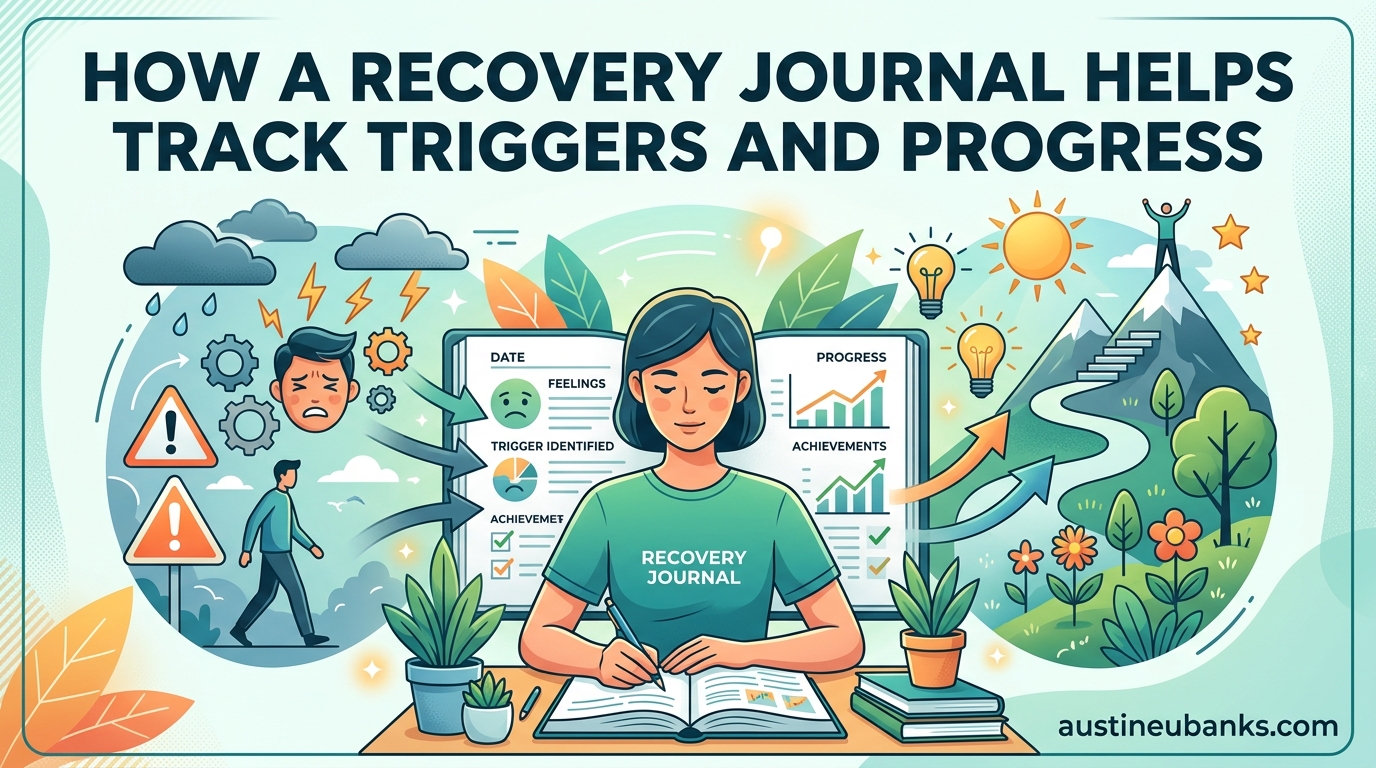
Recovery is not a straight line. Some days you feel strong and grounded, and other days something small sets off a wave of cravings or difficult emotions you did not see coming. Without a way to track what happened and when, those moments feel random. Understanding how a recovery journal helps track triggers and progress can change that completely.
A recovery journal turns the invisible work of healing into something you can actually see. It gives you a private, judgment-free space to record what you felt, what triggered you, how you responded, and what worked. Over time, those daily entries become a map of your personal patterns and a record of how far you have come.
In this guide, I will walk you through exactly what a recovery journal is, how it works to identify triggers, how it measures real progress, and how to start one today. Whether you are in early recovery from addiction, working through trauma, or managing a mental health condition, this practice can become one of your most dependable tools.
Table of Contents
What Is a Recovery Journal?
A recovery journal is a personal writing practice where you document your thoughts, feelings, urges, and daily experiences to identify emotional triggers, recognize behavioral patterns, and measure your progress over time. Unlike a traditional diary that records events, a recovery journal focuses specifically on your internal landscape and healing process.
People use recovery journals for many different paths. Addiction recovery is the most common, but the same principles apply to mental health recovery, trauma processing, eating disorder recovery, and behavioral change. If you are working to understand yourself better and build healthier coping strategies, journaling applies to your situation.
The key difference between a recovery journal and casual journaling is intention. You are not just venting or recording what happened. You are actively looking for patterns, tracking specific data points like craving intensity or mood, and reviewing what you wrote to extract insights. It is part reflection, part data collection, and part self-therapy.
You can use anything as your journal. A simple notebook, a notes app on your phone, a dedicated journaling app, or even voice memos all work. What matters is consistency and honesty, not the format.
How a Recovery Journal Helps Track Triggers
Triggers are the people, places, emotions, situations, or even times of day that increase your risk of relapse, emotional overwhelm, or unhealthy behavior. They are often invisible until you start tracking them systematically. That is where a recovery journal becomes essential.
Here is how the trigger-tracking mechanism works, step by step.
Step 1: Log the Moment
When you experience a craving, an emotional spike, or an urge to act on old behavior, write it down as soon as possible. Record the date, time, and what was happening right before the feeling hit. Were you alone? Did you just see a specific person? Were you bored, angry, or anxious? Even a few sentences capture enough detail to work with.
Step 2: Rate the Intensity
Assign a number from 1 to 10 to the craving or emotional reaction. This is sometimes called a craving intensity scale. A 1 might be a passing thought you can dismiss easily, while a 10 is an overwhelming urge that consumed your attention. Recording intensity helps you see which triggers are mild versus which ones truly challenge you.
Step 3: Note What You Did
Write down how you responded. Did you use a coping skill? Did you reach out to someone? Did you sit with the feeling until it passed? Or did you act on the urge? Recording your response lets you evaluate which coping strategies actually work for you and which ones fall short.
Step 4: Review Weekly for Patterns
This is the step most people skip, and it is the most important one. After one or two weeks of entries, sit down and read through everything. Look for repeats. You might notice that your strongest cravings always hit on Sunday evenings. Or that seeing a certain person consistently sends your anxiety through the roof. Or that boredom triggers more urges than stress does.
Reddit users in recovery communities like r/stopdrinking frequently report that this review process is what made journaling click for them. They could not see their patterns from day to day, but when they read a week or month of entries together, the patterns jumped out.
Step 5: Plan Your Response
Once you identify a trigger pattern, you can prepare for it. If Sunday evenings are hard, you can plan a support call, a meeting, or a healthy activity for that time. If a specific coworker stresses you out, you can develop a strategy for managing those interactions. Your journal transforms triggers from surprises into predictable events you can handle.
Here is a sample trigger entry format you can use:
- Date and time: Tuesday, 7:15 PM
- Trigger: Coworker made a passive-aggressive comment about my work
- Emotion: Anger, then shame, then craving (intensity: 7/10)
- Physical sensation: Tight chest, clenched jaw
- What I did: Took 10 deep breaths, texted my sponsor, went for a walk
- What helped: The walk and the text. Breathing alone was not enough.
- Pattern note: Third time this month that criticism at work has triggered me
This kind of structured entry takes less than five minutes to write, but it gives you a wealth of information over time.
How a Recovery Journal Helps Track Progress
Tracking progress in recovery is notoriously difficult. Counting days sober or symptom-free is helpful, but it does not capture the full picture. A recovery journal helps you measure growth in areas that are harder to quantify, like emotional regulation, self-awareness, and coping skill development.
Milestone Tracking
Your journal becomes a timeline of achievements that matter to you personally. When you look back, you can see the exact entry where you handled a trigger without acting on it for the first time. Or the day you reached out for help instead of isolating. These milestones are easy to forget when you are in the middle of recovery, but your journal preserves them.
Emotional Growth Markers
Over weeks and months, your writing itself changes. Many people notice that early entries are short, scattered, and dominated by negative emotions. Later entries tend to be longer, more reflective, and include more balanced emotional language. You might start including gratitude, humor, or self-compassion where there used to be only frustration and self-criticism. That shift in your writing mirrors real emotional growth.
Coping Skill Development
Your journal tracks which coping strategies you tried, how well they worked, and how your toolkit has expanded. In early recovery, you might have had one or two coping skills. Months later, your entries might reference five or six different strategies you use depending on the situation. Seeing that growth documented gives you confidence that you are building real resilience, not just white-knuckling through difficult moments.
Before and After Comparisons
One of the most powerful moments in recovery is reading an entry from three or six months ago and realizing how much has changed. The situation that felt unbearable then might feel manageable now. The trigger that used to register a 9 out of 10 might now be a 4. Your journal gives you concrete evidence that recovery is working, even on days when it does not feel like it.
Reddit users in recovery forums often share that measuring progress beyond day-counting was a turning point. One common approach is tracking the “weather inside” (your emotional state) alongside the “weather outside” (external circumstances). Over time, you can see that your internal weather has become more stable even when external storms hit.
The Science Behind Journaling in Recovery
Journaling is not just a feel-good practice. Decades of research support its effectiveness for emotional processing, stress reduction, and physical health.
Dr. James Pennebaker, a psychology professor at the University of Texas at Austin, pioneered the research on expressive writing in the 1980s. His studies found that writing about traumatic or difficult experiences for 15 to 20 minutes over several days led to measurable improvements in both mental and physical health. Participants who engaged in expressive writing had fewer doctor visits, improved immune function, and better psychological outcomes compared to control groups.
The mechanism appears to involve cognitive processing. When you write about difficult experiences, you engage the prefrontal cortex, the part of the brain responsible for executive function, planning, and impulse control. This engagement helps you organize fragmented memories and emotions into a coherent narrative. Instead of feeling overwhelmed by a tangled mess of feelings, you gain a structured understanding of what happened and why.
For people in recovery, this matters enormously. Addiction and trauma both weaken prefrontal cortex function, which is why impulse control and emotional regulation are so challenging during early recovery. Regular journaling exercises this same brain region, essentially giving it a workout. Over time, the practice strengthens the neural pathways that support self-control and emotional balance.
Research also shows that journaling reduces stress by lowering cortisol levels. Lower stress means fewer stress-triggered cravings and better overall recovery outcomes. The act of putting feelings into words, what psychologists call affect labeling, has been shown in brain imaging studies to reduce activity in the amygdala, the brain’s fear and threat detection center.
Core Benefits of Recovery Journaling
The benefits of keeping a recovery journal go beyond trigger tracking and progress measurement. Here are the core advantages that practitioners and researchers consistently report.
1. Emotional Release — Writing provides a safe outlet for emotions that might otherwise build up and lead to unhealthy behavior. Instead of suppressing anger, fear, or sadness, you express them on the page. Many people find that the simple act of writing down a difficult feeling reduces its intensity.
2. Self-Awareness — Journaling forces you to pay attention to your inner world. Over time, you develop a much clearer understanding of your emotional triggers, your typical thought patterns, and your automatic reactions. This self-awareness is the foundation of all meaningful change.
3. Stress Reduction — As mentioned above, expressive writing lowers cortisol and reduces stress. Lower stress levels directly support recovery by reducing one of the most common relapse triggers.
4. Improved Emotional Regulation — By naming and processing emotions through writing, you build your capacity to manage them without acting on them. This skill transfers to real-world situations where you face triggers and need to respond rather than react.
5. Relapse Prevention — By identifying your personal triggers and planning responses in advance, you reduce the likelihood of relapse. Your journal becomes a personalized relapse prevention plan that evolves as you learn more about yourself.
6. Therapy Enhancement — Journal entries give you concrete material to bring to therapy sessions. Instead of trying to remember how your week went, you can reference specific entries. Many therapists encourage journaling between sessions for exactly this reason.
7. Accountability — The act of recording your actions and feelings creates a gentle form of self-accountability. You are more likely to follow through on commitments when you know you will be writing about them.
8. Confidence Building — Reading past entries where you successfully handled difficult situations reminds you that you are capable. This evidence-based confidence is more durable than motivational quotes or pep talks.
Forum users across recovery communities consistently highlight one principle: consistency matters more than length or quality of writing. Even one sentence per day is better than skipping entirely. The value compounds over time as entries accumulate.
Recovery Journal Types and How to Choose
There is no single right way to keep a recovery journal. Different formats serve different purposes. Here is a breakdown of the most common types and when to use each one.
Trigger and Craving Log: This is the most structured format. You use a consistent template to record each trigger event, craving intensity, your response, and what helped. Best for people in early recovery who need to identify patterns quickly.
Emotional Journal: Focuses on documenting your emotional states throughout the day. You track what you felt, when, and what might have caused it. Best for people working on emotional regulation or processing trauma.
Gratitude Journal: You write down three to five things you are grateful for each day. This practice shifts your focus toward positive aspects of life and has been shown to improve mood and resilience. Best as a complement to other journal types, not a replacement.
Self-Reflection Journal: Open-ended writing about your thoughts, experiences, and insights. Less structured than a trigger log but more intentional than a diary. Best for people who enjoy writing and want space to explore their inner world.
Goal-Setting Journal: You set recovery goals, track your progress toward them, and reflect on obstacles. Best for people who are motivated by targets and measurable outcomes.
Bullet Journal: A customizable system that combines task lists, habit trackers, mood trackers, and short reflections. Best for people who want structure without heavy writing and appreciate visual tracking. Reddit’s bullet journal communities are full of recovery-focused layouts.
When it comes to format, you have three main options. Physical notebooks offer privacy, tactile engagement, and no screen distractions. Many people find that handwriting itself slows their thinking in a helpful way. Digital journaling apps offer search functionality, password protection, and convenience since your phone is always with you. Audio or video journals work well for people who process better by talking than writing, though reviewing audio entries for patterns takes more effort.
Many people combine formats. A physical notebook for evening reflection, a quick phone note for trigger events during the day, and a weekly review session where they pull it all together. There is no wrong combination as long as it works for you.
How to Start a Recovery Journal: Step by Step
Starting a recovery journal is simple, but building the habit takes strategy. Here is a practical guide to getting started and sticking with it.
Step 1: Choose your format. Pick whatever feels easiest and most accessible. If you love notebooks, get one. If your phone is always in your hand, use a notes app. The best journal is the one you will actually use.
Step 2: Set a minimum commitment. Start with five minutes per day. Forum users in recovery communities consistently say that lowering the barrier to entry is what helped them build the habit. Five minutes feels achievable. Once the habit is established, you can write longer if you want to.
Step 3: Attach it to an existing routine. This technique, called habit-stacking, dramatically improves consistency. Write in your journal after your morning coffee, before bed, or right after your daily check-in call. Linking the new habit to something you already do makes it automatic.
Step 4: Use prompts when you feel stuck. Writer’s block is the most common reason people abandon journaling. Keep a list of prompts handy so you never face a blank page without direction. The next section includes specific prompts for trigger tracking and progress measurement.
Step 5: Review weekly. Set aside 15 to 20 minutes each week to read through your entries. Look for patterns, celebrate wins, and identify areas where you struggled. This review is where the real insight happens.
Step 6: Be honest. Your journal is private. Nobody else needs to see it unless you choose to share. Honesty is what makes journaling effective. If you filter your entries to make yourself look better, you lose the data that would help you grow.
Step 7: Let go of perfectionism. Misspellings, incomplete sentences, and messy handwriting are all fine. Some days you might write three pages. Other days you might write one sentence. Both count. The goal is consistency, not literary quality.
Common Mistakes to Avoid
Avoid treating your journal like a school assignment. If you approach it as a chore, you will quit. Approach it as a conversation with yourself.
Do not skip the review step. Writing entries without ever reading them back is like collecting data without analyzing it. The patterns live in the aggregate, not in individual entries.
Do not wait for the perfect moment or the perfect notebook. Start today with whatever you have. The first few weeks of entries will feel awkward, and that is normal. It gets easier.
Avoid using your journal only for negative experiences. If you only write when things go wrong, your journal becomes a record of pain rather than a record of growth. Include your wins, your gratitude, and your small victories too.
Recovery Journal Prompts for Triggers and Progress
When you are not sure what to write, prompts get you started. Here are prompts specifically designed for trigger tracking and progress measurement.
Trigger-Tracking Prompts
- What happened right before I felt the urge today?
- Who was I with, and how did I feel in their presence?
- What emotion was I trying to avoid or escape?
- Where in my body did I feel the craving or urge?
- What time of day was it, and what was my energy level?
- What coping skill did I use, and did it work?
- If I could rewind five minutes before the trigger, what would I change?
- Is this a trigger I have seen before? When was the last time?
Progress-Measuring Prompts
- What is one thing I handled better this week than I would have a month ago?
- What coping skill did I use for the first time recently?
- Who did I reach out to for support this week, and how did it feel?
- What is something I am proud of from the past seven days?
- How has my emotional range changed since I started journaling?
- What trigger that used to overwhelm me now feels more manageable?
- What goal did I make progress toward this week?
- What would I tell someone who is where I was six months ago?
Pick one or two prompts per day rather than trying to answer all of them. Rotate through them over the course of a few weeks. You will notice that your answers evolve over time, and that evolution is your progress made visible.
Frequently Asked Questions
Why is journaling important in recovery?
Journaling is important in recovery because it transforms the often invisible process of healing into tangible, trackable data. It helps you identify emotional triggers, recognize behavioral patterns, measure real progress beyond day-counting, reduce stress through emotional expression, and strengthen impulse control through cognitive processing. It also gives you concrete material to bring to therapy sessions and serves as a personalized relapse prevention tool.
What is the 3-3-3 journal method?
The 3-3-3 journal method is a simple daily journaling structure where you write down three things you are grateful for, three goals or intentions for the day, and three accomplishments or positive moments from the day. It provides a quick, balanced framework that covers appreciation, direction, and reflection without requiring lengthy writing sessions.
What are the 5 C’s of recovery?
The 5 C’s of recovery are Competence, Confidence, Connection, Character, and Caring. These represent core areas of personal growth that support lasting recovery. Competence means developing coping skills, confidence is building self-trust, connection is strengthening relationships, character is living by your values, and caring is developing compassion for yourself and others. A recovery journal can help you track growth in each of these areas.
How to journal about triggers?
To journal about triggers, write down the date and time, describe what happened right before the trigger, note the specific emotion and physical sensation you experienced, rate the intensity on a scale of 1 to 10, record what you did in response, and note whether your coping strategy worked. Review these entries weekly to identify repeating patterns in people, places, emotions, or situations that consistently trigger you, then plan specific responses for each identified trigger.
Conclusion
Understanding how a recovery journal helps track triggers and progress gives you one of the most practical tools available for sustained healing. By logging trigger events, reviewing for patterns, and measuring growth beyond simple day-counts, you transform recovery from something that feels abstract into something you can see, understand, and actively shape.
Start small. Five minutes a day with a notebook or phone is enough. The power is not in any single entry but in the accumulation of entries over weeks and months. Your future self will thank you for the roadmap you are creating today.