
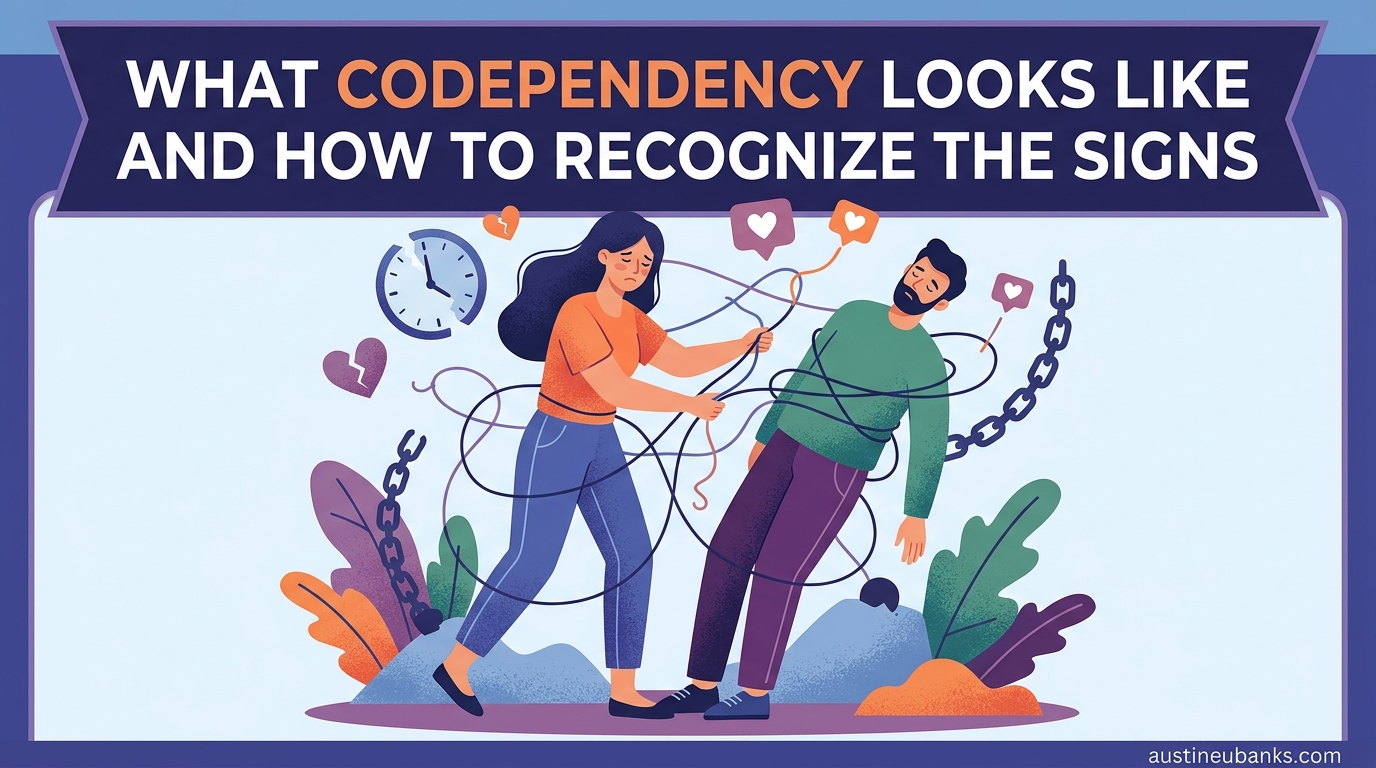
You plan the entire day around their mood. You cancel plans with friends because they seem upset. You spend hours rehearsing what to say so you do not trigger an argument. And when someone asks what you need, you genuinely cannot remember the last time you thought about it.
If this sounds familiar, you are not alone. Millions of people live inside this dynamic without ever putting a name to it. Understanding what codependency looks like and how to recognize the signs is the first real step toward reclaiming your sense of self.
Codependency is one of those patterns that hides in plain sight. It disguises itself as devotion, loyalty, love, and care. Society praises selflessness, so the line between being a good partner and losing yourself entirely can blur until it disappears. I have talked with people who spent 10, 20, even 30 years in codependent dynamics before they stumbled across the term in a book or a Reddit thread and felt the floor drop out from under them.
The confusion is understandable. Nobody hands you a manual for healthy relationships. You learn from what you see growing up, and if what you saw involved sacrifice, enmeshment, or walking on eggshells, that becomes your normal. You carry that blueprint into every friendship, romance, and workplace connection without questioning it.
This guide exists to change that. We are going to break down exactly what codependency looks like in real life, not just in clinical textbooks. You will learn the signs, the underlying causes, how it differs from healthy interdependence, and what you can actually do about it. Whether you are questioning your own patterns or trying to understand someone you love, what you learn here can be the turning point.
Recognizing codependency is not about labeling yourself or assigning blame. It is about clarity. Once you can see the pattern, you can change it. And changing it does not mean becoming cold or selfish. It means learning to love someone without disappearing into them.
Table of Contents
What Codependency Looks Like: Quick Answer
Codependency is a relationship pattern where one person consistently prioritizes another person’s needs, emotions, and problems over their own, often losing their identity, autonomy, and sense of self-worth in the process. It is sometimes called relationship addiction because the person builds their entire emotional life around fixing, rescuing, or pleasing someone else.
The core signs include:
- An exaggerated sense of responsibility for other people’s actions, feelings, and choices
- Confusing love with pity and being drawn to people you feel compelled to rescue or fix
- Consistently doing more than your share while feeling hurt when your efforts go unrecognized
- Difficulty identifying your own needs, wants, opinions, and even preferences
- Staying in unbalanced relationships out of fear of abandonment or being alone
- Feeling anxiety or guilt when you try to set boundaries or take care of yourself
What Is Codependency?
At its core, codependency is a behavioral pattern in which a person becomes emotionally, psychologically, and sometimes practically dependent on another person to the point of losing themselves. The term originated in the 1970s within the addiction recovery community. Therapists noticed that partners of people with substance use disorders often developed their own set of compulsive behaviors centered around managing, enabling, and covering for the addicted person.
Since then, the definition has expanded far beyond addiction contexts. Today, mental health professionals recognize codependency as a pattern that can appear in any type of relationship. Romantic partnerships are the most commonly discussed, but codependent dynamics show up in parent-child relationships, friendships, workplace connections, and even caregiver situations. The common thread is always the same: one person organizes their entire emotional life around another person.
Some therapists prefer the term relationship addiction because it captures the compulsive quality of the pattern. A codependent person does not simply choose to help or support someone. They feel compelled to. The compulsion can be as powerful as any chemical dependency, and walking away from the relationship can trigger genuine withdrawal-like symptoms including anxiety, panic, depression, and physical distress.
It is worth noting that codependency is not recognized as a formal psychiatric diagnosis in the DSM-5. Some clinicians argue it should be. Others prefer to view it through the lens of attachment theory, personality psychology, or family systems theory. Regardless of the framework you use, the experience is real, the patterns are consistent, and the impact on a person’s life can be devastating if left unaddressed.
The 5 Core Symptoms of Codependency (Pia Mellody’s Framework)
One of the most influential frameworks for understanding codependency comes from Pia Mellody, a pioneer in the field of codependency treatment. In her work at The Meadows treatment center, she identified five core symptoms that define the codependent experience. This framework appears frequently in People Also Ask questions, and understanding it provides a solid foundation for recognizing codependency in yourself or others.
1. Difficulty experiencing appropriate levels of self-esteem. Codependent individuals often struggle with low self-worth that is not tied to reality. They may feel inherently defective or less than others, or they may swing to the other extreme and feel entitled and grandiose. Either way, their sense of value is unstable and dependent on external validation.
2. Difficulty setting and maintaining functional boundaries. People with codependency often cannot tell where they end and another person begins. Their boundaries are either too loose, letting everyone’s emotions and problems flood in, or too rigid, walling themselves off entirely. Most commonly, the boundaries are porous, making them highly vulnerable to other people’s moods and demands.
3. Difficulty owning and expressing their own reality. This includes difficulty identifying what they feel, think, want, and need. A codependent person may have spent so long focusing on others that they have lost contact with their own internal experience. When asked what they want for dinner, they genuinely may not know.
4. Difficulty acknowledging and meeting their own needs and wants. Codependent individuals are expert caretakers but terrible self-carers. They can identify exactly what someone else needs and rush to provide it, but they will dismiss, minimize, or feel guilty about their own needs. Self-care feels selfish, even though it is essential.
5. Difficulty experiencing and expressing their reality moderately. Codependent people tend to live in extremes. They are either over-involved or completely detached. They either feel everything intensely or numb out entirely. Moderation, that healthy middle ground where most functional living happens, feels foreign and uncomfortable.
The 4 C’s of Codependency
Another commonly referenced framework in recovery communities is the 4 C’s. This shorthand comes from twelve-step programs like Co-Dependents Anonymous (CoDA) and captures the essence of the codependent experience in four simple statements:
1. I did not Cause it. You did not cause the other person’s behavior, addiction, emotional state, or problems. No matter how much you try to take responsibility, their choices are their own.
2. I cannot Control it. You cannot control another person’s actions or emotions through caretaking, anticipating, managing, or walking on eggshells. The illusion of control is one of codependency’s deepest traps.
3. I cannot Cure it. You cannot fix, heal, or save another person, no matter how much you love them. Their recovery, growth, and choices are theirs alone.
4. I can take Care of myself. This is the turning point. The only person whose behavior, emotions, and life you can genuinely tend to is your own. Shifting your focus back to self-care is the foundation of recovery.
The 4 Types of Codependency
Not all codependency looks the same. Researchers and clinicians have identified several distinct patterns, and understanding which type resonates with your experience can make the path to change clearer.
1. The Caregiver (or Enabler). This person expresses their codependency through compulsive caretaking. They are the fixer, the rescuer, the one who always shows up. They feel most valuable when someone needs them, and they unconsciously seek out situations where they can be needed. The danger is that their helping often crosses into enabling, keeping the other person stuck.
2. The Compliant (or People-Pleaser). This type abandons their own needs to keep the peace and avoid conflict. They are hyper-aware of others’ moods and constantly adjust their behavior to prevent upset. Their identity becomes a mirror reflecting what others want to see.
3. The Controller. Less commonly recognized but equally codependent, the controller manages other people’s lives to manage their own anxiety. They may come across as bossy, manipulative, or overbearing. Underneath the control is deep fear of vulnerability and loss.
4. The Avoidant. This type combines codependency with emotional walling-off. They need the relationship but fear intimacy, creating a push-pull dynamic. They may appear independent on the surface but are actually using distance to manage their fear of engulfment or abandonment.
A Quick Summary of Key Signs to Watch For
Before we go deep into individual signs, here is a rapid-fire overview of the most common indicators. If several of these resonate, the detailed sections below will help you understand exactly how each one shows up in daily life.
You might be experiencing codependency if you regularly feel responsible for other people’s happiness, emotions, or choices. You might notice that your mood depends entirely on how your partner, friend, or family member is feeling. You might find yourself unable to make decisions, even small ones, without checking with someone else first.
Other common signs include feeling guilty when you take time for yourself, having trouble saying no even when you are already overwhelmed, and staying in relationships that feel one-sided because the alternative of being alone feels unbearable. Many people with codependent patterns also describe a pattern of being attracted to people who need fixing or who are emotionally unavailable.
Physical symptoms can accompany these emotional patterns. Anxiety, tension headaches, digestive issues, and sleep problems are frequently reported by people in codependent dynamics. Your body often knows something is wrong before your mind catches up.
Signs of Codependency You Should Never Ignore
Now let us look at the specific, recognizable signs of codependency in detail. These are organized into categories so you can identify which patterns show up most strongly in your life or in someone you care about.
Emotional Signs of Codependency
You feel responsible for other people’s emotions. If your partner is sad, you feel like it is your job to fix it. If they are angry, you immediately wonder what you did wrong. This sense of responsibility extends to everyone around you, and it is exhausting. You carry emotional weight that does not belong to you.
Your self-worth depends on being needed. You feel most valuable when someone is relying on you. When no one needs you, you feel empty, purposeless, or anxious. Being needed feels like being loved, and being self-sufficient feels like being abandoned.
You experience guilt when practicing self-care. Taking time for yourself, spending money on your own needs, or even resting feels selfish. You might intellectually know that self-care is healthy, but emotionally, it feels wrong. This guilt is one of the clearest indicators that codependent patterns are at work.
You fear abandonment intensely. The thought of being alone or rejected triggers deep, almost primal fear. This fear drives much of the codependent behavior, keeping you in relationships long after they have stopped being healthy. You might tolerate mistreatment simply to avoid being left.
You feel resentment building but cannot express it. You do more than your share, give more than you receive, and pour yourself out for others. But underneath the giving, resentment grows. You cannot express it because conflict feels dangerous, so it calcifies into passive aggression, emotional withdrawal, or physical tension.
You struggle to identify your own feelings. When someone asks how you feel, you draw a blank. You might be able to describe what others feel with pinpoint accuracy, but your own emotional landscape feels foggy. This disconnection from your feelings is a direct result of years of prioritizing others’ emotions over your own.
You feel a high from caretaking that eventually crashes. Many people describe a rush of satisfaction when they are rescuing or helping someone. It feels purposeful and meaningful. But that high is always followed by a crash, especially when the person you helped does not change, does not appreciate your effort, or moves on without you.
Behavioral Signs of Codependency
You consistently do more than your share. In every relationship and situation, you end up carrying the load. You plan the dates, manage the household, handle the emotional labor, and step in to solve problems that are not yours to solve. Doing less feels uncomfortable, even wrong.
You have difficulty saying no. Whether it is a request from a coworker, a favor for a friend, or a demand from a partner, saying no feels impossible. You might say yes immediately and regret it later, or you might agonize over how to decline without disappointing anyone. Your default is compliance.
You avoid conflict at all costs. Disagreement feels dangerous. You will bend your preferences, suppress your opinions, and absorb unfair treatment rather than risk an argument. Peace-keeping is not a choice for you. It is a survival strategy.
You make decisions based on what others want. What to eat, what movie to watch, where to live, whether to take a job. Instead of consulting your own preferences, you defer. If you do have a preference, you might suppress it to avoid inconveniencing someone else.
You check in constantly. If you have not heard from your partner or close friend, you feel anxious. You might send multiple texts, check their social media, or feel physical tension until you receive confirmation that everything is okay. The need for reassurance is constant and compulsive.
You isolate yourself to focus on the relationship. Over time, your social circle shrinks. You cancel plans because your partner wants your attention, or because they disapprove of certain friends. Your world becomes smaller and smaller until the relationship is your entire world.
You engage in enabling behaviors. You cover for someone’s mistakes, make excuses for their behavior, lend money you cannot afford, or shield them from consequences. You tell yourself you are helping, but you are actually preventing them from facing reality and making necessary changes.
Relational Signs of Codependency
You are drawn to people who need fixing. There is a pattern in who you choose. You are attracted to people who are struggling, emotionally unavailable, dealing with addiction, or carrying significant baggage. The desire to rescue feels like love, but it is actually a codependent dynamic in disguise.
Your relationships feel one-sided. You give, they take. You accommodate, they expect. You compromise, they do not. Despite this imbalance, you stay, often convincing yourself that things will change or that your love will be enough to transform the dynamic.
You cannot tell where you end and your partner begins. Your identities have merged. You finish each other’s sentences, share all the same opinions, and have lost track of which hobbies, preferences, and beliefs were yours before the relationship. Independence feels like a threat to the bond.
You stay in relationships that are clearly unhealthy. Friends and family have expressed concern. You have thought about leaving many times. But the fear of being alone, the hope that things will improve, and the identity you have built around the relationship keep you locked in place.
You feel jealous or threatened by your partner’s independence. When your partner spends time with friends, pursues their own interests, or seems happy without you, it triggers anxiety. Their independence feels like rejection, even when it is healthy and normal.
You have a history of repeating the same relationship patterns. Different partners, same dynamic. Each relationship starts with hope and ends with the same exhaustion, resentment, and loss of self. The pattern repeats because the underlying wound has not been addressed.
Codependency in Friendships and the Workplace
Most discussions of codependency focus on romantic relationships, but the pattern shows up everywhere. In friendships, codependency can look like being the designated therapist for everyone in your circle. You are always available, always listening, always helping. Your friends rely on you completely, but no one asks how you are doing. The friendship feels essential to you but is deeply unbalanced.
In the workplace, codependency manifests as the employee who cannot stop overworking. You take on extra projects, cover for colleagues, and never push back on unreasonable demands. You might be praised as a team player, but you are burning out. Your self-worth is tied to being indispensable, and the thought of letting someone down triggers intense anxiety.
Parent-child codependency is another common but under-discussed dynamic. This can go in both directions. A parent might be overly enmeshed with their adult child, unable to let them make independent decisions or live their own life. Or an adult child might feel responsible for a parent’s emotional well-being, sacrificing their own life trajectory to caretake.
Recognizing codependency in these non-romantic contexts is just as important. The pattern does not need a romantic partner to thrive. Any relationship where you consistently abandon yourself to focus on someone else can become codependent.
What Does High-Functioning Codependency Look Like?
This is one of the most searched questions about codependency, and almost no top article answers it in a dedicated section. That needs to change, because high-functioning codependency is arguably the most common form, and it is also the hardest to recognize.
High-functioning codependency describes a pattern where the person appears successful, competent, and put-together on the outside. They have a career, a social life, and a stable relationship. From the outside, everything looks fine. But underneath the surface, the same codependent patterns are running.
Signs of high-functioning codependency include:
- You are the person everyone relies on, and you wear that as a badge of honor rather than recognizing it as a burden
- You are highly competent and successful in your career but feel empty or lost when you are not being needed
- You appear independent but actually structure your entire life around someone else’s moods and needs
- You are the friend who always has it together, so no one thinks to ask if you are okay
- You excel at managing other people’s problems but avoid looking at your own emotional landscape
- You feel anxious or restless when things are calm, because you are accustomed to being in crisis-management mode
- You use busyness and productivity to avoid sitting with your own feelings
- Your relationships look functional on paper but feel one-sided and draining in practice
The danger of high-functioning codependency is that it is invisible. Friends, family, and colleagues see someone who is thriving. The person themselves may not recognize the pattern because they are not falling apart in visible ways. But the internal experience is one of chronic anxiety, emotional disconnection, and a persistent sense that something is missing.
Many people with high-functioning codependency do not seek help until a crisis forces the issue. A burnout at work, a relationship breakdown, or a health scare finally cracks the facade. If any of the signs above resonate, do not wait for a crisis. Recognizing the pattern now can save you years of quiet suffering.
Codependent vs. Interdependent: What Is the Difference?
One of the most common questions people ask when they first learn about codependency is whether all close relationships involve some level of dependency. The answer is yes, healthy relationships do involve mutual reliance. But there is a profound difference between codependency and interdependence, and understanding that difference is essential.
Interdependence means two people who are each whole, autonomous individuals choosing to share their lives. They support each other, rely on each other, and are deeply connected. But neither person has lost their identity, autonomy, or sense of self. Both can function independently, and both choose to be together not out of fear but out of genuine desire.
Codependency, by contrast, involves a loss of self. The codependent person cannot function independently without anxiety. Their identity, self-worth, and emotional stability depend on the relationship. What looks like closeness is actually enmeshment, and what feels like love is often a mixture of fear, obligation, and compulsive caretaking.
Here is a practical comparison to help you tell the difference:
- Identity: Interdependent people know who they are inside and outside the relationship. Codependent people lose their identity within the relationship.
- Boundaries: Interdependent people can say no without guilt and respect when their partner says no. Codependent people have porous boundaries and feel rejected when a partner sets a limit.
- Needs: Interdependent people communicate their needs directly. Codependent people suppress their needs and expect their partner to read their mind.
- Emotions: Interdependent people take responsibility for their own emotional state. Codependent people feel responsible for their partner’s emotions and vice versa.
- Conflict: Interdependent people can disagree and still feel secure. Codependent people experience conflict as a threat to the relationship and avoid it at all costs.
- Independence: Interdependent people enjoy time apart and have their own interests. Codependent people feel abandoned when their partner is independent.
- Self-worth: Interdependent people have stable self-esteem that exists regardless of relationship status. Codependent people only feel worthy when needed.
Enabling vs. Helping: Knowing the Difference
A related distinction that trips people up is the difference between helping and enabling. Both look like support on the surface, but they have opposite effects.
Helping empowers the other person. You provide assistance that allows them to grow, handle their responsibilities, and become more capable. You set limits on what you will do and communicate them clearly. Helping is intentional, bounded, and respectful of the other person’s autonomy.
Enabling keeps the other person stuck. You take over responsibilities that are rightfully theirs, shield them from consequences, and solve problems they should be solving themselves. Enabling feels like love but actually perpetuates the dysfunction. It comes from a place of fear, not empowerment.
Ask yourself this simple question: Is what I am doing helping this person become more capable, or is it keeping them dependent on me? If the answer is the latter, you may be enabling, and the most loving thing you can do is step back.
What Causes Codependency?
Codependency does not appear out of nowhere. It develops over time, usually beginning in childhood, as a set of survival strategies that once made sense but have outlived their usefulness. Understanding the roots of your codependent patterns is not about blaming your family. It is about making sense of why you do what you do so you can choose differently.
Childhood and Family Dynamics
The most common origin of codependency is growing up in a family where emotional needs were not consistently met. This can happen in families affected by addiction, mental illness, abuse, or chronic illness, but it can also happen in families that look perfectly functional from the outside.
If you grew up with a parent who was emotionally unavailable, you may have learned to suppress your own needs and focus on managing the parent’s emotions. If a parent relied on you for emotional support, you may have been parentified, taking on adult responsibilities far too early. If love was conditional on being good, helpful, or quiet, you learned that your worth depended on performance.
Children are incredibly adaptive. If the environment rewards self-sacrifice, compliance, and caretaking, those behaviors become deeply ingrained. By the time you reach adulthood, they feel like personality traits rather than learned patterns. But they are learned, which means they can be unlearned.
Specific family dynamics that contribute to codependency include having a parent with substance use disorder, growing up with a mentally ill parent, experiencing emotional neglect even in the absence of overt abuse, being the peacemaker in a high-conflict household, and being praised exclusively for helpfulness and compliance rather than for authenticity.
Attachment Style and Codependency
Attachment theory provides another lens for understanding codependency. Your attachment style forms in early childhood based on your relationship with your primary caregivers, and it shapes your relationship patterns for life.
Anxious attachment, also called anxious-preoccupied or ambivalent attachment, is the attachment style most closely associated with codependency. If your caregivers were inconsistent, sometimes responsive and sometimes not, you likely developed a hyperactive attachment system. You learned to monitor the other person constantly, cling to connection, and fear abandonment as a matter of survival.
People with anxious attachment tend to feel unworthy of love and deeply afraid of being alone. They seek constant reassurance, become preoccupied with their partner’s availability, and interpret neutral behavior as rejection. These traits map almost perfectly onto codependent patterns.
It is worth noting that attachment styles are not fixed. With awareness, therapy, and practice, you can develop what psychologists call earned secure attachment. This means moving from an anxious or avoidant pattern toward a secure one through intentional work and healthy relationship experiences.
Cultural and Gender Factors
No top competitor in this space addresses how culture and gender shape codependency, but these factors are significant. Many cultures, particularly those with strong collectivist values, emphasize self-sacrifice, family duty, and putting others first. While these values have positive aspects, they can create a fertile environment for codependent patterns to develop and go unrecognized.
Women in particular are socialized from a young age to be caretakers, peacemakers, and emotional laborers. Society rewards women for self-sacrifice and punishes them for assertiveness. Many women internalize the message that their value lies in how well they care for others, which is essentially codependency training.
Men experience codependency too, but it often looks different. Men may express codependent patterns through workaholism, controlling behavior, or emotional withdrawal rather than overt caretaking. The cultural expectation that men should be stoic and self-reliant can make it harder for them to recognize and seek help for codependent patterns.
Recognizing these cultural and gender influences does not excuse unhealthy behavior. But it does help explain why codependency is so widespread and why certain patterns feel so deeply ingrained. You are not just dealing with personal psychology. You are also navigating cultural messages that have been reinforced your entire life.
How to Recognize Codependency in Yourself
Reading about codependency is one thing. Recognizing it in your own life is another. The following self-reflection questions are designed to help you honestly assess your patterns. There is no score and no diagnosis. These questions are a mirror, not a verdict.
Take a moment with each one. Notice your gut reaction. If a question makes you uncomfortable, that discomfort is worth exploring.
- When was the last time I made a decision based purely on what I wanted, without considering anyone else’s reaction?
- If my partner, closest friend, or family member were unhappy with me, how would I feel? Would I be able to tolerate it?
- Do I know what my own needs are right now? Can I name three?
- When someone I care about is struggling, is my first impulse to fix it for them or to listen and let them navigate it?
- Do I have interests, hobbies, or friendships that exist completely outside of my primary relationship?
- How do I feel when I am alone? Is it peaceful, or does it trigger anxiety and restlessness?
- Have I ever stayed in a relationship or friendship long after I knew it was unhealthy? What kept me there?
- Do I feel guilty when I take time, money, or energy for myself?
- Would the people in my life describe me as easygoing, or would they say I never complain and always say yes?
- Do I confuse being needed with being loved?
- Am I drawn to people who are struggling, emotionally unavailable, or in need of rescue?
- Do I feel like I have to earn love through what I do for others?
If you answered honestly and several of these questions hit close to home, that is not cause for shame. It is cause for hope, because awareness is where change begins. Every person who has ever recovered from codependency started exactly where you are right now, recognizing a pattern they want to change.
Many people wonder whether they are codependent or just a caring person. This is one of the most common questions in codependency forums. The distinction comes down to motivation and impact. Healthy caring comes from a place of abundance. You help because you want to, not because you feel compelled to, and you can stop when helping becomes harmful to you. Codependent caretaking comes from a place of fear, obligation, and anxiety. You cannot stop even when it is hurting you, and your sense of self depends on the other person’s response.
How to Break Codependent Patterns
Recognizing codependency is a massive first step. But recognition alone does not change the pattern. Breaking codependent patterns requires intentional, ongoing effort. The good news is that it is absolutely possible, and people do it every day.
Step 1: Shift Your Focus Back to Yourself
The foundation of recovery from codependency is learning to turn your attention inward. For years, possibly decades, your radar has been pointed outward, scanning for what others need and feel. Start asking yourself what you need and feel, even if the answers are slow to come at first.
Begin with small questions. What do I want for lunch? What movie do I actually want to watch? How am I feeling right now? These seem trivial, but for someone with codependent patterns, they are profound. You are rebuilding the skill of knowing yourself.
Journaling is one of the most effective tools for this process. Write down your thoughts and feelings without filtering them for anyone else. Over time, patterns will emerge, and you will start to reconnect with preferences, desires, and needs that have been buried.
Step 2: Learn to Set and Maintain Boundaries
Boundaries are the antidote to enmeshment. A boundary is simply a clear statement of what you will and will not do, what you need, and what is acceptable to you. For codependent people, boundaries feel terrifying because they fear conflict and rejection. But without boundaries, healthy relationships are impossible.
Start small. Practice saying no to low-stakes requests. Communicate a preference instead of deferring. Tell someone you need time to think before answering. Each time you set a boundary and the world does not end, your confidence grows.
Remember that setting a boundary is not about controlling the other person. You cannot make them respect it. A boundary is about what you will do. If someone consistently crosses your boundaries, you may need to limit contact or step back from the relationship. That is not cruelty. It is self-respect.
Step 3: Build Your Self-Esteem Independent of Others
Codependency thrives on external validation. Recovery requires building an internal sense of worth that does not depend on being needed. This is deep work, and it takes time, but it is the most important thing you can do.
Identify your values, interests, and strengths that have nothing to do with your relationships. Pursue hobbies that are yours alone. Set personal goals that have nothing to do with anyone else. Practice self-compassion when you make mistakes instead of spiraling into self-criticism.
Affirmations can feel cheesy, but they work. Replace the voice that says you are only worth what you do for others with one that says you are inherently valuable. Over time, that new voice becomes louder and more convincing.
Step 4: Challenge Codependent Thoughts
Codependency comes with a set of deeply ingrained beliefs that drive the behavior. Thoughts like if I do not help, no one will. Or if I set a boundary, they will leave me. Or my needs are not as important as theirs. These thoughts feel like facts, but they are distortions.
Cognitive behavioral techniques can help you identify and challenge these thoughts. When a codependent belief surfaces, ask yourself: Is this actually true? What evidence do I have? Is there another way to see this? Over time, you can replace distorted thinking with more balanced, realistic perspectives.
Step 5: Seek Professional Support
Therapy is one of the most effective paths to overcoming codependency. A skilled therapist can help you explore the roots of your patterns, develop healthier relationship skills, and provide support and accountability as you change. Several therapeutic approaches are particularly effective for codependency.
Cognitive Behavioral Therapy (CBT) helps you identify and change distorted thought patterns. EMDR (Eye Movement Desensitization and Reprocessing) can process traumatic experiences from childhood that underlie codependent patterns. Psychodynamic therapy explores the deeper roots of your relationship dynamics. Co-Dependents Anonymous (CoDA) and Al-Anon offer free peer support based on twelve-step principles.
Many people in codependency recovery credit therapy as the turning point. It provides a safe space to explore painful patterns, practice new skills, and receive guidance from someone who understands the terrain. If cost is a barrier, many therapists offer sliding-scale fees, and online therapy platforms have made mental health support more accessible than ever.
What Healing from Codependency Looks Like
Recovery is not linear, and it does not happen overnight. But people who have done the work describe specific milestones that signal healing. Knowing what recovery looks like can give you hope and direction.
You will start to notice that you can be alone without feeling anxious. You will hear yourself saying no and feel calm instead of guilty. You will make decisions based on what you want and feel surprised by how natural it seems. Your relationships will start to feel more balanced, and you will attract people who respect your boundaries.
You will still have moments of slipping into old patterns. That is normal. The difference is that you will recognize the slip faster and course-correct sooner. Recovery is not about perfection. It is about awareness, choice, and gradual transformation.
FAQs
What are the 5 core symptoms of codependency?
The 5 core symptoms of codependency, as identified by Pia Mellody, are: difficulty experiencing appropriate self-esteem, difficulty setting and maintaining functional boundaries, difficulty owning and expressing your own reality (thoughts, feelings, needs), difficulty acknowledging and meeting your own needs and wants, and difficulty experiencing and expressing your reality moderately instead of in extremes.
What are the 4 C’s of codependency?
The 4 C’s of codependency are: I did not Cause it (the other person’s behavior is not your fault), I cannot Control it (you cannot manage another person’s choices through caretaking), I cannot Cure it (you cannot fix or save another person), and I can take Care of myself (shifting focus to your own needs and well-being is the path forward).
What are the 4 types of codependency?
The 4 main types of codependency are the Caregiver or Enabler (compulsive caretaking and rescuing), the Compliant or People-Pleaser (abandoning own needs to keep the peace), the Controller (managing others to manage their own anxiety), and the Avoidant (needing the relationship but fearing intimacy, creating a push-pull dynamic).
How do you tell if you are codependent?
You may be codependent if you consistently prioritize others’ needs over your own, feel responsible for other people’s emotions, struggle to identify your own wants and needs, fear abandonment, feel guilty when practicing self-care, have trouble saying no, avoid conflict at all costs, or feel your self-worth depends on being needed. If several of these signs resonate, it is worth exploring further.
What does high functioning codependency look like?
High-functioning codependency looks like someone who appears successful and put-together on the outside but is internally driven by codependent patterns. They are the reliable person everyone counts on, they excel at managing others’ problems while avoiding their own feelings, they feel anxious when things are calm, and they use busyness and productivity to avoid emotional introspection. It is the most common and hardest-to-recognize form of codependency.
Is codependency a mental illness?
Codependency is not classified as a mental illness or formal psychiatric diagnosis in the DSM-5. It is best understood as a behavioral pattern or relationship dynamic that develops from childhood experiences, family dynamics, and attachment style. However, it can coexist with and worsen mental health conditions like anxiety, depression, and CPTSD, and it can be effectively addressed through therapy.
Can codependency be cured?
Codependency cannot be cured overnight, but it can be effectively overcome with consistent effort. Therapy (especially CBT and EMDR), support groups like Co-Dependents Anonymous, boundary-setting practice, and self-esteem work all contribute to recovery. Many people who once struggled with severe codependent patterns go on to build healthy, balanced, interdependent relationships.
What is the difference between codependency and interdependence?
Codependency involves losing your identity, autonomy, and sense of self within a relationship, with your emotional stability dependent on the other person. Interdependence involves two autonomous individuals who choose to share their lives while maintaining their own identities, boundaries, and self-worth. Interdependent people can function independently and feel secure; codependent people feel anxious and lost without the relationship.
Conclusion: Recognizing the Pattern Is the First Step
Understanding what codependency looks like and how to recognize the signs is not an exercise in self-diagnosis or blame. It is an act of clarity and courage. The patterns we have explored, from compulsive caretaking and people-pleasing to fear of abandonment and loss of identity, are not character flaws. They are learned survival strategies that once kept you safe. The fact that they no longer serve you does not make them shameful. It makes them ready to be changed.
Every person who has ever recovered from codependency started with exactly what you are doing right now: paying attention. They noticed the pattern. They asked questions. They sought understanding. And then, one boundary at a time, one journal entry at a time, one therapy session at a time, they built a different way of relating to themselves and others.
If you recognized yourself in these signs, the most important next step is to seek support. Whether that means finding a therapist, joining a CoDA meeting, reading books like Codependent No More by Melody Beattie, or simply starting to ask yourself what you need, every step forward counts. You do not have to figure it all out at once. You just have to begin.
You deserve relationships where you are loved for who you are, not just for what you do. And you deserve to know who you are, independent of anyone else. That is not selfish. That is the foundation of every genuinely healthy relationship you will ever build.