
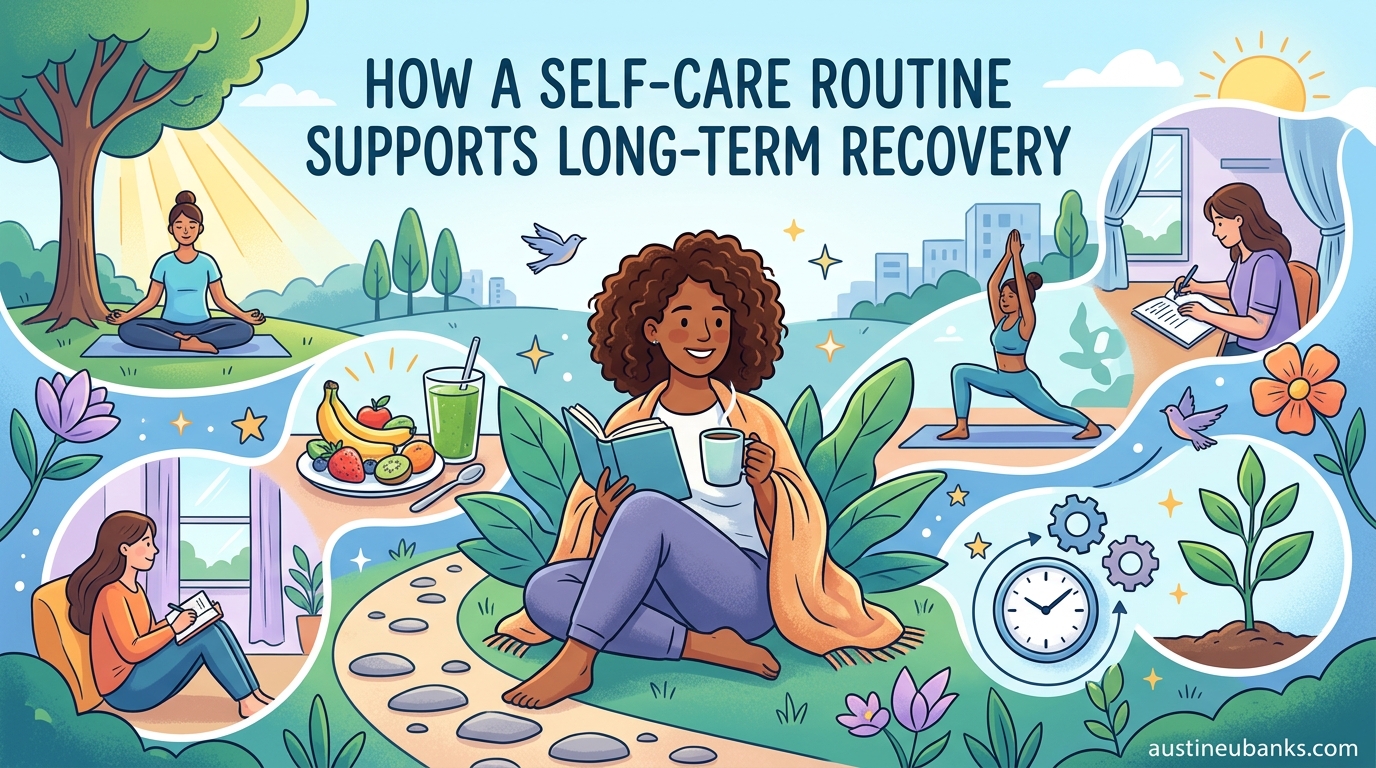
Self-care in recovery refers to intentional, daily practices across physical, emotional, psychological, and social dimensions that reduce stress, build resilience, and help prevent relapse. A self-care routine supports long-term recovery by giving your brain and body the consistent structure they need to heal.
If you are reading this, you probably already know that recovery is not a straight line. You might be 30 days in or 30 years in, and you have likely discovered that motivation comes and goes. What carries people through is not willpower alone. It is the daily structure they build around themselves. That is where self-care comes in.
Our team has spent years researching what actually sustains people through recovery, from addiction to mental health challenges to burnout. The same theme shows up every time: people who build consistent self-care routines stay in recovery longer, report higher quality of life, and bounce back faster when setbacks happen. This guide breaks down exactly how that works and gives you a practical plan to follow.
We are going to cover the science behind why self-care matters, the five dimensions of self-care that support recovery, how to build a routine that sticks, and the difference between genuine self-care and avoidance dressed up as self-care. Whether you are in early recovery or years into your journey, you will find something here you can use today.
Table of Contents
Quick Summary: Key Takeaways
Here is what this article covers at a glance, in case you need the essentials quickly.
- Self-care in recovery is intentional, consistent daily practice across physical, emotional, psychological, behavioral, and social dimensions.
- The science: self-care regulates dopamine, reduces cortisol, and helps rewire neural pathways that were shaped by addiction or chronic stress.
- Relapse prevention: consistent self-care helps you detect early warning signs, manage cravings, and respond to triggers without falling back into old patterns.
- Consistency beats intensity: small daily actions (10 minutes of journaling, a short walk, a regular sleep schedule) are more effective than occasional grand gestures.
- Self-care is not self-indulgence: self-care aligns with your recovery values and long-term goals. Self-indulgence seeks short-term escape and often leaves guilt behind.
- Build gradually: start with one anchor habit, protect it with boundaries, and add layers only when the first one feels automatic.
- Recovery stages matter: what your self-care routine looks like at 30 days should differ from what it looks like at 3 years.
What Is Self-Care in the Context of Recovery?
Self-care in recovery goes far beyond bubble baths and face masks. It is the deliberate, repeated practice of activities that protect and strengthen your physical, emotional, psychological, and social well-being. These practices support healing and help you maintain the stability needed for long-term recovery from addiction, mental illness, trauma, or chronic burnout.
In everyday language, self-care means treating your well-being as a non-negotiable priority. It means recognizing that your body, mind, and relationships need ongoing attention to function well. When you are in recovery, that attention is not optional. It is the foundation everything else rests on.
The Substance Abuse and Mental Health Services Administration (SAMHSA) identifies eight dimensions of wellness that support recovery: emotional, spiritual, intellectual, physical, environmental, financial, occupational, and social. Self-care touches every one of these dimensions. You do not need to address all eight at once. But understanding the framework helps you see recovery as a whole-life process, not just the absence of a substance or a symptom.
Here is the key distinction that matters most. In recovery, self-care is not about treating yourself. It is about maintaining yourself. It is the difference between getting a massage because your body hurts and getting regular sleep because your brain needs it to regulate emotions. Both can feel good. Only one builds long-term resilience.
Self-care also differs from treatment. Therapy, medication, and formal treatment programs address specific clinical needs. Self-care is the daily maintenance work you do between sessions. It is the routines, habits, and boundaries that keep you stable enough to benefit from treatment and eventually transition out of it.
How a Self-Care Routine Supports Long-Term Recovery: The Science
Understanding how a self-care routine supports long-term recovery requires looking at what happens in the brain and body during recovery. The changes are measurable, and they explain why consistent self-care is not just helpful but biologically necessary.
Dopamine Regulation and Reward Pathways
Addiction and chronic mental health conditions disrupt the brain’s reward system. Substances and compulsive behaviors flood the brain with dopamine, creating artificially high peaks that the brain then tries to balance with crashes. Over time, the brain reduces its natural dopamine production and receptor sensitivity. This is why early recovery often feels flat, gray, or anhedonic, meaning the inability to feel pleasure.
Self-care practices help restore this system naturally. Regular exercise, meaningful social connection, creative expression, and accomplishing small goals all produce dopamine at healthy, sustainable levels. These activities do not deliver the intense spikes that substances do. Instead, they train the reward system to respond to natural, gradual stimuli again.
This rewiring takes time. Research on Mindfulness-Oriented Recovery Enhancement (MORE) shows that mindfulness-based practices can help restructure reward responses, shifting attention away from substance-related cues and toward naturally rewarding experiences. This is one reason why meditation and mindful movement are so frequently recommended in recovery programs.
Cortisol Reduction and Stress Hormone Management
Chronic stress is one of the most well-documented triggers for relapse. When you live in a state of elevated stress, your body produces high levels of cortisol and adrenaline. Over time, this wears down your immune system, disrupts sleep, impairs decision-making, and increases cravings. It also makes emotional regulation significantly harder.
Self-care practices directly counteract this physiological stress response. Deep breathing exercises activate the parasympathetic nervous system, which slows heart rate and signals safety to the brain. Regular physical activity reduces baseline cortisol levels. Consistent sleep allows the body to complete its natural stress-recovery cycle. Even 10 minutes of journaling has been shown to lower cortisol by externalizing anxious thoughts.
The point is that self-care is not just psychological. It produces measurable biological changes that make you more resilient to stress. When your baseline cortisol is lower, the daily stressors that might have triggered a relapse six months ago become manageable.
Neuroplasticity and Rewiring Neural Pathways
The brain’s ability to reorganize itself by forming new neural connections is called neuroplasticity. This is the biological mechanism behind all behavioral change, including recovery. Every time you choose a healthy coping strategy instead of an old destructive one, you strengthen a new neural pathway. Every time you repeat that choice, the pathway becomes stronger and more automatic.
This is why consistency matters more than intensity. A single hour-long meditation session is less impactful than 10 minutes of daily meditation practiced for 60 days. The repetition is what builds the pathway. Self-care routines work because they create repeated, predictable opportunities for the brain to practice new responses.
Over months and years, these new pathways become the default. The old pathways associated with substance use or destructive coping do not disappear entirely, but they weaken significantly. This is the neuroscience behind what recovery communities call building a new life where the old one no longer fits.
The Five Dimensions of Self-Care in Recovery
Self-care in recovery is not one thing. It operates across five interconnected dimensions. Neglecting any one of them creates a vulnerability that can undermine the others. Understanding all five helps you build a balanced routine that addresses your whole self.
Physical Self-Care
Physical self-care addresses the body’s fundamental needs. This includes sleep, nutrition, hydration, movement, and medical care. When these basics are neglected, everything else becomes harder. Poor sleep impairs emotional regulation and decision-making. Poor nutrition affects energy, mood, and cognitive function. Lack of movement increases tension and stagnation.
Practical physical self-care in recovery means aiming for 7 to 9 hours of sleep on a consistent schedule. It means eating regular, balanced meals rather than skipping them or relying on sugar and caffeine to get through the day. It means finding some form of physical activity you can sustain, whether that is walking, yoga, swimming, or strength training.
It also means attending to medical and dental care that may have been neglected during active addiction or mental health crises. Many people in recovery discover underlying health issues that went untreated. Addressing these is not separate from recovery. It is part of it.
Emotional Self-Care
Emotional self-care involves recognizing, processing, and expressing your feelings in healthy ways. In recovery, emotions that were previously numbed or escaped often surface with surprising intensity. Without strategies to handle them, these emotions can feel overwhelming and trigger a return to old coping patterns.
Emotional self-care practices include journaling, talking with a trusted friend or therapist, practicing self-compassion, and using grounding techniques like the 5-4-3-2-1 method when emotions spike. The 5-4-3-2-1 technique works by engaging your five senses to bring you back to the present moment. You identify five things you can see, four things you can touch, three things you can hear, two things you can smell, and one thing you can taste.
The goal of emotional self-care is not to eliminate difficult feelings. It is to build your capacity to sit with them without being controlled by them. This skill, called emotional regulation, is one of the strongest predictors of long-term recovery success.
Psychological Self-Care
Psychological self-care focuses on how you engage your mind. This includes learning, personal growth, creative expression, and the quality of your inner dialogue. While emotional self-care deals with feelings, psychological self-care deals with thoughts, beliefs, and mental stimulation.
Practices in this dimension include reading, taking courses, engaging in creative hobbies, practicing mindfulness or meditation, and challenging negative thought patterns through cognitive-behavioral techniques. It also means managing your information intake. Doomscrolling through negative news or spending hours on social media that triggers comparison and anxiety is the opposite of psychological self-care.
For people in recovery, psychological self-care often involves rebuilding a sense of identity beyond the addiction or illness. Exploring new interests, setting meaningful goals, and reconnecting with personal values all fall under this dimension. Recovery is not just about stopping something harmful. It is about building something meaningful in its place.
Behavioral Self-Care
Behavioral self-care covers the structure, habits, and boundaries that keep your daily life stable. This includes maintaining a daily routine, setting and honoring boundaries, managing your time, and creating environments that support your recovery goals.
In practice, behavioral self-care might mean setting a firm boundary around work hours so you have time to rest. It might mean declining social invitations that put you near triggers. It might mean establishing a morning routine that starts with a glass of water and five minutes of stretching instead of immediately reaching for your phone.
Behavioral self-care also includes self-monitoring. Tracking your mood, noting your energy levels, and paying attention to early warning signs of relapse or mental health decline are all behavioral practices. Research shows that people who regularly self-monitor are better at catching problems early, before they escalate into crises.
Social Self-Care
Social self-care involves maintaining healthy relationships and a sense of community. Humans are social creatures, and isolation is one of the most common predictors of relapse and mental health decline. Recovery thrives on connection.
Social self-care means nurturing relationships with people who support your recovery. It might involve attending support group meetings, maintaining regular contact with a sponsor or accountability partner, or simply making time for weekly calls with friends who understand your journey. It also means being honest about which relationships are harmful and having the courage to set distance from people who undermine your recovery.
Peer support is particularly powerful. Connecting with others who have walked a similar path provides validation that therapy alone cannot always offer. Hearing someone say “I have been there, and it gets better” from someone who means it can be the thing that gets you through a difficult night.
How Self-Care Practices Prevent Relapse
Relapse rarely happens without warning. It follows a predictable pattern that starts with subtle changes in thoughts, emotions, and behaviors long before any actual substance use or behavioral relapse occurs. A consistent self-care routine helps you recognize and interrupt this pattern before it progresses.
The relapse process typically moves through three stages. The first is emotional relapse, where you are not thinking about using but your self-care is slipping. You might be skipping meals, isolating, sleeping poorly, or avoiding meetings. The second is mental relapse, where there is an internal war between wanting to stay clean and remembering the “good” parts of old behaviors. The third is physical relapse, the actual return to the substance or behavior.
Self-care addresses the first stage directly. When you have a consistent routine, the disruption to that routine becomes a signal. If you suddenly stop journaling, skip your morning walk three days in a row, or find yourself withdrawing from your support network, those are early warning signs. A self-care routine makes those signs visible.
Beyond early detection, self-care actively reduces the factors that drive relapse. Chronic stress, poor sleep, isolation, and emotional dysregulation are the four most common relapse triggers. Each of these is directly addressed by the self-care dimensions we covered above. By maintaining your physical health, processing emotions, staying socially connected, and managing stress, you are systematically dismantling the conditions that make relapse possible.
Research on relapse prevention consistently shows that self-efficacy, the belief in your ability to handle difficult situations without relapsing, is a stronger predictor of long-term outcomes than any single coping strategy. Self-care builds self-efficacy by giving you daily evidence that you can take care of yourself. Each day you maintain your routine, you prove to yourself that change is possible and sustainable.
Self-Care at Different Stages of Recovery
No competitor we reviewed addresses how self-care needs change across different recovery stages. This is a significant gap, because a routine that works in your first 30 days will likely need to look very different from one that sustains you at year three. Understanding these shifts helps you adapt rather than abandon your routine when it stops working.
Early Recovery (0 to 90 Days): Focus on Survival and Structure
In the first 90 days, your brain and body are working hard to stabilize. Physical withdrawal symptoms may be subsiding, but sleep, mood, and energy are often erratic. The most important self-care priorities at this stage are the basics: consistent sleep, regular meals, hydration, and attending structured support (meetings, therapy, outpatient programs).
Do not try to build an elaborate self-care routine in early recovery. Keep it simple. Focus on two or three non-negotiables: a regular sleep schedule, at least one connection with a supportive person per day, and one grounding practice you can do in under five minutes. Trying to change everything at once is a setup for failure.
This is also the stage where structure matters most. External structure from treatment programs, intensive outpatient programs, or daily meeting attendance provides a scaffold. Lean on it heavily. Self-care at this stage is less about doing and more about accepting help.
Middle Recovery (3 to 12 Months): Building New Habits
Between 3 and 12 months, the initial crisis phase passes. You are likely sleeping better, thinking more clearly, and starting to feel moments of genuine well-being. This is where many people make the mistake of easing up on self-care because they “feel fine.”
This stage is actually when you need to deepen your self-care practice. The immediate motivation of crisis has faded, and what carries you forward now is habit. This is the time to add practices that go beyond survival: regular exercise, creative hobbies, deeper relationships, and more sophisticated emotional regulation skills like meditation or breathwork.
Middle recovery is also when identity work becomes important. Exploring who you are without the addiction or illness means trying new activities, setting new goals, and building a life that feels worth maintaining. Self-care at this stage is about expansion, not just maintenance.
Long-Term Recovery (1 Year and Beyond): Maintenance and Refinement
After the first year, self-care shifts from active building to ongoing maintenance. Your routines should feel relatively automatic by now. The challenge is keeping them fresh and preventing complacency.
In long-term recovery, self-care might include giving back through mentorship or peer support, pursuing deeper personal growth through therapy or coaching, and refining your practices based on what you have learned about yourself. It also means staying vigilant. Complacency, not active craving, is the biggest threat in long-term recovery.
Life will still throw disruptions at you. Job changes, moves, relationship shifts, and health issues can all destabilize a routine that has worked for years. The skill of long-term recovery is not just maintaining a routine but knowing how to rebuild one when life inevitably disrupts it.
Self-Care vs Self-Indulgence: Knowing the Difference
One of the most common questions in recovery is how to tell the difference between self-care and self-indulgence. This is not a trivial distinction. Confusing the two can quietly undermine your recovery, and many people do not realize it until they are in trouble.
Self-care strengthens your well-being, supports your recovery goals, and aligns with your values. It often involves doing things that are not immediately pleasurable but contribute to long-term stability. Going to bed early when you want to stay up watching TV is self-care. Attending a meeting when you would rather isolate is self-care. Cooking a healthy meal when you could grab fast food is self-care.
Self-indulgence, on the other hand, focuses on short-term comfort and often involves avoiding discomfort or responsibility. Binge-watching a show to avoid processing a difficult emotion is not self-care. Spending money you do not have to distract yourself is not self-care. Using any behavior, even a seemingly healthy one, to escape rather than engage with life is a red flag.
The simplest test is to ask yourself two questions after the activity. First: do I feel better in a lasting way, or do I feel guilty, sluggish, or worse? Second: does this activity move me toward my recovery goals or away from them? Self-care leaves you feeling restored and aligned. Self-indulgence often leaves you feeling empty or ashamed.
Here is a quick comparison to help you evaluate your own practices:
- Intent: Self-care is motivated by self-respect and health. Self-indulgence is motivated by avoidance or escapism.
- Outcome: Self-care leaves you feeling restored, grounded, and more capable. Self-indulgence leaves you feeling guilty, depleted, or disconnected.
- Frequency: Self-care is regular and planned. Self-indulgence is often impulsive and reactive.
- Alignment: Self-care aligns with your values and recovery commitments. Self-indulgence conflicts with them.
- Growth: Self-care builds resilience and self-efficacy. Self-indulgence keeps you stuck in the same patterns.
None of this means you can never enjoy yourself. Pleasure is part of recovery. The question is whether your choices are intentional and aligned with the life you are building.
How to Build a Self-Care Routine That Actually Sticks
Knowing that self-care matters is not the same as doing it consistently. Most people in recovery have tried and abandoned multiple routines. The problem is rarely motivation. It is usually a combination of starting too big, lacking structure, and not accounting for the realities of recovery life.
Here is a step-by-step process designed specifically for people in recovery, drawing on what actually works based on both clinical research and real-world experience from recovery communities.
Step 1: Assess Your Current Baseline
Before adding anything, take an honest inventory of where you are right now. How is your sleep? What does your diet look like? How often do you connect with supportive people? What is your stress level on a typical day? Write this down. You cannot build on a foundation you have not examined.
Be specific. “I sleep okay” is not useful. “I get about 5 hours on weeknights and crash for 10 on weekends” gives you something to work with. The goal is to identify the biggest gap, the one dimension of self-care that is most neglected and causing the most damage.
Step 2: Start With One Anchor Habit
Pick exactly one practice to start with. Not five. Not three. One. This is your anchor habit. It should be small enough to do even on your worst day. It should be tied to something you already do, like drinking a glass of water right after you brush your teeth, or taking five deep breaths before you check your phone in the morning.
Research on habit formation consistently shows that starting small dramatically increases the likelihood of success. A habit that takes two minutes to complete is harder to skip than one that takes thirty. Once the anchor is established, everything else becomes easier to add.
Commit to this one habit for at least two weeks before adding anything else. It should feel almost automatic before you move on. This patience is what separates routines that stick from routines that collapse in week three.
Step 3: Build Around Your Natural Rhythms
Not everyone is a morning person. Not everyone has the same schedule. The best self-care routine is the one that fits your actual life, not an idealized version of it. Pay attention to when you naturally have energy, when you tend to struggle, and when you have uninterrupted time.
If you are sharpest in the morning, put your most demanding self-care practice (meditation, exercise, journaling) there. If you crash in the afternoon, schedule a walk or a grounding break at that time. If your evenings are chaotic, focus your self-care on the morning. Work with your rhythms, not against them.
Step 4: Add Layers Gradually
Once your anchor habit is solid, add one more practice. Give it the same two weeks. Then add another. Build your routine one layer at a time, always protecting the habits you have already established. A good target is to eventually have practices across all five dimensions of self-care: one physical, one emotional, one psychological, one behavioral, one social.
This does not mean five separate hour-long activities. Your physical practice might be a 20-minute walk. Your emotional practice might be three minutes of journaling before bed. Your social practice might be a weekly call with a friend. The total time investment can be 30 to 45 minutes a day, spread across different parts of your schedule.
Step 5: Track and Adjust
Tracking your self-care practices serves two purposes. First, it provides accountability. You are more likely to do something if you know you are going to record whether you did it. Second, it gives you data. Over time, you can look back and see which practices correlate with better mood, lower stress, or fewer cravings.
This does not need to be complicated. A simple checklist on your phone or a notebook where you mark off each practice daily is enough. If you want to go deeper, mood-tracking apps can help you identify patterns you might otherwise miss. The goal is not to create more work for yourself. It is to make your self-care more effective through awareness.
Review your routine monthly. Drop what is not working. Keep what is. Adjust based on what is happening in your life. A self-care routine is a living thing, not a static prescription.
A Sample Daily Self-Care Routine for Recovery
One of the most requested resources in recovery communities is a concrete example of what a daily self-care routine actually looks like. Here is a realistic template that covers all five dimensions. Adapt it to your schedule and preferences.
Morning (Physical and Psychological):
- Wake at a consistent time (within a 30-minute window every day)
- Drink a glass of water before looking at your phone
- Spend 5 minutes on a grounding practice: deep breathing, stretching, or a brief meditation
- Eat a nourishing breakfast rather than skipping or grabbing sugar
- Write down one intention for the day
Afternoon (Behavioral and Physical):
- Take a 15 to 20 minute walk, ideally outside
- Check in with your energy and stress level (rate 1 to 10)
- Use a grounding technique if stress is high (5-4-3-2-1 method or box breathing)
- Eat a balanced lunch and stay hydrated
Evening (Emotional and Social):
- Spend 10 minutes journaling about the day: what went well, what was hard, what you are grateful for
- Connect with at least one supportive person: call, text, meeting, or in-person
- Practice a creative or enjoyable activity for 15 to 30 minutes (music, art, reading, gardening)
Before Bed (Behavioral and Physical):
- Turn off screens 30 to 60 minutes before sleep
- Review your day without judgment. Note one thing you handled well
- Go to bed at a consistent time to support your sleep cycle
This entire routine takes about 60 to 75 minutes spread across the day. On difficult days, you can scale it back to the essentials: sleep, one grounding practice, one connection. The goal is consistency, not perfection.
Common Barriers to Self-Care in Recovery (and How to Overcome Them)
Knowing what to do is half the battle. Actually doing it consistently is where most people struggle. Recovery communities on forums like Reddit consistently surface the same barriers. Here are the most common ones and practical strategies for each.
Barrier 1: “I Feel Guilty Taking Time for Myself”
Guilt about self-care is extremely common, especially for people who have spent years putting substances or destructive behaviors ahead of their responsibilities. Taking time for yourself can feel selfish, particularly when family members or employers were hurt during active addiction.
The reframe is this: self-care is not selfish. It is the opposite. When you are rested, emotionally regulated, and physically healthy, you show up better for everyone in your life. The oxygen mask analogy applies here. You cannot help others if you are not breathing yourself. Give yourself permission to rest without guilt, and recognize that guilt itself is often a leftover thought pattern from active addiction.
Barrier 2: “I Start Routines but Never Stick With Them”
Inconsistency is the most common complaint we see. People start strong, maintain a routine for a week or two, and then abandon it. This usually happens because they started too big. They tried to overhaul their entire life overnight.
The fix is simple but requires discipline. Go smaller. Much smaller. If you cannot maintain a 30-minute meditation practice, do 3 minutes. If you cannot maintain a daily gym routine, do a 10-minute home workout. The version of the habit you can do consistently is infinitely better than the ideal version you do for a week and quit. Consistency builds confidence. Confidence builds momentum. Momentum builds lasting change.
Barrier 3: “Self-Care Feels Like Another Chore on My To-Do List”
When self-care becomes another item on an already overwhelming list, it stops being restorative. It becomes a source of stress itself. This is a sign that your routine needs simplification, not expansion.
Remember that self-care does not have to be a separate activity. It can be woven into existing routines. Drinking water while you work is physical self-care. Taking three deep breaths before a stressful meeting is emotional self-care. Texting a friend while you wait in line is social self-care. When self-care becomes part of how you live rather than another thing you have to do, it stops feeling like a burden.
Barrier 4: “I Do Not Know Where to Start”
Overwhelm from too many options paralyzes many people. There is so much information about self-care that starting feels impossible. This is why we recommend beginning with the simplest possible practice and building from there.
Start here: for the next two weeks, do one thing every day. One glass of water first thing in the morning. One five-minute walk. One text to a supportive friend. That is it. Do not read another article. Do not research apps. Do not plan an elaborate routine. Just pick one thing and do it for two weeks. The clarity about what to do next will come from the doing, not from more research.
When to Seek Additional Professional Support
Self-care is powerful, but it is not a substitute for professional treatment. There are times when you need more than a routine can provide, and recognizing those moments is itself a form of self-care.
Seek professional help if you experience any of the following: persistent thoughts of returning to substance use that you cannot manage with your current tools, symptoms of depression or anxiety that are worsening rather than improving, sleep disruption lasting more than two weeks, inability to function in daily life (work, relationships, self-care), thoughts of self-harm or suicide, or a sense that your routine is no longer working and you do not know why.
If you are in crisis, reach out immediately. The 988 Suicide and Crisis Lifeline is available 24/7 by calling or texting 988 in the United States. You can also text HOME to 741741 to connect with the Crisis Text Line. These resources are free, confidential, and staffed by trained counselors.
Professional support is not a sign of failure. It is a sign that you are taking your recovery seriously enough to use every tool available. Many people in long-term recovery work with therapists, attend regular support groups, or check in with medical providers as part of their ongoing self-care strategy. The strongest recovery plans combine personal self-care with professional support.
Frequently Asked Questions
What is self-care in recovery?
Self-care in recovery refers to intentional, consistent practices across physical, emotional, psychological, and social dimensions that support healing, build resilience, and help prevent relapse during and after treatment for mental health or substance use disorders.
How does self-care support long-term recovery?
Self-care supports long-term recovery by reducing chronic stress, building emotional regulation skills, strengthening self-efficacy and autonomy, maintaining physical health, and creating a support network that provides accountability and connection during vulnerable moments. These factors work together to address the root causes of relapse.
How often should I practice self-care when recovering?
Self-care should be practiced daily during recovery. Small, consistent actions such as 10 minutes of journaling, a daily walk, or a regular sleep schedule build resilience over time. Weekly activities like therapy sessions or support group meetings complement daily practices.
Can self-care really prevent relapse?
Yes. Self-care helps prevent relapse by enabling early detection of stress and cravings, reducing chronic stress levels, strengthening resilience and coping capacity, and fostering a sense of autonomy and self-efficacy that empowers individuals to manage triggers without returning to old patterns.
What are the best self-care routines for recovery?
The best self-care routines for recovery include a consistent sleep schedule, daily physical activity, mindful eating, regular journaling or reflection, setting healthy boundaries, maintaining social connections, practicing gratitude, and attending therapy or support groups. The most effective routine is personalized and sustainable for your specific lifestyle.
What is the difference between self-care and self-indulgence in recovery?
Self-care strengthens your well-being, routines, and long-term recovery goals. Self-indulgence focuses on short-term comfort or escape and often leaves guilt or regret behind. The key difference is intent: self-care aligns with your values and recovery commitments, while self-indulgence avoids discomfort or responsibility.
How do you build a self-care routine in recovery?
Build a self-care routine by identifying activities that align with your values, starting with one small manageable practice, scheduling it at a consistent time, balancing physical and emotional needs, setting boundaries to protect your routine, and adjusting over time based on what actually works for you.
Conclusion
Understanding how a self-care routine supports long-term recovery comes down to this: recovery is not a single event but a daily practice. The science is clear that consistent self-care regulates your nervous system, rewires neural pathways, reduces relapse risk, and builds the self-efficacy that sustains lasting change. None of this happens overnight, but all of it compounds over time.
Start small. Pick one practice. Do it for two weeks. Then add another. The version of yourself that is stable, resilient, and thriving in recovery is not built by a single dramatic decision. It is built by hundreds of small, consistent choices made day after day.
If you take one thing from this article, let it be this: consistency matters more than intensity. A 5-minute daily practice will outperform a 2-hour weekly session every time. Your recovery is not about being perfect. It is about showing up for yourself, one day at a time, in ways that are small enough to sustain and meaningful enough to matter.
You do not need to have it all figured out. You need to start. Pick one thing from the five dimensions of self-care we covered and begin today. Your future self will thank you for it.