
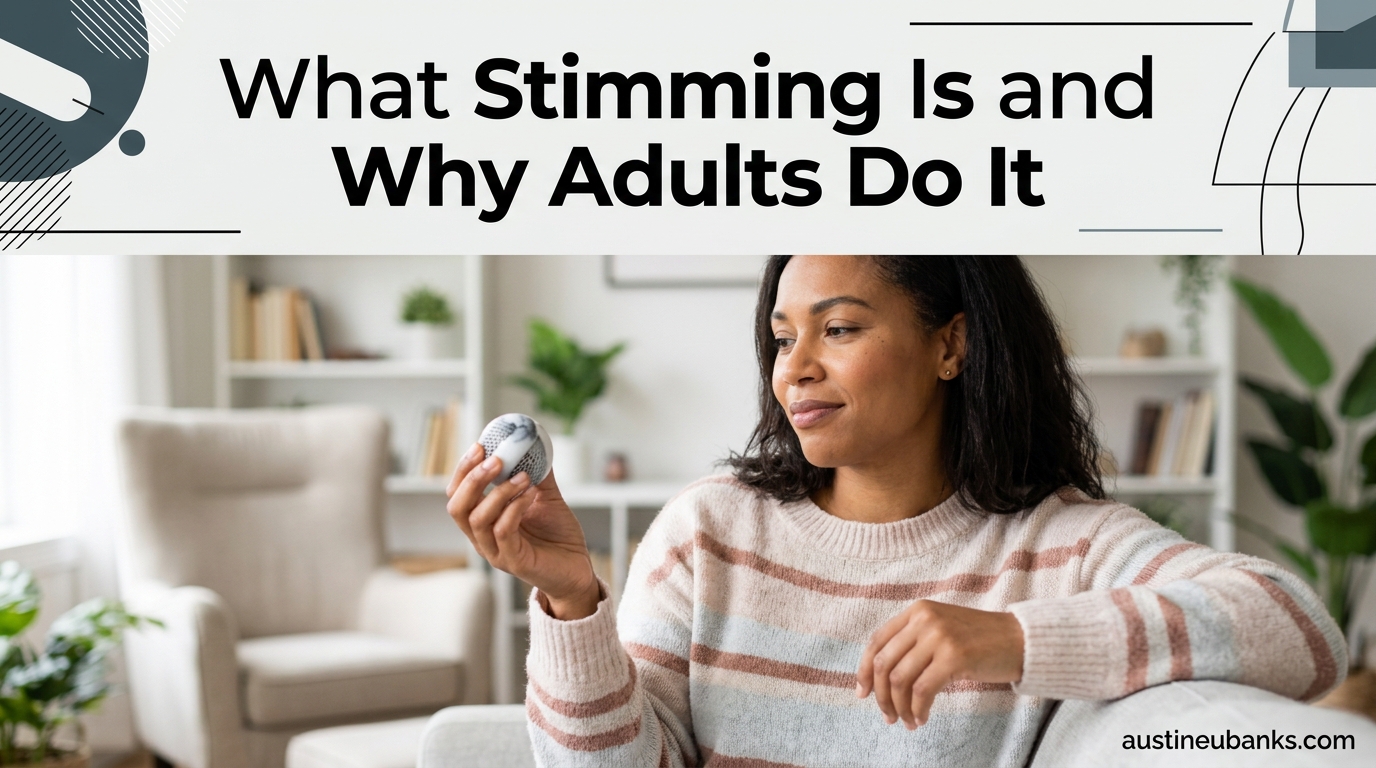
Tap your foot when you are nervous. Click a pen during a long meeting. Hum a song on repeat for three days straight. Twirl your hair while reading. If you have done any of these things, you have already stimmed today. Understanding what stimming is and why adults do it can help you recognize this behavior in yourself, support the people around you, and let go of the shame that often surrounds it.
Stimming is not something only autistic people do. It is a universal human behavior that becomes especially visible in neurodivergent adults, but everyone stims in some form. The difference is usually about frequency, intensity, and how others react to it. In this guide, our team breaks down the science behind stimming, the most common types, why adults stim, and how to create space for it in daily life.
We dug through peer-reviewed research, forum discussions from autistic communities, and clinical resources to bring you answers that go beyond surface-level definitions. Whether you are exploring your own behaviors, supporting a partner, or managing a team, this article will give you clarity on a topic that is often misunderstood.
Table of Contents
Quick Answers: What Stimming Is and Why Adults Do It
What is stimming? Stimming (short for self-stimulatory behavior) refers to repetitive movements, sounds, or actions that people use to regulate their nervous system, manage emotions, or process sensory input. It is not exclusive to autistic people.
Why do adults stim? Adults stim to reduce anxiety, cope with sensory overload, focus attention, express emotions, soothe themselves during stress, or simply because it feels good. Research from the Cleveland Clinic found that 72% of people stim to manage anxiety, 57% stim due to overstimulation, and 80% stim because they enjoy how it feels.
Can you stim without being autistic? Yes. Neurotypical adults stim too, through foot-tapping, nail-biting, leg-bouncing, and pen-clicking. Stimming becomes more pronounced in neurodivergent individuals but is fundamentally a human behavior.
What are the most common stims in adults? The most common stims include rocking, hand-flapping, pacing, skin-picking, hair-twirling, repeating words or sounds (echolalia), listening to songs on repeat, and using fidget tools like stress balls or rings.
What Is Stimming? A Clear Definition
Stimming, formally known as self-stimulatory behavior or stereotypy, refers to repetitive body movements, sounds, or object interactions that a person performs repeatedly. The term comes from the phrase “self-stimulatory” because these behaviors provide sensory stimulation to the person doing them. Clinicians and researchers also use the term “repetitive motor movements” or “restricted and repetitive behaviors” when describing stimming in clinical contexts.
Stimming works by providing sensory input that helps balance the nervous system. When the world feels overwhelming, stimming can block out excess stimulation. When the environment feels flat or under-stimulating, stimming provides the sensory input your brain is seeking. Think of it as a self-regulatory mechanism that your nervous system uses to stay within a comfortable range.
Dr. Laura Howk, a board-certified behavior analyst quoted by the Cleveland Clinic, explains that stims are things people do often without thinking about them. They serve a purpose even when that purpose is not immediately obvious to an outside observer. The behavior itself is adaptive, meaning it helps the person function better in their environment.
One important distinction: stimming is different from a tic. Tics are sudden, involuntary movements or vocalizations (associated with conditions like Tourette syndrome) that the person cannot easily control. Stimming, while sometimes hard to suppress, is typically a voluntary or semi-voluntary behavior that serves a regulatory function. A person can often redirect their stim to a different behavior, whereas tics are far more difficult to redirect.
Stimming is also different from a simple habit. Habits are learned behaviors that become automatic, like biting your nails when bored. Stimming has a sensory and emotional regulation component that habits may lack. That said, the line between a habit and a stim can be blurry, and some behaviors function as both.
The word “stimming” entered popular vocabulary largely through autism communities. However, the behavior itself predates the term by centuries. Rocking, humming, pacing, and other repetitive movements have been documented across cultures and throughout human history. What changed is the language we use to describe it and the growing recognition that stimming serves a real purpose.
Types of Stimming Behaviors (With Examples)
Stimming behaviors fall into categories based on the sensory system they engage. Understanding these categories helps you recognize stims in yourself and others. Our team organized the most common types into the comparison table below, sorted by sensory modality.
| Sensory Category | What It Involves | Common Adult Examples |
|---|---|---|
| Auditory (Sound) | Repetitive sounds or vocalizations | Humming, repeating words or phrases (echolalia), listening to a song on repeat, snapping fingers, making clicking sounds with the tongue |
| Tactile (Touch) | Repeated touch or texture-based movements | Skin-picking, nail-biting, hair-twirling, rubbing fabric between fingers, using fidget spinners or stress balls, scratching |
| Visual (Sight) | Repetitive visual stimulation | Staring at spinning objects, watching repetitive videos, lining up objects, hand-flapping near the face, blinking patterns |
| Vestibular (Movement) | Whole-body movement and balance | Rocking back and forth, pacing, bouncing on toes, spinning in circles, swinging legs, weight-shifting |
| Olfactory (Smell) | Sniffing or smelling repetitive items | Sniffing clothing, smelling specific objects repeatedly, seeking out certain scents for comfort |
| Oral (Mouth) | Mouth-based repetitive actions | Chewing on pens, lip-biting, teeth-grinding, chewing gum excessively, biting the inside of the cheek |
| Proprioceptive (Body Pressure) | Deep pressure and body awareness | Squeezing into tight spaces, using weighted blankets, pressing hands together firmly, seeking deep pressure on the body |
Many adults stim across multiple categories without realizing it. A Reddit user in r/AutismInWomen shared a realization that surprised them: “I had NO IDEA that listening to songs on repeat or repeat watching of shows and movies was a stim.” This is a common experience. People often discover that behaviors they considered quirks or habits are actually forms of stimming.
Stims can also be classified as overt or covert. Overt stims are visible to others, such as hand-flapping, rocking, or pacing. Covert stims are subtle and harder to notice, such as wiggling toes inside shoes, pressing a thumb against a finger, or clenching jaw muscles. Many adults, especially those who mask their neurodivergence, have developed elaborate covert stims to self-regulate without drawing attention.
Why Adults Stim: 7 Common Reasons
Adults stim for a wide range of reasons, and most people stim for several of these at different times. Here are the seven most common reasons, drawn from clinical research and self-reported experiences from neurodivergent communities.
1. To reduce anxiety. This is the single most common reason adults stim. The Cleveland Clinic study found that 72% of people who stim do so to manage anxiety. Repetitive movements have a calming effect on the nervous system, similar to how rocking soothes infants. When anxiety spikes, stimming helps bring the body back to a baseline state.
2. To cope with sensory overload. When the environment delivers too much sensory input at once (loud noises, bright lights, crowded spaces), stimming helps block out the excess. A person might cover their ears, hum to create a predictable sound, or focus on a tactile stim to drown out overwhelming stimuli. About 57% of people who stim cite overstimulation as a primary trigger.
3. To improve focus and concentration. Many adults stim to stay attentive during tasks that require sustained mental effort. Fidgeting with a pen, bouncing a leg, or squeezing a stress ball can actually improve focus by giving the brain a secondary, low-demand task that keeps it from drifting. This is why fidget tools became popular in classrooms and offices.
4. To express emotions. Stimming is not always about calming down. People also stim when they are excited, happy, or passionate. Hand-flapping when sharing good news, jumping up and down when excited, or pacing when angry are all forms of emotional expression through stimming. For many neurodivergent adults, these stims are how their bodies process and release intense positive emotions.
5. To self-soothe during stress. When faced with difficult situations, repetitive movements provide comfort and predictability. The body knows what is coming next with each repetition, which feels safe when the rest of life feels unpredictable. This self-soothing function is why rocking is used therapeutically and why weighted blankets have become so popular.
6. Because it feels good. Not all stimming is tied to distress or regulation. The Cleveland Clinic found that 80% of people who stim do so simply because they enjoy the sensation. Stimming can produce dopamine and other feel-good neurotransmitters. Sometimes stimming is purely pleasurable, and that is a valid reason on its own.
7. To regulate an under-stimulated nervous system. When the environment is too quiet, too still, or too predictable, some people stim to generate the stimulation their brain needs. This is common in adults with ADHD, who may seek out movement, sound, or tactile input to stay engaged when they feel understimulated. Bouncing a leg during a boring meeting is a classic example.
The Kapp et al. 2019 study, published in the journal Autism and cited over 848 times, gathered first-person accounts from autistic adults about why they stim. Participants described stimming as “primarily a self-regulatory mechanism” and “an important adaptive mechanism that helps them to soothe or communicate intense emotions or thoughts.” This research shifted the conversation from viewing stimming as a problem to fix toward understanding it as a functional, adaptive behavior.
Stimming Beyond Autism: ADHD, Anxiety, and Neurotypical Adults
One of the biggest misconceptions about stimming is that it only happens in autistic people. In reality, stimming is a human behavior that spans across neurotypes. What differs is the intensity, frequency, and social response to the behavior.
Neurotypical adults stim all the time. Tapping a foot during a tense conversation, chewing on a pen cap during a test, cracking knuckles before a big presentation, twirling hair while on a phone call. These are all forms of stimming. The difference is that society labels these behaviors as “normal” and rarely comments on them. When an autistic adult does something similar, it is more likely to be noticed, questioned, or stigmatized.
Adults with ADHD also stim frequently, though the connection is less discussed. ADHD-related stimming often involves movement-based behaviors like leg-bouncing, fidgeting, pacing, or manipulating objects. These stims help regulate attention and provide the stimulation an ADHD brain craves. Many adults with ADHD use fidget tools, exercise, or movement breaks to meet this need without realizing they are stimming.
Anxiety disorders are another major driver of stimming in adults. Repetitive behaviors like skin-picking (excoriation disorder), nail-biting (onychophagia), and hair-pulling (trichotillomania) are often classified separately from stimming, but they serve a similar self-regulatory function. The line between an anxiety-driven compulsive behavior and a stim is not always clear, and many people experience both.
The forum insights we reviewed reveal that many adults are surprised to learn that stimming is not exclusive to autism. One Reddit user asked, “Can an adult stim and not be autistic?” and received dozens of responses confirming that yes, neurotypical people stim too. What matters is not whether you stim, but whether the behavior is helping you or causing harm.
Masking, Unmasking, and the Stigma Around Stimming
Masking is the process of hiding or suppressing natural behaviors to appear neurotypical. For many autistic and neurodivergent adults, masking includes suppressing stims in public, at work, or around family. While masking may help someone blend in socially, it comes at a significant cost to mental health.
Research has linked long-term masking to anxiety, depression, and burnout. When a person suppresses their primary self-regulatory mechanism (stimming), they lose access to a key coping tool. The energy required to constantly monitor and suppress natural behaviors is exhausting, and over time it can lead to a state of complete exhaustion known as autistic burnout.
Forum discussions from r/AutismInWomen and r/AutisticAdults highlight how difficult it can be to “unlock” stimming after years of suppression. One Reddit user shared: “In my early 20s I started using a stress ball and essentially stimmed with that. In my mid 20s I learned I am autistic and I just started to unlearn the suppression.” This journey of unmasking and rediscovering stimming is a common experience for adults diagnosed later in life, particularly women.
Stimming in adult women is an especially underexplored topic. Women are often socialized from childhood to be quiet, still, and unobtrusive, which means their stims tend to be more covert. Hair-twirling, skin-picking, and subtle finger movements are easy to hide but still serve a regulatory function. Many women receive autism or ADHD diagnoses in their 30s or 40s and realize that behaviors they have been hiding for decades were actually stims.
The neurodiversity movement has played a major role in reframing stimming as something to be accepted rather than eliminated. As the APA-published article on stimming notes, the research suggests that “society is the entity that may need to change” rather than the person stimming. This perspective shift is gaining traction in clinical settings, workplaces, and schools.
Stimming at Work: Practical Strategies for Adults
Workplace stimming is a topic no major competitor covers well, yet it is one of the most searched concerns among adults who stim. The fear of being judged, perceived as unprofessional, or misunderstood by colleagues leads many adults to suppress stims during the workday. Here are practical strategies our team compiled from forum discussions and clinical recommendations.
Use covert stims in meetings. Wiggle your toes inside your shoes, press your thumb against your index finger under the table, or clench and release your jaw. These movements are invisible to others but still provide sensory input. Many adults also use discreet fidget jewelry, such as spinner rings or textured bracelets, that looks like regular accessories.
Keep fidget tools at your desk. Stress balls, fidget cubes, putty, and textured objects can be used during calls or while working at a computer. If you are worried about appearance, choose tools that look professional. A smooth stone paperweight on your desk can double as a tactile stim tool.
Take movement breaks. Pacing during phone calls, taking a short walk between meetings, or using a standing desk can satisfy the need for vestibular stimulation. Many neurodivergent adults find that regular movement breaks improve both their comfort and their productivity.
Use noise-canceling headphones. For auditory stimming needs or sensory overload in open offices, noise-canceling headphones let you control your auditory environment. Listening to the same song on repeat (a common auditory stim) is easier to do with headphones in a shared space.
Communicate with trusted colleagues. If you feel safe doing so, explaining your stims to a manager or close coworker can reduce anxiety about being observed. You do not need to disclose a diagnosis. Simply saying “I focus better when I can fidget” or “I use this stress ball to help me concentrate” is often enough.
When Stimming May Need Attention
Most stimming is harmless and beneficial. However, there are situations where stimming behaviors may warrant professional support. The key distinction is whether the stim is causing harm to the person or significantly interfering with their daily life.
Self-injurious stims, such as hitting oneself, biting skin until it bleeds, or head-banging, are signs that the person may need additional support. These behaviors are often a response to extreme distress, pain, or severe sensory overload that the person cannot otherwise communicate. An occupational therapist or board-certified behavior analyst can help identify replacement behaviors that provide similar sensory input without causing injury.
Skin-picking and hair-pulling that result in tissue damage or scarring also fall into this category. While these behaviors serve a regulatory purpose, they can become compulsive and harmful over time. Mental health professionals can help develop alternative coping strategies.
Stimming that appears suddenly in adulthood can sometimes signal an underlying change. If you have never stimmed before and suddenly start engaging in repetitive behaviors, it is worth exploring whether something has changed in your stress levels, sensory environment, or neurological health. This does not necessarily mean something is wrong, but a conversation with a healthcare provider can provide clarity.
The goal is never to eliminate stimming. Instead, the focus should be on finding safe, effective ways to meet the same sensory and emotional needs. Suppression is almost never the answer. Replacement and redirection are the approaches recommended by clinicians and the autistic community alike.
FAQs
Why did I start stimming as an adult?
Adults may start stimming for several reasons: increased stress or anxiety, discovering a neurodivergent identity (such as autism or ADHD) later in life, unmasking after years of suppression, changes in sensory environment, or simply becoming more aware of behaviors they have always had. Many adults realize they have been stimming their entire lives without knowing the term for it. Starting to stim in adulthood is not inherently a sign of a problem and often reflects a natural response to stress or a growing self-awareness.
What are common stims in adults?
The most common stims in adults include leg-bouncing, hair-twirling, skin-picking, nail-biting, rocking, hand-flapping, pacing, humming, repeating words or phrases (echolalia), listening to songs on repeat, chewing on pens, and using fidget tools like stress balls, rings, or cubes. Stims can be overt (visible to others) or covert (subtle and hidden), and many adults use a combination of both.
Can an adult stim and not be autistic?
Yes, absolutely. Neurotypical adults stim regularly through behaviors like foot-tapping, pen-clicking, leg-bouncing, and nail-biting. Stimming is also common in adults with ADHD, anxiety disorders, and OCD. While stimming is more pronounced and frequent in autistic individuals, it is fundamentally a human behavior that everyone engages in to some degree.
What is the most common stim?
The most common stims across all adults are repetitive hand movements (fidgeting, tapping, picking), leg or foot movements (bouncing, tapping, shaking), and oral behaviors (chewing, lip-biting, nail-biting). Among autistic adults, rocking, hand-flapping, and vocal repetition (echolalia) are also very common. The specific stim a person uses depends on their individual sensory needs and preferences.
Conclusion
Understanding what stimming is and why adults do it comes down to one core truth: stimming is a natural, adaptive behavior that helps people regulate their nervous system, manage emotions, and navigate a world that is often too loud, too quiet, or too unpredictable. It is not something to be ashamed of, and it is not exclusive to any one group.
Whether you stim yourself, love someone who does, or simply want to be more informed, the most important takeaway is this: stimming serves a purpose. Suppressing it does not make it go away. It only pushes the need underground, where it shows up as anxiety, exhaustion, and burnout. The healthier path is to understand your stims, find safe ways to express them, and give others permission to do the same.
If you want to learn more about neurodivergent self-regulation, talk to an occupational therapist, explore neurodiversity-affirming resources, or connect with communities like r/AutismInWomen and r/AutisticAdults where people share their stimming experiences openly. Your nervous system knows what it needs. Sometimes the best thing you can do is let it do its job.