
Your heart is pounding. Your thoughts are spiraling. Your chest feels tight, and your breathing has gone shallow. You are in the middle of an anxious moment, and your brain is screaming that something is wrong even though no obvious threat exists.
If you have ever been there, you know how desperately you want it to stop. You want a switch to flip. Some way to hit the brakes on a runaway nervous system.
That switch might be closer than you think. It sits right in your bathroom, your kitchen, or even a water fountain. Understanding how cold water on the face can calm an anxious moment gives you one of the fastest, most accessible grounding tools available. No prescription, no equipment, no appointment required.
The technique is rooted in human biology, not folklore. When cold water hits a specific area of your face, it triggers an ancient reflex wired into every mammal on the planet. This reflex slows your heart rate, deepens your breathing, and shifts your nervous system out of panic mode in a matter of seconds.
In this guide, our team breaks down the science behind the cold water face technique, walks you through exactly how to do it, and addresses the questions real people are asking in forums and therapy offices. We will also cover what to do when it does not work, when to seek professional help, and how to pair cold water with breathing exercises for a compounded calming effect.
Table of Contents
The Quick Answer: How Cold Water on the Face Can Calm an Anxious Moment
Cold water on the face triggers the mammalian diving reflex, which activates the vagus nerve and rapidly switches the nervous system from fight-or-flight (sympathetic) to rest-and-digest (parasympathetic) mode. When cold water contacts the area below the eyes and above the cheekbones, it stimulates the trigeminal nerve, which signals the vagus nerve to slow heart rate and reduce the physical symptoms of anxiety within 15 to 30 seconds.
This means cold water does not simply distract you from anxiety. It produces a measurable physiological shift in your body. Heart rate drops. Breathing slows. Blood pressure adjusts. The cascade of stress hormones that fuels a panic attack gets interrupted at the source.
Think of it as an emergency brake for your nervous system. When anxiety has hijacked your body, cold water gives you a way to manually override the panic response and bring your system back to baseline. It is fast, it is free, and the research behind it is surprisingly robust for something so simple.
The Science: How Cold Water Calms the Brain
To understand why cold water on the face works so well for anxiety, you need to understand three interconnected biological systems. The diving reflex, the vagus nerve, and the parasympathetic nervous system form a chain reaction that can interrupt panic in its tracks.
The Mammalian Diving Reflex
Every mammal, including humans, carries a built-in survival mechanism called the mammalian diving reflex. When your face contacts cold water, your body behaves as though you are about to dive underwater for an extended period. It begins conserving oxygen and redirecting blood flow to the brain and heart.
The reflex was first documented in the 1960s by physiologist Per Scholander, who studied how seals and humans respond to facial cold water exposure. Scholander found that the heart rate drops dramatically the moment cold water touches the face, even before breath holding begins. This was not a learned response. It was hardwired biology.
The diving reflex is so reliable that cardiologists use a version of it, called the cold face test, to assess vagal nerve function in patients. If it works reliably enough for clinical diagnostics, it works reliably enough for anxiety relief.
The Vagus Nerve Connection
The vagus nerve is the longest cranial nerve in your body, running from your brainstem down through your neck, chest, and abdomen. It serves as the main communication highway between your brain and your parasympathetic nervous system, the network responsible for rest, digestion, and recovery.
When the diving reflex fires, the vagus nerve is the star of the show. It carries signals from the face to the brainstem, instructing the heart to slow down and the body to shift into a calmer state. People with higher vagal tone, meaning a stronger, more responsive vagus nerve, tend to recover from stress faster and regulate emotions more effectively.
Cold water stimulation is one of the most direct ways to activate the vagus nerve. Unlike meditation or progressive muscle relaxation, which require time and practice to engage vagal pathways, cold water produces an immediate, reflexive response. You do not need to be good at it. Your body does the work automatically.
The Trigeminal Nerve: The Gateway
Here is where the story gets specific. The diving reflex does not fire when cold water hits just any part of your body. It fires when cold water stimulates the trigeminal nerve, a major cranial nerve that supplies sensation to your face.
The trigeminal nerve has three branches that cover your forehead and eyes, your cheeks and upper jaw, and your lower jaw. The densest concentration of cold-sensitive receptors sits in the area below your eyes and above your cheekbones. This is the trigger zone. Cold water elsewhere on the face may feel refreshing, but cold water on this specific area is what activates the full diving reflex.
This detail matters because it explains why splashing water on your chin or forehead might not produce the same calming effect. The technique works best when you target the right area.
Parasympathetic Activation: From Fight-or-Flight to Rest-and-Digest
Your autonomic nervous system has two main branches. The sympathetic nervous system drives the fight-or-flight response, flooding your body with adrenaline and cortisol when it perceives a threat. The parasympathetic nervous system does the opposite, promoting rest, digestion, and recovery.
Anxiety is essentially a sympathetic nervous system stuck in the on position. Your body is primed for danger that does not exist. Heart rate rises, breathing accelerates, muscles tense, and digestion slows. You feel jittery, lightheaded, and overwhelmed.
Cold water on the face forces the parasympathetic nervous system to engage. The vagus nerve activation caused by the diving reflex directly counters the sympathetic activation that fuels anxiety. It is like pressing both the gas pedal and the brake at the same time, but the brake is stronger. Within seconds, heart rate begins to drop and breathing starts to deepen.
This is why cold water feels so dramatically different from simply trying to talk yourself down from anxiety. Cognitive approaches work on your thoughts. Cold water works on your physiology. For many people, especially those in the middle of a full panic attack, the physiological approach is more effective because it does not require clear thinking to work.
Hormonal and Neurotransmitter Effects
The calming effect of cold water goes beyond heart rate and breathing. Research suggests that cold exposure triggers the release of several neurochemicals that influence mood and stress levels.
Cold stimulation increases the release of noradrenaline, a neurotransmitter that plays a role in attention, focus, and emotional regulation. Studies on cold water immersion have shown significant increases in noradrenaline and dopamine, both of which help counteract the depressive, foggy feeling that often accompanies anxiety.
Beta-endorphins, the body’s natural pain relievers and mood elevators, also increase with cold exposure. This hormonal cocktail helps explain why people often feel clearer, calmer, and even slightly energized after using cold water techniques, rather than simply less anxious.
Additionally, regular cold exposure may help reduce systemic inflammation, which some researchers believe is connected to chronic anxiety and depression. While the cold water face technique alone is unlikely to produce the same anti-inflammatory effects as full-body cold water immersion, the cumulative effect of regular practice may still contribute to improved stress resilience over time.
The Exact Target Zone: Where Cold Water Must Hit
This is the detail that most articles gloss over, and it is the single most important factor in whether the technique works for you. The cold water must contact the area of your face below the eyes and above the cheekbones.
This zone includes the area around your cheekbones, the sides of your nose, and the skin just beneath your eyes. The trigeminal nerve branches that feed into the diving reflex are most concentrated here. Cold water on your forehead, chin, or jaw alone will not produce the same reflexive response.
Psychology Today’s coverage of this technique emphasizes this anatomical precision, and it aligns with what clinicians see in practice. When people say cold water did not work for them, the most common reason is that they splashed water on the wrong part of their face or used water that was not cold enough.
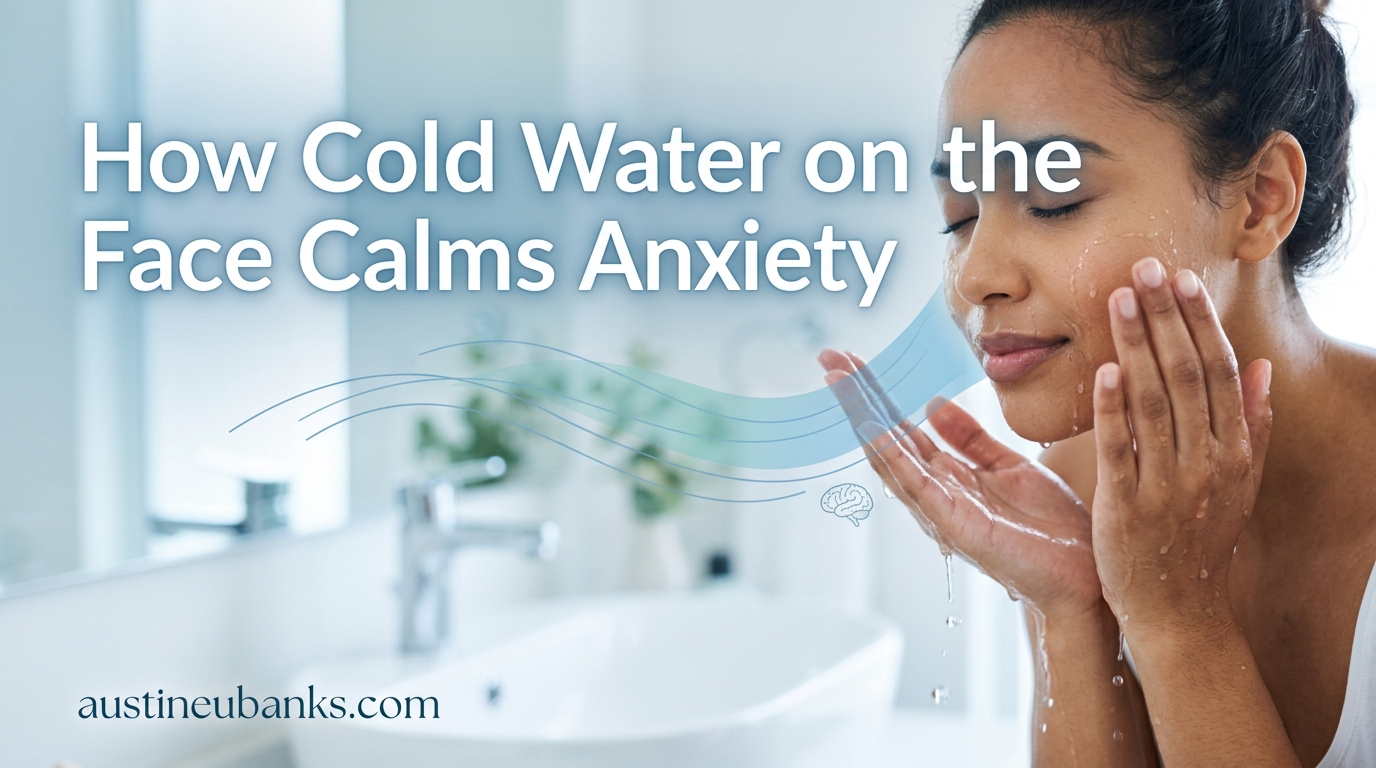
If you are using the splash method, cup water in your hands and press your palms against the lower half of your face, covering from just under your eyes down to your chin. If you are using a bowl, submerge your face so that the water line reaches at least your cheekbones. The goal is sustained cold contact with that trigger zone for 15 to 30 seconds.
One Reddit user who struggles with dissociation during anxiety shared that running cold water over this specific zone, along with their wrists, is what brings them back to their body when nothing else works. The precision matters.
Step-by-Step: The Cold Water Face Technique
There are three primary methods for using cold water on the face to calm anxiety. Each has slightly different requirements, but all three target the same physiological mechanism. Choose the one that fits your situation, your environment, and your comfort level.
Method 1: Face Immersion (Bowl Method)
This is the most powerful version of the technique and the one backed by the most research. It produces the strongest diving reflex response because it combines cold water with breath holding, which amplifies the vagal nerve activation.
Step 1: Fill a bowl with cold water. The water should be between 50 and 60 degrees Fahrenheit (10 to 15 degrees Celsius). If you do not have a thermometer, the water should feel uncomfortably cold but not painful. Water from a cold tap is usually sufficient. You can add ice cubes to bring the temperature down further.
Step 2: Take a deep breath and hold it. Breath holding is not strictly necessary for the cold water to work, but it significantly amplifies the diving reflex. If holding your breath is uncomfortable or triggering, you can skip this step and still get benefits.
Step 3: Submerge your face in the bowl. Lower your face into the water so that the water line reaches at least your cheekbones. The critical area below your eyes and above the cheekbones must be fully covered.
Step 4: Hold for 15 to 30 seconds. If you are holding your breath, 15 seconds is enough for most people. If you are breathing through a straw or using a method that allows breathing, you can stay longer. Listen to your body and come up for air whenever you need to.
Step 5: Remove your face from the water and notice the shift. Take a slow, deep breath. You should feel your heart rate begin to slow within the first few seconds. Some people feel an immediate sense of clarity and calm. Others feel the effect build over the next minute or two.
Step 6: Repeat if needed. If one round does not fully calm your anxiety, wait 30 seconds and do another round. Most people find that one to three rounds is sufficient.
Method 2: Cold Water Splash
If you do not have a bowl available or find full face immersion too intense, the splash method is a great alternative. It is what most people picture when they think of using cold water for anxiety, and it can be done anywhere there is a sink.
Step 1: Turn on the cold water tap and let it run until it reaches its coldest temperature. In some buildings, this takes 10 to 20 seconds.
Step 2: Cup your hands together and collect a pool of cold water.
Step 3: Press your cupped hands against your face, focusing on the area below your eyes and above your cheekbones. The goal is sustained contact, not a quick splash and release. Hold your hands against your face for 10 to 15 seconds.
Step 4: Repeat three to five times, each time focusing on keeping the cold water pressed against the trigger zone. You can also splash and then immediately press a cold wet towel against the same area for sustained contact.
Step 5: Follow up with slow, deep breathing. The splash method produces a gentler diving reflex response than full immersion, so pairing it with deliberate breathing helps amplify the calming effect.
Method 3: Ice Pack Alternative
If you are at home or have access to a freezer, an ice pack or bag of ice cubes pressed against the target zone can be just as effective as water immersion. This method is also useful for people who find water immersion sensory-overwhelming.
Step 1: Wrap an ice pack or a handful of ice cubes in a thin towel or Ziploc bag. Do not apply ice directly to bare skin, as this can cause ice burns.
Step 2: Press the cold pack against the area below your eyes and above your cheekbones. You can also hold it against the sides of your neck, just below your jaw, where the vagus nerve runs close to the surface.
Step 3: Hold for 15 to 30 seconds. The Psychology Today article on this technique recommends the ice pack method as an alternative that some people find easier to tolerate than full water immersion.
Step 4: Remove the pack and take slow, deep breaths. Notice the shift in your body before deciding whether to repeat.
One Reddit user with CPTSD shared that rubbing an ice cube over their neck and the area around their vagus nerve helped significantly during panic episodes. This variation can be especially useful when you are too distressed to hold your face in a bowl of water.
How Cold Does the Water Need to Be?
This is one of the most common questions people ask, and most articles do not answer it. The short answer: the water needs to be cold enough to feel uncomfortable, but not so cold that it causes pain.
Research on the cold face test, which is the clinical version of this technique used to measure vagal nerve function, typically uses water between 50 and 60 degrees Fahrenheit (10 to 15 degrees Celsius). This temperature range is cold enough to trigger the diving reflex reliably without being dangerous or painful.
For context, the average household cold water tap produces water around 50 to 55 degrees Fahrenheit, depending on your location and the season. This means in most cases, cold tap water is cold enough. You do not need to add ice unless your tap water runs warm.
If you want to increase the intensity, add ice cubes to bring the temperature down toward 40 degrees Fahrenheit (4 degrees Celsius). However, there is a point of diminishing returns. Water colder than 40 degrees can trigger a cold shock response, which is a sudden gasp reflex and spike in sympathetic activation. That is the opposite of what you want when dealing with anxiety.
The key test is simple. If the water feels refreshing and slightly uncomfortable, it is cold enough. If it feels warm or neutral, it is not cold enough. If it feels painful or makes you gasp involuntarily, it is too cold.
For people with sensory sensitivities, starting with slightly warmer water (around 60 degrees) and gradually decreasing the temperature over multiple sessions can help build tolerance without overwhelming the nervous system.
Pairing Cold Water with Breathing Techniques
Cold water alone is a powerful anxiety intervention. But when you pair it with specific breathing techniques, the calming effect compounds. The diving reflex slows your heart rate through vagal nerve activation. Controlled breathing deepens and sustains that parasympathetic response.
The most effective pairing is the 4-7-8 breathing technique. After removing your face from cold water, inhale through your nose for 4 seconds, hold your breath for 7 seconds, and exhale slowly through your mouth for 8 seconds. The extended exhale is what drives parasympathetic activation. Repeat this cycle four times.
Another effective option is box breathing, which Navy SEALs use to manage stress. Inhale for 4 seconds, hold for 4 seconds, exhale for 4 seconds, and hold empty for 4 seconds. This pattern is especially useful if the 7-second breath hold in 4-7-8 feels too long during an anxiety spike.
A third option recommended by therapists is an inhale-exhale ratio of 4 to 6. Inhale for 4 seconds and exhale for 6 seconds. The longer exhale signals safety to your nervous system and reinforces the parasympathetic shift initiated by the cold water.
The sequence matters. Cold water first, then breathing. Cold water acts as the emergency brake that stops the panic spiral. Breathing then helps maintain and deepen the calm state. If you try to breathe first without breaking the physiological panic cycle, you may find it difficult to slow your breathing at all.
Some practitioners recommend combining cold water with the 5-4-3-2-1 grounding technique. After using cold water to interrupt the acute anxiety response, name 5 things you can see, 4 things you can touch, 3 things you can hear, 2 things you can smell, and 1 thing you can taste. This engages your senses and brings your attention fully into the present moment, reinforcing the nervous system reset.
Cold Water and DBT: The TIP Skill Connection
If you have been in therapy for anxiety, PTSD, or emotional dysregulation, you may have encountered Dialectical Behavior Therapy, or DBT. One of the core skill sets in DBT is called TIP, which stands for Temperature, Intense exercise, Paced breathing, and Paired muscle relaxation.
The T in TIP is specifically about using cold water on the face to calm an anxious moment. DBT practitioners teach this technique as one of the most reliable ways to change your body’s physiology fast enough to interrupt an emotional crisis. It is not a folk remedy or a internet hack. It is a clinically validated technique taught in evidence-based therapy programs.
The reason DBT emphasizes cold water over the other TIP skills during acute distress is speed. Intense exercise takes minutes to shift your physiology. Paced breathing can take several minutes of sustained effort. Cold water works in seconds. When someone is in a full emotional crisis, those seconds matter.
This connection to DBT also helps answer the question of whether cold water is a legitimate technique or just a hack. It is legitimate. It is taught by licensed therapists, backed by peer-reviewed research, and used in clinical settings around the world.
Comparison of Cold Therapy Methods for Anxiety
Not all cold therapy methods are equally effective for acute anxiety. Here is how the most common approaches compare.
Face immersion in cold water: This is the most effective method for acute anxiety and panic attacks. It produces the strongest diving reflex response because it combines cold water with breath holding. Duration is 15 to 30 seconds. Difficulty is moderate because breath holding can be challenging for some people. Accessibility is high since all you need is a bowl and cold water.
Cold water splash: Slightly less powerful than full immersion but more accessible. You can do it anywhere with a sink. Duration is 10 to 15 seconds per splash, repeated three to five times. Difficulty is low. This is the best option for beginners or for use in public restrooms.
Ice pack on face or neck: Comparable effectiveness to face immersion when held against the correct target zone. Duration is 15 to 30 seconds. Difficulty is low and it is ideal for people who find water immersion overwhelming. Accessibility is lower since it requires access to a freezer.
Cold shower burst: Effective but more intense. A 30 to 60 second cold shower at the end of your regular shower can build long-term stress resilience through cross-adaptation, where your body becomes better at handling all forms of stress. Difficulty is high and it is not ideal for acute panic attacks because the intensity can initially spike anxiety before calming it.
Cold water hand or foot dip: The gentlest option. Submerging your hands or feet in cold water provides mild vagal stimulation and sensory grounding. It is a good starting point for people with trauma or sensory sensitivities who find facial cold exposure too intense. Duration is 30 to 60 seconds. Effectiveness for acute panic is lower than face methods.
For most people, the face immersion or splash method will be the go-to for acute anxiety. Cold showers and hand dips are better suited for building long-term stress resilience through regular practice rather than stopping an active panic attack.
Safety and Contraindications
Cold water on the face is generally safe for most healthy adults, but there are important contraindications to be aware of. The diving reflex significantly slows heart rate, which is normally a beneficial effect but can be dangerous for people with certain cardiovascular conditions.
If you have a history of bradycardia (abnormally slow heart rate), heart block, or any arrhythmia, talk to your doctor before using this technique. The additional heart rate reduction from the diving reflex could cause dizziness, fainting, or more serious cardiac events in susceptible individuals.
People with coronary artery disease, recent heart surgery, or uncontrolled hypertension should also consult a physician before using cold water therapy. Cold exposure causes blood vessels to constrict, which temporarily raises blood pressure before the parasympathetic response brings it back down.
If you are pregnant, the technique is generally considered safe in moderation, but you should check with your healthcare provider first. The diving reflex does not directly affect the fetus, but any technique that significantly alters cardiovascular function warrants caution during pregnancy.
For people with epilepsy or seizure disorders, cold water on the face is usually safe, but sudden cold shock can rarely trigger seizures in sensitive individuals. Start with the gentle splash method rather than full immersion.
If you have Raynaud’s disease, where cold exposure causes painful narrowing of blood vessels in the extremities, you may want to avoid prolonged cold water contact or stick to very brief exposures.
Finally, if you have a history of trauma involving water, drowning, or suffocation, face immersion may be triggering rather than calming. The ice pack method or hand dip method can provide similar benefits without activating traumatic associations. Always listen to your body and stop if the technique increases rather than decreases your distress.
What to Do If the Technique Does Not Work
Cold water on the face is highly effective for many people, but it is not a magic bullet. If you try it and it does not calm your anxiety, you are not doing anything wrong. Here is how to troubleshoot and adjust.
First, check your target zone. The most common reason the technique fails is that cold water is hitting the wrong part of the face. Make sure the water is contacting the area below your eyes and above your cheekbones, where the trigeminal nerve is most concentrated.
Second, check your water temperature. If the water feels only mildly cool, it may not be cold enough to trigger the diving reflex. Try adding ice or running the tap longer to reach its coldest temperature.
Third, try combining cold water with breath holding. Breath holding amplifies the diving reflex significantly. If you have been splashing without holding your breath, switching to the bowl immersion method with breath holding may produce a stronger response.
Fourth, consider that the technique may only partially work. Some people report feeling 50 to 70 percent relief rather than complete calm. That is still a meaningful improvement. Follow up with breathing exercises, grounding techniques, or physical movement to build on the partial relief.
Fifth, recognize that cold water addresses the physiological symptoms of anxiety, not the underlying thoughts. If your anxiety is being driven by a persistent anxious thought loop, you may need to address the cognitive component separately after the cold water has reduced the physical intensity.
Finally, some people simply have lower vagal tone or different nervous system wiring that makes them less responsive to this particular technique. That does not mean nothing will work. It means this specific tool may not be the best fit for your nervous system, and other grounding techniques like paced breathing, progressive muscle relaxation, or bilateral stimulation may be more effective for you.
When to Seek Professional Help
Cold water on the face is a tool, not a treatment plan. If you are experiencing anxiety several times a week, if panic attacks are interfering with your daily life, or if anxiety is affecting your sleep, relationships, or work, it is time to talk to a mental health professional.
A therapist can help you identify the root causes of your anxiety, develop a comprehensive toolkit of coping strategies, and determine whether additional support such as medication might be appropriate. Cold water can be part of that toolkit, but it should not be the only tool you rely on.
If your anxiety is accompanied by thoughts of self-harm, feelings of hopelessness, or an inability to function, reach out to a professional immediately. In the United States, you can call or text 988 to reach the Suicide and Crisis Lifeline. In other countries, equivalent crisis lines are available.
There is no weakness in seeking help. Anxiety disorders are among the most treatable mental health conditions, and the combination of professional support and self-management techniques like cold water therapy offers the best outcomes for most people.
FAQs
Does putting your face in cold water help with anxiety?
Yes. Cold water on the face triggers the mammalian diving reflex, which activates the vagus nerve and shifts your nervous system from fight-or-flight to rest-and-digest mode. When the water contacts the area below your eyes and above your cheekbones, heart rate drops and breathing slows within 15 to 30 seconds, producing a measurable calming effect.
Can cold water cure anxiety?
No, cold water cannot cure anxiety. It is an effective acute relief tool that interrupts the physical symptoms of a panic attack or anxious moment, but it does not address the underlying causes of chronic anxiety. For long-term relief, cold water techniques work best as part of a broader approach that includes therapy, stress management, and in some cases medication.
How to snap out of anxiety fast?
The fastest method is to submerge your face in cold water (50 to 60 degrees Fahrenheit) for 15 to 30 seconds while holding your breath. This triggers the diving reflex and activates the vagus nerve, slowing your heart rate within seconds. Follow up with 4-7-8 breathing: inhale for 4 seconds, hold for 7 seconds, exhale for 8 seconds.
How to relax face when anxious?
Apply cold water to the area below your eyes and above your cheekbones to stimulate the trigeminal nerve and activate the vagus nerve. You can also try gently massaging your jaw and temples, releasing clenched teeth, and practicing slow exhalations. Combining cold water with these physical relaxation techniques produces the fastest relief from facial tension caused by anxiety.
How long should you hold your face in cold water for anxiety?
15 to 30 seconds is the recommended duration for most people. Research on the cold face test, which is the clinical version of this technique, typically uses 15 to 30 seconds of cold water exposure to trigger the diving reflex. If you are holding your breath, start with 15 seconds and work up to 30 as you build comfort. You can repeat the technique up to three times with 30-second rest periods between rounds.
Does drinking cold water help anxiety attacks?
Drinking cold water provides mild sensory grounding and hydration, which can help with general anxiety, but it does not trigger the diving reflex the way facial cold water exposure does. The vagus nerve activation that produces the strong calming effect requires cold water contact with the trigeminal nerve on your face, specifically below the eyes and above the cheekbones. For acute panic, facial application is far more effective than drinking.
Conclusion
Learning how cold water on the face can calm an anxious moment gives you one of the most practical, accessible, and scientifically grounded tools for managing acute anxiety. The technique works because it taps into an ancient biological reflex that directly activates your parasympathetic nervous system, slowing your heart rate and interrupting the physiological cascade of panic in seconds.
The key details to remember are the target zone, the temperature, and the duration. Cold water must hit the area below your eyes and above your cheekbones. The water should be between 50 and 60 degrees Fahrenheit. And 15 to 30 seconds of exposure is enough for most people to feel a significant shift.
Pair cold water with controlled breathing for a compounded effect. Use the splash method when you need something gentle, the bowl immersion method when you need maximum impact, and the ice pack method when water is not practical. And know that if cold water alone does not fully resolve your anxiety, you have many other tools available, from grounding techniques to professional therapy.
Anxiety can feel overwhelming in the moment, but your body comes equipped with built-in mechanisms for restoring calm. Cold water is one of the fastest ways to access them. The next time you feel panic rising, head to the nearest sink, turn on the cold water, and let your biology do what it was designed to do.
1 thought on “How Cold Water on the Face Calms Anxiety? (October 2026) Top Picks”