
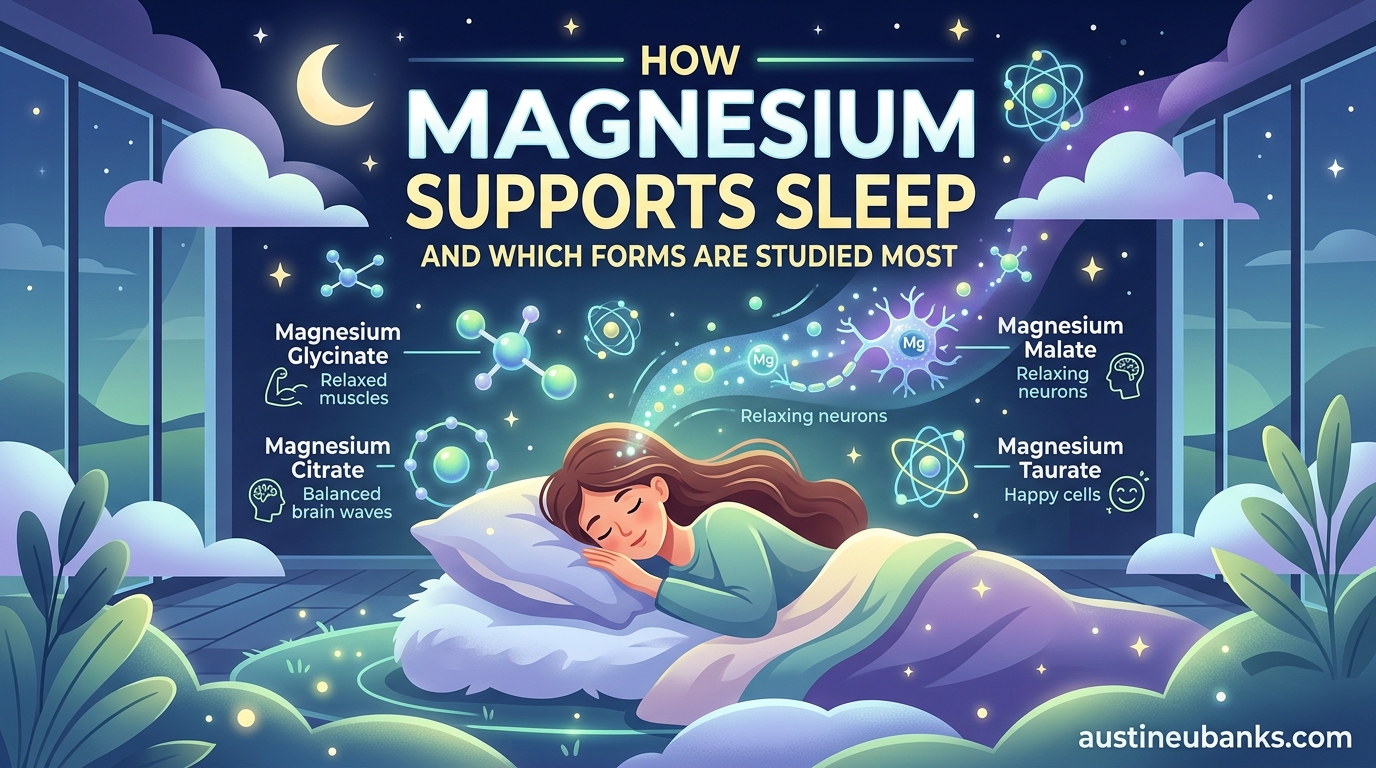
If you have ever stared at the ceiling at 2 a.m. with a racing mind, you have probably searched for something — anything — that might help you fall asleep. One mineral keeps showing up in sleep research, supplement aisles, and doctor conversations: magnesium. But understanding how magnesium supports sleep, and which forms are studied most, is not as simple as grabbing the first bottle on the shelf.
Magnesium for sleep has become one of the most talked-about natural approaches in 2026, and for good reason. Research suggests this essential mineral plays a direct role in calming your nervous system, regulating neurotransmitters that control relaxation, and supporting the hormones that govern your sleep-wake cycle. Yet many people do not know which form to take, how much to use, or what the science actually says.
In this guide, we break down exactly how magnesium interacts with your brain and body to influence sleep. We also compare the most studied forms — glycinate, citrate, threonate, and others — so you can understand the differences in bioavailability, absorption, and side-effect profiles. Whether you are dealing with occasional restlessness, stress-related sleep trouble, or just want to optimize your sleep quality, this article walks you through what the research supports and what it does not.
Table of Contents
What Is Magnesium and Why Does It Matter for Sleep
Magnesium is the fourth most abundant mineral in the human body and is involved in over 300 biochemical reactions. It supports nerve function, muscle contraction, blood sugar regulation, blood pressure control, and the synthesis of proteins and DNA. Every single cell in your body depends on magnesium to function properly.
When it comes to sleep, magnesium matters because it directly influences the systems that control how fast you fall asleep and how deeply you stay asleep. It helps regulate the HPA axis — the same stress-response system that pumps out cortisol when you are anxious. It supports the production of melatonin, the hormone that tells your brain it is time to sleep. And it activates GABA receptors, which act as your nervous system’s natural brake pedal.
Despite how essential magnesium is, deficiency is surprisingly common. Research suggests that up to 50 percent of adults in the United States consume less magnesium than the recommended daily allowance. Modern diets heavy in processed foods, combined with soil depletion that has reduced magnesium content in vegetables, make it harder to get enough from food alone. Stress, alcohol, caffeine, and certain medications like proton pump inhibitors and diuretics can further deplete magnesium stores.
This matters for sleep because even a mild magnesium deficiency can increase nervous system excitability. That translates to muscle tension, racing thoughts at bedtime, and difficulty transitioning into deep sleep. People with low magnesium often describe feeling “tired but wired” — physically exhausted but mentally unable to shut off. This is one of the first signs that magnesium status may be affecting sleep quality.
How Magnesium Supports Sleep: The Science Explained
Understanding how magnesium supports sleep requires looking at several interacting systems in the brain and body. Magnesium does not act like a sleeping pill that knocks you out. Instead, it creates the neurological conditions that make falling asleep and staying asleep easier. Here is what the research tells us about the specific mechanisms involved.
Magnesium and GABA: Your Brain’s Brake Pedal
GABA, or gamma-aminobutyric acid, is the primary inhibitory neurotransmitter in the brain. Think of it as your nervous system’s brake pedal — when GABA activity increases, neural activity slows down, and you feel calm. Many prescription sleep medications, including benzodiazepines, work by enhancing GABA activity.
Magnesium supports this same pathway naturally. Research shows that magnesium binds to GABA-A receptors and enhances their inhibitory effect. A 2021 systematic review by Zhang and colleagues found that magnesium supplementation was associated with improved sleep outcomes across multiple studies, with GABAergic modulation identified as a primary mechanism. Essentially, magnesium helps your brain apply the brakes at bedtime without the dependency risks of pharmaceutical sleep aids.
People who describe having a “busy brain” at night — those who replay conversations or worry about tomorrow — may benefit most from this GABA-supporting effect. It is not that magnesium forces your brain to stop thinking. Rather, it makes it easier for your nervous system to shift gears from active processing to rest mode.
Magnesium and Melatonin Production
Melatonin is the hormone that controls your circadian rhythm — your internal 24-hour clock. When melatonin rises in the evening, it signals to your body that it is time to sleep. When it drops in the morning, you feel alert. Magnesium plays a supporting role in this process by helping regulate the enzymes involved in melatonin production.
Specifically, magnesium is required for the conversion of serotonin to melatonin in the pineal gland. Without adequate magnesium, this conversion pathway can become less efficient, potentially leading to lower melatonin levels and delayed sleep onset. This is one reason why people with magnesium deficiency often report difficulty falling asleep at a reasonable hour, even when they feel physically tired.
A 2026 systematic review by He et al. examined the relationship between magnesium status and sleep health across dozens of studies. The review concluded that magnesium supplementation was associated with improvements in sleep onset latency — the time it takes to fall asleep — and that melatonin regulation was a contributing factor. The evidence was strongest in populations with existing magnesium deficiency.
Magnesium and NMDA Receptors
While GABA acts as the brain’s brake pedal, NMDA receptors are part of the excitatory pathway — the gas pedal. NMDA receptors are activated by glutamate, the brain’s primary excitatory neurotransmitter. When NMDA activity is too high, your nervous system stays in overdrive, making relaxation and sleep difficult.
Magnesium naturally blocks NMDA receptors. It sits inside the receptor channel and physically prevents excess calcium from entering the neuron. This is important because calcium influx through NMDA receptors is what drives neural excitation. By blocking this channel, magnesium keeps excitatory signaling in check and prevents your nervous system from becoming overstimulated.
This dual action — enhancing GABA while blocking NMDA — is what makes magnesium uniquely suited for sleep support. It simultaneously promotes calming signals and dampens excitatory ones. Few other nutrients have this bidirectional effect on the nervous system, which helps explain why so many people report noticeable improvements in sleep quality after starting supplementation.
Magnesium and Cortisol Regulation
Cortisol is often called the stress hormone, and for good reason. It follows a daily rhythm — peaking in the morning to help you wake up and declining in the evening to allow sleep. But chronic stress can disrupt this pattern, causing cortisol to stay elevated at night when it should be low. This is a major contributor to stress-related insomnia.
Magnesium helps regulate the HPA axis, the system that controls cortisol release. Research suggests that adequate magnesium levels are associated with lower and more stable cortisol patterns. When magnesium is low, the stress response can become exaggerated, making it harder to wind down at night. Supplementing with magnesium may help normalize this rhythm, particularly in people whose sleep trouble is clearly linked to daytime stress.
Muscle Relaxation and Physical Calm
Beyond its neurological effects, magnesium directly supports muscle relaxation. Magnesium acts as a natural calcium blocker in muscle cells. Calcium causes muscles to contract, while magnesium allows them to relax. When magnesium levels are low, muscles can remain partially contracted, leading to tension, twitches, cramps, and that feeling of not being able to get comfortable in bed.
This muscle-relaxing effect is particularly relevant for people with restless legs syndrome, nighttime leg cramps, or general physical tension. Many users in sleep-focused online communities report that magnesium glycinate, taken 30 to 60 minutes before bed, helps reduce physical restlessness that otherwise keeps them awake. While individual responses vary, this mechanism is well-documented in the scientific literature and represents one of the more direct ways magnesium can improve sleep.
Magnesium Forms Studied Most for Sleep
Not all magnesium supplements are created equal. The form of magnesium — meaning what it is bound to — determines how well it absorbs, whether it crosses into the brain, and what side effects it may cause. Here is a detailed look at the forms most commonly studied for sleep, ranked by evidence and practical use.
Magnesium Glycinate: The Gentle Calmer
Magnesium glycinate, also sold as magnesium bisglycinate, is magnesium bound to glycine. Glycine is an amino acid that itself has been studied for sleep benefits. Research shows that glycine supplementation can improve subjective sleep quality and reduce the time it takes to fall asleep. When combined with magnesium, you get a compound that supports sleep through two complementary pathways.
This form is widely recommended by sleep specialists and healthcare providers because it is highly bioavailable and gentle on the digestive system. Unlike magnesium citrate, glycinate does not draw water into the intestines, so it rarely causes diarrhea or stomach upset. For people who want to take magnesium daily for sleep support without digestive side effects, glycinate is typically the first choice.
The Sleep Foundation identifies magnesium glycinate as the most commonly recommended form for sleep, noting its calming properties and low risk of side effects. While it may not have the largest body of clinical trial data compared to citrate, its combination of absorption, tolerability, and glycine’s own sleep-supporting properties makes it the practical favorite among both practitioners and users.
Magnesium Citrate: The Most Researched
When it comes to sheer volume of clinical research on sleep outcomes, magnesium citrate has the most evidence. The Mayo Clinic notes that the strongest research supporting magnesium as a sleep aid specifically involves magnesium citrate. Multiple controlled trials have used this form and reported improvements in sleep quality, sleep onset latency, and sleep duration.
The catch is that magnesium citrate is also a well-known osmotic laxative. It works by drawing water into the intestines, which is great for constipation but can cause diarrhea, cramping, and urgency when taken in higher doses. This limits its practical usefulness as a nightly sleep supplement for many people. If your sleep issues are mild and you tolerate citrate well, the research backing is strong. But for long-term nightly use, the digestive effects are a real drawback.
Citrate has good bioavailability — better than oxide but slightly lower than glycinate. It absorbs reasonably well in the gut, making it an effective option for raising magnesium levels. Some practitioners recommend cycling between citrate and glycinate, using citrate a few times a week to boost magnesium stores and glycinate nightly for sleep support.
Magnesium Threonate: The Brain Penetrator
Magnesium threonate, or magnesium L-threonate, is the newest form being studied for sleep and cognitive function. Developed by researchers at MIT, this form was specifically designed to cross the blood-brain barrier more effectively than other types of magnesium. Because of this enhanced brain penetration, threonate may deliver more magnesium directly to the central nervous system.
Emerging research suggests magnesium threonate may be particularly beneficial for sleep quality and cognitive function. Animal studies have shown that it can increase magnesium levels in cerebrospinal fluid and improve memory and learning. Human studies are still limited but promising, with some evidence suggesting improvements in sleep architecture — specifically deeper, more restorative sleep stages.
The main downside is cost. Magnesium threonate is significantly more expensive than glycinate or citrate. For people with budget constraints, glycinate offers most of the sleep benefits at a lower price point. However, if cognitive symptoms accompany your sleep issues — brain fog, difficulty concentrating, age-related memory concerns — threonate may offer additional benefits worth the investment.
Magnesium Oxide: Limited Bioavailability
Magnesium oxide is the form most commonly found in cheap supplements and is often what you will see on the lowest-priced shelf. It contains a high percentage of elemental magnesium by weight, which looks impressive on the label. However, its bioavailability is poor — typically estimated at around 4 percent absorption.
Most of the magnesium in oxide form passes through your digestive system without being absorbed. Not only does this mean you get minimal benefit for sleep, but the unabsorbed magnesium draws water into the intestines and acts as a laxative. Studies comparing oxide to other forms consistently show inferior absorption and more side effects.
If your current supplement lists magnesium oxide as the primary ingredient, switching to glycinate, citrate, or threonate will likely produce noticeably better results. This single change is one of the most impactful upgrades you can make for both sleep and overall magnesium repletion.
Magnesium Taurate and Malate: Niche Options
Magnesium taurate pairs magnesium with taurine, an amino acid that supports cardiovascular health and has calming properties. Some practitioners recommend taurate for people whose sleep issues are linked to heart palpitations, high blood pressure, or anxiety. While research specifically on sleep is limited, the theoretical mechanism — combining magnesium’s calming effects with taurine’s GABA-enhancing properties — is sound.
Magnesium malate pairs magnesium with malic acid, which is involved in the cellular energy production cycle. Malate is sometimes recommended for people with fibromyalgia or chronic fatigue. However, because it plays a role in energy metabolism, some practitioners suggest taking it earlier in the day rather than at bedtime to avoid feeling too energized to sleep. Neither taurate nor malate has extensive sleep-specific research, so they are best considered as secondary options based on individual needs.
Magnesium Glycinate vs Citrate vs Threonate for Sleep
The question of which magnesium form to choose comes up constantly in sleep communities, and it is one of the most common search queries related to magnesium for sleep. Each form has distinct advantages, and the right choice depends on your primary concerns.
Magnesium glycinate is the best all-around choice for nightly sleep support. It absorbs well, does not cause digestive upset, and the attached glycine has its own sleep-promoting properties. If you want one form to take every night long-term, this is it. It is also the form most recommended by healthcare providers for patients who are new to magnesium supplementation.
Magnesium citrate has the most clinical research behind it for sleep outcomes. If you want the form with the strongest trial data, citrate is the answer. The trade-off is the laxative effect, which makes it less suitable for daily long-term use unless your digestion tolerates it well. Citrate is also a good choice if you specifically need to correct a magnesium deficiency quickly, as it raises blood magnesium levels efficiently.
Magnesium threonate is the best choice if your primary concern is cognitive function alongside sleep. Because it crosses the blood-brain barrier more effectively, it may deliver benefits for brain health that other forms cannot match. If budget is not a concern and you are dealing with brain fog, memory issues, or age-related cognitive changes along with poor sleep, threonate is worth considering.
A practical approach many users adopt is glycinate nightly for general sleep support, with an occasional cycle of citrate to boost overall magnesium levels. Threonate can be added if cognitive symptoms are a concern. This layered approach lets you take advantage of each form’s strengths while minimizing their weaknesses.
How Much Magnesium Should You Take for Sleep
Dosage is where many people go wrong with magnesium. Too little and you will not notice any effect. Too much and you will spend the night in the bathroom instead of in bed. Getting the dose right requires understanding both the research-backed ranges and how your body responds individually.
Recommended Dosage Range
The Recommended Dietary Allowance for magnesium varies by age and sex, but for most adults it ranges from 310 to 420 milligrams per day. This is the total amount from all sources — food, water, and supplements combined. The typical Western diet provides roughly 200 to 250 milligrams daily, meaning many people fall short of the target.
For sleep specifically, research studies typically use supplement doses in the range of 250 to 500 milligrams of magnesium per day. The NIH has set a tolerable upper intake level of 350 milligrams per day for supplemental magnesium — meaning from supplements alone, not including food. This is an important distinction because it means you can safely get additional magnesium from food sources on top of your supplement.
Most practitioners recommend starting with 200 to 250 milligrams of supplemental magnesium taken in the evening and adjusting based on your response. If you do not notice improvement after two to three weeks, you can gradually increase the dose, staying below the 350-milligram supplement limit unless advised otherwise by a healthcare provider.
When to Take Magnesium for Sleep
Timing matters when using magnesium for sleep support. The general recommendation is to take your magnesium supplement 30 to 60 minutes before you plan to go to sleep. This gives the mineral time to absorb and begin exerting its calming effects on your nervous system and muscles.
Some people find that splitting the dose — taking half in the early evening and half right before bed — provides a smoother effect. This can be especially helpful if your sleep trouble involves waking up in the middle of the night rather than just difficulty falling asleep.
Avoid taking magnesium at the exact same time as calcium, zinc, or iron supplements, as these minerals can compete for absorption. If you take other supplements, space your magnesium dose at least two hours apart from them. Taking magnesium with a small amount of food or a light snack can also improve absorption and reduce any chance of mild stomach upset.
How Long Until You See Results
This is one of the most common questions people ask, and the answer depends on your starting magnesium status. If you are significantly deficient, you may notice improvements in sleep quality within the first two to three nights. Many users in online sleep communities report falling asleep faster and experiencing deeper sleep within just a few days of starting magnesium glycinate at 200 to 240 milligrams.
For others, especially those whose magnesium levels are closer to adequate, it may take two to four weeks of consistent daily use before noticeable sleep improvements occur. Magnesium needs to build up in your tissues to have its full effect on GABA receptors, melatonin production, and nervous system regulation. This is why consistency matters more than dose — taking a moderate amount every single night will outperform taking a large dose sporadically.
The Mayo Clinic recommends a practical three-month trial period to evaluate whether magnesium is helping your sleep. This allows enough time to build tissue stores, identify the right form and dose, and assess whether sleep quality has genuinely improved. Keep a simple sleep diary during this period so you can objectively evaluate changes rather than relying on impression alone.
Safety, Side Effects, and Who Should Avoid Magnesium
Magnesium is generally safe for most healthy adults when taken within recommended doses. However, like any supplement, it carries potential risks and is not appropriate for everyone. Understanding these safety considerations is essential before adding magnesium to your nightly routine.
The most common side effects of magnesium supplementation are digestive. As mentioned earlier, magnesium citrate and oxide can cause diarrhea, abdominal cramping, and bloating, especially at higher doses. Glycinate and threonate are much gentler and rarely cause these issues. If you experience digestive upset from one form, switching to glycinate usually resolves the problem without abandoning magnesium entirely.
Exceeding the tolerable upper intake level of 350 milligrams per day from supplements can lead to magnesium toxicity. Early signs include nausea, vomiting, low blood pressure, muscle weakness, and irregular heartbeat. In severe cases, extremely high magnesium levels can cause cardiac arrest. These dangerous levels are almost never reached from supplements alone in people with healthy kidney function, but they are a risk for people with impaired kidneys.
People with kidney disease should not take magnesium supplements without medical supervision. The kidneys are responsible for excreting excess magnesium, and when kidney function is impaired, magnesium can accumulate to dangerous levels. If you have any form of kidney disease or reduced kidney function, talk to your doctor before starting any magnesium supplement.
Magnesium can also interact with several common medications. It can reduce the absorption of certain antibiotics, particularly tetracyclines and fluoroquinolones, so these should be taken at least two hours apart from magnesium. Magnesium may also enhance the effects of blood pressure medications and increase the risk of low blood pressure. People taking bisphosphonates for osteoporosis should also separate their dose from magnesium supplements.
If you take proton pump inhibitors for acid reflux, be aware that long-term use of these medications can lower magnesium levels. Paradoxically, this means PPI users may be among those who benefit most from supplementation, but they should discuss this with their prescribing doctor to determine appropriate monitoring and dosing.
Who Benefits Most from Magnesium for Sleep
Magnesium for sleep is not a universal solution — some people will see dramatic improvements while others notice little difference. Understanding who tends to benefit most can help you decide whether it is worth trying.
Older adults are one of the groups most likely to benefit. Magnesium absorption decreases with age, and older adults typically consume less magnesium from food. Research shows that elderly populations often have lower magnesium stores, and supplementation studies in this group have produced some of the strongest sleep improvement results.
People with stress-related sleep issues are another responsive group. If your sleep trouble is driven by anxiety, racing thoughts, or physical tension from daily stress, magnesium’s calming effects on GABA and cortisol may provide meaningful relief. Users in anxiety and mental health communities frequently report that magnesium glycinate helps quiet the mental chatter that keeps them awake.
Individuals with restless legs syndrome or nighttime leg cramps often find magnesium helpful. The mineral’s role in muscle relaxation makes it a logical fit for these conditions. While research results are mixed — some studies show clear benefit, others find minimal effect — many people report enough improvement to justify continued use.
Women going through perimenopause and menopause frequently report sleep benefits from magnesium. Hormonal changes during this transition can disrupt sleep through hot flashes, night sweats, and mood changes. Magnesium’s role in temperature regulation, muscle relaxation, and nervous system calming may help address several of these symptoms simultaneously.
Finally, anyone with a documented or suspected magnesium deficiency is a strong candidate. Since deficiency is so common — affecting up to half of adults — and since deficiency directly interferes with sleep-related pathways, correcting low magnesium through a combination of dietary improvements and supplementation can produce noticeable sleep benefits relatively quickly.
Conversely, if your sleep issues stem from sleep apnea, chronic insomnia unrelated to anxiety or deficiency, or environmental factors like noise and light, magnesium may not be the answer. It works best when the underlying cause of poor sleep involves nervous system overactivity, muscle tension, or suboptimal magnesium status.
FAQs
What is the most effective form of magnesium for sleep?
Magnesium glycinate is the most commonly recommended form for sleep because it absorbs well, is gentle on the digestive system, and the attached glycine amino acid has its own sleep-promoting properties. Magnesium citrate has the most clinical trial data, but its laxative effect makes it less practical for nightly use. For most people seeking a daily sleep supplement, glycinate offers the best combination of effectiveness and tolerability.
Is there any scientific evidence that magnesium helps sleep?
Yes. Multiple studies, including a 2021 systematic review by Zhang et al. and a 2026 review by He et al., have found that magnesium supplementation is associated with improved sleep quality, reduced sleep onset latency, and better overall sleep outcomes. The evidence is strongest in older adults and people with existing magnesium deficiency. Magnesium’s effects on GABA receptors, melatonin production, and NMDA receptor blocking provide well-documented neurological mechanisms for these sleep benefits.
Which magnesium is best for sleep and anxiety?
Magnesium glycinate is typically the best choice for combined sleep and anxiety support. Glycine itself has calming properties, and the form’s high bioavailability means more magnesium reaches your nervous system to support GABA activity. Magnesium threonate is another option if cognitive symptoms accompany anxiety, as it crosses the blood-brain barrier more effectively. Both forms are gentle on the stomach, making them suitable for daily use.
How much magnesium should you take for sleep?
Most research studies use 250 to 500 milligrams of magnesium per day for sleep support. The NIH sets a tolerable upper intake level of 350 milligrams per day from supplements alone. A practical starting dose is 200 to 250 milligrams taken 30 to 60 minutes before bed, which can be adjusted after two to three weeks based on your response. Always stay below 350 milligrams from supplements unless advised by a healthcare provider.
How long does it take for magnesium to work for sleep?
Some people notice improvements in sleep quality within two to three nights, especially if they were magnesium deficient. For others, it may take two to four weeks of consistent daily use before noticeable changes occur. Magnesium needs to accumulate in your tissues to fully support GABA receptors, melatonin production, and nervous system regulation. The Mayo Clinic recommends a three-month trial to properly evaluate results.
Can you take too much magnesium?
Yes. Exceeding 350 milligrams per day from supplements can cause side effects including diarrhea, nausea, abdominal cramping, and low blood pressure. In severe cases, magnesium toxicity can cause irregular heartbeat and cardiac arrest. People with kidney disease are at particularly high risk because their kidneys cannot efficiently excrete excess magnesium. Always follow recommended dosing and consult a doctor if you have kidney conditions or take medications.
What foods are high in magnesium?
The best dietary sources of magnesium include pumpkin seeds, spinach, Swiss chard, dark chocolate, black beans, almonds, cashews, avocado, and whole grains. A single ounce of pumpkin seeds provides about 150 milligrams of magnesium. Eating a varied diet rich in leafy greens, nuts, seeds, and legumes can help you reach the daily recommended intake of 310 to 420 milligrams from food alone.
What is the difference between magnesium and melatonin?
Magnesium is a mineral that supports hundreds of bodily processes and helps regulate neurotransmitters and hormones involved in sleep, including melatonin. Melatonin is a hormone produced by the pineal gland that directly signals your brain that it is time to sleep. Magnesium helps your body produce melatonin naturally, while melatonin supplements provide the hormone directly. The two can work together, but they act through different pathways.
Conclusion
Magnesium for sleep has earned its reputation as one of the most promising natural approaches to better rest. The science is clear: magnesium supports your nervous system through multiple pathways, from enhancing calming GABA activity to supporting melatonin production and blocking excitatory NMDA receptors. For a mineral that most adults do not get enough of, correcting this gap can produce meaningful improvements in how fast you fall asleep and how rested you feel.
If you are just starting out, magnesium glycinate at 200 to 250 milligrams taken 30 to 60 minutes before bed is the most practical entry point. It is gentle, well-absorbed, and combines magnesium with glycine for a dual sleep-supporting effect. Give it at least two to four weeks of consistent nightly use before evaluating results, and keep a simple sleep log to track changes objectively.
Remember that magnesium works best as part of a broader sleep strategy. It is not a replacement for good sleep hygiene — consistent bedtimes, a dark and cool bedroom, limited screen time before bed, and regular exercise all matter. But if you have those foundations in place and still struggle with sleep, magnesium may be the missing piece that helps your nervous system finally shift into rest mode at night.
As always, talk to your healthcare provider before starting any new supplement, especially if you take medications or have underlying health conditions. With the right form, the right dose, and realistic expectations, magnesium may help you get the deeper, more restorative sleep you have been missing.