
You pop a melatonin gummy, climb into bed ten minutes later, and wonder why you are still staring at the ceiling an hour later. I have been there, and so have millions of people who treat melatonin like a sleeping pill they can swallow right before lights out. Here is the truth that surprised me when I first dug into the research: melatonin is not a sedative. It is a timing signal. Understanding how melatonin works changes everything about how (and when) you should use it.
In this guide, we will break down what melatonin actually is, how it interacts with your brain and circadian rhythm, and why taking it at the wrong time can backfire. By the end, you will know exactly why timing matters more than dose and how to work with your body instead of against it.
Table of Contents
What Is Melatonin?
Melatonin is a hormone produced naturally by the pineal gland, a tiny pea-shaped structure sitting deep in the center of your brain. Often called the “darkness hormone,” melatonin is your body’s internal signal that night has arrived and it is time to wind down. It does not force you to sleep the way a prescription sedative might. Instead, it tells your brain that the day is over and shifts you into a state researchers call “quiet wakefulness,” which makes falling asleep feel easier and more natural.
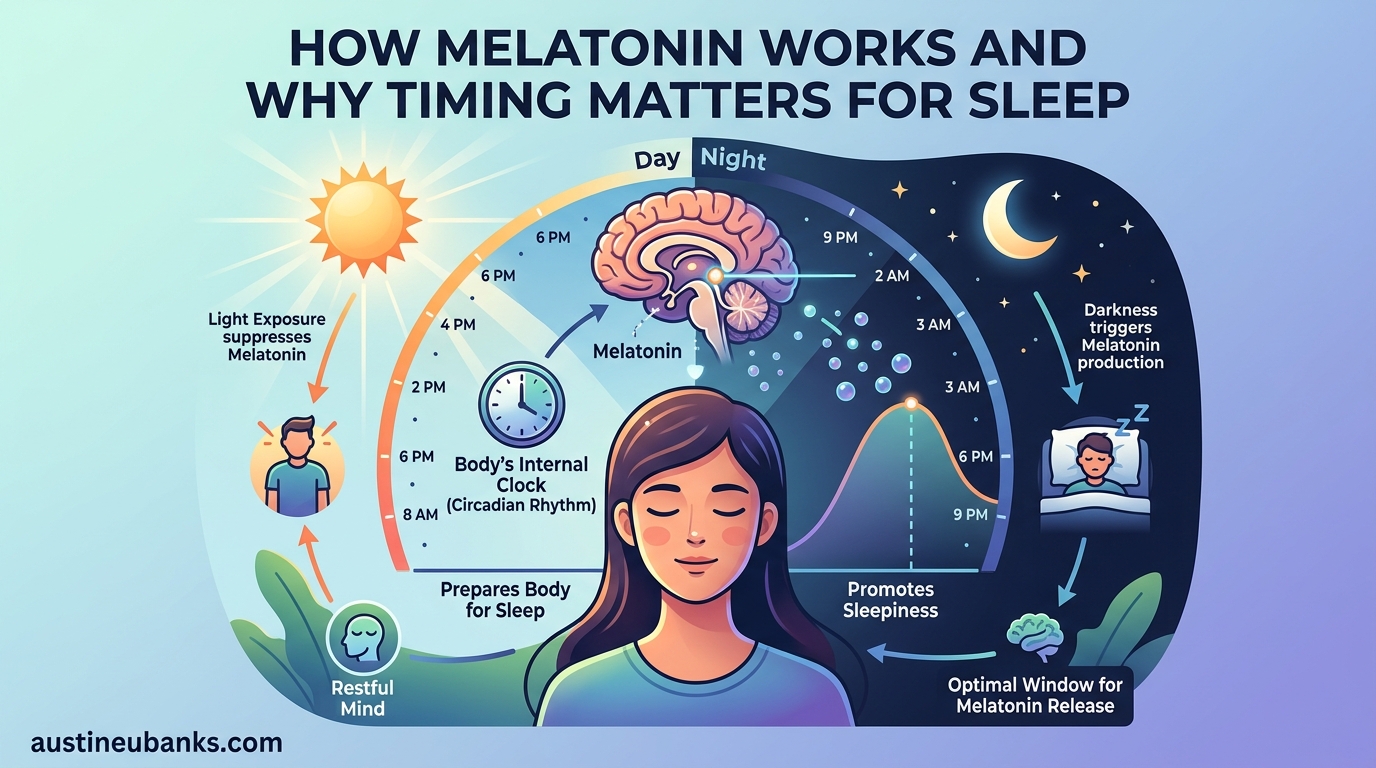
Your body makes melatonin from serotonin, a neurotransmitter also involved in mood regulation. When light hits your retinas during the day, melatonin production stays suppressed. As darkness falls in the evening, that suppression lifts and your pineal gland starts pumping out melatonin. This is the endogenous melatonin your body produces on its own.
Exogenous melatonin, on the other hand, refers to the melatonin you take as a supplement. This is the version sold in gummies, tablets, and liquids at pharmacies. The key difference is that your body tightly regulates its own melatonin based on light cues, while a supplement delivers a fixed dose whenever you choose to take it. That distinction matters enormously for timing, which we will get to shortly.
One important note: melatonin levels naturally decline as you age. A teenager may produce ten times more melatonin at night than a 60-year-old. This age-related decline is one reason older adults often struggle with sleep onset and why melatonin supplements can feel more impactful later in life.
How Melatonin Works in the Brain
Understanding how melatonin works starts with the suprachiasmatic nucleus, or SCN. This small cluster of cells in the hypothalamus acts as your master biological clock. Every morning, light entering your eyes sends a signal through your optic nerves directly to the SCN, which then orchestrates your entire sleep-wake cycle, body temperature, and hormone release throughout the day.
When the SCN registers that light is fading, it removes its brake on the pineal gland. The pineal gland then begins producing melatonin. Levels typically start rising about two hours before your usual bedtime, peak sometime between 2:00 AM and 4:00 AM, and gradually fall back to near-zero by morning. This rising curve is what scientists call the dim light melatonin onset, or DLMO.
Once melatonin enters your bloodstream, it binds to specific receptors in the brain, particularly MT1 and MT2 receptors in the SCN itself. This binding has a clever effect: it dials down the wake-promoting signals that the SCN normally sends during daylight hours. Think of it as turning down the volume on an alarm system rather than pressing an off switch. Your brain shifts from alert and active to calm and receptive to sleep.
This is why melatonin produces a state of quiet wakefulness rather than sudden unconsciousness. You feel drowsy, relaxed, and less mentally active, but you still need to actually lie down and let sleep take over. If you fight it by scrolling through your phone or watching an action movie, the melatonin signal gets overridden by light and stimulation.
It is also worth noting that melatonin has a relatively short half-life, usually between 30 and 60 minutes for standard immediate-release supplements. This means that half of the dose is cleared from your bloodstream within an hour. That short half-life explains a common complaint I see in sleep forums: people fall asleep fine but wake up at 3:00 AM unable to get back to sleep. The melatonin has already worn off.
How Melatonin Works and Why Timing Matters for Sleep
This is where the circadian rhythm connection comes in. Your circadian rhythm is the roughly 24-hour internal cycle that governs sleep, hunger, body temperature, and hormone release. Melatonin is one of the most important chemical messengers that keeps this rhythm synchronized with the outside world.
When your melatonin rises at the right time each evening, it reinforces a stable circadian rhythm. You feel sleepy at a consistent hour, you sleep through the night, and you wake up refreshed in the morning. But when melatonin timing gets disrupted, the whole system can drift. This is what happens with jet lag, shift work, and the phenomenon of being a “night owl” who cannot fall asleep until 3:00 AM.
Here is the part most people miss: melatonin does not just make you sleepy in the moment. It actually shifts your circadian clock. If you take melatonin early in the evening, it pulls your clock earlier, making you want to sleep sooner. If you take it in the morning, it pushes your clock later. This shifting effect is called a phase response, and it is the reason melatonin is classified as a chronobiotic, a substance that alters circadian timing, rather than a pure sleeping pill.
This is precisely why timing matters so much. Take melatonin at the wrong hour and you can accidentally shift your body clock in the wrong direction. I have spoken with people who started taking melatonin at 10:00 PM hoping to fall asleep by 10:30, but because their natural DLMO was already happening around 9:00 PM, the late dose actually confused their rhythm and made sleep harder to achieve over time.
Why Melatonin Timing Matters More Than Dose
If there is one thing I want you to take away from this article, it is this: when you take melatonin matters far more than how much you take. The research and the countless user experiences I have read all point to the same conclusion. People obsess over whether to take 1mg, 3mg, 5mg, or 10mg, but they ignore the clock.
Most sleep experts, including those at Johns Hopkins, recommend taking melatonin about two hours before your desired bedtime. If you want to be asleep by 11:00 PM, that means taking your supplement around 9:00 PM. This timing mirrors the natural rise of endogenous melatonin and gives your brain the signal it expects.
Taking melatonin right before bed, or worse, after you are already in bed frustrated that you cannot sleep, is the most common mistake I see. By that point, your body has already been receiving its natural melatonin signal for an hour or two. Adding a supplement on top does little to help and can actually create a confusing overlap of signals.
What about dose? Most studies show that lower doses in the 0.3mg to 3mg range are just as effective as higher doses for sleep onset. Doses above 5mg do not produce proportionally better sleep and are more likely to cause side effects like grogginess the next morning, vivid dreams, or even paradoxical wakefulness. Many people in online sleep communities report that dropping from 10mg to 1mg actually improved their sleep.
The short half-life issue deserves special attention. Standard melatonin clears your system within a few hours, which is great for falling asleep but not for staying asleep. If middle-of-the-night waking is your main problem, timing a standard dose will not solve it. Some people benefit from extended-release formulations, but even those have limits. The root issue is often circadian misalignment, not a melatonin deficiency.
Here is a simple framework I recommend for getting the timing right. First, identify your target bedtime. Second, take a low dose of melatonin two hours before that time. Third, dim the lights in your home during that two-hour window, because bright light will suppress and counteract the melatonin signal. Fourth, get bright light exposure first thing in the morning to lock in your circadian rhythm. Repeat this pattern consistently for at least a week before judging whether it works.
When Melatonin Actually Helps (and When It Does Not)
Melatonin is not a cure-all for every sleep problem. Understanding when it works and when it does not will save you frustration and money. The evidence is strongest for specific situations where circadian timing is the core issue.
Jet lag is one of the best-studied uses. When you cross multiple time zones, your internal clock is out of sync with local time. Strategically timed melatonin can help shift your clock faster. The general rule is to take it at the equivalent of your target bedtime in the new time zone, starting a day or two before travel if possible.
Delayed sleep phase syndrome, or DSPS, is another condition where melatonin shines. People with DSPS naturally fall asleep very late, sometimes 4:00 AM or later, regardless of how tired they feel. Taking small doses of melatonin several hours before their natural sleep onset can gradually pull the clock earlier. Many users in the DSPD community on Reddit report significant improvement with consistent low-dose timing protocols.
Shift workers face a particularly tough challenge because their work schedule fights their biology. Melatonin taken before a daytime sleep period can help signal to the body that it is time to rest despite the sunlight outside. This use requires careful timing and consistency.
For general, occasional insomnia, melatonin can help take the edge off. If you are stressed and lying awake, it may shorten the time it takes to fall asleep by 10 to 15 minutes according to some studies. But it is not powerful enough to overcome severe anxiety, caffeine consumed late in the day, or a disrupted sleep environment.
Where melatonin tends to disappoint is for chronic, long-term insomnia rooted in anxiety, depression, or poor sleep hygiene. People in these situations often report that melatonin stopped working after a few weeks. That is not surprising, because the underlying issue was never a melatonin deficiency in the first place.
You can also boost your natural melatonin production without supplements. Get bright sunlight exposure during the day, especially in the morning. Avoid bright screens and overhead lights in the two hours before bed. Keep your bedroom cool, dark, and quiet. Eat dinner earlier, since digestion can delay melatonin onset. These habits support the system your body already has in place.
Safety, Side Effects, and Who Should Avoid Melatonin
Melatonin sold as a dietary supplement is generally considered safe for short-term use in healthy adults, but it is not without risks. Common side effects include daytime drowsiness, headache, dizziness, and nausea. Many users in sleep forums also report unusually vivid dreams or even nightmares, especially at higher doses. This effect appears to be linked to melatonin’s influence on REM sleep stages.
Because melatonin interacts with the immune system, people with autoimmune conditions should be cautious. There is some evidence that melatonin can stimulate immune activity, which theoretically could worsen conditions like Hashimoto’s thyroiditis, rheumatoid arthritis, or lupus. If you have an autoimmune disorder, talk to your doctor before using melatonin regularly.
A frequent question I see is whether melatonin lowers cortisol. Cortisol and melatonin have an inverse relationship in a healthy circadian rhythm. Cortisol peaks in the morning to help you wake, while melatonin peaks at night. Some research suggests that properly timed melatonin supplementation may help normalize a disrupted cortisol rhythm, but melatonin is not a cortisol-lowering treatment in the direct sense. If you suspect a cortisol problem, work with a healthcare provider rather than self-medicating.
Some people worry about dependency. Melatonin is not addictive in the way that prescription sleep medications can be, and it does not cause withdrawal in the traditional sense. However, long-term daily use may reduce your body’s natural melatonin receptor sensitivity, making supplements feel less effective over time. Most experts recommend using melatonin intermittently or for short stretches of a few weeks rather than every night indefinitely.
Pregnant and breastfeeding women, children, and people taking blood thinners, blood pressure medications, or immunosuppressants should consult a physician before using melatonin. The supplement aisle is not a substitute for medical advice, especially when other conditions or medications are involved.
FAQs
What is the 3-3-3 rule for sleep?
The 3-3-3 rule for sleep is a simple wind-down guideline: stop eating heavy meals 3 hours before bed, stop working or doing mentally intense tasks 3 hours before bed, and stop looking at bright screens 3 hours before bed. Following this rule supports your body’s natural melatonin rise and creates ideal conditions for sleep onset.
Can I take melatonin if I have Hashimoto’s?
Melatonin may stimulate immune activity, so people with Hashimoto’s thyroiditis or other autoimmune conditions should use caution. Some research suggests melatonin could theoretically worsen autoimmune symptoms. Talk to your endocrinologist or primary care doctor before using melatonin regularly if you have Hashimoto’s.
Why is melatonin not recommended anymore?
Melatonin is not banned or universally discouraged, but some sleep specialists have grown more cautious because many people use it incorrectly. High doses, poor timing, and long-term daily use can cause side effects and disrupt natural rhythms. Experts now emphasize that melatonin should be used at low doses, timed correctly about two hours before bed, and reserved for short-term or situational use rather than nightly reliance.
Can taking melatonin lower cortisol?
Melatonin and cortisol follow an inverse daily rhythm, with cortisol high in the morning and melatonin high at night. Properly timed melatonin may help normalize a disrupted cortisol pattern by supporting a healthy circadian rhythm, but melatonin is not a direct cortisol-lowering medication. If you suspect a cortisol imbalance, consult a healthcare provider for proper testing and guidance.
Key Takeaways on How Melatonin Works
Melatonin is a timing hormone, not a knockout pill. It works by signaling darkness to your brain and shifting your circadian rhythm into sleep mode. Getting the timing right, roughly two hours before your target bedtime, matters far more than chasing higher doses. Support your natural production with morning light, evening darkness, and consistent sleep habits. If you understand how melatonin works and respect why timing matters for sleep, you can finally stop fighting your biology and start working with it.