
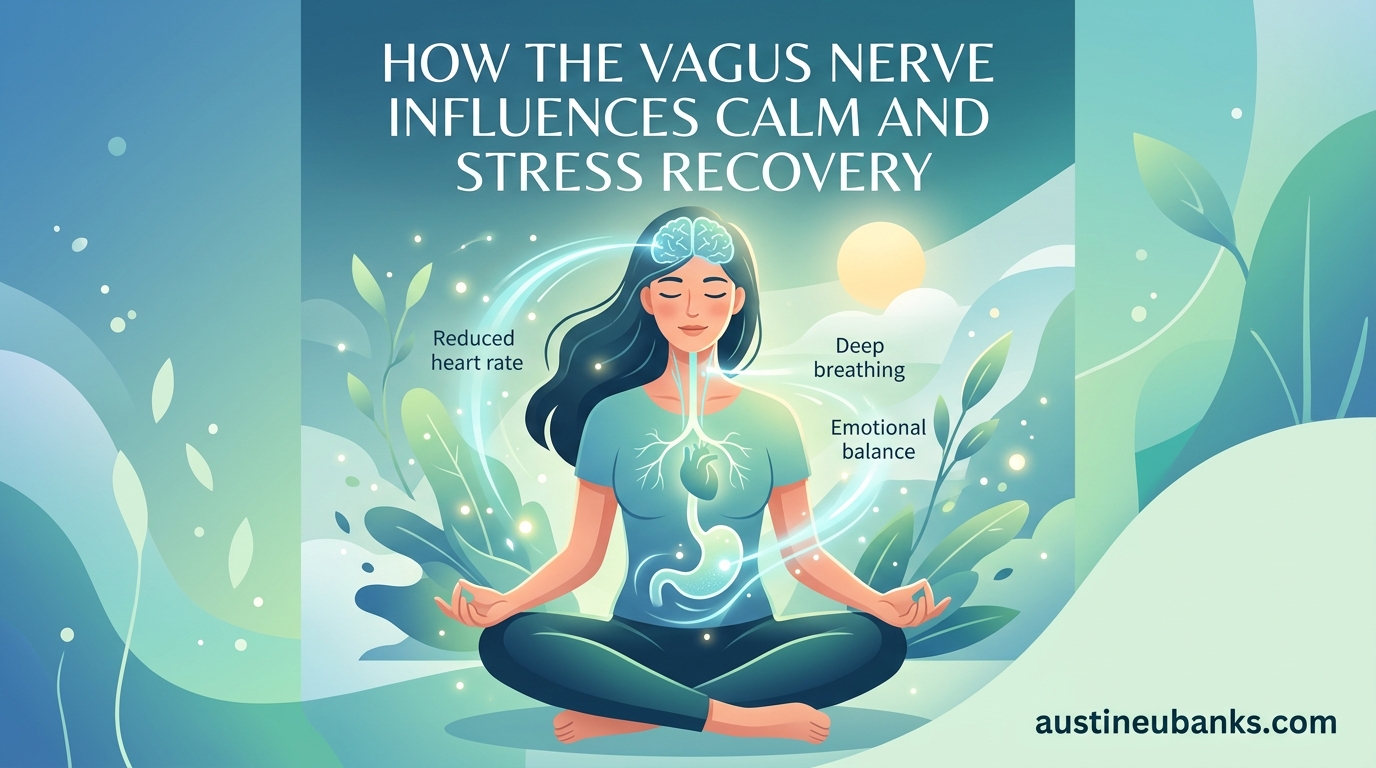
High vagal tone is associated with a greater ability to recover from stress, as it promotes activation of the parasympathetic nervous system. That one sentence captures the core of what science tells us about the vagus nerve and stress recovery. When your vagus nerve functions well, it helps your body return to calm after stressful situations, regulating everything from your heart rate to your digestion to your mood.
If you have ever felt stuck in “fight or flight” mode, unable to relax even when nothing is wrong, your vagus nerve may be part of the picture. This remarkable nerve acts as the master switch between stress and calm. Understanding how it works gives you practical, science-backed tools to shift your nervous system out of overdrive and into recovery.
In this guide, we will walk through exactly how the vagus nerve influences calm and stress recovery. You will learn what vagal tone is, how to tell if yours might be low, and seven specific exercises you can try today to activate your body’s natural relaxation response. No equipment, no gimmicks, just your breath, your body, and a bit of biology working in your favor.
Table of Contents
What Is the Vagus Nerve?
The vagus nerve is the longest cranial nerve in your body, designated as cranial nerve X (the Roman numeral ten). The word “vagus” comes from Latin for “wanderer,” which is fitting because this nerve wanders from your brainstem down through your neck, chest, and abdomen, branching out to connect with nearly every major organ along the way.
It originates in the medulla oblongata at the base of your brainstem. From there, the left and right vagus nerves travel down both sides of your neck, pass through your chest near the heart and lungs, and continue into your digestive tract. This extensive pathway is why the vagus nerve touches so many bodily functions at once.
The vagus nerve is a core component of your autonomic nervous system, specifically the parasympathetic branch. While the sympathetic nervous system handles your “fight or flight” response, the parasympathetic system governs “rest and digest” activities. The vagus nerve carries roughly 80% of its fibers upward, from body to brain, meaning it is primarily a sensory highway reporting the state of your organs back to your brain.
This upward flow of information is what makes the vagus nerve so influential over how you feel moment to moment. It tells your brain whether your body is safe or under threat, and your brain responds accordingly by either promoting calm or triggering stress chemistry.
How the Vagus Nerve Influences Calm and Stress Recovery
The vagus nerve influences calm and stress recovery by serving as the primary brake on your stress response. When a threat appears, your sympathetic nervous system floods your body with adrenaline and cortisol, raising your heart rate, tightening your muscles, and sharpening your focus. Once the threat passes, the vagus nerve steps in to bring everything back down.
Think of the vagus nerve as the foot lifting off the gas pedal and pressing the brake. It releases a neurotransmitter called acetylcholine, which slows your heart rate, reduces inflammation, and signals to your brain that the danger has passed. This process is called parasympathetic activation, and it is the biological foundation of stress recovery.
Research shows that people with higher vagal tone recover from stress faster. Their hearts respond more flexibly to changing conditions, their inflammation levels stay lower, and their emotional regulation tends to be stronger. High vagal tone does not mean you never feel stress. It means your body efficiently returns to baseline after a stressful event instead of staying elevated for hours.
The connection between the vagus nerve and calm also extends to mood regulation. Studies have linked low vagal tone to anxiety, depression, and difficulty processing emotions. When the vagus nerve is underactive, the body has trouble shifting out of sympathetic dominance, leaving you in a prolonged state of physiological arousal that feels like chronic anxiety or restlessness.
Here is where it gets encouraging. Unlike many aspects of your biology, vagal tone is not fixed. You can improve it through consistent, simple practices. The same nerve that governs your stress response can be trained to respond more effectively.
Parasympathetic vs Sympathetic: The Two Sides of Your Stress Response
Your autonomic nervous system operates like a seesaw with two main branches. On one side sits the sympathetic nervous system, your body’s accelerator. On the other side sits the parasympathetic nervous system, your body’s brake. Health and calm come from a dynamic balance between the two.
The sympathetic system evolved to keep you alive in immediate danger. When activated, it increases heart rate, dilates pupils, redirects blood to muscles, and shuts down digestion. This is the “fight or flight” response, and in genuine emergencies, it is lifesaving. The problem for most people today is that this system activates for non-life-threatening stressors like emails, traffic, deadlines, and social conflicts.
The parasympathetic system does the opposite. It slows the heart, stimulates digestion, relaxes muscles, and promotes cellular repair. This is the “rest and digest” state, and the vagus nerve is its primary driver. When parasympathetic activation dominates, your body focuses on recovery, healing, and energy conservation.
Ideally, these two systems trade off smoothly throughout your day. A stressful moment triggers sympathetic activation, then the vagus nerve brings you back to parasympathetic dominance once the moment passes. But chronic stress can leave the sympathetic system stuck in the “on” position, overwhelming the vagus nerve’s ability to restore calm. This is what people mean when they say they feel “stuck in fight or flight.”
Nervous system regulation is not about eliminating stress. It is about training your body to move fluidly between activation and recovery. The vagus nerve is the mechanism that makes that movement possible.
Understanding Vagal Tone and Why It Matters
Vagal tone refers to the activity level of your vagus nerve. Just as muscle tone describes how responsive a muscle is, vagal tone describes how effectively your vagus nerve is communicating with your organs and brain. Higher vagal tone means your parasympathetic system responds quickly and efficiently to bring your body back to calm after stress.
The most common way scientists measure vagal tone indirectly is through heart rate variability, or HRV. HRV is the variation in time between each heartbeat. A higher HRV indicates that your heart is responding dynamically to signals from both the sympathetic and parasympathetic systems, which is a sign of strong vagal tone. A lower HRV suggests your nervous system is less flexible and may be dominated by one branch, typically the sympathetic.
You can track HRV with many modern fitness devices, including chest straps and some smartwatches. While consumer devices are not as precise as clinical measurements, they can give you a useful baseline and help you see trends over time as you incorporate vagal tone practices.
People with high vagal tone tend to share certain traits. They bounce back from setbacks more quickly. Their resting heart rate is lower. They digest food comfortably. They fall asleep without lying awake for hours. They can sit with difficult emotions without becoming overwhelmed.
People with low vagal tone often describe the opposite experience. Stress lingers long after the triggering event. Their resting heart rate feels elevated. Digestion is sluggish or irregular. Sleep is fragmented. Small frustrations trigger outsized emotional reactions. These are not character flaws. They are signs that the vagus nerve may need support.
Polyvagal Theory Explained Simply
Polyvagal theory, developed by Dr. Stephen Porges in the 1990s, offers a framework for understanding how the autonomic nervous system responds to stress and safety. It has become widely discussed in trauma recovery communities because it provides a biological explanation for why some people freeze or shut down under stress rather than fighting or fleeing.
According to polyvagal theory, your nervous system moves through three distinct states depending on whether it perceives safety, danger, or life-threatening crisis. The first is the ventral vagal state, associated with social engagement, calm, connection, and presence. When you are in this state, you can think clearly, relate to others, and feel grounded.
The second is the sympathetic state, the familiar fight or flight response. Your body mobilizes energy to deal with a perceived threat. Your heart races, muscles tense, and attention narrows. This state is meant to be temporary, a quick burst to handle danger.
The third is the dorsal vagal state, sometimes called “freeze” or shutdown. This is the oldest evolutionary response, triggered when the nervous system perceives that neither fight nor flight will work. The body conserves energy by shutting down, leading to feelings of numbness, disconnection, dissociation, or emotional flatness. People who describe feeling “checked out” or “gone” during overwhelming situations are often experiencing dorsal vagal activation.
Polyvagal theory introduces a concept called neuroception, which is your nervous system’s subconscious scanning for cues of safety or danger. Neuroception happens below conscious awareness. Your body reacts to facial expressions, tone of voice, body language, and environmental factors before your conscious mind even registers them.
Understanding these three states helps explain why stress recovery is not as simple as “just relax.” If your nervous system is stuck in sympathetic or dorsal vagal activation, conscious effort alone may not be enough. You need to give your body cues of safety that reach below the level of thought. This is exactly what vagus nerve exercises aim to do.
The Gut-Brain Axis and the Vagus Nerve
The vagus nerve is a major communication highway in what scientists call the gut-brain axis. It carries signals from your digestive tract to your brain and back, linking gut health directly to mood, cognition, and emotional regulation. This connection is why stress so often shows up as digestive discomfort, and why gut issues frequently accompany anxiety.
Roughly 90% of the body’s serotonin, a neurotransmitter involved in mood regulation, is produced in the digestive tract. The vagus nerve helps transmit information about gut conditions to the brain, including the state of your gut microbiome. Research suggests that a healthy, diverse gut bacterial population supports better vagal tone, creating a positive feedback loop between digestion and emotional well-being.
This is why people with chronic gut issues like irritable bowel syndrome often report higher rates of anxiety. The vagus nerve serves as the link, carrying stress signals from brain to gut and digestive distress signals from gut to brain. Supporting vagal tone can help calm this two-way communication channel.
Eating slowly, chewing thoroughly, and avoiding meals during high-stress moments all support the vagus nerve’s digestive role. When you eat in a rushed, sympathetic state, digestion is impaired because the vagus nerve is suppressed. Eating in a relaxed parasympathetic state allows the vagus nerve to properly stimulate digestive enzymes and smooth muscle contractions.
Signs Your Vagal Tone May Be Low
Low vagal tone is not a medical diagnosis on its own, but it produces a cluster of symptoms that many people recognize. If you experience several of the following consistently, your vagus nerve may benefit from targeted support:
1. Difficulty calming down after stressful events, even minor ones.
2. A resting heart rate that feels high or rarely slows during rest.
3. Chronic digestive issues like bloating, constipation, or irritable bowel symptoms.
4. Frequent anxiety or a sense of being “on edge” without a clear cause.
5. Sleep difficulty, including trouble falling asleep or waking frequently.
6. Low heart rate variability on a fitness tracker.
7. Emotional reactions that feel disproportionate to the situation.
8. Chronic inflammation or slow recovery from illness and exercise.
If these signs sound familiar, the good news is that vagal tone is responsive to training. Consistent practice of the exercises below can produce noticeable improvements in how your body handles and recovers from stress.
7 Practical Exercises to Stimulate the Vagus Nerve
The following exercises are backed by research and widely recommended by clinicians, therapists, and people who use them daily. None require any equipment. Pick two or three to start with and practice consistently for at least two weeks before judging results.
1. Diaphragmatic (Belly) Breathing
Most adults breathe shallowly from their chest, which signals the sympathetic nervous system. Belly breathing reverses this pattern and directly stimulates the vagus nerve through the diaphragm’s movement.
Step 1: Lie on your back or sit comfortably with one hand on your chest and the other on your belly.
Step 2: Breathe in slowly through your nose for a count of four, focusing on making your belly hand rise while your chest hand stays still.
Step 3: Exhale slowly through pursed lips for a count of six, letting your belly fall.
Step 4: Repeat for five to ten minutes, keeping the exhale longer than the inhale.
The longer exhale is the key. It activates the vagus nerve through what is called the respiratory sinus arrhythmia, a natural rhythm where your heart rate slows during exhalation.
2. The 4-7-8 Breathing Technique
Developed by Dr. Andrew Weil, the 4-7-8 technique is a structured breathing pattern that forcefully engages the parasympathetic system.
Step 1: Exhale completely through your mouth, making a whoosh sound.
Step 2: Close your mouth and inhale quietly through your nose to a mental count of four.
Step 3: Hold your breath for a count of seven.
Step 4: Exhale completely through your mouth to a count of eight.
Step 5: Repeat this cycle four times to start. You can work up to eight cycles.
The extended breath hold and long exhale create a strong vagal response. Many people use this technique to fall asleep faster or to calm acute anxiety within minutes.
3. Cold Exposure
Sudden cold exposure activates the vagus nerve through a mechanism called the mammalian dive reflex. When cold hits your face, your heart rate slows and parasympathetic activity increases.
Step 1: Fill a bowl with cold water and ice, or use a cold shower.
Step 2: If using a bowl, hold your breath and splash cold water on your face, or submerge your face for 10 to 30 seconds.
Step 3: If using a shower, end your normal shower with 30 to 60 seconds of cold-only water.
Step 4: Notice the shift in your breathing and heart rate as the cold triggers the vagal response.
Start gradually. Even 15 seconds of cold water on your face can produce a measurable calming effect. Do not use cold exposure if you have heart conditions without consulting a doctor.
4. Humming, Chanting, and Singing
The vagus nerve passes through your neck and is connected to your vocal cords and the muscles at the back of your throat. Vibrations from humming, chanting, or singing mechanically stimulate the nerve.
Step 1: Close your mouth and inhale deeply through your nose.
Step 2: Exhale while humming a single tone, feeling the vibration in your chest and throat.
Step 3: Continue for two to five minutes, varying the pitch to find what produces the strongest vibration.
Chanting “om” is particularly effective because the prolonged “mmm” sound creates sustained vibration. Singing along to music in your car or shower works just as well. The mechanical stimulation directly activates vagal fibers.
5. Vagus Nerve Massage (Neck and Ear)
Gentle massage of areas where the vagus nerve runs close to the surface can stimulate parasympathetic activation. The ear is especially responsive because the vagus nerve has a branch that reaches the auricular concha, the bowl-shaped area of the outer ear.
Step 1: Gently rub the concha (the bowl-shaped hollow) of each ear with your thumb in slow circular motions for one to two minutes per ear.
Step 2: With light pressure, massage the sides of your neck in downward strokes, from just below your ears to your collarbones.
Step 3: Continue for three to five minutes total, breathing slowly throughout.
Some people report immediate calm from ear massage, while others find it overstimulating at first. Start with very light pressure and short sessions, then adjust based on how your body responds.
6. Progressive Muscle Relaxation
This technique works by systematically tensing and releasing muscle groups, which reduces overall sympathetic arousal and indirectly supports vagal tone.
Step 1: Lie down comfortably and close your eyes.
Step 2: Starting with your feet, tense the muscles tightly for five seconds.
Step 3: Release the tension suddenly and notice the contrast for 10 seconds.
Step 4: Move up your body: calves, thighs, glutes, abdomen, hands, arms, shoulders, neck, and face.
Step 5: After completing all muscle groups, lie still for several minutes, breathing slowly.
The contrast between tension and release helps your nervous system recognize and drop unnecessary sympathetic activation. Many people use this technique before bed to improve sleep quality.
7. Social Connection and Laughter
Polyvagal theory emphasizes that the ventral vagal state is tied to social engagement. Positive social interactions, warm eye contact, and genuine laughter all stimulate the vagus nerve through the social engagement system.
Step 1: Call or meet with someone you trust and feel safe around.
Step 2: Engage in conversation that includes eye contact and authentic expression.
Step 3: Watch something genuinely funny and allow yourself to laugh fully.
Step 4: Practice expressing gratitude or appreciation to someone out loud.
This may sound too simple to be biological, but research consistently shows that social connection improves vagal tone and HRV. Your nervous system evolved to co-regulate with others. Safe social contact is one of the most powerful vagal stimulators available.
Can You Overstimulate the Vagus Nerve?
Yes, it is possible to overstimulate the vagus nerve, though it is uncommon with the gentle exercises described above. Overstimulation typically happens with aggressive techniques, medical vagus nerve stimulation devices used incorrectly, or in people with certain pre-existing conditions.
Signs of vagal overstimulation include lightheadedness, dizziness, fainting (vasovagal syncope), nausea, and a sudden drop in heart rate or blood pressure. If you feel any of these during an exercise, stop immediately and sit or lie down until the sensation passes.
People with heart conditions, low blood pressure, or a history of fainting should consult a doctor before trying cold exposure or intensive breathing techniques. Start with the gentlest exercises, like humming and social connection, and build gradually.
The goal is consistent, gentle stimulation, not intense force. Your vagus nerve responds better to regular, moderate practice than to occasional aggressive sessions. Think of it as building a relationship with your nervous system, not overriding it.
Debunking Common Vagus Nerve Myths
The vagus nerve has become a wellness buzzword, and with that attention has come a wave of misinformation. Let us separate fact from fiction on a few common claims.
Myth 1: You can “reset” your vagus nerve in 30 seconds. While a single breathing exercise or cold splash can produce a temporary shift, lasting changes in vagal tone require consistent practice over weeks. There is no instant reset button, just gradual training.
Myth 2: You need a special device to stimulate your vagus nerve. Consumer vagus nerve stimulation devices exist, and some show promising research for specific conditions. But the free exercises in this guide, especially breathing and social connection, are well-supported by evidence and accessible to everyone.
Myth 3: Low vagal tone means something is permanently wrong with you. Vagal tone fluctuates based on sleep, stress, diet, illness, and many other factors. It is a trainable capacity, not a fixed trait. Even people with chronically low vagal tone can see meaningful improvement with consistent practice.
Myth 4: If breathing exercises do not work immediately, they are useless. Some people need weeks of daily practice before noticing significant shifts. The vagus nerve, like any part of your nervous system, adapts gradually to repeated signals.
When to See a Doctor
The exercises and information in this guide are educational and supportive, not a substitute for medical care. If you experience symptoms that significantly interfere with daily life, it is worth talking to a healthcare provider.
Symptoms that warrant medical evaluation include frequent fainting, severe digestive problems like gastroparesis, heart rhythm abnormalities, persistent chest pain, or anxiety that does not respond to any self-help strategies. These could indicate vagus nerve dysfunction or another underlying condition that requires diagnosis and treatment.
A doctor can order tests to assess autonomic function, including HRV testing, tilt-table tests, and gastric emptying studies. Treatment may include medication, physical therapy, or referral to a specialist in autonomic disorders.
FAQs
How to heal a damaged vagus nerve?
Healing a damaged vagus nerve depends on the underlying cause. For most people, consistent daily practice of vagal tone exercises like diaphragmatic breathing, cold exposure, and humming can significantly improve vagal function over time. If damage stems from a specific medical condition like diabetes, surgery, or physical trauma, working with a neurologist or autonomic specialist is essential. They may recommend medical vagus nerve stimulation, targeted physical therapy, or treating the underlying condition. Most cases of low vagal tone are not permanent damage but rather underactivation that responds well to regular practice.
Can you overstimulate the vagus nerve?
Yes, the vagus nerve can be overstimulated, though it is rare with gentle exercises like breathing and humming. Signs of overstimulation include lightheadedness, dizziness, nausea, sudden heart rate drops, and fainting (vasovagal syncope). If you experience these symptoms during an exercise, stop immediately and rest. People with low blood pressure, heart conditions, or a history of fainting should consult a doctor before trying cold exposure or intensive breathing techniques. Start gently and build gradually.
What exercises stimulate the vagus nerve?
The most effective vagus nerve exercises include diaphragmatic belly breathing with a longer exhale than inhale, the 4-7-8 breathing technique, cold water exposure on the face, humming or chanting, gentle ear and neck massage, progressive muscle relaxation, and positive social connection with laughter. These exercises work by mechanically stimulating the nerve, activating the dive reflex, or engaging the social engagement system. Practice two or three techniques consistently for at least two weeks to notice results.
Can the vagus nerve cause anxiety?
The vagus nerve does not directly cause anxiety, but low vagal tone contributes to anxiety symptoms. When the vagus nerve is underactive, your body struggles to shift out of sympathetic fight or flight activation after stress. This leaves your nervous system in a prolonged state of arousal that feels like chronic anxiety. By improving vagal tone through breathing exercises, cold exposure, and social connection, many people experience significant reductions in anxiety symptoms as their body becomes better at returning to calm.
Conclusion
The vagus nerve is your body’s built-in pathway for calm and stress recovery. It is the brake that slows your heart, the messenger that connects your gut to your brain, and the switch that moves your nervous system from survival mode to restoration. Understanding how it works gives you real, practical tools to influence how you feel.
We covered what the vagus nerve is, how vagal tone shapes your stress response, what polyvagal theory reveals about freeze states, and seven specific exercises you can start practicing today. The key takeaway is that vagal tone is trainable. With consistent practice, your body can get better at returning to calm after stress.
Start small. Pick one exercise, ideally belly breathing or humming, and practice it daily for two weeks. Notice what shifts in your sleep, your digestion, and your emotional responses. Then add a second technique. Over time, these small practices compound into a nervous system that handles stress more gracefully and recovers more completely.