
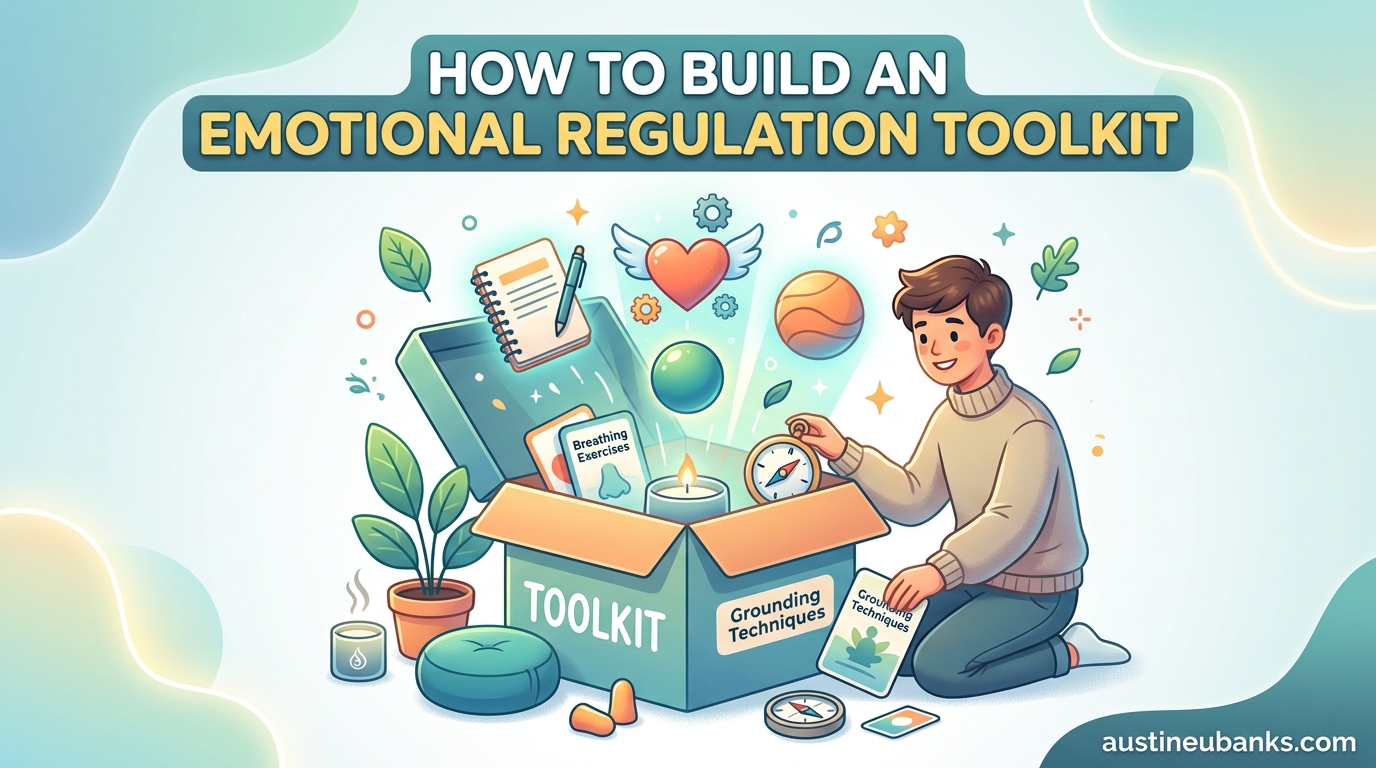
You know that moment when your chest tightens, your thoughts start racing, and a simple text message sends you into a spiral? That is your nervous system asking for help. Learning how to build an emotional regulation toolkit gives you a set of ready-to-use strategies for exactly those moments, so you do not have to figure it out while overwhelmed. I have spent years working with people in therapy, on forums, and in my own life testing what actually helps when emotions take over. This guide walks you through every step of creating a personalized toolkit that fits your nervous system, your lifestyle, and your specific needs.
Table of Contents
What Is an Emotional Regulation Toolkit?
An emotional regulation toolkit is a personal collection of practices, objects, and reminders that help you return to a state of calm when emotions feel overwhelming. Think of it like a first-aid kit for your feelings. You assemble it ahead of time so you never have to scramble for what to do in the heat of the moment.
Unlike generic advice like “just take a deep breath,” a real toolkit is built around your unique nervous system. What calms one person down might overstimulate another. A toolkit that works for someone with ADHD might look completely different from one designed for trauma recovery.
The goal is simple: have proven, practiced strategies within arm’s reach before you need them. When emotional flooding hits, your prefrontal cortex goes partially offline. You cannot think your way out of it in that state. You need tools that are already familiar and easy to access.
Why Emotional Regulation Matters
Unmanaged emotions do not just feel bad in the moment. They damage relationships, hurt your productivity, and even affect your physical health over time. Chronic emotional dysregulation is linked to higher rates of anxiety, depression, and burnout.
On the flip side, people who develop strong self-regulation strategies tend to make better decisions under pressure. They recover from setbacks faster. They communicate more effectively in relationships instead of reacting impulsively.
If you grew up in an environment where emotions were dismissed, punished, or ignored, you might be learning these skills for the first time as an adult. That is far more common than people realize. Forum discussions on Reddit are filled with adults asking where to even start because no one ever taught them. You are not behind. You are right on time.
How to Build an Emotional Regulation Toolkit: Step by Step
Building your toolkit takes about a week of intentional effort, but the payoff lasts a lifetime. Here is the exact process I recommend, broken into five manageable steps.
Step 1: Assess Your Emotional Patterns
Before choosing tools, you need to understand your own emotional landscape. Spend three to five days tracking what triggers you, how your body reacts, and what typically happens afterward.
Ask yourself these questions:
- What situations reliably trigger strong emotions for me?
- Where do I feel emotions in my body? Tight chest, clenched jaw, hot face?
- Do I tend to shut down and go numb, or do I escalate and spiral?
- How long does it typically take me to calm down after getting triggered?
- What has helped me feel better in the past, even briefly?
This self-awareness forms the foundation. If you skip this step, you will end up with a generic toolkit that does not fit your nervous system. That is exactly why most one-size-fits-all advice fails.
Step 2: Choose Techniques Across Five Categories
A well-rounded toolkit includes strategies from at least five different categories. This matters because different types of overwhelm need different responses. Cognitive reframing will not help much when your body is in full fight-or-flight. Somatic movement will not address the thought loop keeping you stuck in worry.
The five categories are:
- Somatic and body-based practices (working through your nervous system)
- Cognitive strategies (working with your thoughts)
- Sensory tools (using physical sensations to regulate)
- Social and co-regulation (calming through connection with others)
- Creative expression (channeling emotions into making something)
Pick at least one technique from each category. You can find specific options in the next section of this guide.
Step 3: Gather Your Physical and Digital Tools
Some techniques require objects. Others need nothing at all. Gather the physical items you want in your toolkit and put them in one accessible place, like a drawer, a basket, or a bag you can carry.
Common physical toolkit items include a journal and pen, a weighted item or blanket, essential oils, a fidget tool, a printed list of your go-to techniques, and noise-canceling headphones. Digital tools might include saved guided meditations, a calming playlist, and a notes app with affirmations or grounding prompts.
The key is accessibility. If your toolkit lives in a closet you never open, it will not help. Keep it where you spend the most time or where meltdowns tend to happen.
Step 4: Create a Crisis Plan
Here is something almost no guide talks about: sometimes your regular tools will not work. During acute emotional flooding, your standard breathing exercise might feel useless. You need a crisis plan for those moments.
A crisis plan is a short, written set of steps you follow when you are too dysregulated to think clearly. It should include one high-intensity tool (like cold water on your face or intense physical movement), one person you can call or text, and one reminder that the feeling will pass.
Write this plan when you are calm. Do not try to create it during a crisis. Tape it somewhere visible or save it as your phone lock screen if needed.
Step 5: Test, Refine, and Personalize
Your first toolkit is a draft, not a final product. Use each technique at least three times before deciding whether it stays or goes. Some tools will work beautifully one day and fall flat the next, and that is normal.
Pay attention to your nervous system type. If you have ADHD, you might find movement-based tools more effective than sitting still for meditation. If you are navigating CPTSD or trauma, somatic and body-based approaches may work better than cognitive techniques. There is no wrong answer here. The best toolkit is the one that works for your body.
Plan to review and update your toolkit every few months. As you grow and your stressors change, your tools should evolve too.
Core Techniques to Include in Your Toolkit
Here are specific, proven techniques organized by category so you can build a toolkit that covers all your bases. These draw from DBT skills, cognitive behavioral strategies, mindfulness traditions, and real-world feedback from people who use them daily.
Somatic and Body-Based Practices
Emotions live in the body. If you only try to think your way through regulation, you are missing half the picture. Somatic tools work directly with your nervous system to shift you out of fight-or-flight.
Paced breathing is the foundation. Inhale for four counts, exhale for six to eight counts. The longer exhale activates your parasympathetic nervous system, which signals safety to your body. Practice this when you are calm so it becomes automatic under stress.
Progressive muscle relaxation involves tensing and releasing each muscle group from your feet to your head. This releases stored tension and brings awareness back to your physical body. It takes about ten minutes and works well before bed.
Temperature change is one of the most effective crisis tools. Cold water on your face triggers the mammalian dive reflex, which rapidly slows your heart rate. Many people in trauma recovery communities swear by this for acute dysregulation when nothing else works.
Mindful walking combines movement with present-moment awareness. Walk slowly, noticing the sensation of each foot hitting the ground. This is especially powerful for people with ADHD who find seated meditation frustrating.
Cognitive Strategies
Once your body is somewhat settled, cognitive tools help you work with the thoughts keeping you stuck. These come from cognitive behavioral therapy and DBT traditions.
Thought reframing means catching a catastrophic thought and examining it. Ask: Is this true? Is it helpful? What would I tell a friend having this thought? This is not about forcing positivity. It is about seeing the full picture instead of just the worst-case scenario.
Opposite action is a DBT skill that works when an emotion is not justified by the facts. If fear tells you to hide but there is no real danger, do the opposite: step forward and engage. If sadness says stay in bed all day but isolation makes it worse, get up and connect with someone.
The Stop-Breathe-Reflect-Choose framework from Harvard Health gives you four steps in the moment. Stop whatever you are doing. Breathe to create a pause. Reflect on what you are feeling and why. Choose a response instead of reacting on autopilot.
Sensory Tools
Sensory regulation uses physical sensations to calm your nervous system. These tools are especially helpful when cognitive approaches feel too demanding.
Grounding techniques pull your attention into the present. Try naming five things you see, four things you hear, three things you feel, two things you smell, and one thing you taste. This interrupts spiraling thoughts by forcing your brain to process sensory input.
Weighted items provide deep pressure stimulation, which calms the nervous system similarly to a hug. A weighted blanket, weighted lap pad, or even a heavy backpack can help. Many people report this is their single most effective tool.
Fidget items give restless hands something to do, which can channel anxious energy. Putty, textured stones, rings, and textured fabric swatches all work. These are not just for kids. Many adults find them genuinely regulating.
Essential oils and scent tap into your limbic system directly. Lavender, bergamot, and frankincense are popular for calming. Keep a roller bottle in your toolkit and apply it to your wrists when you need a quick reset.
Social and Co-Regulation
Humans are wired to regulate through connection. Co-regulation, the process of calming down through contact with another regulated nervous system, is one of the most powerful tools available.
Identify one or two people you can reach out to when overwhelmed. This could be a partner, a close friend, a therapist, or a support group. You do not always need advice. Sometimes you just need to hear a calm voice.
If you do not have someone available, recorded co-regulation can help. A saved voicemail from someone you trust, a podcast with a soothing host, or even a guided meditation with a warm-voiced narrator can provide a similar effect.
Creative Expression
Creative tools give emotions somewhere to go instead of bouncing around inside your head. They work especially well when you cannot name what you are feeling.
Journaling for emotions does not require good writing. Dump everything onto the page without editing. Name what you feel, describe where it lives in your body, and let yourself be messy. The act of externalizing reduces the intensity.
Doodling or coloring engages your hands and gives your mind a break. Keep a small sketchbook or adult coloring book in your toolkit. The goal is not art. The goal is regulation.
Calming playlists work through rhythm and familiarity. Create a playlist of songs that make you feel safe, grounded, or comforted. Music bypasses the thinking brain and reaches your emotional centers directly.
How to Use Your Toolkit in the Moment
Having a toolkit is only half the battle. Knowing when and how to use it is what makes it work. When emotions spike, decision paralysis sets in. You cannot remember which tool to reach for.
Solve this by creating a simple decision flow. Start with body-based tools like paced breathing or cold water. If your body is still activated after two minutes, add a cognitive tool like grounding or thought reframing. If you are still struggling after five minutes, use your crisis plan or reach out for co-regulation.
Practice your tools when you are calm, not just during crises. This is critical. Your nervous system needs to learn these pathways through repetition. Aim to practice at least one technique daily, even if you feel fine. Five minutes a day builds the neural pathways that make the tools work when you actually need them.
Common Mistakes to Avoid
Relying on a single tool. No technique works every time. If you only have one strategy and it fails, you are left with nothing. Build diversity into your toolkit.
Only using tools during crises. If you never practice when calm, your tools will not be effective when you are overwhelmed. Daily practice is what builds the skill.
Copying someone else’s toolkit. What calms your friend might overstimulate you. Personalization is not optional. It is the entire point.
Expecting instant results. Emotional regulation is a skill that takes weeks to months to develop. Be patient with yourself. Progress shows up as faster recovery times, not perfect calm.
FAQs
What is emotional regulation?
Emotional regulation is the ability to manage your feelings in healthy, helpful ways. It means noticing emotions as they arise, tolerating the discomfort they bring, and responding intentionally rather than reacting on autopilot.
What goes in an emotional regulation toolbox?
An emotional regulation toolbox should include techniques from five categories: somatic practices like paced breathing, cognitive strategies like thought reframing, sensory tools like weighted items and grounding, social tools like co-regulation with trusted people, and creative outlets like journaling. Add a written crisis plan for moments when standard tools are not enough.
How do you build emotional regulation skills?
You build emotional regulation skills through daily practice. Choose one technique from each category, practice it when you are calm, track what works, and refine your toolkit over time. Consistency matters more than intensity. Five minutes daily builds the neural pathways needed for regulation under pressure.
What are the best techniques for emotional regulation?
The best techniques depend on your nervous system, but the most widely effective include paced breathing, cold water exposure for acute crisis, progressive muscle relaxation, grounding exercises, opposite action from DBT, journaling, and co-regulation with trusted people. The best technique is the one that works for your body.
How can I improve my emotional self-regulation?
Improve emotional self-regulation by first assessing your patterns, then building a personalized toolkit with techniques from multiple categories. Practice daily when calm, create a crisis plan for intense moments, and refine your tools every few months. If you struggle despite consistent effort, working with a therapist trained in DBT or somatic approaches can accelerate your progress.
Conclusion
Learning how to build an emotional regulation toolkit is one of the most practical investments you can make in your mental health. You now have a five-step process, techniques across five categories, and a crisis planning strategy that no other guide covers this thoroughly. Start small. Pick three techniques this week. Practice them daily. Your future self, the one facing the next emotional storm, will thank you for being ready.