
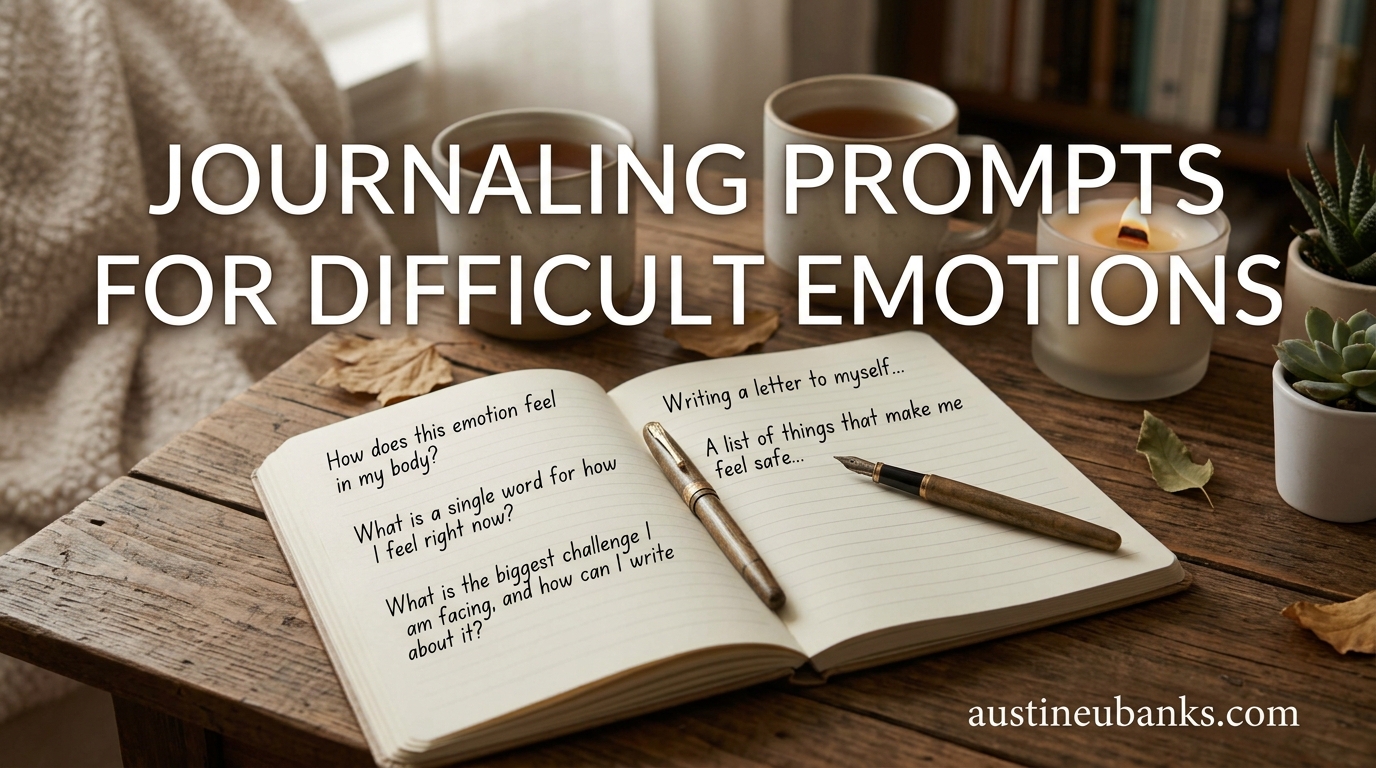
Some days the feelings show up uninvited. You wake up heavy, or a wave of anger hits you in traffic, or grief surfaces from a place you thought you had already packed away. If you have ever sat with a pen in your hand wondering where to even begin, you are in the right place. This guide brings together over 40 journaling prompts for processing difficult emotions, organized by the specific feeling you are dealing with right now.
I have spent years studying how writing helps people move through emotional stuckness, and the pattern is clear. The people who benefit most are not the ones with the most talent or the fanciest notebooks. They are the ones who have a starting point. A prompt gives you that starting point. It turns a blank page into a doorway.
Throughout this article you will find prompts for grief, anger, anxiety, guilt, shame, and overwhelm. You will also discover somatic body-based prompts, fill-in-the-blank sentence starters, self-compassion exercises, and a before-and-after example showing how a prompt transforms a raw emotional entry into real insight. Whether you are new to journaling or you have been writing for months without feeling progress, there is something here designed to help you go deeper.
Table of Contents
What Are Journaling Prompts for Processing Difficult Emotions?
Journal prompts for processing difficult emotions are structured questions, sentence starters, or guided writing exercises that help you identify, explore, and work through challenging feelings by putting them into words. Instead of sitting in front of a blank page hoping the right words come, a prompt gives your mind a specific direction to move in.
Think of a prompt as a flashlight in a dark room. The emotions are already there, but you cannot see their shape or size until something illuminates them. A well-designed prompt does exactly that. It asks you to look at one specific corner of your emotional experience at a time so the whole thing feels less overwhelming.
Here is the key distinction that most resources miss. There is a difference between emotional venting and emotional processing. Venting is pouring everything out onto the page without any structure or reflection. It can feel good in the moment but often leaves you circling the same thoughts. Processing goes a step further. It involves naming the emotion, exploring where it comes from, and beginning to understand what it is trying to tell you.
Good journaling prompts for difficult feelings bridge that gap. They start by helping you vent, then gently guide you toward reflection and understanding. That is what makes them so effective for emotional healing.
How Journaling Helps Process Difficult Emotions
The act of writing about your feelings does something that thinking about them alone cannot accomplish. When emotions stay locked inside your head, they tend to loop. The same worry replays. The same anger simmers. Writing interrupts that loop by forcing your brain to translate vague emotional sensations into concrete language. Psychologists call this process externalization, and it is one of the most powerful tools for emotional regulation.
Research in expressive writing, pioneered by Dr. James Pennebaker, shows that putting emotional experiences into words reduces stress, improves physical health, and helps people make sense of difficult events. The mechanism is straightforward but profound. When you name an emotion, you create distance from it. Instead of being angry, you can observe that you are feeling anger. That shift in perspective is where real processing begins.
Journaling also builds somatic awareness, which is your ability to notice where emotions live in your body. Many people feel anxiety as tightness in the chest or anger as heat in the shoulders. Writing helps you track these physical signals and connect them to the emotions underneath. This mind-body connection is why so many Reddit users in the r/Journaling community report that hand-writing feels more emotionally grounding than typing.
Another way journaling helps is by revealing cognitive distortions, which are the mental shortcuts your brain takes that can intensify difficult feelings. When you write out your thoughts, patterns like catastrophizing, black-and-white thinking, and self-blame become visible on the page. Once you can see them, you can begin to challenge and reframe them.
There is also an important distinction between journaling for emotional release and journaling for emotional reflection. Release journaling is fast, raw, and unstructured. You write without stopping, without editing, without worrying about making sense. The goal is to empty the emotional container. Reflection journaling is slower and more intentional. You revisit what you wrote, look for themes, and ask yourself what the emotion is trying to teach you. Both are valuable, and the prompts in this guide support both approaches.
Journaling Prompts for Processing Difficult Emotions by Type
Not all difficult emotions are the same, and the prompts that help with grief will not necessarily help with anger or anxiety. That is why this section is organized by specific emotion types. Pick the category that matches what you are feeling right now, or bookmark this page and come back as your emotional landscape shifts.
A quick note before you begin. If you are working through trauma, childhood emotional neglect, or emotions connected to a deeply painful experience, please move at your own pace. You do not have to answer every prompt. You can stop at any time. Journaling about difficult material can bring up more than you expect, and there is no shame in stepping away or seeking support from a licensed therapist.
Journaling Prompts for Grief and Loss
Grief is one of the most complex emotions to process because it does not follow a straight line. It comes in waves, changes shape, and often carries layers of anger, guilt, and longing underneath the sadness. These prompts are designed to help you sit with grief without trying to fix it or rush it along.
1. What did I lose, and what did that loss take from my daily life that nobody else can see?
2. If I could say one thing to the person or thing I lost, what would it be? Write it as a letter you will never send.
3. What is a memory I am afraid I will forget? Describe it in as much sensory detail as I can, including sounds, smells, and textures.
4. Where in my body do I feel the grief right now? What does it feel like physically?
5. What am I grieving beyond the obvious loss? Am I also grieving a future, a version of myself, or an expectation?
Journaling Prompts for Anger and Frustration
Anger gets a bad reputation, but it is one of the most informative emotions you can experience. Anger tells you that a boundary has been crossed, a need has gone unmet, or something you value is under threat. These prompts help you understand what your anger is trying to protect.
1. I am angry because my boundary around __________ was crossed. The boundary I need to set now is __________.
2. If my anger could speak in a full sentence, it would say: “Stop doing __________ and start doing __________.”
3. Underneath this anger, is there a different emotion hiding? Am I also feeling hurt, scared, disappointed, or powerless?
4. Who taught me how to handle anger? What did I learn about expressing anger from my family or culture, and does that still serve me?
5. What is the most constructive action this anger is asking me to take? What would happen if I channeled this energy into one specific step?
Journaling Prompts for Anxiety and Worry
Anxiety thrives in the space between what might happen and what you can control. It pulls your attention into worst-case scenarios and keeps your nervous system on high alert. These prompts are designed to bring you back to the present moment and separate real concerns from anxious projections.
1. What am I afraid will happen? Now write out the most likely outcome alongside the worst-case scenario. How different are they?
2. What is within my control right now in this exact moment? What is completely outside my control?
3. If a calm and trusted friend were looking at my situation, what would they say to me about it?
4. What is the story my anxiety is telling me? What evidence supports that story, and what evidence contradicts it?
5. What does my body need right now to feel even 5 percent safer? A glass of water, a walk, a deep breath, a change of scenery?
Journaling Prompts for Guilt and Shame
Guilt and shame often travel together, but they are not the same emotion. Guilt says “I did something bad.” Shame says “I am something bad.” Both can be deeply painful, and both respond well to the structured reflection that journaling provides. These prompts help you separate what you actually did wrong from the story you are telling yourself about who you are.
1. What specific action or decision am I feeling guilty about? Was it a genuine mistake, or am I holding myself to an impossible standard?
2. If someone I loved did the exact same thing, would I judge them as harshly as I am judging myself? What would I say to them?
3. Whose voice does my shame sound like? Did this critical inner narrative originate with me, or did I absorb it from someone else?
4. What would it look like to take responsibility for my actions without punishing myself indefinitely? What does accountability without self-destruction sound like?
5. What is one small thing I can do today to make amends, either to someone else or to myself?
Journaling Prompts for Overwhelm and Burnout
Overwhelm happens when everything feels urgent and nothing feels manageable. Your brain stops being able to prioritize because every task, emotion, and responsibility feels equally pressing. These prompts are designed to help you slow down, sort through the noise, and find one next step.
1. List everything weighing on you right now, no matter how small. Get it all out of your head and onto the page.
2. Looking at that list, which items actually need my attention today? Which ones can wait until tomorrow, next week, or never?
3. What am I carrying that belongs to someone else? What responsibilities or emotional burdens have I taken on that are not mine to hold?
4. What does my body need right now that I have been ignoring? Sleep, food, movement, silence, connection?
5. If I could only do one thing today to feel slightly more in control, what would it be?
Somatic Journaling Prompts for Difficult Emotions
Somatic journaling focuses on the connection between your body and your emotions. Instead of asking “What am I thinking?” these prompts ask “What am I feeling physically?” This approach is especially helpful for people who struggle to name their emotions intellectually but can sense them in their bodies. Many users in online journaling communities report that body-based prompts bridge the gap when traditional cognitive prompts feel stuck.
1. If my body could speak right now, what would it say? Let each part of your body have a voice, starting from your head and moving down.
2. Where in my body do I feel this emotion the most? Describe the sensation without trying to interpret it. Is it tight, heavy, hot, empty, buzzing?
3. If this physical sensation had a color and a shape, what would they be?
4. What does this part of my body need right now? Rest, movement, pressure, warmth, release?
5. Place your hand on the area where you feel the emotion. What shifts when you bring physical attention to that spot?
Self-Compassion Journal Prompts for Difficult Feelings
Self-compassion is the practice of treating yourself with the same kindness you would offer a close friend. When you are in emotional pain, your inner critic often gets louder, not quieter. These prompts help you meet difficult emotions with warmth instead of judgment.
1. This is a moment of suffering. Suffering is part of being human. May I be kind to myself in this moment. (Write this three times, pausing between each.)
2. What am I telling myself about this emotion that I would never say to someone I love?
3. What would I say to my best friend if they were feeling exactly what I am feeling right now? Write it down, then read it back to yourself.
4. What do I need to hear right now that nobody has told me? Can I be the one to say it?
5. How have I shown courage in simply facing this emotion today instead of running from it?
Fill-in-the-Blank Journal Prompt Templates
Sometimes the hardest part of journaling is figuring out how to start a sentence. Fill-in-the-blank templates remove that friction. They give you just enough structure to begin while leaving plenty of room for your own thoughts. Copy any of these into your journal and complete them in whatever way feels honest.
1. Right now I am feeling __________, and I think it started when __________.
2. A part of me feels __________, and another part of me feels __________. Both of these feelings are valid because __________.
3. The story I am telling myself about this situation is __________. The actual facts of the situation are __________.
4. What I need most right now is __________, and the first small step toward that is __________.
5. I forgive myself for __________, and I am learning __________.
6. This emotion is trying to tell me that __________ matters to me because __________.
7. The last time I felt this way, I got through it by __________. This time, I can also try __________.
How to Start Journaling for Emotional Processing
Knowing the prompts is only half the equation. The other half is actually sitting down and using them. If you have ever felt too overwhelmed to start, or if you have journaled for months without feeling like you are making progress, these practical tips will help you build a practice that actually works for emotional processing.
Set a timer for 5 to 10 minutes. This is the single most effective technique I can recommend, and it comes up again and again in journaling communities. A short timer makes the task feel safe and contained. You know there is an end point. If difficult emotions surface, you only have to stay with them for a few more minutes. For beginners, this removes the pressure of “I have to fill three pages” and replaces it with something entirely doable.
Try writing by hand instead of typing. Multiple Reddit users in the r/Journaling community report that handwriting creates a stronger emotional connection than typing on a keyboard. The slower pace gives your brain time to process what you are writing. You do not have to write by hand forever, but if you are working through something difficult, it is worth trying at least once to see if the embodied experience feels different.
There is no right way to do this. You do not need perfect grammar, complete sentences, or a logical structure. You can write in bullet points. You can write fragments. You can doodle in the margins. You can answer one prompt and stop. The goal is not to produce polished writing. The goal is to move emotional energy from the inside to the outside.
Close your journaling session with a grounding ritual. This is something very few resources mention, and it matters enormously. When you open up difficult emotions through writing, you need a way to transition back into your daily life. Try one of these grounding practices. Take three slow breaths and name five things you can see around you. Splash cold water on your face. Step outside and feel the air on your skin. Do something physical that signals to your body that the emotional deep dive is over for now.
Here is a before-and-after example to show the difference a prompt can make. Imagine you are feeling anxious after a difficult conversation with a coworker.
Raw entry without a prompt: “I feel awful. That conversation was terrible. I cannot stop thinking about it. I am so stupid for saying that thing. Now everything is going to be weird. I hate this.”
Prompt-guided entry: “Right now I am feeling anxious and embarrassed, and I think it started when my coworker pointed out that mistake during the meeting. The story I am telling myself is that everyone thinks I am incompetent. The actual facts are that I made one error in a report, and one person mentioned it. Underneath this anxiety, I think I am feeling insecure about a project I already felt unsure about. What I need most right now is reassurance that one mistake does not define my work, and the first small step toward that is reviewing the corrected version tomorrow when I have a clearer head.”
Notice the difference. The raw entry stays in the loop of anxious venting. The prompted entry names the emotion, separates the story from the facts, identifies the deeper insecurity, and produces an actionable next step. That is what processing looks like.
Frequently Asked Questions About Journaling for Difficult Emotions
What are journal prompts for processing difficult emotions?
Journal prompts for processing difficult emotions are structured questions or sentence starters that help you identify, explore, and work through challenging feelings like grief, anger, anxiety, guilt, and shame by putting them into words in a private, judgment-free space.
How do journaling prompts help with emotional release?
Journaling prompts help with emotional release by giving you a focused starting point that bypasses the blank-page paralysis. They guide you to externalize feelings from your mind onto the page, which interrupts the cycle of repetitive anxious thoughts and allows pent-up emotional energy to move and release in a structured way.
What are the best journaling prompts for anger?
The best journaling prompts for anger ask you to identify what boundary was crossed, what need is going unmet, and what your anger is trying to protect. Prompts like ‘If my anger could speak in a full sentence, it would say ___’ and ‘Underneath this anger, what else am I feeling?’ are especially effective for processing frustration productively.
How can journaling help with emotional awareness?
Journaling builds emotional awareness by forcing you to translate vague emotional sensations into specific language. When you regularly write about your feelings, you become faster at identifying and naming emotions in real time, which is a foundational skill for emotional regulation and mental health.
How do I journal when I feel emotionally stuck?
When you feel emotionally stuck, start with a short timer of 5 to 10 minutes and use a fill-in-the-blank prompt like ‘Right now I am feeling ___ and I think it started when ___.’ Lowering the barrier to entry with structure and a time limit makes it easier to begin, and beginning is often the hardest part.
What journal prompts help with self-compassion and difficult feelings?
Self-compassion journal prompts ask you to treat yourself with the same kindness you would offer a friend. Prompts like ‘What would I say to my best friend if they were feeling this way?’ and ‘What do I need to hear right now that nobody has told me?’ help you meet difficult emotions with warmth instead of judgment.
Conclusion: You Do Not Have to Face Difficult Emotions Alone
Difficult emotions are not problems to solve. They are signals to listen to. The journaling prompts for processing difficult emotions in this guide give you a structured, private, and compassionate way to listen to what those signals are telling you.
Start with one prompt. Set a timer for five minutes. Let the words be messy. The goal is not to feel better instantly but to understand yourself a little more deeply each time you write.
If journaling brings up emotions that feel too heavy to carry alone, please reach out to a licensed therapist or counselor. Emotional processing is brave work, and you deserve support while doing it.