
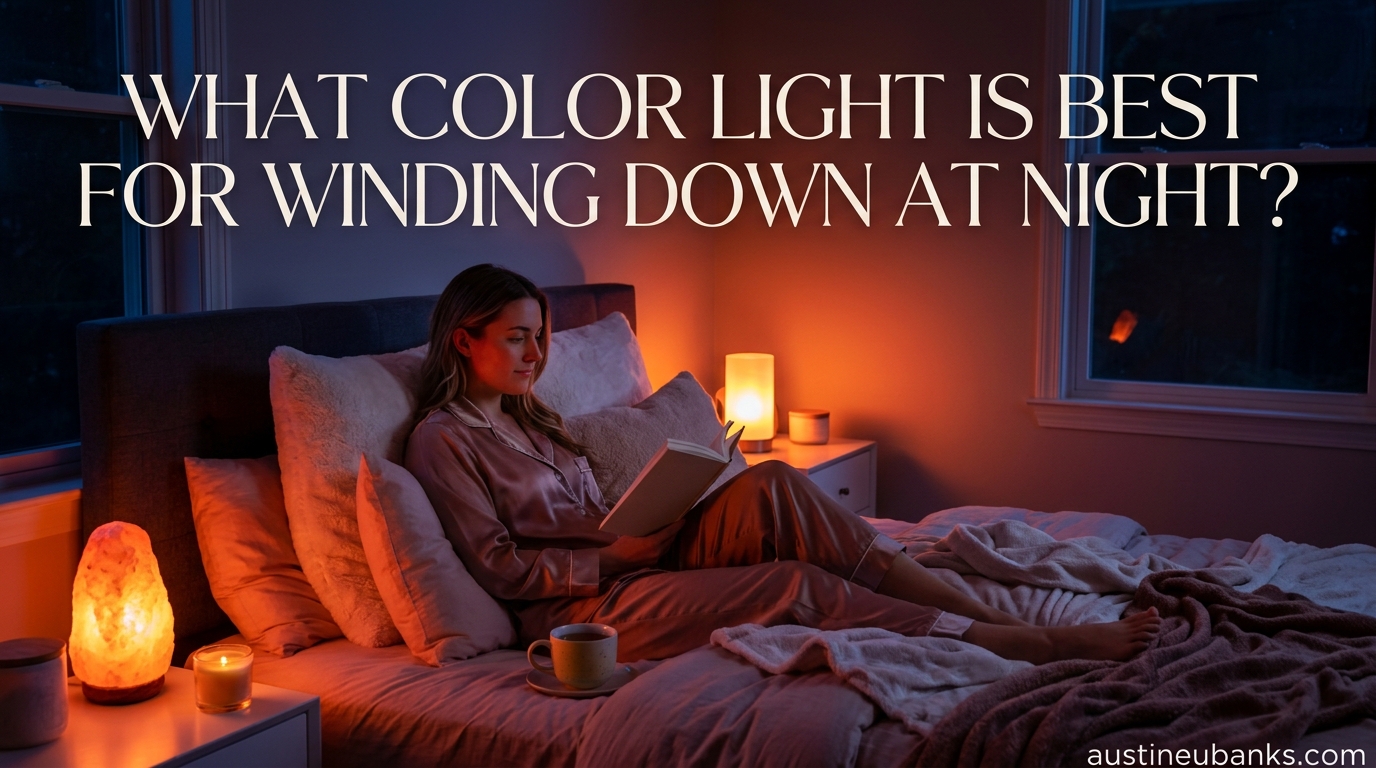
Warm colors of light — specifically red, amber, orange, and yellow — are the best choices for winding down at night because they have minimal impact on melatonin production and do not disrupt your circadian rhythm. Blue and cool white light, on the other hand, signal to your brain that it is still daytime, suppressing the hormones that make you feel sleepy.
I spent months researching the science behind light and sleep after struggling with my own nighttime routine. What I found was a mix of well-established research and some surprising gaps in what most people know about evening lighting. The color of your bedroom lights, your screens, and even your nightlights plays a direct role in how fast you fall asleep and how rested you feel the next morning.
In this guide, we break down exactly what color light is best for winding down at night, why it works, which colors to avoid, and how to build an evening light routine that actually helps you sleep.
Table of Contents
How Light Affects Your Sleep Cycle
Light is the single most powerful external cue your body uses to regulate its sleep-wake cycle. Every time light enters your eyes, specialized cells called intrinsically photosensitive retinal ganglion cells (ipRGCs) send signals to a tiny region of your brain called the suprachiasmatic nucleus. This region acts as your master biological clock.
When that clock detects bright or blue-rich light, it tells your body to stay awake and alert. When light fades or shifts to warm tones, the clock signals that night is approaching. This triggers a cascade of hormonal changes that prepare your body for rest.
The Melatonin Connection
Melatonin is the hormone responsible for making you feel drowsy and ready for sleep. It is produced by the pineal gland, a small pea-shaped structure deep in the center of your brain. Under normal conditions, melatonin levels begin rising in the early evening, peak during the night, and drop off as morning approaches.
Here is where light color becomes critical. Research shows that light in the blue spectrum (roughly 450 to 480 nanometers in wavelength) suppresses melatonin production significantly. Warm colors like red and amber have wavelengths above 600 nanometers, which have almost no effect on melatonin levels. This means you can have a dim red light on in your bedroom and still produce melatonin normally.
A study published in the Journal of Clinical Endocrinology and Metabolism found that exposure to blue light for just 30 minutes in the evening can suppress melatonin production by up to 50 percent in some individuals. That is a dramatic effect from something as simple as the wrong light bulb.
Circadian Rhythm and Light Signals
Your circadian rhythm is your body’s internal 24-hour clock. It controls not just sleep but also body temperature, hormone release, digestion, and even immune function. Light exposure is the primary signal that keeps this clock aligned with the natural day-night cycle.
Think of light as the “time-setter” for your internal clock. Bright blue-rich light in the morning tells your brain the day has started, pushing your sleep drive forward so you feel tired 14 to 16 hours later. Warm, dim light in the evening sends the opposite signal: wind down, power down, get ready for sleep.
When you expose yourself to the wrong type of light at the wrong time — say, scrolling through your phone in bed — you confuse the clock. Your body delays melatonin release, shifts its sleep phase later, and you end up lying awake wondering why you cannot drift off.
Why Wavelengths Matter
Light travels in waves, and each color of light has a different wavelength measured in nanometers (nm). Shorter wavelengths appear as blue and violet light, while longer wavelengths appear as red and orange. The wavelength determines how much that light interferes with your sleep biology.
Color temperature, measured in Kelvins (K), is another way to think about this. Daylight and cool white LEDs typically sit at 5000K to 6500K, which produces that blue-white appearance. Warm white bulbs are around 2700K to 3000K, giving off a yellowish-amber glow. Candlelight — one of the most sleep-friendly light sources — sits at about 1900K.
For winding down at night, aim for color temperatures at or below 2700K, with the ideal range being 1800K to 2200K for the hour or two before bed.
What Color Light Is Best for Winding Down at Night
When it comes to what color light is best for winding down at night, the answer comes down to four warm colors. Each one offers slightly different benefits, and the best choice for you depends on your routine, your sensitivity to light, and how you plan to use it.
Here is a breakdown of the best colors for evening use, ranked from most sleep-friendly to least (though all four are still good options).
Red Light: The Gold Standard for Sleep
Red light is widely considered the absolute best color for sleep. It has the longest wavelength in the visible spectrum (620 to 750 nanometers), which means it has essentially zero effect on melatonin production. Your brain does not interpret red light as a daytime signal, so your sleep cycle stays on track.
Reddit users on forums like r/sleep and r/redlighttherapy consistently report positive experiences with red light in the evening. Common feedback includes falling asleep within 15 to 20 minutes of switching to a red-toned environment, feeling calmer before bed, and waking up with less grogginess. Several users with chronic insomnia noted that switching their bedroom lights to red helped reset their sleep patterns over the course of a few weeks.
Red light therapy devices have also gained attention in recent years. While full clinical evidence is still developing, some small studies suggest that exposure to low-intensity red light in the evening may improve sleep quality and reduce the time it takes to fall asleep. The key is low intensity — a dim red glow, not a bright red flood.
For practical use, you can switch your bedroom lamps to red LED bulbs, use a red light nightlight, or set smart bulbs (like Philips Hue or LIFX) to a deep red tone about 60 to 90 minutes before bed.
Amber Light: A Warm and Soothing Option
Amber light sits between red and orange on the color spectrum, with wavelengths around 590 to 620 nanometers. It provides a bit more brightness and visibility than pure red light, making it a popular choice for people who still want to read, cook, or move around the house in the evening without tripping in near-darkness.
Amber light simulates the natural glow of a sunset, which is exactly the cue your circadian rhythm evolved to respond to. For most of human history, the only light available after sundown was firelight — which burns at roughly 1800K to 1900K, producing a warm amber-orange glow. Your body is biologically wired to interpret that color as “evening is here.”
I personally use amber-toned smart bulbs in my living room and hallway starting about two hours before bed. It creates a noticeably calmer atmosphere compared to standard white bulbs, and I have found it easier to unwind mentally in that warm-toned environment.
If red light feels too dim or unusual for your space, amber is an excellent middle ground. It gives you enough light to function while still protecting your melatonin production.
Orange Light: Gentle and Calming
Orange light (600 to 620 nanometers) is another strong option for evening lighting. Like amber, it provides a warm glow that does not trigger significant melatonin suppression. Many sleep experts recommend orange as a practical choice for reading lamps and bedside lights.
The advantage of orange over red is visibility. You can comfortably read a book under a dim orange light without straining your eyes, while maintaining a sleep-friendly environment. Pure red light can make text difficult to see, especially if you are reading physical books with smaller print.
Some smart light manufacturers include a preset “reading” mode that uses a warm orange-white tone at reduced brightness. These modes typically sit around 2200K to 2400K, which strikes a good balance between usability and sleep compatibility.
For best results, keep the brightness low. Even warm orange light can be stimulating if it is too intense. Dim the light to the lowest comfortable level for your activity.
Yellow Light: Soft and Familiar
Yellow light, or warm white light, is the most commonly available warm lighting option. Standard “soft white” or “warm white” LED bulbs produce a yellowish tint at around 2700K. While not as sleep-optimal as red or amber, yellow light is still far better than cool white or daylight bulbs.
If you are not ready to invest in smart bulbs or specialty red/amber lighting, simply replacing your bedroom bulbs with warm white LEDs (2700K) is a solid first step. It is the lowest-effort change that still makes a measurable difference in your evening light environment.
The key distinction is color temperature. Anything labeled “daylight,” “cool white,” or “bright white” typically runs 4000K or higher and will have a blue-ish tint that interferes with melatonin. Stick with “soft white” or “warm white” and you are already on the right track.
For the hour closest to bedtime, try to dim even these warm white bulbs to create a progressively darker environment. The goal is to mimic a natural sunset — gradual reduction in both brightness and color temperature.
Colors to Avoid Before Bedtime
Just as certain colors help you wind down, others actively work against your sleep. The worst offenders are colors with short wavelengths — the blue, white, and green spectrum that your brain interprets as daylight.
Blue Light: The Biggest Sleep Disruptor
Blue light is the single most disruptive light color for sleep. It falls in the 450 to 480 nanometer wavelength range, which is exactly the range that most strongly suppresses melatonin production. This is not a coincidence — blue light is the dominant color in natural daylight, so your brain evolved to treat it as a wakefulness signal.
The problem in modern life is that blue light is everywhere after sundown. Smartphone screens, tablets, computer monitors, televisions, LED light bulbs, and even some digital alarm clocks all emit significant amounts of blue light. Every time you look at one of these devices in the evening, you are essentially telling your brain it is noon.
Research from Harvard Medical School found that blue light exposure at night suppresses melatonin for about twice as long as green light, and shifts circadian rhythms by twice as much. The researchers recommended avoiding blue light for 2 to 3 hours before bedtime.
If you must use screens in the evening — and let’s be honest, most of us do — use blue light filtering tools. Most phones and computers now include built-in night mode features that shift the display to warmer tones. Third-party apps like f.lux and Twilight offer more granular control. While these tools do not eliminate all blue light, they significantly reduce its impact.
White Light: Not as Innocent as It Seems
White light might seem neutral, but it is actually a composite that includes significant blue wavelengths. Cool white and daylight LED bulbs (4000K to 6500K) emit a substantial amount of blue light, making them poor choices for evening use.
Many people make the mistake of thinking “white light is fine, it’s just bright.” But the color temperature of that white light matters enormously. A 5000K daylight bulb in your bedroom lamp at 10 PM is working against your sleep just as much as staring at your phone screen.
If you currently use daylight or cool white bulbs in your bedroom, bathroom, or any space you use in the evening, consider this one of the highest-impact changes you can make. Switch them to warm white (2700K) or lower. The difference in sleep quality can be noticeable within a few nights.
Green Light: Still Problematic
Green light (495 to 570 nanometers) is less studied than blue light but still has a measurable effect on melatonin suppression. Research from Harvard found that green light exposure suppresses melatonin, though not as strongly as blue light.
Green light is less common as a primary light source in most homes, but it can appear in LED indicators, clock displays, and decorative lighting. Some smart devices use green LED notification lights that blink or glow throughout the night.
If you have any green light sources in your bedroom — power indicators on electronics, smart speaker lights, or decorative LEDs — cover them with tape, turn them off, or move them out of the room. Even small amounts of green light in a dark bedroom can interfere with deep sleep.
Light Intensity Matters Too (Not Just Color)
Color gets most of the attention in sleep lighting discussions, but brightness plays an equally important role. Even the best warm-colored light can disrupt sleep if it is too intense. The measurement of light brightness is called lux, and the lux level of your evening environment has a direct impact on melatonin production.
For context, direct sunlight is about 100,000 lux. A well-lit office is around 300 to 500 lux. Typical living room lighting at full brightness is about 100 to 200 lux. For evening wind-down, sleep researchers generally recommend keeping light levels below 30 to 50 lux, and ideally below 10 lux for the hour before bed.
What does 10 lux look like in practice? It is roughly equivalent to a single dim lamp with a low-wattage warm bulb, or the light from a few candles. It is bright enough to see where you are walking and maybe read large text, but not bright enough for detailed tasks.
To manage light intensity in the evening, use dimmer switches on your main lights. If you do not have dimmers, use lamps with lower-wattage bulbs for evening use instead of overhead lighting. Smart bulbs with app-controlled brightness are particularly useful because you can program them to gradually dim over the course of the evening.
The combination of warm color and low intensity is what creates the ideal sleep-friendly environment. A dim red or amber light at 5 to 10 lux is the sweet spot for the final hour before sleep.
Building Your Evening Light Routine
Knowing which colors are best is only half the battle. The real results come from building a consistent evening light routine that gradually transitions your environment from daytime brightness to sleep-friendly warmth. Here is a practical framework you can start tonight.
2 Hours Before Bed: Start the Transition
Begin shifting your light environment about two hours before your target bedtime. Turn off overhead lights and switch to lamps with warm-toned bulbs (2700K or lower). If you have smart bulbs, set them to an amber or warm orange tone at reduced brightness. This is also the time to enable night mode on your phone and computer screens.
This gradual transition matters because it mimics a natural sunset. Your circadian rhythm responds to changes in light over time, not just instantaneous shifts. A slow fade from bright to dim signals your body to begin its natural wind-down process.
1 Hour Before Bed: Deepen the Warmth
In the final hour before bed, shift your lighting to the warmest and dimmest setting you can manage. If you have red or amber bulbs, this is when to switch them on. Lower the brightness on your devices to the minimum comfortable level, or better yet, put screens away entirely.
This is a good time for activities that do not require bright light — gentle stretching, listening to music or a podcast, taking a warm bath, or reading a physical book under a dim warm lamp. The goal is to keep your light exposure below 30 lux.
30 Minutes Before Bed: Near Darkness
In the last 30 minutes before sleep, reduce light to the absolute minimum. A single dim red or amber nightlight is ideal if you need to navigate to the bathroom or bedroom. Avoid looking at any screens during this window.
Your bedroom should be as dark as possible for sleep. Use blackout curtains if street lights or early sunrise are an issue. Cover or remove LED indicators on electronics. If you need an alarm clock, choose one with a red or amber display that can be dimmed.
The 3-3-3 Sleep Rule Explained
Some sleep coaches reference a simple guideline called the 3-3-3 rule for evening habits. While it is not a formal clinical protocol, it provides an easy-to-remember framework:
3 hours before bed: Stop eating large meals. Digestion can interfere with sleep quality, and late meals can cause acid reflux when you lie down.
3 hours before bed: Stop drinking alcohol. While alcohol may make you feel drowsy initially, it fragments sleep and reduces REM sleep quality in the second half of the night.
30 minutes before bed (sometimes written as the second 3 for screens): Put away all screens and switch to the dimmest, warmest light possible. This is your final wind-down window.
The exact numbers can be adjusted to fit your schedule, but the principle is sound: give your body a clear runway of reduced stimulation before sleep, and manage your light environment as part of that runway.
Special Considerations: Babies, Kids, and Individual Differences
The principles of sleep-friendly lighting apply across age groups, but there are some nuances worth noting for children and for individual variation.
For babies and young children, warm dim lighting is especially important in the nursery. Red nightlights are the top recommendation from pediatric sleep consultants because they provide just enough visibility for nighttime feedings and diaper changes without disrupting the baby’s developing sleep cycle. Avoid white or blue-toned nightlights in nurseries entirely.
Individual preferences also play a role. Healthline’s coverage of this topic highlighted research showing that personal preference for light color can influence perceived sleepiness. Some people find amber more relaxing than red, while others prefer the deeper warmth of orange. If a particular warm color feels more calming to you personally, that psychological comfort can contribute to better wind-down.
If you have persistent sleep difficulties despite optimizing your light environment, it may be worth consulting a sleep specialist. Light is one of many factors that affect sleep, and chronic insomnia can have underlying causes that require professional evaluation.
Quick Reference: Light Colors and Their Sleep Effects
Here is a quick summary you can use as a reference when setting up your evening lighting:
Best colors for winding down:
- Red — Best overall. Zero melatonin suppression. Ideal for nightlights and the final hour before bed.
- Amber — Excellent for evening use. Mimics sunset. Good balance of visibility and sleep compatibility.
- Orange — Great for reading lamps. Warm enough to protect melatonin, bright enough for tasks.
- Yellow/Warm White (2700K) — Good baseline. Better than cool white. Solid first step if you are just starting.
Colors to avoid at night:
- Blue (450-480nm) — Worst offender. Suppresses melatonin by up to 50%. Found in screens and daylight bulbs.
- Cool White (4000K+) — Contains hidden blue light. Common in offices and daylight LED bulbs.
- Green (495-570nm) — Still suppresses melatonin. Found in LED indicators and some decorative light.
FAQs
What is the best color light to wind down?
Red light is the best color for winding down because it has the longest wavelength in the visible spectrum and has essentially zero effect on melatonin production. Amber, orange, and yellow warm light are also excellent choices, with amber being a great middle ground between sleep-friendliness and visibility.
What is the 3 3 3 rule for sleep?
The 3-3-3 sleep rule suggests stopping large meals 3 hours before bed, stopping alcohol 3 hours before bed, and putting away screens 30 minutes before bed. It is a simple framework for building an evening routine that supports natural sleep onset.
What color light to avoid at night?
Avoid blue, cool white, and green light at night. Blue light (450-480nm) is the most disruptive because it strongly suppresses melatonin production. Cool white LED bulbs contain hidden blue wavelengths, and green light also interferes with melatonin even though it is less potent than blue.
Which type of lighting is best for winding down before sleep?
Dim warm-toned lighting is best for winding down. Use red or amber LED bulbs, warm white bulbs at 2700K or lower, or smart bulbs set to a sunset tone. Keep brightness below 30 to 50 lux, and avoid all screen light in the final 30 minutes before bed.
How long before bed should I switch to warm light?
Start transitioning to warm, dim light about 2 hours before your target bedtime. Shift to the warmest and dimmest settings about 1 hour before bed, and reduce light to near-darkness with only a dim red or amber nightlight in the final 30 minutes.
Wrapping Up
Understanding what color light is best for winding down at night comes down to a simple principle: warm colors support sleep, cool colors disrupt it. Red light is the gold standard with zero melatonin impact, while amber, orange, and yellow all provide practical alternatives depending on your needs.
The biggest changes you can make tonight are straightforward. Replace cool white bulbs with warm white ones, enable night mode on your screens 2 hours before bed, and switch to dim red or amber lighting for the final hour of your evening. These small adjustments can have a measurable impact on how quickly you fall asleep and how rested you feel in the morning.
Start with one change — even just swapping a single bedroom bulb — and build from there. Your sleep is worth the effort.