
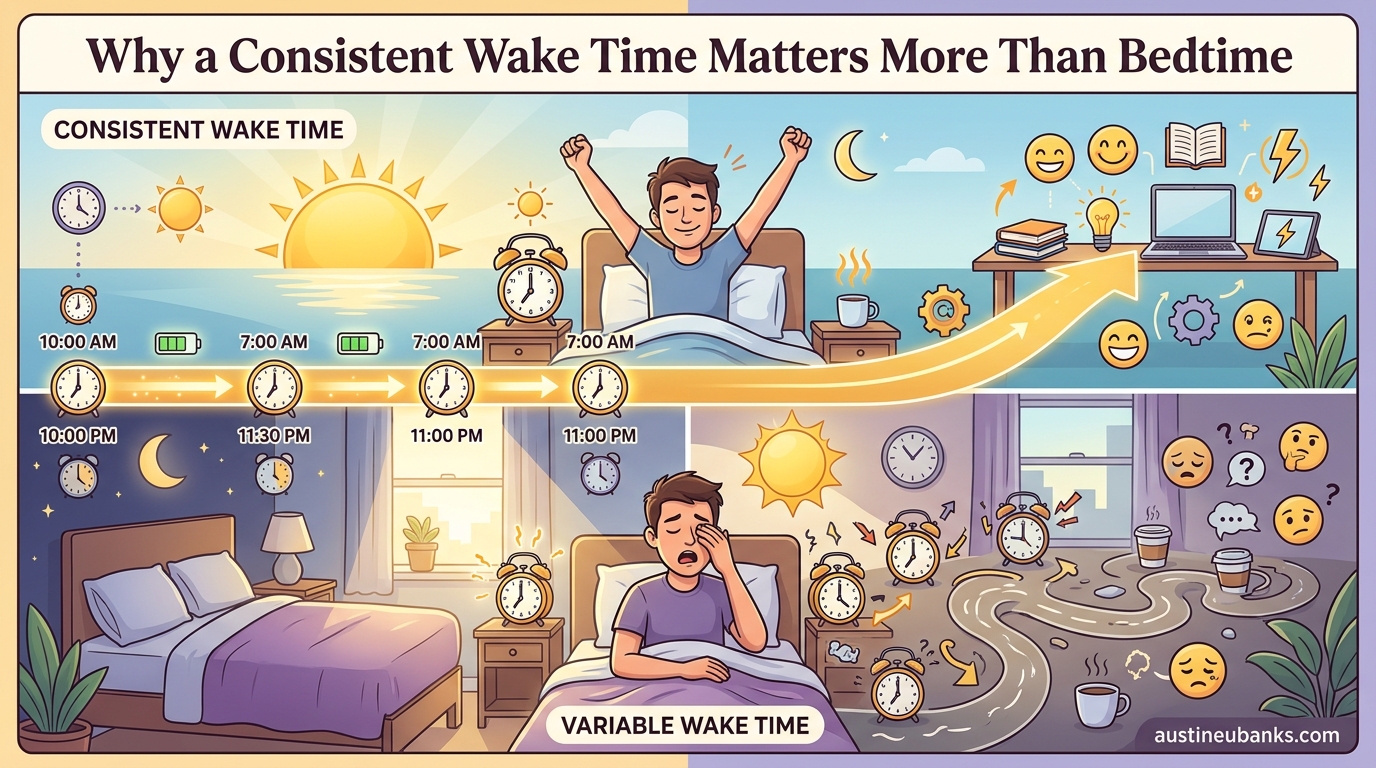
Most people obsessed over getting to bed on time, but the research points somewhere else entirely. A consistent wake time, not a fixed bedtime, is what actually anchors your body’s internal clock and drives better sleep quality, improved health outcomes, and steadier energy levels throughout the day.
Studies from BYU found that young women who maintained a consistent wake time, especially between 6:30 and 8:30 AM, had significantly lower body fat than those with irregular sleep schedules, even when total sleep duration stayed within the 6.5 to 8.5 hour range. The finding surprised even the researchers, because it suggested that when you wake up matters as much as how long you sleep.
If you have been stressing about hitting the pillow at exactly 10 PM every night while your wake time swings wildly between 6 AM and 9 AM, you may be focusing on the wrong variable. I spent years treating bedtime as the non-negotiable and letting my alarm float based on how late I stayed up. Once I flipped that logic, my sleep quality improved within two weeks.
In this guide, we break down the science behind why a consistent wake time matters more than bedtime, how it interacts with your circadian rhythm, and what practical steps you can take to lock in a schedule that actually sticks, even on weekends.
Table of Contents
Why a Consistent Wake Time Matters More Than Bedtime
The short answer comes down to biology. Your circadian rhythm, the 24-hour internal clock that governs hormone release, body temperature, and sleep-wake cycles, is anchored primarily by two signals: light exposure and wake time. Bedtime is a downstream effect, not the driver.
When you wake up at the same time every day, you send a powerful, predictable signal to your brain’s master clock, the suprachiasmatic nucleus. This clock then coordinates the release of melatonin roughly 14 to 16 hours later, making you naturally sleepy at a consistent hour. Lock in the wake time and bedtime largely takes care of itself.
The reverse does not work nearly as well. If you go to bed at 10 PM consistently but wake at random times, your circadian rhythm never gets a clean anchor point. Melatonin release becomes erratic, morning cortisol spikes at inconsistent intervals, and you wake up groggy more often than not.
The National Sleep Foundation’s consensus panel concluded that consistent timing of both bedtimes and wake times is associated with improved outcomes across multiple dimensions of health. But the stronger correlation, especially for body composition and metabolic health, was with wake time consistency.
One BYU study put a finer point on it. Researchers found that a consistent wake time was more strongly related to lower body fat than a consistent bedtime. Participants who kept wake times within a one-hour window had meaningfully better body composition than those whose wake times varied by more than 90 minutes, regardless of how much sleep they got.
This is the core message: bedtime is a consequence of wake time, not the other way around. Fix your wake time and your body will push you toward an appropriate bedtime on its own.
How Your Circadian Rhythm Actually Works
Your circadian rhythm is a roughly 24-hour biological cycle that regulates nearly every system in your body. It controls when you feel alert, when you feel sleepy, when hormones like cortisol and melatonin get released, and even when your body temperature peaks and dips.
The central pacemaker of this system sits in a tiny cluster of cells in your hypothalamus called the suprachiasmatic nucleus, or SCN. Think of the SCN as your body’s master clock. It keeps time based primarily on light signals received through your eyes.
When light hits your retinas in the morning, the SCN registers it and initiates a cascade. Cortisol rises to promote alertness. Body temperature climbs. Melatonin, the sleep hormone, gets suppressed. This is your body’s “start the day” signal, and it is triggered most reliably by a consistent combination of light exposure and wake time.
Here is where it gets interesting. About 12 to 14 hours after that morning light signal, melatonin production begins ramping up again. This is known as the dim light melatonin onset, or DLMO, and it is what makes you feel sleepy in the evening. The timing of DLMO is directly influenced by when you got your morning light.
So if you wake up at 6:30 AM and get light exposure shortly after, your body starts producing melatonin around 8:30 to 10:30 PM. Wake up at 9 AM instead, and that melatonin window shifts later. Keep bouncing your wake time around, and your melatonin production never settles into a predictable rhythm.
This is why a consistent wake time matters more than bedtime. Wake time is the input that sets the entire 24-hour cycle in motion. Bedtime is simply the output.
The Science: Wake Time Anchors Your Internal Clock
Beyond the circadian rhythm, there is a second system at play called homeostatic sleep pressure. This is the buildup of sleep need, sometimes called sleep debt, that accumulates the longer you are awake. The chemical primarily responsible is adenosine, and it builds up steadily from the moment you wake until you go to sleep.
These two systems, the circadian rhythm and homeostatic sleep pressure, work together to determine when you feel sleepy and when you feel alert. They are known together as the two-process model of sleep regulation, first described by sleep researcher Alexander Borbély in 1982.
Here is the key insight: homeostatic sleep pressure starts building the moment you wake up. If you wake at a consistent time, sleep pressure builds on a predictable schedule and peaks at roughly the same hour each evening. That makes falling asleep feel effortless, because your body is biologically ready.
If your wake time is erratic, sleep pressure peaks at random times. You might feel exhausted at 8 PM one night and wide awake at midnight the next. Your body literally cannot predict when sleep should happen.
This is also why people who struggle with insomnia are often advised to fix their wake time first, before worrying about bedtime. A consistent wake time creates a consistent pressure curve, and that pressure curve is what makes sleep onset feel natural rather than forced.
Research from the Sleep Health Journal consensus statement reinforced this, finding that sleep regularity, defined as consistent timing of sleep onset and offset, is important for health, safety, and performance. The statement noted that irregular sleep schedules are associated with metabolic dysfunction, cardiovascular risk, and impaired cognitive performance.
Health Benefits of a Consistent Wake Time
The research connecting sleep regularity to health outcomes has expanded significantly in recent years. Here is what the evidence shows across several key areas.
Body Composition and Weight Management
The BYU study remains one of the most cited findings in this space. Researchers tracked sleep patterns in young women and found that those with consistent wake times had lower body fat percentages. The effect held even after controlling for sleep duration, meaning that women sleeping the same number of hours showed different body composition outcomes based on schedule consistency alone.
The mechanism likely involves the hormones ghrelin and leptin, which regulate hunger and fullness. Irregular sleep patterns disrupt these hormones, increasing appetite and cravings for calorie-dense foods. A consistent wake time keeps these hormones in check.
Mental Health Outcomes
Multiple studies have linked irregular sleep schedules to higher rates of depression and anxiety. One study published in the journal NPJ Digital Medicine found that sleep regularity was a stronger predictor of mood than sleep duration. Participants with consistent sleep-wake times reported better emotional regulation and lower depressive symptoms.
The connection runs through the circadian rhythm. When your internal clock is stable, neurotransmitters like serotonin and dopamine follow predictable patterns. When the clock is chaotic, mood regulation suffers.
Cognitive Performance
Sleep regularity affects reaction time, memory consolidation, and executive function. Research from the consensus panel noted that consistent sleep-wake timing is associated with improved cognitive performance, including better attention, faster processing speed, and stronger working memory.
This makes sense given what we know about sleep architecture. Deep sleep and REM sleep follow predictable cycles, and a stable circadian rhythm helps ensure you get adequate amounts of each. Irregular schedules fragment these cycles and reduce sleep quality even when total hours look fine on paper.
Cardiovascular Health
The National Geographic coverage of sleep timing highlighted the connection between sleep regularity and heart health. Irregular sleep schedules have been associated with higher blood pressure, increased inflammation markers, and elevated cardiovascular risk. The body’s cardiovascular system follows a daily rhythm, and disrupting that rhythm through erratic sleep appears to carry real consequences.
Researchers believe the link involves cortisol. When wake times vary, cortisol rhythms become unstable, and chronic cortisol dysregulation is a known contributor to cardiovascular disease.
Social Jetlag: The Hidden Cost of Weekend Sleep-In
If there is one concept that dramatically changed how I think about sleep, it is social jetlag. Coined by chronobiologist Till Roenneberg, social jetlag refers to the mismatch between your biological clock and your social obligations. It is most visible in the gap between your weekday and weekend sleep schedules.
Here is how it works. During the week, your alarm drags you out of bed at 6:30 AM for work or school. On weekends, you sleep until 9 or 10 AM because you can. That two to three hour shift is equivalent to flying from New York to Denver every Friday and back every Sunday.
Your circadian rhythm does not understand weekends. It treats a 6:30 AM Friday wake time and a 9:30 AM Saturday wake time as conflicting signals, and the result is a clock that never fully stabilizes. By Sunday night, you cannot fall asleep at a reasonable hour because your body thinks it is still on weekend time. Monday morning feels brutal.
Research shows that social jetlag of two hours or more is associated with increased risk of obesity, metabolic syndrome, and depressive symptoms. It also correlates with higher caffeine consumption and poorer academic performance in students.
The fix is not to abandon weekend social life. It is to narrow the gap. Sleep researchers typically recommend keeping your weekend wake time within an hour of your weekday wake time. If you normally wake at 6:30 AM, sleeping until 7:30 on Saturday is fine. Sleeping until 10 AM is not.
Reddit users on r/sleep consistently report that narrowing the weekend gap, even by 30 to 45 minutes, makes Monday mornings dramatically easier. One user described it as “the single most impactful sleep change I have ever made.”
How to Build a Consistent Wake Time Habit
Knowing that wake time matters is one thing. Actually locking it in is another. Here is a step-by-step approach based on sleep science and real-world experience.
Step 1: Pick a Realistic Wake Time
Choose a wake time you can sustain seven days a week, including weekends. If your earliest weekday obligation requires a 6:30 AM wake time, that is your anchor. If your schedule is more flexible, pick a time that feels natural and allows for 7 to 9 hours of sleep based on when you typically get sleepy.
Do not pick 5 AM because some productivity guru told you to. A wake time you cannot maintain is worse than a slightly later one you can hold steady.
Step 2: Get Morning Light Immediately
Light is the most powerful zeitgeber, the scientific term for a cue that synchronizes your circadian clock. Within 15 to 30 minutes of waking, get bright light exposure. Step outside for 5 to 10 minutes, open curtains wide, or use a 10,000 lux light therapy lamp if natural light is not available.
Morning light suppresses residual melatonin, boosts cortisol at the right time, and sets your internal clock for the day. Without it, your wake time signal is much weaker.
Step 3: Let Bedtime Float for Two Weeks
For the first two weeks, do not set a bedtime. Just hold your wake time steady and go to bed when you feel sleepy. This allows homeostatic sleep pressure to recalibrate. You may have a few short nights initially, but within 7 to 10 days, your body will naturally start getting sleepy at a consistent hour.
Once a stable bedtime emerges, you can start using it as a secondary anchor. But remember, it is secondary. If you have a late night, still wake up at your anchor time the next morning rather than sleeping in.
Step 4: Manage the Weekend
Keep weekend wake times within one hour of your weekday anchor. If you stay out late on Saturday, still set the alarm for no more than one hour past your normal time. You will be tired, and an early evening nap or an earlier Sunday bedtime will help you recover without blowing up your schedule.
This is the hardest part for most people. Social pressure pushes toward late nights and late mornings on weekends. But the research is clear: the cost of social jetlag is real, and narrowing the weekend gap pays off within days.
Step 5: Be Consistent with Caffeine and Meals
Caffeine and food timing also act as circadian cues. Try to have your first coffee at a consistent time each morning, ideally after your wake time anchor, not before. Stop caffeine intake 8 to 10 hours before your emerging bedtime. Eat meals at consistent times as well, since your digestive system follows its own circadian rhythm that links back to your master clock.
Notes for Shift Workers
If you work rotating or night shifts, full consistency may not be possible. The goal shifts to partial consistency: try to hold your wake time steady on working days and limit the swing on days off. Use bright light exposure at the start of your active period regardless of whether that is 6 AM or 6 PM. Controlled light therapy and melatonin timing under medical guidance can help stabilize a non-traditional schedule.
FAQs
Is a consistent bedtime or wake time more important?
A consistent wake time is more important than a consistent bedtime. Your circadian rhythm is primarily anchored by morning light exposure and wake time. When you wake at the same time daily, your body naturally regulates melatonin production and sleep pressure, making bedtime fall into place on its own.
What is the 3-3-3 rule for sleep?
The 3-3-3 rule for sleep is a general guideline suggesting you stop eating 3 hours before bed, stop looking at screens 3 hours before bed, and aim for 3 consistent sleep habits nightly. While not a formal clinical standard, it encourages behaviors that support better sleep onset and quality.
What’s more important, enough sleep or waking up at the same time consistently?
Both matter, but research suggests consistency may edge out duration. Studies show that people with regular sleep-wake times often have better health outcomes than those who get adequate hours on an irregular schedule. Ideally, aim for both: 7 to 9 hours of sleep at consistent times, but if you must prioritize one, fix your wake time first.
Is having a consistent sleep schedule good?
Yes. A consistent sleep schedule is strongly associated with better metabolic health, improved mood, enhanced cognitive performance, lower body fat, and reduced cardiovascular risk. Research from the National Sleep Foundation consensus panel confirms that sleep regularity benefits health, safety, and performance across multiple dimensions.
Should I wake up at the same time even if I sleep late?
Yes, generally you should still wake at your anchor time. Sleeping in to compensate for a late night disrupts your circadian rhythm and pushes your schedule backward. Wake at your normal time, accept that you will be tired that day, and go to bed earlier the following night. This keeps your internal clock stable.
The Bottom Line on Wake Time Consistency
If you take one thing from this article, let it be this: a consistent wake time matters more than bedtime because it is the signal your body uses to set its entire 24-hour rhythm. Bedtime, sleep pressure, melatonin release, and hormone cycles all flow from when you wake up.
The research is consistent across studies. People with regular sleep-wake schedules have lower body fat, better mood, sharper cognition, and healthier cardiovascular profiles. The effect holds even when total sleep duration stays the same, which tells us that timing is not just a detail. It is a biological input.
The practical path is simple but not easy. Pick a wake time you can hold seven days a week. Get bright light within 30 minutes of waking. Let bedtime find itself for two weeks. Keep your weekend within an hour of your weekday schedule. Within 10 to 14 days, your sleep will feel noticeably more natural and your daytime energy will follow.
Small change, big biological payoff. That is the power of treating your wake time as the anchor of your sleep schedule in 2026.