
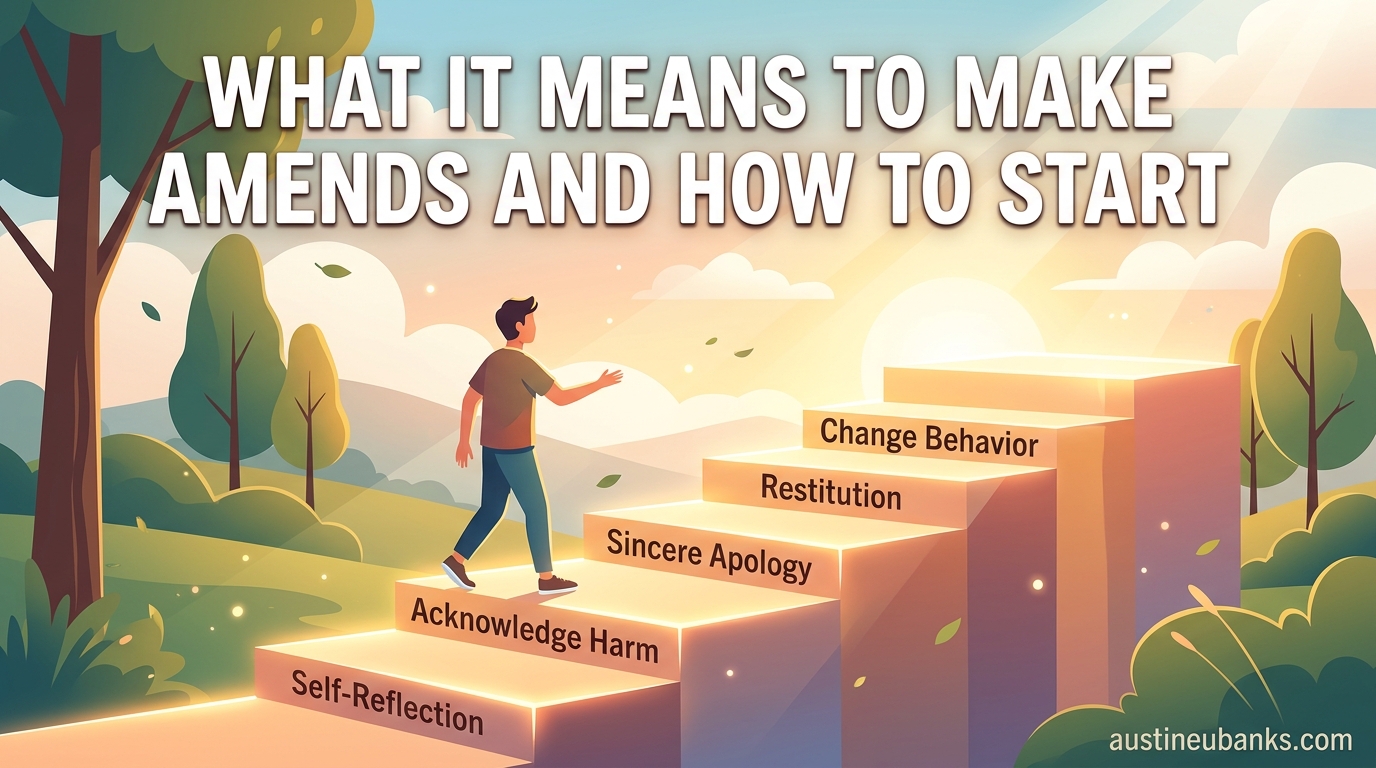
You know that feeling when something you did keeps pulling at you weeks, months, or even years later. Maybe you lied to someone who trusted you. Maybe you disappeared when a friend needed you most. Or maybe you caused harm during a period in your life that you are not proud of. That lingering weight is not just guilt talking. It is your values reminding you that your actions and your conscience are out of alignment.
Learning what it means to make amends and how to start can change that. Making amends is not about groveling or hoping someone will say “it’s okay.” It is about taking real, measurable action to repair harm and align your behavior with the person you want to be. Whether you are working through a 12-step program, trying to heal a damaged relationship, or simply wanting to face something you have been avoiding, this guide will walk you through the process step by step.
I have spent years studying recovery literature, talking with people in 12-step communities, and reading firsthand accounts from people who have sat across from someone they hurt and tried to make things right. The insights below draw from all of that, plus practical frameworks you can use today.
Table of Contents
What It Means to Make Amends
To make amends means to take action that corrects a mistake or repairs harm you caused. The word itself comes from the Latin “emendare,” meaning to correct or set right. Merriam-Webster defines making amends as “to do something to correct a mistake that one has made or a bad situation that one has caused.”
Here is the part most people miss. An amend is a change, not just an apology. When you make amends, you are not simply expressing regret. You are aligning your behavior with your values and backing up your words with concrete action. That distinction matters because anyone can say “I’m sorry.” Far fewer people are willing to do the harder work of actually making things right.
In 12-step programs like Alcoholics Anonymous, making amends is the focus of Steps 8 and 9. Step 8 involves making a list of people you have harmed and becoming willing to make amends to them all. Step 9 is where you actually make those amends. But you do not need to be in a recovery program to benefit from this process. The principles apply to any relationship where trust has been damaged.
Apology vs Making Amends: What’s the Difference
People often use these terms interchangeably, but they are fundamentally different. Understanding the gap between them is the foundation of doing this work well.
An apology is a statement of regret. It acknowledges that something went wrong. Making amends, on the other hand, is action-oriented. It demonstrates that you understand the harm and are willing to do something about it.
Think of it this way. If you break a neighbor’s window, saying “I’m sorry” is an apology. Replacing the window is an amend. One is words. The other is repair.
Here are the key differences at a glance:
- Apology centers on words and regret. “I’m sorry I did that.”
- Amends centers on action and change. “Here is what I am doing to make it right.”
- Apology often seeks forgiveness for the person apologizing.
- Amends focuses on the other person’s healing, not your relief from guilt.
- Apology can be vague. “I’m sorry for everything.”
- Amends is specific. “I’m sorry I stole $200 from you. Here is the money back.”
One insight that comes up again and again in recovery communities is this: if your amends is really about making yourself feel better, it is probably more of an apology. Genuine amends keep the focus on the person you harmed.
Three Types of Amends: Direct, Indirect, and Living
Not every situation calls for the same approach. There are three main types of amends, and knowing when to use each one is a skill that develops with practice and guidance.
Direct Amends
Direct amends involve face-to-face (or voice-to-voice) contact with the person you harmed. You acknowledge the specific harm, take responsibility without making excuses, and offer to make things right. This is the most common image people have when they think about making amends.
A direct amend sounds like this: “I lied to you about where I was that night, and I know it damaged your trust in me. I want to be honest with you from now on, and I am here to answer any questions you have.”
Indirect Amends
Indirect amends are used when direct contact is impossible or would cause more harm. Maybe the person has passed away, has asked for no contact, or would be retraumatized by your reappearance. In these cases, you take action to repair the harm without involving that person directly.
For example, if you stole money from someone you can no longer reach, you might donate that amount to a charity in their honor. If you neglected your children during active addiction, indirect amends might mean volunteering with youth organizations as a way of giving back what you could not give at the time.
Living Amends
Living amends is the ongoing practice of changed behavior. Instead of a single conversation or action, you demonstrate through your daily life that you are no longer the person who caused that harm. This is especially relevant when someone is not ready to hear a direct amend, or when the harm was ongoing and a one-time apology feels hollow.
As people in recovery often say, living amends is not an event. It is a commitment to continuous change. You show up consistently, you act with integrity, and over time your behavior becomes the apology.
How to Start Making Amends: Step by Step
If you are wondering how to start making amends, the process below breaks it into manageable steps. You do not have to do everything at once. Take it one step at a time, and if you are in a recovery program, work with a sponsor or mentor who can guide you.
Step 1: Reflect and Make a List
Start by sitting down and writing out everyone you believe you have harmed. Do not filter the list yet. Include family members, friends, coworkers, and even yourself. This list becomes your roadmap. Be as specific as you can about what happened and how it affected them.
This step is emotionally difficult. Be honest with yourself, but also be patient. You are not expected to remember every detail perfectly.
Step 2: Understand the Specific Harm
For each person on your list, identify exactly what you did and why it was harmful. Vague amends fall flat. “I’m sorry for being a bad friend” does not land the same way as “I’m sorry I canceled on you the night before your surgery and left you to go through it alone.”
Put yourself in their shoes. What did your action cost them emotionally, financially, or relationally? This is not about self-flagellation. It is about clarity.
Step 3: Decide on the Type of Amend
For each person, determine whether a direct, indirect, or living amend is appropriate. Consider their current situation. Would hearing from you help them heal, or would it reopen a wound they have worked hard to close? When in doubt, err on the side of caution.
This is where consulting with a sponsor, therapist, or trusted advisor becomes especially valuable. They can offer perspective you might not have on your own.
Step 4: Prepare What You Will Say
Write out or rehearse your amend beforehand. A good amend has three components: acknowledgment of the specific harm, genuine ownership without excuses, and a concrete offer to make things right.
Keep it focused on them, not on you. Avoid explaining your side of the story unless they ask. Do not say “but” after your apology. The moment you add “but I was going through a lot,” the amend turns back into an excuse.
Step 5: Choose the Right Time and Setting
Pick a time and place where the other person will not feel ambushed or cornered. Ask if they would be willing to talk. If they say no, respect that. You can offer an indirect amend instead, or wait until they are ready.
Privacy matters. Making amends in front of an audience can feel performative. Choose a setting where the other person feels safe to respond honestly.
Step 6: Make the Amend
This is the hardest step. Deliver what you prepared. Be genuine, specific, and humble. Let them respond however they need to. They might be angry. They might cry. They might say they forgive you. They might say they are not ready to forgive you.
All of those responses are valid. Your job is to make the amend, not to control the outcome.
Step 7: Follow Through with Changed Behavior
The amend does not end when the conversation is over. The real amend is what you do next. If you said you would be more reliable, be more reliable. If you said you would pay back what you owe, set up a payment plan and stick to it. This is where living amends begins.
As recovery communities emphasize, making amends is a commitment to a continuous process of change. The conversation opens the door. Your ongoing behavior is what actually repairs the trust.
When Not to Make Amends
This is one of the most important sections in this guide, and it is something many resources under-cover. There are real situations where making amends can cause more harm than good. Knowing when to hold back is just as important as knowing when to step forward.
You should consider not making a direct amend when:
- Contact would retraumatize the person. If your presence in their life was genuinely dangerous or deeply damaging, reappearing can reopen wounds they have worked hard to heal.
- They have asked for no contact. Respecting their boundary is itself a form of amends. Showing up against their wishes is about your needs, not theirs.
- The amend would harm third parties. If being honest about something would hurt an innocent person who does not know about it, you need to weigh whether your disclosure serves them or just relieves your guilt.
- You are not emotionally stable enough. If you are in early recovery or an active crisis, you may not be in the right headspace. Wait until you have a foundation of stability.
- Your motivation is selfish. If you are making amends primarily to feel better about yourself, pause. Reframe your approach around the other person’s healing.
In these cases, indirect amends or living amends are usually the better path. You can still take action to make things right without forcing a confrontation that might do damage.
Common Challenges When Making Amends
The process is rarely smooth. Here are the most common challenges people face and how to navigate them.
Fear of Rejection
This is the number one barrier people describe in forums and support groups. You worry that the other person will refuse to speak to you, will get angry, or will tell you that your amend is too little, too late.
The reality is that some people will not be ready. That is their right. Your responsibility is to make the amends when it is appropriate to do so, not to guarantee a specific response. If they reject the amend, you have still done the right thing by trying.
Not Knowing What to Say
Sitting across from someone you hurt and finding the right words is genuinely hard. That is why Step 4 above matters so much. Prepare ahead of time. Write it down if you need to. Having a script does not make the amend less genuine. It makes you more likely to actually say what needs to be said.
If face-to-face feels impossible, a written amend can be appropriate. A letter gives the other person space to process on their own timeline. Just be clear that you are available to talk if and when they want.
Dealing With Silence
What happens when you make an amend and the other person says nothing? They might not respond to your message. They might listen and then walk away without saying a word. Silence does not mean your amend failed. It means they need time.
Do not follow up repeatedly. Do not demand a response. Give them the space you would want if the roles were reversed.
The Urge to Explain Yourself
This trips up almost everyone. You start the amend, and then you hear yourself saying “but the reason I did that was…” Before you know it, you have turned an amend into a justification.
Catch yourself. If you feel the urge to explain, take a breath. Ask yourself whether the explanation serves them or serves you. If it is the latter, leave it out.
Making Amends to Yourself
This is the most under-discussed part of the amends process, and it is something I want to give real attention to. Most resources focus entirely on making amends to others. But if you have spent years harming yourself through self-destructive behavior, negative self-talk, or neglecting your own needs, you owe yourself an amend too.
Making amends to yourself means treating yourself with the same accountability and compassion you would offer someone else. It means acknowledging the specific ways you have undermined your own well-being and then taking action to change that pattern.
Here is what that can look like in practice:
- Acknowledge the self-harm. Name it specifically. “I neglected my physical health for years. I ignored warning signs and put myself at risk.”
- Take responsibility without self-punishment. Own it, but do not use it as another reason to beat yourself up. Accountability is not the same as shame.
- Take concrete action. Commit to specific changes. Schedule the doctor appointment you have been avoiding. Set boundaries that protect your well-being. Feed yourself well. Get the sleep you need.
- Practice ongoing self-compassion. Living amends to yourself is a daily practice. Treat yourself the way you would treat a friend who is trying to rebuild their life.
Self-forgiveness is not about pretending the past did not happen. It is about refusing to let the past dictate how you treat yourself today. You are allowed to be someone who made mistakes and is still worthy of care.
Frequently Asked Questions
What does it really mean to make amends?
Making amends means taking concrete action to correct a mistake or repair harm you caused. It goes beyond saying sorry. An amend is a change in behavior backed by specific action that demonstrates you understand the harm and are committed to making things right.
How do you start making amends?
Start by making a list of everyone you have harmed and identifying the specific harm for each person. Then decide whether a direct, indirect, or living amend is appropriate. Prepare what you will say, choose the right setting, and make the amend when the time is right. Working with a sponsor or therapist can help guide the process.
What are the three things in making amends?
The three core components of making amends are: 1) acknowledging the specific harm without excuses, 2) taking genuine responsibility for your actions, and 3) taking concrete action to make things right. These three elements distinguish a real amend from a simple apology.
When should you not make amends?
You should avoid making direct amends when contact would retraumatize the person, when they have requested no contact, when your disclosure would harm innocent third parties, or when you are not emotionally stable enough to handle the conversation. In these cases, indirect amends or living amends are usually the better choice.
How do you make amends to yourself?
Making amends to yourself means acknowledging the specific ways you have neglected or harmed your own well-being, taking responsibility without spiraling into shame, and committing to concrete changes that support your health and growth. It is an ongoing practice of self-compassion paired with accountability.
What do you do if someone won’t accept your amends?
If someone refuses to accept your amends, respect their decision without pushing for a different outcome. You cannot control their response. You can continue making living amends through changed behavior, and you can leave the door open in case they want to reconnect in the future. Their forgiveness is not the goal of making amends.
Moving Forward After Making Amends
Understanding what it means to make amends and how to start is just the beginning. The real work happens in the days, weeks, and months after you have those conversations. Every choice you make either reinforces the change or chips away at it.
Remember that making amends is not about achieving forgiveness. It is about taking responsibility, repairing what you can, and becoming someone who no longer causes that kind of harm. Some people will welcome your efforts. Others will not be ready. Both outcomes are outside your control.
What is within your control is how you live tomorrow. Show up honestly. Follow through on what you said you would do. Treat people, including yourself, with the care and accountability they deserve. That is what making amends truly looks like in practice, and it is something you can start today.