
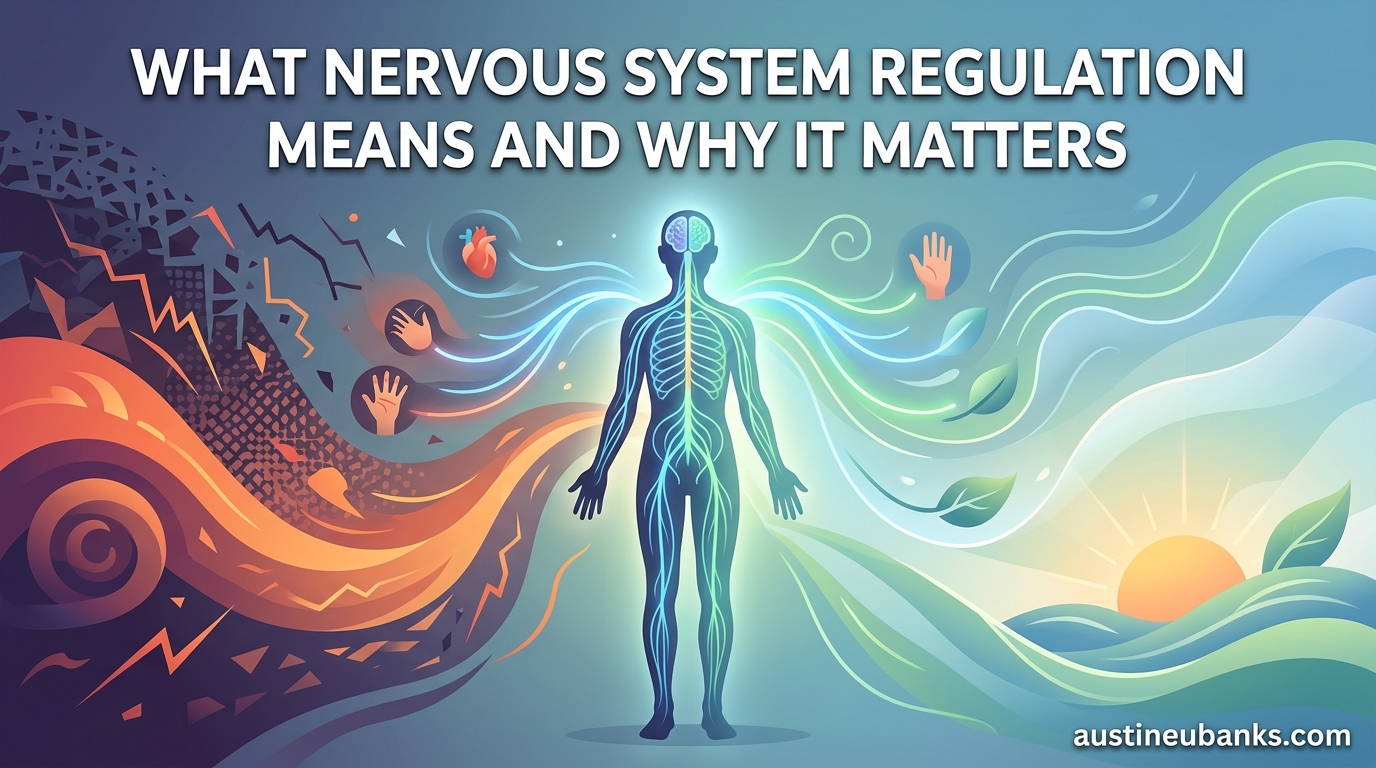
Nervous system regulation is your body’s ability to shift smoothly between activated states like fight-or-flight and calm states like rest-and-digest, depending on what the moment demands. When this system works well, you feel grounded under pressure and recover quickly from stress. When it does not, even small challenges can feel overwhelming, exhausting, or impossible to shake.
You have probably seen the phrase “regulate your nervous system” all over social media in 2026. Wellness influencers mention it. Therapists talk about it. Even coworkers casually blame their burnout on a dysregulated nervous system. But behind the trend sits a real and well-studied biological process that affects nearly every part of how you think, feel, and function.
In this guide, we break down what nervous system regulation means and why it matters in plain language. You will learn how the autonomic nervous system works, what signs point to dysregulation, and which practical techniques actually help. We also cover the difference between quick coping tools and long-term healing, because that distinction matters more than most online advice admits.
Whether you live with chronic stress, anxiety, trauma history, or simply want to understand why some days feel harder than others, this information can change how you relate to your own body. Many people report feeling genuine relief the moment they learn their symptoms have a biological explanation rather than a personal failing. Let us start with the basics.
Table of Contents
What Nervous System Regulation Means
Nervous system regulation refers to the way your autonomic nervous system continuously adjusts your internal state to match the situation in front of you. A regulated nervous system can ramp up energy and alertness when you face a deadline, then settle back down into calm once the moment passes. The key word here is flexibility. A healthy system moves between states rather than getting stuck in any one of them.
Think of it like a thermostat. A good thermostat does not stay locked at one temperature forever. It responds to changes in the room, kicks the heater on when things cool down, and switches off when warmth returns. Your nervous system works the same way. It reads signals from inside your body and from the environment, then shifts your heart rate, breathing, muscle tension, and digestion to match what is needed.
Regulation is not the same as relaxation. This is one of the biggest misconceptions online. A regulated nervous system can be highly activated during exercise, a difficult conversation, or an emergency. What makes it regulated is the ability to return to balance afterward. If you cannot gear up when needed, that is also a form of dysregulation, not just being unable to calm down.
This process is largely automatic, happening below conscious awareness. Your body is scanning your environment and internal signals constantly, even when you are asleep. But here is the good news. You can also influence this system intentionally through breathing, movement, attention, and specific practices that have been studied for decades. That is what makes nervous system regulation both a biological reality and a learnable skill.
It also helps to understand what regulation is not. It is not forcing yourself to stay positive. It is not suppressing emotions or pretending you feel fine when you do not. And it is definitely not a personality trait that some people have and others lack. Regulation is an ongoing biological process that responds to your habits, your environment, your relationships, and your history. Everyone has a nervous system. Everyone regulates, sometimes well and sometimes poorly. The goal is to understand the process so you can work with it more skillfully.
The Autonomic Nervous System Explained
Your autonomic nervous system has two main branches that work like a gas pedal and a brake. The sympathetic nervous system acts as the accelerator. It powers the fight-or-flight response, raises your heart rate, sharpens focus, and prepares your body for action. The parasympathetic nervous system acts as the brake. It drives the rest-and-digest state, slows your heart, supports digestion, and helps you recover.
These two branches are always active to some degree. They are not switches that flip on and off but dials that turn up and down in relation to each other. At any given moment, one is slightly more dominant depending on what you are doing and what your body perceives. Healthy regulation means both dials can move freely in response to changing circumstances.
A third player deserves attention here, especially in trauma-informed approaches. The vagus nerve is the longest cranial nerve in your body, and it carries signals between your brain and major organs including your heart, lungs, and digestive tract. According to polyvagal theory developed by Dr. Stephen Porges, the vagus nerve has different branches that influence not just calm but also social connection and shutdown responses. A well-toned vagus nerve is closely linked to better emotional regulation and resilience.
Vagus nerve stimulation has become a popular wellness topic, and many of the techniques covered later in this article work at least in part by influencing vagal tone. Singing, humming, deep breathing, and slow movement all engage the vagus nerve. This is not a fringe theory. There is solid research behind the connection between vagal activity and stress resilience.
Heart rate variability, or HRV, is one measurable sign of how flexible this system is. A higher HRV generally means your nervous system can adapt quickly to stress and recover efficiently. Many people now track HRV using wearable devices, though the science is still evolving on how much everyday readings should guide your decisions. Treat HRV as one data point among many, not a verdict on your overall health.
The hypothalamic-pituitary-adrenal axis, or HPA axis, is another core piece. This is the hormonal pathway that releases cortisol when you face stress. Short bursts of cortisol are normal and helpful. They give you energy and focus when you need it. Chronic activation, however, keeps your body in a low-grade alarm state that wears down nearly every system over time. This cumulative wear is called allostatic load, and it sits at the root of many stress-related health problems.
Signs of a Regulated vs. Dysregulated Nervous System
One of the most common questions people ask is how to tell whether their nervous system is regulated. The honest answer is that signs vary from person to person, but certain patterns show up consistently. Here is what to look for in each state.
Signs Your Nervous System Is Well Regulated
A regulated nervous system tends to produce a felt sense of safety in your body. You can hold strong emotions without being flooded by them. Stress still happens, but it moves through you rather than camping out indefinitely.
- You recover from stressful events within hours or days, not weeks.
- You can fall asleep within a reasonable time and stay asleep most of the night.
- You feel a range of emotions without feeling hijacked by any single one.
- Your digestion feels stable, without chronic bloating, nausea, or irregularity.
- You can think clearly under pressure rather than going blank or spiraling.
- You feel capable of social connection, even when you are tired.
- Your energy matches the demands of your day without constant caffeine or willpower.
None of this means you are calm all the time. It means your system has the range to meet life’s demands and return to baseline without getting stuck. Some days will still be hard. The difference is that hardness does not become a permanent state.
Signs Your Nervous System May Be Dysregulated
Dysregulation shows up when the nervous system loses its flexibility. You might get locked into high activation, low shutdown, or rapid swings between the two. These signs often build gradually, which is why people miss them until they feel truly burned out.
- You feel stuck in fight-or-flight, constantly on edge or easily startled.
- You experience emotional numbness, dissociation, or feeling disconnected from your body.
- Sleep is fragmented, with frequent waking or trouble winding down.
- Small stressors trigger outsized emotional reactions you struggle to control.
- You feel exhausted even after resting, as if recovery never fully lands.
- Digestive issues, tension headaches, or jaw clenching show up regularly.
- You swing between anxiety and collapse without much middle ground.
- You rely heavily on substances, screens, or distractions to feel okay.
If several of these sound familiar, it does not mean your nervous system is broken. It means the system is doing exactly what it was designed to do under sustained stress. The goal is not to force calm but to give the system better conditions and tools to find its way back to flexibility.
People often feel a wave of validation when they first encounter this list. Suddenly, symptoms that felt random or embarrassing have a name and a cause. That recognition is not a finish line, but it is an important starting point. You cannot work with a system you do not understand.
What Triggers Nervous System Dysregulation
Dysregulation rarely comes from a single event. More often, it builds from a combination of factors that overwhelm the nervous system’s capacity to adapt. Understanding your triggers is the first step toward working with your body instead of against it.
Chronic stress is the most common driver. When deadlines, financial pressure, caregiving demands, or relationship conflict pile up without adequate recovery time, your sympathetic nervous system stays activated. Over weeks and months, this sustained activation raises baseline cortisol levels and chips away at your resilience. The problem is not stress itself but stress without recovery.
Trauma plays a significant role as well. Experiences that overwhelm your ability to cope, whether in childhood or adulthood, can leave the nervous system primed to detect threat even when no danger is present. This is not a character flaw. It is a survival mechanism that has not yet received the message that the threat has passed. Trauma-informed approaches to regulation recognize that some techniques can actually intensify symptoms if the underlying trauma is not addressed.
This is particularly relevant for people with complex PTSD or developmental trauma. Their nervous systems may have spent years adapting to unsafe environments, and those adaptations do not simply disappear when the environment changes. Healing requires patience and often professional support, not just breathing exercises downloaded from an app.
Lifestyle factors also contribute. Poor sleep, heavy caffeine or alcohol use, sedentary routines, social isolation, and inconsistent eating patterns all place additional load on the nervous system. None of these alone will dysregulate you, but together they create conditions where regulation becomes much harder. Staring at screens late into the night, skipping meals, and living in environments with constant noise or conflict all send signals of threat to a nervous system that cannot tell the difference between modern stress and actual danger.
Even positive life changes can tax the system. A new job, a move, a baby, or a promotion all require adjustment. The nervous system does not distinguish between good stress and bad stress as cleanly as we would like. What matters is the total load and the recovery resources available to you.
Medical conditions can also contribute. Chronic illness, chronic pain, hormonal imbalances, and certain medications all affect nervous system function. If you have addressed lifestyle factors and still feel stuck, it is worth exploring whether an underlying medical issue is part of the picture.
Why Nervous System Regulation Matters for Daily Life
It is easy to talk about the nervous system in abstract biological terms, but what does regulation actually change about your day-to-day experience? Quite a lot, as it turns out. When your nervous system functions well, the effects ripple through nearly every area of life.
Emotionally, regulation gives you access to a wider range of feelings without being consumed by them. You can feel angry without exploding. You can feel sad without spiraling into despair. You can feel joy without bracing for something bad to happen. This emotional range is what allows for genuine intimacy, creativity, and engagement with life. When your system is stuck in survival mode, the emotional palette narrows to fear, anger, numbness, or some combination of all three.
Cognitively, a regulated nervous system supports clear thinking and better decision-making. When your system is stuck in survival mode, the prefrontal cortex, the part of your brain responsible for planning and judgment, goes partially offline. You react instead of respond. You reach for quick fixes instead of considered solutions. Regulation brings that higher-order thinking back online, which is why people often say they “cannot think straight” when they are dysregulated. They are describing a real neurological phenomenon, not a personal failing.
In relationships, regulation matters more than most people realize. When your nervous system reads the people around you as threats, even loved ones, conflict escalates quickly. You misread tone. You assume the worst. You shut down or lash out before you can catch yourself. A more regulated system allows you to stay present during hard conversations and repair ruptures when they happen. This is one reason couples therapy often focuses on nervous system regulation before communication skills. Without regulation, no amount of communication technique will help.
Physically, chronic dysregulation is linked to a long list of health concerns. Persistent cortisol elevation affects immune function, blood sugar regulation, cardiovascular health, and digestive function. Chronic stress has been associated with increased risk of hypertension, insulin resistance, inflammatory conditions, and compromised immunity. This is not about fear-mongering. It is about recognizing that the mind-body connection is not a wellness slogan but a biological reality backed by decades of research.
For sleep, regulation is foundational. If your nervous system does not feel safe enough to downshift into parasympathetic dominance at night, no amount of magnesium or blue-light blocking will fully solve the problem. Many people chase sleep solutions while ignoring the underlying state of their nervous system. Improving regulation during the day often improves sleep at night more reliably than any nighttime routine alone.
At work, regulation affects focus, creativity, and collaboration. A dysregulated nervous system makes it harder to concentrate, easier to procrastinate, and more difficult to handle feedback. Many people attribute these struggles to laziness or lack of discipline when the real issue is that their nervous system is running an outdated survival program in the background.
None of this means you need a perfectly regulated nervous system to live a good life. Human biology is resilient. But understanding this system gives you a powerful lens for making sense of patterns that might otherwise feel random or personal. That understanding alone can be transformative.
Practical Techniques for Nervous System Regulation
This is where the conversation often gets overwhelming. The internet offers endless lists of techniques, and many people abandon the whole project before they even start. So here is the principle to keep in mind: no single technique works for everyone, and consistency matters far more than finding the perfect method. Start with one practice, give it a real trial, and build from there.
Breathing Techniques
Breath is the most direct lever you have over your autonomic nervous system. You cannot consciously control your heart rate or hormone release, but you can control the length and depth of your breath, and that signal cascades through the entire system. This is why nearly every contemplative tradition across cultures includes some form of breath practice.
Slow breathing at around five to six breaths per minute has been shown to increase heart rate variability and activate parasympathetic response. A simple way to practice is to inhale for four counts, hold briefly, exhale for six counts, and repeat for three to five minutes. The longer exhale is what signals safety to your nervous system.
Box breathing, used by military personnel and first responders, follows a four-count pattern: inhale for four, hold for four, exhale for four, hold for four. It is particularly useful in moments of acute stress when you need to think clearly and regulate quickly before responding to a situation.
Cyclic sighing, studied by researchers at Stanford University, involves two quick inhales through the nose followed by a long, slow exhale through the mouth. The second short inhale fully expands the air sacs in your lungs, and the extended exhale releases that air slowly. Research suggests this pattern reduces anxiety more effectively than other breathing techniques in as little as five minutes a day.
Alternate nostril breathing, a practice from yoga tradition, involves closing one nostril at a time while breathing through the other. Studies suggest it may help balance autonomic activity. It takes a few minutes and can be done anywhere, making it a practical tool for midday regulation.
Mindfulness and Meditation
Mindfulness trains your attention to stay in the present moment without judgment. For nervous system regulation, the key benefit is that it strengthens interoception, your ability to notice what is happening inside your body. People with strong interoception tend to catch dysregulation earlier, before it snowballs into a full stress response.
You do not need to sit in silence for thirty minutes to get benefits. Even three to five minutes of focused attention on your breath, your feet on the floor, or the sounds around you can shift your state. The goal is not emptying your mind but practicing the skill of returning your attention when it wanders. That returning is the repetition that builds the neural pathway.
Body scan meditation is a particularly useful practice for nervous system awareness. Starting at the top of your head and slowly moving attention down through your body, you simply notice what you feel without trying to change anything. Over time, this builds the interoceptive awareness that makes all other regulation techniques more effective.
Somatic and Grounding Exercises
Somatic practices work directly with the body to release tension and complete stress responses that got interrupted. These approaches recognize that stress does not just live in your thoughts. It lives in your muscles, your breathing patterns, and your posture. Somatic experiencing, developed by Dr. Peter Levine, is one of the best-known approaches in this category.
One simple grounding exercise is the 5-4-3-2-1 technique. Notice five things you can see, four things you can feel, three things you can hear, two things you can smell, and one thing you can taste. This engages your senses and pulls your nervous system into the present moment, which is especially useful during anxiety spikes or dissociation.
Progressive muscle relaxation involves tensing and then releasing each muscle group in your body, starting from your feet and moving upward. This helps your nervous system notice the difference between tension and relaxation, which is a skill many stressed people lose over time. Chronic tension becomes so familiar that it feels normal, and this practice helps reawaken the contrast.
Gentle movement also matters. Yoga, walking, slow stretching, and even humming or singing stimulate the vagus nerve and support regulation. You do not need intense exercise to shift your state. Sometimes the most powerful intervention is slow, intentional movement that signals safety to your body. For people who have been stuck in freeze or shutdown, gentle movement is often more effective than vigorous workouts, which can actually reinforce activation.
Cold Exposure
Cold showers and cold plunges have become popular regulation tools, and there is some science behind them. Cold exposure activates the diving reflex, which slows heart rate and shifts the body toward parasympathetic dominance. Some research also suggests regular cold exposure may improve stress resilience over time.
However, cold exposure is an acute tool, not a cure. For some people, especially those with trauma histories, cold can actually trigger a threat response rather than calm one. Start gradually, perhaps with thirty seconds of cold at the end of a warm shower, and pay close attention to how your body responds during and after. If you feel more activated rather than less, this may not be the right tool for your nervous system.
Acute Techniques vs. Long-Term Healing
This distinction is one of the most underserved topics in the nervous system regulation conversation, and it causes a lot of confusion and frustration. Acute techniques and long-term healing serve different purposes, and mistaking one for the other leads to disappointment.
Acute techniques include breathing exercises, cold plunges, grounding, and most quick interventions you see online. These tools shift your state in the moment. They are valuable and worth having in your toolkit. But they do not, on their own, rewire a nervous system shaped by years of chronic stress or trauma. Think of them like aspirin for a headache. Useful, sometimes necessary, but not a treatment plan for the underlying cause.
Long-term healing involves deeper work. This might include trauma-focused therapy such as EMDR, somatic experiencing, internal family systems, or other modalities that address the root causes of dysregulation. It involves building new patterns of safety in the body over months, not minutes. Forum discussions across communities focused on CPTSD, trauma recovery, and somatic experiencing consistently report that real nervous system healing takes months and sometimes years, not days or weeks.
Both approaches matter. Using breathing techniques to get through a stressful afternoon is not a failure because it does not heal your trauma. Healing trauma is not diminished because you also use quick tools to manage daily stress. The trap is expecting acute tools to do the work of long-term healing, or dismissing acute tools because they are not a complete solution.
If you find that techniques feel abstract or do not seem to work, you are not alone. Many people in trauma and nervous system communities report frustration when somatic exercises feel confusing or when breathwork does not produce the promised calm. This often means the nervous system needs a slower, more supported approach, sometimes with professional guidance, before the standard techniques become accessible. The fact that a technique did not work for you says nothing about you. It may simply mean your nervous system needs a different entry point.
A Simple Daily Practice for Nervous System Regulation
People often ask what a realistic daily routine looks like. The answer should not require expensive equipment, apps, or hours of free time. Here is a simple framework you can adapt to your own life. The goal is consistency, not perfection.
Morning, within thirty minutes of waking: Spend three to five minutes doing slow breathing before reaching for your phone. Try cyclic sighing or simple slow exhales. This sets a calmer baseline for the day before external demands start pulling your attention.
Midday check-in: Take two minutes to notice your body. Are your shoulders tense? Is your jaw clenched? Is your breathing shallow? You do not need to fix anything. Just noticing begins to build interoception. If you want to add a technique, try one minute of box breathing or a brief walk outside.
Afternoon transition: When shifting between work and personal time, use a grounding exercise to mark the transition. The 5-4-3-2-1 technique works well here. So does a few minutes of gentle stretching or humming. The point is to give your nervous system a signal that the demands of the day are shifting.
Evening wind-down: Spend five to ten minutes doing something that signals safety to your body. This could be progressive muscle relaxation, a slow walk, light reading, or simply sitting quietly. Avoid screens during this window if possible, since the blue light and content stimulation keep the sympathetic system slightly engaged.
You do not need to do all of these every day. Even one or two, practiced consistently, can create noticeable shifts over a few weeks. The nervous system responds to repetition, not intensity.
Common Misconceptions About Nervous System Regulation
Because this topic has exploded in popularity, several misconceptions have spread alongside the accurate information. Clearing these up can save you frustration and help you set realistic expectations.
Misconception one: regulation means being calm. As covered earlier, regulation is about flexibility, not a single state. A regulated person can feel intense energy, anger, or excitement. What matters is the ability to return to baseline afterward.
Misconception two: there is one correct technique. Different nervous systems respond to different inputs. Some people feel instant relief from cold exposure. Others find it activating. Some people love meditation. Others find it increases their anxiety. The right technique is the one that works for your body, not the one with the most followers on social media.
Misconception three: if techniques are not working, you are doing it wrong. Sometimes techniques do not land because the nervous system needs a slower, more supported approach. This is common with trauma histories and does not indicate personal failure. It may mean you need professional guidance rather than self-directed practice.
Misconception four: nervous system regulation replaces therapy. Self-regulation practices complement therapy but do not replace it, especially when trauma, chronic mental health conditions, or significant life disruptions are involved. The two work best together.
Misconception five: results should be immediate. Some techniques provide quick relief, but deeper changes in how your nervous system responds to stress take weeks and months of consistent practice. People who expect instant transformation often abandon helpful practices before those practices have time to work.
When to Seek Professional Help
Self-regulation practices are powerful, but they have limits. Knowing when to seek professional support is itself a form of regulation. Pushing through alone when you need help often reinforces the very patterns you are trying to change.
Consider working with a therapist or medical professional if your symptoms significantly interfere with daily functioning. This includes persistent insomnia, panic attacks, dissociation, inability to work or maintain relationships, or physical symptoms like chronic pain and digestive distress that have not responded to other approaches.
If you suspect you may have dysautonomia, a medical condition where the autonomic nervous system does not function properly, talk to a doctor. Dysautonomia is not the same as general nervous system dysregulation, though the symptoms can overlap. Conditions like POTS, or postural orthostatic tachocardi syndrome, require medical evaluation and treatment, not just breathing exercises. Other conditions that affect nervous system function include thyroid disorders, autoimmune conditions, and vitamin deficiencies, all of which need proper diagnosis.
Therapists trained in somatic experiencing, EMDR, sensorimotor psychotherapy, or other body-based approaches can offer guidance that no article or app can replace. They help you work with your nervous system at a pace that respects your unique history and capacity. They can also help you identify which techniques are safe and appropriate for your specific situation and which might be counterproductive.
There is no weakness in seeking that support. For many people, it is the most efficient path to lasting change. The self-help mindset can sometimes become its own form of avoidance when it prevents people from getting the level of care they actually need.
FAQs
How do I tell if my nervous system is regulated?
Signs of a regulated nervous system include recovering from stress within hours rather than days, sleeping without long wakeful periods, feeling a full range of emotions without being overwhelmed, digesting food comfortably, and thinking clearly under pressure. Regulation is not about being calm all the time but about having the flexibility to shift between states and return to baseline.
Are autoimmune diseases related to the nervous system?
There is growing research on the connection between chronic nervous system dysregulation, sustained stress, and immune function. Chronic cortisol elevation and high allostatic load can contribute to inflammation, which plays a role in some autoimmune conditions. However, autoimmune diseases have complex causes and require medical diagnosis and treatment from a healthcare provider.
Is dysautonomia the same as dysregulated nervous system?
No, they are not the same. General nervous system dysregulation refers to a pattern where your autonomic nervous system struggles to shift between stress and calm states, often due to lifestyle, stress, or trauma. Dysautonomia is a medical condition where the autonomic nervous system does not function properly and requires clinical diagnosis and treatment from a physician.
How do I fix my dysregulated nervous system?
There is no single fix, but consistent practices help over time. Start with slow breathing techniques like cyclic sighing for five minutes daily, build mindfulness or grounding exercises into your routine, prioritize sleep, reduce unnecessary stressors, and consider body-based therapy if trauma is involved. Real healing typically takes months, so consistency matters more than intensity.
Conclusion
Understanding what nervous system regulation means and why it matters gives you a practical framework for working with your body instead of fighting it. Your nervous system is not broken when it struggles. It is responding to conditions, often difficult ones, using the tools it has. With consistent practice, professional support when needed, and realistic expectations about timelines, you can build genuine flexibility into your system over time.
Start with one technique. Give it a few weeks. Pay attention to what shifts and what does not. The goal is not perfection but a wider, more comfortable range of being human. Your nervous system has been with you since before you had language for it, and it will keep working on your behalf. The more you understand it, the better you can work together.