
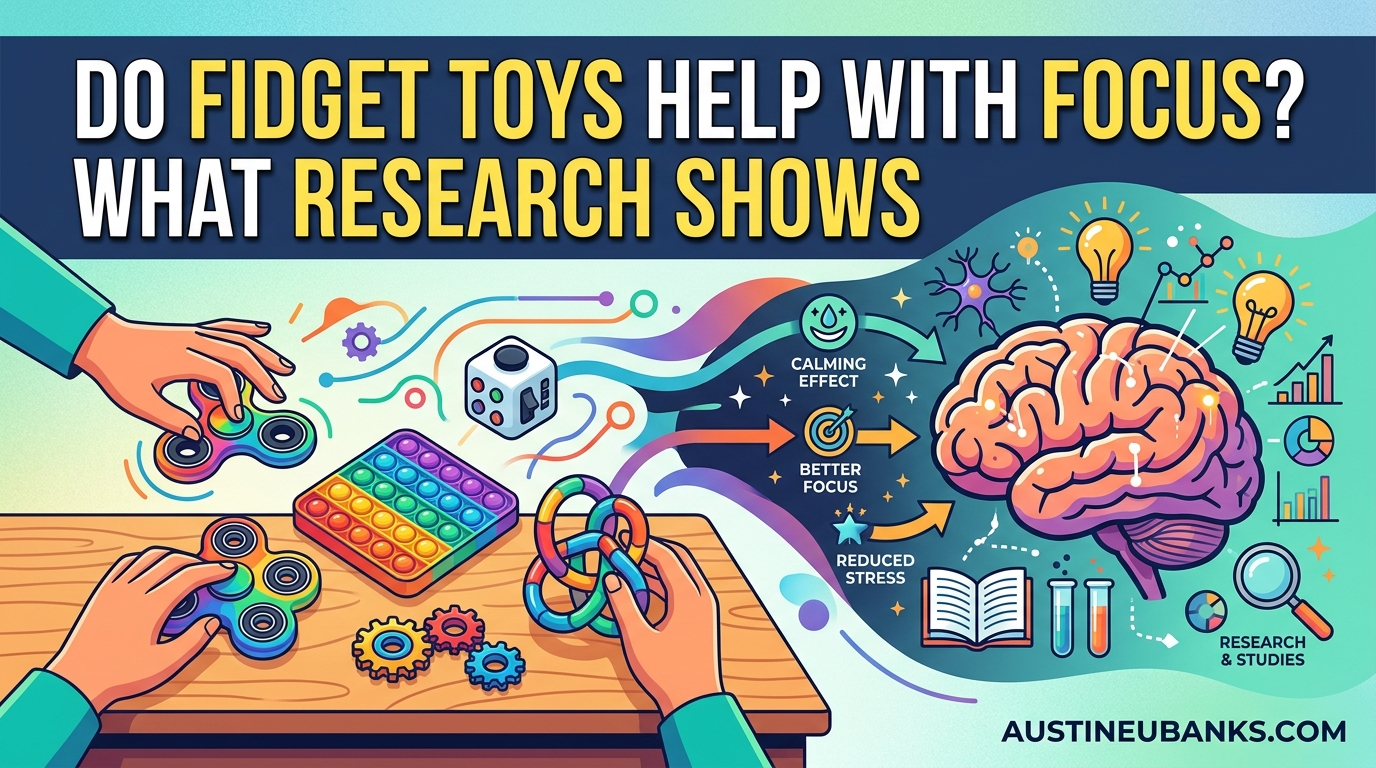
In 2017, fidget spinners were everywhere. Kids spun them in classrooms, adults clicked them during meetings, and stores could barely keep them in stock. Then schools started banning them. Teachers called them distractions, parents questioned whether they actually worked, and researchers began asking a question that still doesn’t have a simple answer: do fidget toys help with focus, or are they just toys?
Our team spent weeks digging through peer-reviewed studies, university research publications, and expert interviews to separate the marketing claims from the actual evidence. What we found surprised us. The answer isn’t a clean yes or no. It depends heavily on who is using the fidget toy, what type of fidget it is, and whether we’re talking about marketed fidget devices or the natural fidgeting your body already does.
The distinction between intrinsic fidgeting and fidget devices is the single most overlooked point in this entire conversation. Most articles lump them together, but the research treats them very differently. Understanding that difference changes everything about how you think about whether fidget toys help with focus.
We’ll walk you through what the science actually says, who benefits most, why some studies found fidget spinners made things worse, and how to know whether a fidget toy might help you or your child. We’ll also cover what researchers still don’t know and what the limitations of current studies are.
Whether you’re a parent trying to decide if a fidget toy belongs in your child’s classroom, an adult with ADHD looking for focus strategies, or a teacher trying to make evidence-based decisions for your students, this article gives you the full picture without the hype.
Table of Contents
The Short Answer: Do Fidget Toys Help With Focus?
Research on whether fidget toys help with focus is genuinely mixed, and the honest answer is: it depends on the person and the type of fidget. For neurotypical individuals, marketed fidget devices like fidget spinners show little to no benefit and may actually impair memory and concentration. For people with ADHD, the evidence shifts in a more positive direction, but even then, the strongest findings are about natural, intrinsic fidgeting rather than commercial fidget toys.
Here is the key distinction that most people miss. Studies that examine intrinsic fidgeting (small body movements like leg bouncing, pen clicking, doodling, or hair twirling) consistently find that these movements can improve cognitive performance in people with ADHD. Studies that examine marketed fidget devices like fidget spinners and fidget cubes show much weaker and sometimes negative results.
So if you are wondering whether fidget toys help with focus, the most accurate answer based on current research is: natural, low-effort fidgeting appears to help people with ADHD maintain attention during tasks. Commercial fidget toys have not demonstrated the same benefits, and for neurotypical users, they may actually reduce performance.
That said, anecdotal evidence from neurodivergent communities is strong. Many adults with ADHD and autism report that specific types of fidget toys, particularly quiet and tactile ones like stress balls, fidget rings, and textured objects, genuinely help them stay focused during meetings, lectures, and work tasks. The research hasn’t fully caught up with these lived experiences yet.
What the Research Actually Shows
The body of research on fidget toys and focus is surprisingly small given how popular these products became. What makes interpretation tricky is that different studies measured different things. Some looked at on-task behavior, others measured academic performance, and still others tested working memory. These are related but distinct outcomes, and a fidget toy that improves one doesn’t necessarily improve the others.
Let’s break down the most significant studies and what they actually found.
The 2021 Classroom Study: Fidget Spinners and On-Task Behavior
The most frequently cited study on fidget spinners was published in 2021 in the journal Behavior Analysis in Practice. Researchers used a rigorous single-case experimental design to study three second-grade students with ADHD in a general education classroom setting. The study measured whether fidget spinners improved on-task behavior during instruction.
The findings were nuanced. Fidget spinners did increase on-task behavior for one of the three students. But for the other two, the results were inconsistent or showed no meaningful improvement. More importantly, the study found no evidence that fidget spinners improved academic performance. Students might have looked more attentive, but they weren’t necessarily learning more.
The researchers also noted a habituation effect. Students appeared to lose interest in the fidget spinners over time, and the initial novelty wore off quickly. Teachers reported low satisfaction with the spinners, describing them as distracting and difficult to manage in a classroom setting.
This study matters because it used a proper experimental design rather than just observation. But with only three participants, the findings are limited in how broadly they can be applied. It tells us fidget spinners are not a magic solution for ADHD in classrooms, but it doesn’t tell us much about other types of fidget tools.
The UC Davis MIND Institute Findings
Some of the most compelling research on fidgeting and focus comes from the UC Davis MIND Institute, where Dr. Julie Schweitzer has been studying attention and movement in people with ADHD for years. In 2024, UC Davis published findings showing that fidgeting can help both children and adults with ADHD focus on tasks.
Schweitzer’s research distinguishes itself by focusing on intrinsic fidgeting rather than fidget devices. Her team found that small, natural movements like foot tapping, leg bouncing, and hand movements were associated with improved cognitive performance in individuals with ADHD. The longer and more demanding the task, the more benefit participants derived from fidgeting.
This finding aligns with what many people with ADHD report anecdotally. When forced to sit perfectly still, their minds wander more. When allowed to move subtly, they can redirect that restless energy into something productive. Their bodies stay busy so their brains can stay focused.
The MIND Institute research also found that fidgeting appeared to serve an emotional regulation function. Participants who fidgeted reported feeling calmer and less overwhelmed during challenging cognitive tasks. This emotional component is something that classroom-focused studies often overlook but matters enormously in real-world settings.
Schweitzer’s team is currently developing a smart fidget ball that can measure movement patterns and provide data on how different types of fidgeting correlate with attention and performance. This kind of research could eventually help us understand exactly which movements help and which don’t.
The 44% Memory Problem
One of the most striking findings in the fidget toy research comes from studies on college students and fidget spinners. Research published in 2020 found that college students who used fidget spinners during a lecture retained 44% less information than students who did not use them.
That number gets attention, and it should. A 44% drop in memory retention is not a minor effect. It suggests that for neurotypical adults in learning environments, fidget spinners don’t just fail to help. They actively interfere with the brain’s ability to encode and retain new information.
Why would this happen? The likely explanation is attentional competition. A fidget spinner requires visual attention, fine motor coordination, and cognitive engagement. When you are spinning a device while trying to listen to a lecture, your brain has to split its resources. For most people, that split comes at a cost to learning.
This finding doesn’t mean all fidget toys are harmful for all people. But it does challenge the marketing narrative that fidget spinners are universal focus tools. For the general population in learning environments, the evidence points in the opposite direction.
Johns Hopkins and the Evidence Gap
Johns Hopkins Medicine addressed the fidget toy question directly in a piece that asked whether fidget tools like stress balls, magnets, and fidget spinners help with concentration. Their conclusion was blunt: there is no reliable scientific evidence that these devices improve focus for the general population.
This position from a major medical institution highlights the core problem with fidget toy marketing. Products were sold with claims about improved focus, reduced anxiety, and better classroom behavior, but those claims outpaced the evidence by a wide margin. Schools banned fidget spinners not because they hate fun, but because the promised benefits never materialized for most students.
The Johns Hopkins perspective doesn’t deny that some individuals benefit from fidgeting. Instead, it draws a line between the natural human behavior of fidgeting and the commercial products marketed as focus aids. That line matters more than most people realize.
Edutopia, a respected education resource, surveyed hundreds of teachers about fidget toys in the classroom. The overwhelming consensus was that when fidgets are treated as tools with clear rules, some students benefit. When they are treated as toys without structure, they become distractions for everyone, including the student using them.
How Fidgeting Affects the Brain
To understand why fidgeting helps some people and not others, we need to look at what happens in the brain when we engage in small, repetitive movements. The neuroscience of fidgeting connects to two key neurotransmitters: dopamine and norepinephrine.
The Dopamine Connection
Research suggests that small physical movements stimulate the release of dopamine and norepinephrine in the brain. These are the same neurotransmitters that ADHD medications like stimulants target. Dopamine is involved in motivation, reward, and sustained attention. Norepinephrine plays a role in alertness and cognitive control.
When you engage in light physical activity, even something as subtle as bouncing your leg or squeezing a stress ball, your brain gets a small but meaningful boost in these neurochemicals. For someone with ADHD, whose brain may have lower baseline levels of dopamine, this boost can make a real difference in their ability to sustain attention on a task.
This is why the benefit appears strongest for people with ADHD. Their brains are essentially seeking stimulation, and fidgeting provides a low-cost way to get it. For neurotypical individuals, whose dopamine systems are already functioning at typical levels, the additional stimulation from fidgeting may be unnecessary or even counterproductive. It becomes extra noise rather than helpful signal.
Think of it like caffeine. If you are tired, a cup of coffee sharpens your focus. If you are already alert, that same cup might make you jittery and scattered. The same input produces different outcomes depending on your starting state.
Fidgeting as a Compensatory Mechanism
Researchers have proposed that fidgeting serves as a compensatory mechanism for individuals with ADHD. The theory goes like this: when the brain struggles to maintain alertness during a boring or repetitive task, the body generates movement to increase arousal. This movement sends signals back to the brain that help maintain engagement with the task.
This model explains why fidgeting increases during long, monotonous tasks and decreases during highly engaging ones. If you are watching a thrilling movie, you probably don’t feel the need to fidget. If you are sitting through a dry, two-hour lecture, your body starts looking for ways to stay awake and engaged.
For people with ADHD, this compensatory mechanism may be more pronounced because their brains have a harder time maintaining arousal during low-stimulation tasks. Fidgeting is their nervous system’s way of self-medicating, creating the neural stimulation that their brain chemistry isn’t providing on its own.
This theory also explains why fidget spinners might fail where natural fidgeting succeeds. A fidget spinner demands active visual and cognitive engagement. It competes with the primary task for attention. Natural fidgeting like leg bouncing or pen clicking operates below the level of conscious attention. It provides stimulation without demanding cognitive resources.
ADHD, Neurodivergence, and Who Benefits Most
If there’s one clear takeaway from all the research, it’s this: fidget toys and fidgeting benefit some people far more than others. The groups that consistently show the most benefit are people with ADHD, autistic individuals, and people dealing with anxiety. Let’s look at why.
Why ADHD Brains Crave Movement
ADHD is a neurodevelopmental condition characterized by differences in attention regulation, impulse control, and activity levels. People with ADHD often describe their experience as having a brain that constantly seeks stimulation. When their environment doesn’t provide enough stimulation, their attention drifts, their body gets restless, and focusing becomes a battle.
Fidgeting provides a way to meet that need for stimulation without abandoning the task entirely. The UC Davis MIND Institute research found that children and adults with ADHD performed better on cognitive tasks when they were allowed to fidget. The improvement was most noticeable on longer, more demanding tasks.
This finding has significant implications for classroom and workplace accommodations. If fidgeting genuinely helps people with ADHD focus, then policies that require complete stillness may actually be working against these individuals. The traditional classroom expectation of sitting quietly and paying attention may be exactly the wrong approach for a child with ADHD.
Dr. Schweitzer from the MIND Institute has argued that schools need a paradigm shift in how they view movement. Rather than seeing fidgeting as misbehavior, educators could reframe it as a self-regulation strategy that some students genuinely need. This doesn’t mean chaos. It means allowing subtle, non-disruptive movement.
It’s worth noting that not all fidget toys are equally effective for ADHD. Reddit communities focused on ADHD and autism consistently distinguish between fidgets that help and fidgets that distract. The consensus is that quiet, tactile fidgets like stress balls, fidget rings, putty, and textured objects tend to work best. Flashy, visually engaging fidgets like spinners tend to become the focus rather than a background aid.
Autism and Sensory Regulation
Autistic individuals often use fidget toys for reasons that overlap with but also extend beyond focus. For many autistic people, fidgeting is a form of stimming, which stands for self-stimulatory behavior. Stimming involves repetitive movements or sounds that help with sensory regulation, emotional processing, and self-calming.
Fidget toys can provide the tactile, visual, or auditory sensory input that helps an autistic person manage their environment. In a loud, bright, or overwhelming setting, a fidget toy can serve as an anchor, something predictable and controllable that helps ground the nervous system.
Autistic community members on platforms like Reddit describe fidget toys as essential tools for managing sensory overload. They help quiet internal noise, reduce anxiety, and create a sense of predictability in chaotic environments. For some autistic individuals, having access to a fidget toy can mean the difference between participating in a social situation and needing to leave entirely.
This is why the question of whether fidget toys help with focus is more complex than it appears. For an autistic person, a fidget toy might not directly improve attention in the way researchers measure it. But it might reduce the sensory overload that was preventing them from focusing in the first place. The benefit is indirect but real.
Anxiety and Emotional Regulation
Anxiety adds another layer to the fidget toy conversation. Research from UC Davis and clinical observations from multiple health institutions suggest that fidgeting serves an emotional regulation function, not just a cognitive one. People who feel anxious often engage in repetitive movements as a way to self-soothe.
Fidget toys can provide a healthy outlet for this anxiety-driven movement. Squeezing a stress ball, rolling a fidget ring between your fingers, or manipulating putty gives the body something productive to do with nervous energy. Instead of channeling that energy into nail biting, skin picking, or other less helpful behaviors, the person channels it into the fidget toy.
Many people who use fidget toys for anxiety report that the benefit is most noticeable during high-stress situations like exams, public speaking, difficult conversations, or crowded spaces. The fidget toy doesn’t eliminate anxiety, but it provides a small, controllable action that helps the person feel more grounded.
It’s important to note that the research on fidget toys and anxiety is less developed than the research on fidgeting and ADHD. Most anxiety-related evidence is anecdotal or comes from clinical observation rather than controlled studies. But the consistency of these reports across thousands of users suggests there’s something real happening, even if science hasn’t fully mapped it yet.
Intrinsic Fidgeting vs. Fidget Devices
This is the section that could change how you think about this entire topic. The research draws a critical line between intrinsic fidgeting and fidget devices, and most popular articles completely ignore this distinction.
Intrinsic fidgeting refers to the natural, self-generated movements your body produces without any external tool. This includes leg bouncing, foot tapping, pen clicking, hair twirling, doodling, swaying, and chewing gum. These behaviors are universal. Almost everyone fidgets in some way during long periods of stillness.
Fidget devices are commercial products designed to facilitate or channel fidgeting. Fidget spinners, fidget cubes, pop-its, stress balls, and fidget rings all fall into this category. They are external objects you bring into your environment to serve as a focus for your fidgeting energy.
Here’s where the research gets interesting. The strongest positive findings in the literature are about intrinsic fidgeting, not fidget devices. The UC Davis MIND Institute research showed cognitive benefits from natural movement. The studies showing negative effects, like the 44% memory drop, specifically examined fidget devices like spinners.
Why would natural fidgeting outperform commercial fidget toys? Several factors may be at play. First, intrinsic fidgeting happens below conscious awareness. You bounce your leg without thinking about it, which means it doesn’t compete with your primary task for cognitive resources. A fidget spinner, by contrast, demands visual attention, fine motor control, and at least some cognitive engagement.
Second, intrinsic fidgeting is self-regulated. Your body naturally adjusts the amount and type of movement based on what it needs. When you’re more tired, you might fidget more. When a task becomes more engaging, your fidgeting might naturally decrease. A fidget device doesn’t have this built-in regulation. You either use it or you don’t.
Third, intrinsic fidgeting is socially invisible or at least socially tolerated. Leg bouncing under a desk doesn’t bother anyone. Pen clicking might annoy coworkers, but many other natural fidgets go completely unnoticed. Fidget devices, especially visually flashy ones like spinners, draw attention and can create social friction in classrooms and workplaces.
This doesn’t mean fidget devices are useless. For some people, having a dedicated object to manipulate provides benefits that natural fidgeting doesn’t. A textured fidget ring might provide sensory input that leg bouncing can’t. A stress ball might be more socially acceptable in a meeting than constant foot tapping. The key is matching the right type of fidget to the right person and situation.
The practical takeaway is this: if you or your child naturally fidget and it seems to help focus, don’t rush to replace that behavior with a commercial product. The natural fidgeting may be more effective than any device on the market. If you do want to try a fidget toy, choose one that mimics the qualities of natural fidgeting: quiet, low-effort, and not visually demanding.
Benefits and Drawbacks of Fidget Toys
Let’s lay out both sides clearly. The research and community experiences point to a specific set of benefits and a specific set of drawbacks. Understanding both helps you make an informed decision about whether fidget toys belong in your life or your child’s classroom.
Documented and reported benefits include:
- Improved on-task behavior for some students with ADHD, particularly during long or repetitive tasks
- Enhanced cognitive performance in children and adults with ADHD when intrinsic fidgeting is allowed
- Reduced anxiety and improved emotional regulation during stressful situations
- Sensory regulation support for autistic individuals, helping manage overstimulation
- A healthy outlet for nervous energy that might otherwise go into nail biting, skin picking, or other less productive habits
- Improved ability to sit through long meetings, lectures, or work sessions for people who struggle with stillness
- A non-disruptive way to self-regulate in social situations when feeling overwhelmed or overstimulated
Documented and reported drawbacks include:
- A 44% reduction in memory retention for neurotypical college students using fidget spinners during lectures
- No demonstrated improvement in academic performance, even when on-task behavior appears to improve
- The habituation effect, where fidget toys lose their effectiveness after the novelty wears off
- Visual and auditory distraction to other students or coworkers in shared spaces
- The framing problem: when fidgets are perceived as toys rather than tools, they become objects of play rather than focus aids
- Potential for the fidget device itself to become the focus, drawing attention away from the primary task
- Social stigma, particularly for adults using fidget toys in professional settings
The pattern here is clear. Benefits cluster around neurodivergent users and intrinsic fidgeting. Drawbacks cluster around neurotypical users and commercial fidget devices. This doesn’t mean there are no exceptions. But it does mean that if you’re neurotypical and considering a fidget spinner to help you focus at work, the evidence suggests you’re probably better off without one.
Quiet Fidgets vs. Disruptive Fidgets
If there’s one practical distinction that matters more than any other for real-world use, it’s the difference between quiet and disruptive fidgets. This distinction comes up constantly in teacher surveys, Reddit discussions, and workplace conversations.
Quiet fidgets are objects or movements that provide sensory or tactile input without producing noise or requiring visual attention. Examples include stress balls, fidget rings, textured fabric strips, putty, ankle weights under a desk, and silent fidget cubes. These are the types of fidgets that tend to work well in classrooms and offices because they don’t bother anyone else.
Disruptive fidgets produce noise, require visual attention, or involve large movements that are hard to ignore. Fidget spinners are the obvious example. Clicking fidget pens, pop-its that make noise, and anything with bells or beads also fall into this category. These fidgets can be genuinely helpful for the user, but they often create problems for people nearby.
The Edutopia teacher survey found that classroom fidget programs work best when there are clear rules about what types of fidgets are allowed. Teachers who framed fidgets as tools, not toys, and who set expectations about noise and disruption had much more positive experiences than teachers who simply banned or allowed all fidgets without discussion.
Reddit’s r/WFH community echoes this for adults. Remote workers report that quiet, subtle fidgets like rings, textured bracelets, and desk-friendly putty help them stay focused during long video calls without being visible on camera. The key for adults is finding fidgets that are invisible to others, which rules out most of the flashy products marketed to kids.
The Habituation Effect: Do Fidget Toys Stop Working?
One of the most important and least discussed findings in the research is the habituation effect. Multiple studies and extensive community reports indicate that fidget toys lose their effectiveness over time.
The 2021 PMC study noted that students appeared to lose interest in fidget spinners after the initial novelty period. What felt exciting and engaging in week one became boring and ignored by week three. This isn’t unique to fidget spinners. It’s a well-documented psychological phenomenon called habituation, where the brain stops responding to a stimulus that it has encountered repeatedly.
Habituation is the reason why the fidget spinner craze burned out so fast. Kids weren’t just getting bored with the toy itself. Their brains were adapting to the sensory input and no longer deriving the same stimulation from it. The fidget that felt helpful on day one felt pointless by day twenty.
This has practical implications. If you or your child find that a particular fidget toy helps initially but the benefit fades, that doesn’t mean the fidget never worked. It means your brain adapted to it. The solution may be rotating between different types of fidgets rather than relying on a single one indefinitely.
Some Reddit users in neurodivergent communities report maintaining a collection of different fidget toys and cycling through them. When one stops feeling effective, they switch to another. This approach keeps the sensory input novel enough to maintain its impact.
Intrinsic fidgeting may be less susceptible to habituation because it’s self-generated and variable. Your body naturally changes how it fidgets based on what it needs. A fidget device, by contrast, always provides the same type of input in the same way, which makes habituation more likely.
Practical Guidance: When and How to Use Fidget Toys
Based on the research, community experiences, and expert recommendations, here is practical guidance for using fidget toys effectively in different settings.
For children with ADHD in classroom settings:
- Choose quiet, tactile fidgets like stress balls, textured strips, or putty over flashy devices like spinners
- Establish clear rules: the fidget is a tool, not a toy, and should stay in the child’s hands, not be shown to friends
- Monitor whether the fidget actually improves task completion, not just whether the child looks more attentive
- Be prepared for habituation and rotate fidget types every few weeks
- Don’t assume the fidget alone solves attention challenges. It’s one tool in a broader strategy that may include medication, behavioral support, and environmental modifications
For teachers considering fidget tools in the classroom:
- Distinguish between students who genuinely benefit from fidgeting and those who are simply playing
- Set classroom-wide expectations that fidgets must be silent and non-visual
- Consider alternatives like standing desks, wiggle seats, or scheduled movement breaks
- Frame fidgets as accommodations for specific students rather than universal tools for everyone
- Remember that research shows fidget spinners specifically do not improve academic performance for most students
Fidget Toys for Adults in the Workplace
Adult-focused fidget guidance is almost completely absent from the research literature, which is a significant gap. Most studies examine children in classroom settings. But related searches show strong interest from adults asking about fidget tools for work, remote work, and meetings.
From community reports and the limited research that does exist, here is what we know about fidget toys for adults. The same principles that apply to children generally apply to adults, with some additional considerations around professionalism and social perception.
Adults with ADHD report the most consistent benefits from fidget tools in the workplace. During long meetings, complex tasks requiring sustained attention, or periods of low stimulation (like data entry or reading dense reports), a quiet fidget can provide the stimulation their brain needs to stay engaged.
The key for adults is subtlety. A fidget ring worn on the finger is invisible to coworkers. A textured worry coin kept in a pocket can be used during meetings without anyone noticing. Desk-based fidgets like stress balls or magnetic desk toys are generally accepted in office environments. What doesn’t work is anything that produces noise, requires obvious hand movements, or looks like a children’s toy.
Remote workers have more flexibility. In your own home office, you can use whatever fidget works for you without worrying about social perception. But video calls create a new challenge. Visible fidgeting on camera can read as distraction or disinterest to colleagues. Reddit’s r/WFH community recommends off-camera fidgets like under-desk foot pedals, resistance bands, or items kept below the camera frame.
If you’re an adult considering a fidget tool for the first time, start with something subtle and inexpensive. A textured ring, a small piece of putty, or a smooth stone can provide meaningful tactile input without drawing attention. Give it a few weeks of consistent use before deciding whether it helps. And remember that the habituation effect means you may need to switch things up periodically.
Choosing the Right Fidget Toy
If you’ve decided to try a fidget toy, here’s a framework for choosing one that’s more likely to help than hinder. These guidelines are based on research findings about what types of sensory input support focus versus what types compete with it.
Low-disruption, high-effectiveness fidgets:
- Fidget rings and spinner rings worn on the finger
- Stress balls and sensory putty
- Textured fabric strips or fidget bracelets
- Marble mesh fidgets (a mesh tube with a marble inside that you push back and forth)
- Worry stones and textured coins
- Chewelry (chewable jewelry) for individuals who benefit from oral sensory input
Higher-disruption fidgets to use with caution:
- Fidget spinners (visually demanding, can distract others)
- Pop-its (auditory component may bother people nearby)
- Clicker fidget cubes (individual buttons can be noisy)
- Fidget pens (may look unprofessional in meetings)
The general principle is to choose fidgets that are tactile rather than visual, quiet rather than noisy, and small enough to be used without drawing attention. The best fidget toy is one that no one else knows you’re using.
Frequently Asked Questions
Do fidget toys actually help with focus?
Research shows mixed results. Intrinsic fidgeting (natural small movements like leg bouncing or pen clicking) improves cognitive performance in people with ADHD. Commercial fidget devices like fidget spinners show weaker evidence and may actually impair memory in neurotypical users. The benefit depends on the individual’s neurotype and the type of fidget used.
Are there any evidence that fidget toys work?
Evidence exists but is mixed. A 2021 classroom study found fidget spinners improved on-task behavior for some students with ADHD but did not improve academic performance. UC Davis MIND Institute research (2024) found intrinsic fidgeting improved cognitive performance in children and adults with ADHD. However, a 2020 study found fidget spinners reduced memory retention by 44% in college students, and Johns Hopkins noted no reliable evidence that fidget tools improve concentration for the general population.
Do fidget toys actually help with ADHD?
Yes, research suggests fidgeting can help people with ADHD, but the strongest evidence is for intrinsic fidgeting rather than commercial fidget devices. UC Davis MIND Institute professor Dr. Julie Schweitzer found that fidgeting improved cognitive performance in children and adults with ADHD, with longer tasks showing greater benefits. Fidget toys may work by providing an outlet for hyperactivity that frees up mental bandwidth for the primary task.
Why do autistic people like fidgets?
Autistic individuals often use fidget toys for sensory regulation. Fidgeting provides tactile, visual, or auditory input that helps manage sensory overload and self-regulate emotions. For many autistic people, fidgeting is a form of stimming, a natural self-stimulatory behavior that promotes calm, focus, and grounding in overwhelming environments.
Conclusion
So, do fidget toys help with focus? The research points to a clear pattern: natural fidgeting helps people with ADHD maintain attention, commercial fidget devices show weak or negative results for most users, and neurodivergent individuals derive the most consistent benefits. The evidence does not support fidget spinners as universal focus tools, but it does support allowing subtle movement and quiet sensory input for people who genuinely need it.
The most important takeaway is the distinction between tools and toys. A fidget that operates quietly in the background, providing tactile or proprioceptive input without demanding visual attention, has a much better chance of supporting focus than a flashy device that becomes the center of attention. For adults and children with ADHD, autism, or anxiety, the right fidget used the right way can be a legitimate and valuable self-regulation tool.
If you’re considering trying fidget toys for yourself or your child, start with something quiet and subtle. Pay attention to whether it actually improves task performance, not just whether it feels engaging. And be prepared to rotate fidget types as the habituation effect kicks in. The science is still catching up with lived experience, but the pattern so far is clear enough to guide practical decisions.