
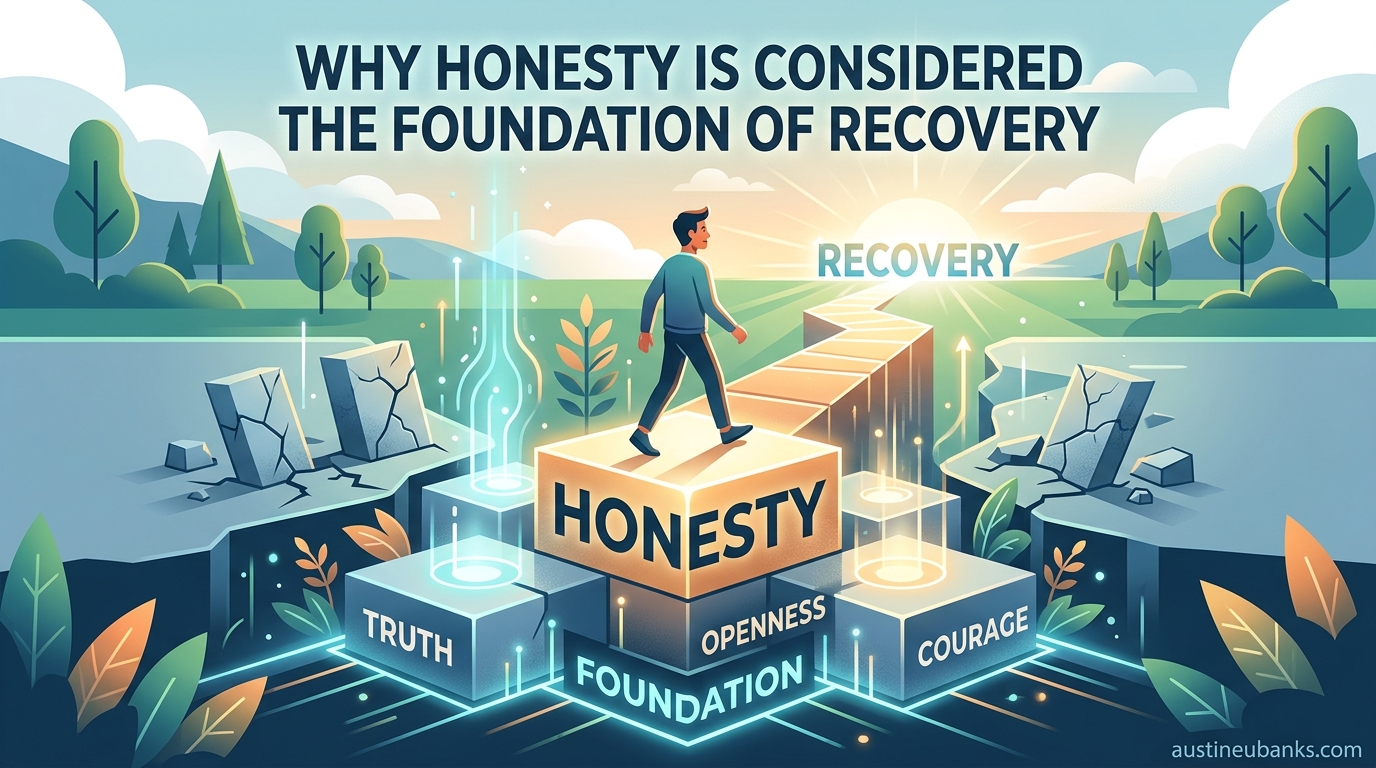
Honesty is considered the foundation of recovery because addiction thrives in secrecy, denial, and self-deception, while genuine healing requires truth. Without honesty, there can be no real self-awareness, no meaningful accountability, and no authentic trust, the three pillars that hold up everything else in the recovery process.
If you have ever sat in a recovery meeting, talked with a sponsor, or worked through a treatment program, you have probably heard some version of this idea repeated over and over. The phrase gets used so often that it can start to sound like a cliché. But after years of observing how recovery actually works, our team has come to see that this is not just a slogan.
It is a description of a psychological mechanism. When someone in recovery begins lying, even in small ways, they are rehearsing the exact same mental patterns that fueled their addiction. Honesty is not just a moral virtue in recovery. It is a practical tool that keeps the entire structure from collapsing under its own weight.
In this guide, we are going to explain exactly why honesty is considered the foundation of recovery, how dishonesty triggers relapse at a neurological and psychological level, and what you can do to build a more honest life in recovery starting today. Whether you are in early recovery, supporting someone who is, or working as a counselor or sponsor, this information is for you.
We will also address questions that come up constantly in recovery communities on Reddit, Sober Recovery, and 12-step forums. Questions like: What does rigorous honesty actually mean? Are white lies acceptable in recovery? And can you stay sober if you are still lying to yourself?
Table of Contents
Quick Answer: What Honesty in Recovery Really Means
Honesty in recovery means the conscious, ongoing commitment to telling the truth to yourself and others about your addiction, your struggles, and your progress. It is not a one-time decision you make when you get sober. It is a daily practice that you return to every single morning, sometimes every hour.
The reason honesty is called the foundation of recovery is simple. Addiction is built on layers of deception, denial, and hidden behavior. Recovery reverses that process. When you remove the lies, you create space for genuine healing to happen. When you keep lying, even in small ways, you are rebuilding the very structure that addiction used to control your life.
Many people in recovery talk about the 4 pillars of recovery: honesty, accountability, connection, and self-care. Honesty is listed first because the other three cannot function without it. You cannot be truly accountable if you are hiding things. You cannot build genuine connections if people do not know the real you. And you cannot practice effective self-care if you are lying to yourself about what you need.
What Honesty Means in the Context of Recovery
When we talk about honesty in recovery, we are talking about something much deeper than simply not telling lies. Honesty in recovery is a multi-layered practice that touches every part of your life, from how you talk to yourself in the mirror to how you show up in relationships with the people who love you.
Honesty With Yourself: The Hardest Kind
Ask anyone who has been in recovery for a while, and they will tell you the same thing. Being honest with others is hard. Being honest with yourself is harder.
Self-honesty in recovery means facing uncomfortable truths about who you are, what you have done, and what you are feeling right now. It means admitting when you are struggling, even when you desperately want to appear fine. It means acknowledging that a craving is building, that a situation feels risky, or that you are drifting toward old patterns.
Self-deception is one of the most powerful forces in addiction. The brain becomes incredibly skilled at rationalizing, minimizing, and explaining away destructive behavior. “I only drank on weekends.” “Everyone else does it.” “I can stop anytime.” These lies do not disappear the moment you get sober. They persist, often for months or years into recovery, quietly undermining your progress.
One Reddit user in r/recovery put it this way: “If you fake either integrity or authenticity, you cause suffering later, just by knowing the dishonesty exists.” That internal knowledge, even when unspoken, eats away at your recovery from the inside.
Honesty With Others: Building the Support Network
Honesty with others in recovery means being truthful with your sponsor, your therapist, your treatment team, your family, and your support group. It means showing up as your real self, not the version of yourself you think people want to see.
This is where many people in recovery hit a wall. Being honest with a sponsor about a relapse, or telling your family the full truth about what happened during active addiction, feels terrifying. The fear of disappointing people, of being judged, of losing relationships can be paralyzing.
But recovery professionals consistently identify honesty with treatment providers as the single biggest predictor of recovery success. When you are honest with your therapist or counselor, they can actually help you. When you hide the truth, you are paying for professional help that cannot reach you.
Rigorous Honesty vs. Everyday Honesty vs. White Lies
This is a topic that causes real confusion, and it is one that most recovery resources do not address clearly enough. Let us break down the differences.
Everyday honesty means generally telling the truth in normal interactions. Most people practice this to some degree, even during active addiction. It is the baseline level of truthfulness that society runs on.
Rigorous honesty is a specific concept from the 12-step tradition. It means being completely, uncompromisingly honest with yourself and others about your addiction, your feelings, your triggers, and your progress. No minimizing. No rationalizing. No convenient omissions. Rigorous honesty means telling the truth even when it is uncomfortable, even when it costs you something, even when a lie would be easier.
White lies are a gray area that comes up constantly in recovery forums. Someone asks: “Are small lies okay if they protect someone’s feelings?” The recovery community’s answer is generally nuanced. In early recovery, the goal is to eliminate all forms of deliberate deception, including white lies. The reasoning is practical, not just moral. Every lie, no matter how small, reinforces the neural pathway of deception that addiction relied on. Over time, as honesty becomes more natural, the question of white lies becomes less critical because honest communication starts to feel like the default.
One Reddit user in r/alcoholicsanonymous shared: “Rigorous honesty is not perfect. I catch myself in little lies, but mostly in situations that would not affect myself or any relationships. The key is to keep working at it.”
The 12-Step Perspective on Honesty
The 12-step tradition places honesty at the center of its program. Multiple steps require deep honesty as a prerequisite for progress. Step 1 asks you to admit powerlessness, which requires brutal self-honesty about the reality of your addiction. Step 4 involves taking a searching and fearless moral inventory, which means cataloging every way you have been dishonest, selfish, or harmful. Step 5 asks you to admit to God, yourself, and another human being the exact nature of your wrongs. Step 8 requires listing all persons you have harmed. Step 10 calls for a continued daily inventory where you promptly admit when you are wrong.
What is striking about the 12-step approach is how it treats honesty not as a destination but as an ongoing practice. You do not achieve honesty and move on. You practice it every day for the rest of your life. The program recognizes that dishonesty is a habit, and habits require constant maintenance to override.
Why Honesty is the Foundation of Recovery
Now let us get into the core question. Why exactly is honesty the foundation of recovery, and not just one of many important principles? The answer comes down to six interconnected reasons.
1. Honesty Breaks Denial and Self-Deception
Denial is the engine that keeps addiction running. It is the psychological defense mechanism that allows someone to continue destructive behavior while convincing themselves that everything is under control. Denial says “I do not have a problem” or “I can handle it” or “This time will be different.”
Recovery cannot begin until denial breaks. The very first step of any recovery process, whether it is a 12-step program, SMART Recovery, or professional treatment, involves admitting the truth about your situation. Honesty is the tool that cracks denial open. Without it, every other aspect of recovery is built on a false foundation.
This is why treatment centers and sponsors focus so heavily on honesty in those first days and weeks. They know that if the denial is still intact, nothing else will work. You can attend meetings, read books, and go to therapy, but if you are still lying to yourself about the severity of your problem, you are going through the motions without actually healing.
2. Honesty Enables Accountability
Accountability in recovery means taking full responsibility for your actions, your decisions, and your progress. It means owning your mistakes instead of blaming circumstances, other people, or bad luck.
You cannot be accountable if you are not honest. Accountability requires an accurate accounting of what happened, what you did, and what the consequences were. Dishonesty distorts that accounting. It lets you off the hook. It allows you to tell a story where you are the victim instead of the person who made harmful choices.
As one Reddit user in r/alcoholicsanonymous explained: “If I am lying to other people, I am not holding myself accountable. Honesty is really powerful for healing and change.”
Accountability is what transforms honesty from a static concept into an active force. When you are honest about your behavior, you create the conditions for accountability. And accountability is what drives actual change.
3. Honesty Rebuilds Trust and Relationships
Addiction damages relationships. It breaks trust in ways that can take years to repair. Family members, partners, friends, and colleagues have been lied to repeatedly, and those lies leave scars that do not heal just because someone gets sober.
Honesty is the only thing that rebuilds that trust. Not apologies. Not promises. Not time. Trust is rebuilt through consistent, observable honest behavior over an extended period. Every time you tell the truth when it would be easier to lie, you deposit a small amount of trust back into the relationship. Every time you choose transparency over secrecy, you demonstrate that you are different now.
This process is slow. Forum users in recovery communities consistently describe rebuilding trust as one of the most frustrating and humbling parts of recovery. The people they love do not immediately believe them when they start telling the truth, and that skepticism can feel unfair. But from the other side, that skepticism is understandable. It was earned through years of dishonesty, and it will be unearned through years of honesty.
4. Honesty Prevents Relapse
This is perhaps the most practically important reason, and we will explore it in depth in the next section. The short version is this: dishonesty is one of the earliest and most reliable warning signs that a relapse is approaching.
When someone in recovery starts lying, even about seemingly unrelated things, it signals that the psychological patterns of addiction are reactivating. The brain is falling back into old grooves. Honesty serves as an early warning system, both for the person in recovery and for their support network.
5. Honesty Fosters Self-Awareness and Authenticity
Self-awareness is the ability to see yourself clearly, to understand your motivations, your triggers, your strengths, and your vulnerabilities. It is the foundation of all personal growth, not just in recovery but in life.
Honesty is what makes self-awareness possible. When you are honest with yourself, you can see your patterns clearly. You can identify the situations that make you vulnerable. You can recognize the emotions that precede a craving. This visibility gives you the power to make different choices.
Authenticity follows naturally from self-awareness. When you know who you really are and you are willing to show that person to the world, you stop performing. You stop pretending. You start living in a way that feels genuine, and that genuineness is one of the most powerful protective factors against relapse.
As one Narcotics Anonymous member shared on Reddit: “Being an honest person is necessary to living with integrity, and living with integrity is important to building self-respect and self-esteem.”
6. Honesty Enables Genuine Treatment Engagement
If you are not honest with your therapist, your counselor, or your treatment team, they cannot help you effectively. Treatment is not a one-size-fits-all process. It requires accurate information about your history, your substance use patterns, your mental health, your trauma, and your current struggles.
When you walk into a therapy session and tell half-truths or omit key information, you are essentially asking a professional to solve a puzzle while hiding half the pieces. The advice you get will be based on incomplete information, and the treatment plan will be built for a person who does not actually exist.
Honesty with treatment professionals is the gateway to receiving care that actually addresses your real needs. It is what transforms therapy from a checkbox activity into a genuinely transformative process.
How Dishonesty Triggers Relapse
Understanding the mechanism by which dishonesty leads to relapse is one of the most important things you can learn in recovery. Most people think relapse happens suddenly, a moment of weakness followed by a drink or a drug. In reality, relapse is a process that unfolds in stages, and dishonesty is almost always the first step.
The Three Phases of Relapse
Clinicians typically describe relapse as occurring in three distinct phases: emotional relapse, mental relapse, and physical relapse. Understanding these phases helps explain why dishonesty is so dangerous.
Emotional relapse is the earliest stage. You are not thinking about using. You may not even be aware that anything is wrong. But your emotional state is deteriorating. You might be isolating, skipping meetings, neglecting self-care, or bottling up feelings. During this phase, dishonesty often shows up as pretending everything is fine when it is not.
Mental relapse is the middle stage. This is where the internal war begins. Part of you wants to stay sober. Part of you is thinking about using. You might find yourself reminiscing about past use, minimizing the consequences, or rationalizing why “just one time” would be okay. Dishonesty during this phase is particularly insidious because you are lying to yourself about your own intentions.
Physical relapse is the final stage. This is the actual act of using. By the time someone reaches this stage, dishonesty has typically been present for weeks or months, eroding the foundation of recovery bit by bit.
The Cycle of Dishonesty and Shame
Here is how the cycle typically works. Someone in recovery tells a lie, perhaps a small one. Maybe they minimize how much they are struggling with a sponsor. Maybe they tell their partner they went to a meeting when they did not. The lie itself creates a small crack in their integrity.
That crack produces a feeling of guilt or shame, even if it is subtle. The person knows, on some level, that they have been dishonest. That knowledge creates emotional discomfort. And here is where the cycle becomes dangerous: the natural response to emotional discomfort in someone with a history of addiction is to seek relief through substances.
So the lie leads to shame, the shame leads to emotional pain, and the emotional pain becomes a trigger for substance use. At a neurological level, dishonesty activates stress circuits in the brain. The same brain regions that process physical pain also process the psychological discomfort of acting against your values. For someone in recovery whose brain has been wired to seek relief from discomfort through substances, this stress response is a direct pathway to craving.
Warning Signs That Dishonesty Is Creeping Back
Because dishonesty is the first domino in the relapse chain, learning to spot it early is one of the most valuable skills you can develop in recovery. Here are the warning signs to watch for:
- You start avoiding certain topics in conversations with your sponsor or therapist.
- You catch yourself minimizing or rationalizing behavior that you would have called out a month ago.
- You stop sharing honestly in meetings, giving surface-level answers instead of real ones.
- You begin isolating from people who might notice that something is off.
- You feel defensive when someone asks you a direct question about your recovery.
- You start telling “small” lies in non-recovery contexts and justifying them.
- You feel a vague sense of unease or guilt that you cannot quite explain.
If you notice any of these signs, the most important thing you can do is talk to someone immediately. Honesty about the dishonesty is what breaks the cycle.
Honesty vs. Dishonesty in Recovery: A Comparison
Sometimes seeing the contrast side by side makes the stakes clearer. Here is how honesty and dishonesty play out across different areas of recovery:
In relationships: Honesty slowly rebuilds trust and deepens connections. Dishonesty erodes trust, creates distance, and eventually alienates even the most supportive people in your life.
In treatment: Honesty gives your therapist and treatment team accurate information to work with. Dishonesty leads to treatment plans that miss the mark and problems that go unaddressed.
In self-perception: Honesty builds self-respect and authenticity. Dishonesty creates a gap between who you present yourself as and who you know yourself to be, and that gap produces chronic anxiety and shame.
In relapse prevention: Honesty serves as an early warning system that lets you catch problems before they escalate. Dishonesty removes the warning system entirely, allowing relapse to develop undetected until it is too late.
In emotional well-being: Honesty produces peace of mind, even when the truth is uncomfortable. Dishonesty produces a constant low-grade stress that, over time, wears down your emotional resilience.
Why People Struggle With Honesty in Recovery
If honesty is so clearly beneficial, why do so many people in recovery struggle with it? The answer is that dishonesty in recovery is not usually a conscious choice. It is a deeply ingrained habit that takes time and intentional effort to change.
Lying Was a Survival Mechanism During Addiction
During active addiction, lying was not optional. It was a survival mechanism. People lied to protect their access to substances. They lied to avoid consequences. They lied to maintain relationships that would have ended if the truth came out. They lied because their brain was hijacked by a substance that reorganized their priorities around one goal: getting and using the substance.
Over months and years, this pattern of lying became neurologically embedded. The brain developed deep neural pathways that defaulted to deception as a response to any perceived threat. Getting sober does not erase those pathways. They are still there, and they activate automatically in moments of stress, fear, or discomfort.
Forum users describe this experience vividly. The feeling of lying even when they do not want to, even when the lie serves no purpose. The words come out before the conscious mind has a chance to intervene. This is not a moral failing. It is a neurological habit, and like any habit, it requires consistent practice to override.
Fear of Consequences and Disappointing Loved Ones
One of the most common reasons people in recovery are dishonest is fear. Fear of what will happen if the truth comes out. Fear of disappointing the people they love. Fear of being judged, rejected, or abandoned.
These fears are not irrational. During active addiction, honesty often did lead to negative consequences. People got angry. Relationships ended. Opportunities were lost. The brain learned that truth equals danger, and that learning does not disappear overnight.
The irony is that this fear-based dishonesty usually produces worse outcomes than the truth would have. A sponsor who hears about a struggle can help. A family member who knows the truth can offer support. But a lie, even a protective one, eventually surfaces, and the damage is compounded by the betrayal of trust.
Shame and Guilt
Shame is the feeling that you are fundamentally flawed, that there is something wrong with you at your core. Guilt is the feeling that you have done something wrong. Both are powerful barriers to honesty in recovery.
When you feel shame, honesty feels like exposure. Telling the truth about what you did, what you thought, or what you feel means letting other people see the parts of yourself that you are most ashamed of. That vulnerability is terrifying, especially in early recovery when self-esteem is already fragile.
But shame thrives in secrecy. The more you hide, the more powerful it becomes. Honesty, particularly honesty shared with a trusted sponsor, therapist, or support group, is what dissipates shame. Every time you speak a shameful truth out loud and someone responds with acceptance instead of rejection, the shame loses a little of its power.
Self-Deception That Persists Into Recovery
Perhaps the most insidious barrier to honesty is self-deception. This is when you are not intentionally lying to others, but you are unknowingly lying to yourself. Self-deception can persist for years into recovery, quietly undermining progress.
Self-deception in recovery can look like: convincing yourself that you are further along than you actually are. Minimizing the impact of past behavior. Telling yourself that a borderline situation is not really a risk. Comparing yourself to people who are “worse off” to feel better about your own situation.
The antidote to self-deception is external feedback. This is why sponsors, therapists, and recovery communities are so important. They can see your blind spots. They can point out inconsistencies between what you say and what you do. They can hold up a mirror that shows you what you cannot see on your own.
Early Recovery vs. Long-Term Recovery Honesty Challenges
The challenges with honesty change as recovery progresses. In early recovery (the first 90 days to 1 year), the biggest challenge is breaking the automatic habit of lying. The neural pathways of deception are still strong, and honesty feels awkward, uncomfortable, and sometimes frightening. The focus during this stage is on building the habit of honesty, even when it feels unnatural.
In long-term recovery (1 year and beyond), honesty becomes more natural, but new challenges emerge. Complacency can set in. You might start thinking that you have honesty figured out and stop doing the daily work of self-reflection. Or you might encounter situations that require a level of honesty you have not faced before, such as honesty about a new relationship, a career change, or a shift in your emotional life.
The key insight is that honesty in recovery is never “solved.” It evolves. The challenges look different at 30 days, 1 year, 5 years, and 10 years, but the need for intentional honesty never goes away.
How to Practice Honesty in Recovery: Practical Steps
Understanding why honesty matters is important, but knowing how to actually practice it day to day is what makes the difference. Here is a practical framework you can start using immediately.
Daily Honesty Practices
Make honesty a structured part of your daily routine. Here are specific practices that people in recovery have found effective:
Do a daily personal inventory. This comes from Step 10 of the 12-step tradition. At the end of each day, take 5 to 10 minutes to review your actions, your words, and your thoughts. Where were you honest? Where were you not? What did you avoid? What did you minimize? Write it down.
Share something real every day. Whether it is in a meeting, with a sponsor, with a therapist, or with a trusted friend, make a point of sharing something genuinely honest about your inner experience every single day. This builds the honesty muscle.
Practice naming uncomfortable emotions. One of the deepest forms of honesty is accurately naming what you feel. Instead of saying “I am fine,” try “I am anxious today” or “I am feeling triggered and I do not know why.” Emotional honesty is the gateway to all other forms of honesty.
Journaling for Honesty
Journaling is one of the most effective tools for building self-honesty. When you write, you slow down your thinking and create space to notice patterns you might miss in the rush of daily life.
Use specific prompts to guide your journaling. Ask yourself: What did I avoid being honest about today? Where did I minimize or rationalize? What am I afraid someone would find out about me? What am I lying to myself about right now?
Do not censor your journal. Let the ugly truths come out on the page. The journal is for your eyes only, and the act of writing something honestly, even if no one else ever reads it, begins to break the power of secrecy.
Working With Your Sponsor or Therapist
Your sponsor and therapist are your honesty mirrors. They exist, in part, to reflect back what you cannot see in yourself. But they can only do this if you give them accurate information.
Make a commitment to tell your sponsor or therapist the complete truth, even when it is uncomfortable. If you are not sure whether something is relevant, share it anyway. Let them help you sort out what matters. And if you catch yourself holding back, name it. Say “I am having a hard time being honest about this” and let them help you through it.
One Reddit user described working through their 4th step: “My sponsor keeps reassuring me that if I am honest, it will get easier.” That reassurance is worth holding onto. Honesty does get easier with practice, but only if you practice it.
Rebuilding Trust With Loved Ones
Rebuilding trust is a long process, and it requires consistent honest action over time. Here are the principles that experienced people in recovery recommend:
Lead with transparency. Instead of waiting to be asked, volunteer information about where you are in your recovery. This proactive honesty signals that you have nothing to hide.
Follow through on promises. Every promise kept is evidence that you are different now. Every promise broken confirms the old story. Be careful about what you commit to, and then follow through without exception.
Accept that trust rebuilds on their timeline, not yours. The people you lied to during addiction need time and evidence to believe that you have changed. Pushing them to trust you faster will backfire. Let your consistent honest behavior do the work over time.
Acknowledge past dishonesty directly. Do not pretend it did not happen. Name it, take responsibility for it, and let the people you hurt know that you understand the impact of your lies. This kind of direct honesty is painful, but it is also deeply healing.
A Simple Self-Assessment: How Honest Are You in Recovery?
Take a few minutes to honestly answer these questions. If you find yourself rationalizing or minimizing your answers, that in itself is useful information.
- When was the last time I told my sponsor or therapist something that was hard to say?
- Is there anything I am currently hiding from the people in my support network?
- Do I share honestly in meetings, or do I give the version of my story that makes me look good?
- Have I been minimizing any recent struggles or behaviors?
- Am I being honest with myself about my current emotional state?
- Is there a relationship in my life where I am not being fully truthful?
- What am I most afraid someone would find out about me right now?
If any of these questions brought up something uncomfortable, that is a sign that there is work to do. Reach out to your sponsor, therapist, or a trusted person in your recovery network and start talking.
Beyond Addiction: Honesty in Other Forms of Recovery
While most of this article has focused on addiction recovery, the principle of honesty as a foundation applies across many types of recovery. If you are recovering from trauma, grief, eating disorders, or mental health challenges, honesty plays the same foundational role.
In trauma recovery, honesty means facing what actually happened instead of minimizing, dissociating, or rewriting the narrative. It means being honest about how the trauma affects you today, even when that truth is painful.
In mental health recovery, honesty means accurately reporting symptoms to your treatment team. It means being truthful about medication adherence, about suicidal ideation, about the gap between how you present publicly and how you feel privately.
The mechanism is the same across all forms of recovery. Healing requires truth. Denial blocks healing. And honesty, practiced consistently over time, creates the conditions where genuine recovery becomes possible.
FAQs
What are the 4 pillars of recovery?
The 4 pillars of recovery are honesty, accountability, connection, and self-care. Honesty is typically listed first because the other three pillars depend on it. You cannot be truly accountable without honesty, you cannot build genuine connections without honesty, and effective self-care requires being honest with yourself about what you need.
What is the foundation of honesty?
The foundation of honesty is self-awareness, the ability to see yourself and your actions clearly without distortion. Self-awareness allows you to recognize when you are tempted to lie, understand why, and make a conscious choice to tell the truth instead. Without self-awareness, honesty remains superficial because you cannot be honest about what you cannot see.
What does AA say about honesty?
AA treats honesty as essential to recovery. The concept of rigorous honesty is central to the program, requiring members to be completely truthful with themselves and others. Steps 1, 4, 5, 8, and 10 all depend on deep honesty: admitting powerlessness, taking a fearless moral inventory, admitting wrongs to another person, listing people harmed, and maintaining a continued daily inventory. AA literature states that half-measures will not lead to lasting recovery, and honesty is the opposite of a half-measure.
What are the 3 C’s of recovery?
The 3 C’s of recovery are: I did not Cause it, I cannot Control it, and I cannot Cure it. This principle is primarily used in the context of family members and loved ones of people with addiction, often associated with Al-Anon. It helps people recognize that they are not responsible for another person’s addiction, they cannot manage or control it, and they cannot fix it on their own. The 3 C’s encourage honesty about the limits of one’s power, which is itself a form of the broader honesty that recovery requires.
Conclusion: Honesty Is a Practice, Not a Destination
If there is one thing to take away from this article, it is this: honesty is considered the foundation of recovery because without it, nothing else in the recovery process can function. Denial cannot break. Accountability cannot take hold. Trust cannot be rebuilt. Relapse cannot be prevented. And treatment cannot reach the person who actually needs help.
Honesty in recovery is not about being perfect. It is about being willing. Willing to look at the truth, even when it hurts. Willing to speak the truth, even when it is uncomfortable. Willing to practice honesty daily, knowing that it gets easier over time but never stops requiring effort.
Whether you are in your first week of recovery or your tenth year, the question is the same. Are you being honest with yourself right now? Are you being honest with the people who are trying to help you? If the answer is not a clear yes, that is your starting point. Tell one person one true thing today. Then do it again tomorrow. That is how foundations are built.
If you are struggling with honesty in your recovery, reach out to your sponsor, therapist, or a trusted support person today. The conversation does not have to be perfect. It just has to be honest.